-Ty E
Saturday, November 20, 2010
Luna Park
I have a soft-spot for Jewish Nazis and self-loathing Jews so when I found out about the Russian film Luna Park, I immediately had to see it. The Russki film follows a Neo-Nazi skinhead named Andrei who finds out that he is the bastard son of a moderately successful Jewish musician. Andrei’s father is everything he hates, a Judaic that is more successful than the majority of ethnic Russians and admittedly disdains anything involving real working-class work. On discovering that he is a mischling in the first degree, Andrei is even more enraged than he is whilst beating swarthy mongrels. After all, Andrei’s whole being and reason for living is destroyed upon learning he is one of Abraham’s bastards sons as his life centers around his anti-Jewish skinhead crew that inhabits the industrial bowels of an amusement park. Luna Park is surely one of those wonderful and rare films that is able to eloquently express the absurdity of being a human as well as the schizoid joy of having a self/hate relationship with oneself.
Currently, Russia contains the most Neo-Nazis in the world (oh, how time changes everything with biting irony), from feeble minded meathead skinhead thugs to somewhat legitimate mainstream Nationalist politicians. Russia used to also have the largest Jewish population in the world (mainly contained in The Pale of Settlement of Imperial Russia). After the “Russian” revolution of 1917 (a largely Jewish supported and executed affair), Jews were able to spread throughout the world like wandering locusts. Mass Murdering mongrel revolutionary Vladimir Lenin (1/4 Jewish himself) even made a speech in 1919 on the capitalist ills of anti-Jewish pogroms which was surely one of the first somewhat famous Pro-Jewish propaganda campaigns, something that has become all too common in the post-Eurocentric and globalized United States of America. Andrei of Luna Park is surely an unfortunate assimilated remnant of the once thriving and still hated Russian Jewry. Unlike Daniel Balint from Henry Bean’s The Believer, there is nothing Jewish about Andrei’s behavior nor pantomimes (not to mention, he is a body builder), for he truly is a robust Russian brute flowing with a radiant energy of testosterone. It is fairly obvious that Andrei would never make it in the world of Jewish vaudevillian comedy but as for his Father, that is a whole other story….
Although a lover of Russian cinema from all eras, I find it nearly impossible to relate to the ‘Russian mentality,’ even at the most fundamental level. With the barbaric Russians featured in Luna Park, this also holds true for me for they seemed to be psychologically wired in a way that Northern Europeans probably could relate to in the Middle Ages. Andrei’s Jewish father, on the other hand, is instantly identifiable as Jewish, for he certainly shares the cynicism, humor, and arrogance of God’s chosen tribe. I bet that the average American would also find Andrei’s Jewish father to be the most 'American' and understandable due to the bombardment of krappy-kosher-komedies that Hollywood has reamed them with since birth. Although clever and humorous, Andrei’s Father is a highly despicable man, a swindling bohemian musician of the most culturally repulsive degree (he brought degenerate Jazz to Russia for god's sake), certainly someone sharing a similar genotype with Adam Sandler and Sacha Baron Cohen. Despite these glaring anti-goy traits, Andrei soon starts respecting his Father and his talents. It doesn’t take Andrei long to realize he needs to shed his working-class skinhead lifestyle for the wealthy (at least rich for a Soviet) hedonistic living of a Judaic entertainer. It soon becomes apparent that the skinheads and virtual prostitutes of Luna Park hate Jews largely out of resentment, not for the love of Mother Russia.
Andrei’s Jewish ancestry is revealed to him by his whorish lover, an older full-figured woman who also happened to be his deceased Mother’s best friend. This older woman hates Andrei’s Father for very personal reasons and wants nothing more than having the old Jewish bohemian die a miserable death with the musical compositions of Richard Wagner as the soundtrack. After all, Andrei’s Jewish Father is a man known for screwing every young blond Russki in town (Andrei’s girlfriend and Mother being two of them) so a lot of women in the area love and hate this Hebrew geezer. The real intensity and drama in Luna Park lies in a total personal war between Andrei’s Father and all of the Russian Neo-Nazis, Andrei being the strongest deciding factor in who takes home final victory. Somehow, I found myself actually cheering for the Jewish con-man and his blue collar bastard son. After all, the skinheads (like in most films of this type and in real-life) in Luna Park come off as being a group of morons that flaunt petty idealism as a rationalization for their uncontrollable and improperly channeled hatred. If the skinheads really wanted to defeat the Jew, they would outdo him with cultural achievements and authentic/organic Russian art, not by proving that they are the untermensch barbarians that the real German National Socialists portrayed them as. These skinheads embody the slave-morality as described by Friedrich Nietzsche, for they cannot make a good reputation of themselves by achievement but instead blame the Judaics (the original promoters of the slave-morality) for their lack of success in their own country.
Luna Park starts excitingly with a savage brawl between skinheads and a group of bikers (ironically, sporting German helmets while fighting with the Neo-Nazis). The opening gang warfare scene also happens to be the most brutal segment in the film for Luna Park is no Romper Stomper. If you’re looking for excessive philistine violence or a film that will pump you up for a fight, Luna Park surely fails in that regard. On the other hand, if you’re looking for a film with somewhat subtle melodrama and multi-layered emotions, Luna Park is a film worth embracing. Despite being a film featuring a Neo-Nazi Anti-Hero, Luna Park is a fairly apolitical work that legitimately looks at the irrationality that is human nature. It is not often that I see a drama like this, where I don’t find myself questioning whether or not the director has any understanding of humanity (not to mention, human emotions) as is the cause with most Hollywood films.
-Ty E
By
soil
at
November 20, 2010
0
comments
Thursday, November 4, 2010
The Warriors
I must be slacking in regards to Hollywood philistine cinema because until the other night I had yet to see The Warriors. Going into the film, I did not have any serious expectations as far as quality cinema goes. Now after watching The Warriors, I must admit it is a fun barbaric flick full of cheesy gang romanticism. Essentially, The Warriors is the perfect film for those people that can only tolerate the first 1/3 of Stanley Kubrick’s A Clockwork Orange. The Warriors has all the ultra-violence minus the intellectual pessimism that most American’s do not seem to be too fond of. Sure, The Warriors maybe a dystopian gang war film set sometime in the near future but I find such a world ideal. After all, there is no diversity in the modern world (most gangs taking their “cultural” cues from the American Negro) but the world that the Warriors battle in is as colorful as a rainbow on fire.
Like A Clockwork Orange before it, The Warriors immediately influenced vandalism (and even death) when it was initially screened in theaters for American audiences. Any film that influences violence and death is certainly doing something right for all great cinema has the ability to change reality. In a way, The Warriors director Walter Hill is a postmodern magician, an individual who through the power of cinema has manipulated reality with his own auteur vision. Of course, there is nothing brilliant or intellectually exceptional about the film itself. The Warriors is like a drug that brings excitement and potent entertainment from beginning to end, certainly positive cinematic qualities few films hold.
One of the most interesting aspects of The Warriors is that each gang has their own distinct wardrobe. Sure, most of these urban warfare uniforms look quite tacky nowadays but they certainly beat the jungle “uniforms” most modern gangs where. After all, for all the talk of diversity in America, this country is becoming quite homogenized and mongrelized. The world of The Warriors features wild boy homo Dingos, effeminate Negro pimpz, baseball clowns, and multicultural skinheads. The protagonist gang, the Warriors, wear a humble yet masculine uniform of leather. The Rogues, the enemy gang of the Warriors, would have been better described as The Scorpio Rising gang in tribute to the Kenneth Anger film of the same name. The Rogues is led by a little loudmouthed turd by the name of Luther (played by David Patrick Kelly of Twin Peaks infamy) who is easily the most memorable yet despicable character in the film.
Another positive aspect of The Warriors, strangely enough, is the “love interest” Mercy. Unfortunately for Mercy, she is from a part of town where the loser gang the Orphans reside. When the Warriors walk through Orphan territory, Mercy makes sure to check out every swinging dick, finally catching her lovely eyes on alpha-warrior Swan. Like a lost kitten, Mercy stalks the the Warriors even after they attempt to throw her away various times like a used condom. Mercy is like a femme fatale minus the brains for her only desire is sex with an alpha and possibly a better life, certainly a girl that does not aspire to be much aside from living in the moment. Angelic (but not angel) Mercy is the kind of woman all feminists should aspire to be.
Apparently, hack action director Tony Scott is planning a loose remake of The Warriors set in Los Angeles. Scott hopes to use real gang members in his dubious remake of the 1979 classic. With all the vintage character of The Warriors, a remake only seems like it could be at best a rotten piece of stillborn cinema, a film that should have never be born and that should be soon forgotten. Of course, with the solely monetary-driven businessmen at Hollywood any remake guarantees an audience (and financial success). It will surely be a dark day for cinema when some Hollywood producer has the audacity to remake A Clockwork Orange. On a more positive note, at least we still have the originals as I will surely be re-watching The Warriors sometime again this year.
-Ty E
By
soil
at
November 04, 2010
5
comments
Tuesday, November 2, 2010
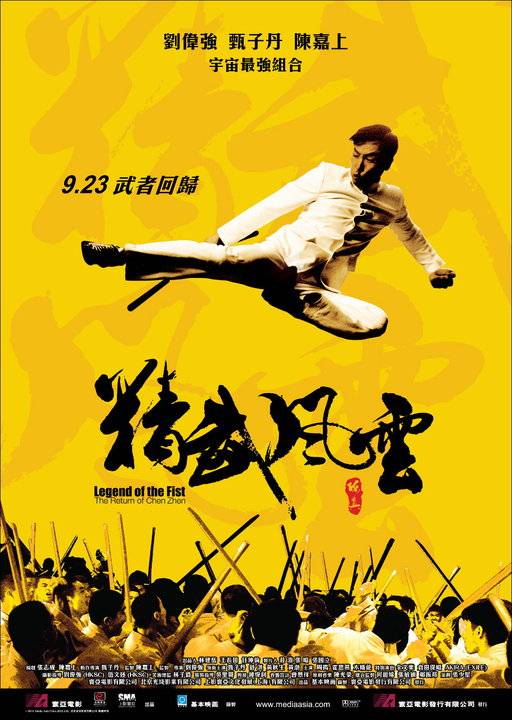
Legend of the Fist: The Return of Chen Zhen
Legend of the Fist highlights the status of Donnie Yen's increasingly successful career to a point. Reprising the incredibly popular spirit of Chen Zhen while filling the shoes worn by both Bruce Lee and Jet Li, Donnie Yen's titular interpretation takes place seven years after the events of his own television series Fists of Fury. Set during the Second Sino-Japanese War, the torch of martial art's legend Chen Zhen is in safe hands because as we all know, Donnie Yen isn't just an artist of the body but one that can dramatize damn near any role. So while he may get caught up on the burlesque portrayal of the cruel Japanese or the visually stimulating violence, it's been declared a safe passage which allows for some of the greatest recent escapism to flood through your nostrils and soak your brain in hair-pin mixed martial arts. And for what it's worth, The Return of Chen Zhen houses an indescribable charm, potent and out of place for this historically fantastical oddity.
Beginning abruptly in a war zone, the impoverished Chinese are panicking while attempting to take cover behind sandbags littered across what seems to have resembled a courtyard at one point. While their numbers dwindle and the need for ammunition becomes unbearable, the camera begins to fixate on Donnie Yen and if you didn't know any better, this is the scene to elect him as the hero of our story, Chen Zhen. After losing several of his friends to the faceless Germans nesting in several buildings surrounding them, Chen Zhen impacts a reserve of glandular focus and sprints at a break-neck speed across the battlefield with several blades. Performing various free-running maneuvers while blending a bit of meta-wuxia within his rhythm, he glides and twirls to reach his murderous destination within the base, singlehandedly killing every German with his affable Asiatic prowess. For a fair and default representation of the Germans, Legend of the Fist receives high marks from me for providing both an action spectacle and a display of warfare and not the warped politics behind the veil. This only further incriminates the sensitive pussies who claim that Legend of the Fist contains a sharp racial animosity towards the Japanese yet fails to even acknowledge the cinematic abuse of Germans since the Cinematographe decided to employ counter-propaganda.
These allegations haven't impeded the success or longevity of talk-back concerning Legend of the Fist but I found them peculiar and irrational enough to discuss within my written reflection. Within the elements of Legend of the Fist exists a storyline all too political concerning China's struggle with the Japanese vowing to occupy and control the "weaker" of their yellow brethren. The truth couldn't really be any closer to what is displayed in this film. The never-ending conflict between the Japanese and Chinese has been revisited many times within the years and I've recently finished Iris Chang's chilling documentation of the cruelty the Japanese have perpetrated in The Rape of Nanking. With the fresh ideals of a "better" holocaust in mind, Legend of the Fist doesn't offend or betray anyone with the depiction of the Japanese and if anything at all, serves as a mixed drink to be consumed by damn near anyone, especially after the realization of how diluted the product is in retrospect. The absurdity of these claims reaches a new peak as my tangent switches rails from the incredible choreographed fight scenes with Chen Zhen donning Kato's costume from The Green Hornet to the reverse-engineered understandable resentment of the Japanese by the Chinese. To be blunt, I'm relieved at the absence of the asinine German crowd control that most cliched villainry seems to adopt with doe in their eyes. And seeing as the Eastern film industry has been modeled meticulously after our own, do we not enjoy staring back at the beast?
To jump ship from the strenuous rant I've just exhausted, Legend of the Fist is an accelerated period piece with enough action to entertain even the most nit-picky arthouse squealer as he reorganizes his Criterion collection ritualistically, by spine number or what have you? This recent exploit from the Chinese fascist of action marks a continuing trend of mobilizing even the most stalwart of screenplays. Not to riff on the alternate-history of war and society's low times but it becomes painfully obvious that absolutely no one could have pulled this character off as well as Donnie Yen has in the Return of Chen Zhen. It's predictable, marvelous, bottom-heavy near the climax, and yet not long enough, but I find something new to love about this film with every thought that pops into my head throughout the day, whether it be the hilarious usage of the infamous feral growl that has found itself to be nature's Wilhelm Scream or the brutal race to save as many as the Japanese kill in a race for a country. Certainly not Donnie Yen's best performance but I'm proud to say I cannot say the same for the fight scenes. Call me giddy but I felt this incredible rush of energy throughout each and every frenetic and implausible blow to the merciless Japanese. Return of Chen Zhen marks yet another highly satisfying tale of a one-man army.
-mAQ
By
soil
at
November 02, 2010
0
comments
Friday, October 15, 2010
Until the Light Takes Us
Norwegian black metal holds a special place in my heart and by that I do not merely mean the music (but mainly the spirit). Growing up watching MTV during my elementary school years, I soon became disillusioned by the messages of peace and tolerance promoted by the majority of white artists I was exposed to. After all, all the Negro “musicians” promoted violence and the will to power (albeit, in a way I could never relate to). For me, it was simply a question of, “Why are all white musicians a bunch of pussy hippies?!?” Of course, I grew older and discovered aggressive music on my own but is was not until I discovered black metal that I realized the power (for better or for worst) a music scene could have. I was first exposed to black metal after watching Harmony Korine’s Gummo about 7 years ago, a cinematic experience that changed my life in more than one way (the discovery of black metal being one of those ways). I soon realized black metal was an expression of an atavistic reawakening in the Nordic countries, the European dream that German Friedrich Nietzsche had hoped for, only on a much smaller (and somewhat degenerate) scale.
The black metal musicians have done much more than most people that simply describe themselves as “musicians.” They burned down churches, murdered homosexuals, committed suicide and even murdered each other. The little Jewish auteur from Tennessee, Harmony Korine, even stated that the black metal muscians killed their Messiah. As a tribute to black metal musicians and their neo-heathen imagery, Korine even exhibited his photography project The Sigil of the Cloven Hoof Marks Thy Path whilst tap-dancing in black-metal-face. Korine’s project can be seen in the 2009 documentary on the history of Norwegian black metal Until the Light Takes Us. Surely, the greatest and most innovative musician involved with black metal is Varg “Count Grishnackh” Vikernes. Varg is best known for his musical outfit Burzum as well as the killing of his musical rival Euronymous, the man Harmony Korine named the messiah of black metal. The documentary Until the Light Takes Us helps to separate the facts and myths surrounding black metal culture.
Aside from the killings and church burnings, the only other thing most people associate black metal with is Satanism. Of course, the media was behind associating black metal with Satanism as Varg Vikernes makes clear in Until the Light Takes Us. The real motivation behind the anti-Christian sentiment associated with black metal is the reawakening of the pre-Christian Nordic soul. As explained by Varg and various other musicians in the documentary, black metal musicians hate Christianity due to the fact that the Christians destroyed their original cultures and replaced it with the religion of Christ. Not only do the black metal musicians despise Christ but they also hate egalitarian globalism and how it is being spread like cancer in a similar manner they feel Christianity was, destroying what is organically theirs and replacing it with “peaceful” universal internationalism. In Until the Light Takes us, Varg Vikernes describes how as a child, when he saw a McDonalds fast food restaurant built in his town, his immediate reaction was to shoot it with a rifle with his comrades. In fact, Varg and his fellow musicians, although taught lies of equality growing up, felt with their truest instincts that globalization was wrong, hence reacting to it in the most violent manner, whether it was by creating raw black metal or catching a church on fire.
Varg in prison
The black metal musician Fenriz sums up the Norwegian soul as one of extreme individualism and isolation. Surely, the modern internationalized world is causing dissonance in the Northern soul with third world immigrants (who are generally collectivist races that lack individualism) flooding into first world nations. As the world gets more globalized and even more groups of people that have nothing in common (both culturally and racially) are cramped together, one can most certainly expect much more violent and powerful resistances to internationalism in the future, for black metal is only the beginning. Since the events discussed in Until the Light Takes Us happened sometime ago, the documentary mainly acts as a reflection of the black metal movement during the early days of a globalized Norway. Recently, Varg Vikernes has even described metal culture as “Nigger Culture” and is now mainly involved with creating dark ambient synthesizer-based (something he has always experimented with) and folkish music, as well as writing books on Heathenism.
The best source for the history of black metal is the book Lords of Chaos written by Michael Moynihan (with the help of Norwegian Didrik Søderlind). Much like the documentary Until the Light Takes Us, Lords of Chaos is fairly objectively done, allowing for the main creators of black metal to tell their own stories. I had already read the book before watching the documentary Until the Light Takes Us so I didn’t really learn anything new by watching it (but at the very least, I was once again treated to the fantastic aesthetic package of black metal). Apparently, Japanese auteur Sion Sono (Suicide Club, Strange Circus) will be directing a film based on Lords of Chaos. For now, treat yourself to Until the Light Takes Us.
-Ty E
By
soil
at
October 15, 2010
6
comments
Thursday, October 7, 2010
Merry Christmas, Mr. Lawrence
David Bowie has played various film roles during his career where he has magical and supernatural powers, probably because he is known for being a space oddity of sorts. That being said, I do not think he has ever seemed more powerful than he does in the film Merry Christmas, Mr. Lawrence directed by Japanese auteur Nagisa Oshima. David Bowie has been an ambiguously queer fellow his whole life (I think he fancies black women now), no doubt the British heir of Oscar Wilde’s dandy boy legacy. In Merry Christmas, Mr. Lawrence Bowie’s Ziggy Stardust powers reach their full potency in a film that Yukio Mishima would have probably (secretly) described as his favorite romance movie had he not committed ritual suicide via Seppuku before the film was released. Despite the film being fairly aesthetically normal (or many times, even boring), Merry Christmas, Mr. Lawrence is a certainly film like no other, a demented forbidden romance between Anglo male and Japanese male, a song of subversive ultra-nationalistic Samurai sexuality.
Colonel John Lawrence is a charming British fellow, a man that looks after his fellow British POW comrades and attempts to form a somewhat positive relationship with his Japanese captors. Lawrence has no tolerance for Japs giving his fellow Brits slaps (on top of much worse physical punishment), thus resulting in being beaten many times whilst coming to his comrades rescue. Like the cultured Brit that he is, Mr. Lawrence also prefers chatting (as opposed to physical barbarism) with his Japanese captors in a respectful manner, attempting to instill reason into a group of Japanese men who still live by a strict and many times irrational spiritual Japanese Samurai code. One Japanese chap asks Mr. Lawrence, “Is it true that all English men are Homosexuals?” I consider that a fair question as I wondered the same thing for the longest time but then I realized I was just used to American-style barbarian manners and a less refined (and bastardized) form of the English language. Mr. Lawrence is no doubt offended by the Japanese man’s question regarding Anglo sexuality and assures the silly Jap that wartime is just a time for extra special male bonding. Somewhat shockingly (to me), the Japanese man states, “You all fear homosexuality, a Samurai doesn’t fear it.” The great Japanese Samurai writer Yukio Mishima probably feared it (or at least was ashamed of it), but that may have also led him to be the last famous figure in Japan to commit Seppuku, a poetic honor like no other, a feat that truly proves that the sword is mightier than the pen.
Aesthetically, aside from the films wonderful (if not somewhat dated) soundtrack, Merry Christmas, Mr. Lawrence is not exactly the most innovative film. The power of the film lies between the chemistry of the actors, most notably David Bowie (who plays Jack Celliers) and Ryuichi Sakamoto (who plays Captain Yonoi). Captain Yonoi is an uptight authoritarian figure who seems to follow a strict Samurai code; that is until he first sees Jack Celliers. Any fellow Jap that attempts to harm Celliers, Captain Yonoi punishes in an almost reflex-like manner. Immediately, Mr. Lawrence becomes perplexed by Yonoi’s obsession with Jack Celliers but soon realizes it is of a homoerotic nature. In fact, it becomes fairly blatant to everyone at the POW camp that Captain Yonoi has a homoerotic obsession with Celliers, so obvious that Yonoi's ADC attempts to kill Jack in hopes that it will free Yonoi-boy from his gay love. David Bowie’s flower-eating super-homo powers are far too powerful for Yonoi, so compelling that Mr. Stardust prevents the execution of a man by kissing the Captain and causing him to lose all of his sexually repressed Samurai discipline. This simple kiss scene is possibly the gayest scene I ever seen in a film despite how seemingly innocent it may seem. In Merry Christmas, Mr. Lawrence David Bowie’s lifelong crusade of extra spacey ambiguously gay power finally reaches it full peak with a mere peck on the cheek.
Merry Christmas, Mr. Lawrence is a film that caught me by surprise for I expected another boring American POW World War II film and received a rainbow roller-coaster through sexually-repressed Samurai hell. No tour through Stalingrad or South Africa could prepare a viewer for a film like Merry Christmas, Mr. Lawrence nor could a Rainer Werner Fassbinder cinema marathon. I fear that the blond rebel beast David Bowie will now haunt my dreams, staring at me with his heterochromia eyes, chewing on his flowers for what would feel like hours. Near the conclusion of the film Merry Christmas, Mr. Lawrence Jack Celliers suffers a tragic end buried from the neck down in a Japanese torture garden. Still, by the end of the film one feels content knowing Captain Yonoi salutes his comrade one last time.
-Ty E
By
soil
at
October 07, 2010
3
comments
Tuesday, October 5, 2010
Pornostar
Titled Pornostar with little explanation and no visible connection to pornography in the slightest, Toshiaki Toyoda's debut feature finds an inexplicable script defining allusion towards the revolting youth of our Eastern brethren. Redubbed Tokyo Rampage for a US distribution seemed to be the only logical choice concerning the ill-kept and illogical titling of Pornostar but as quickly as the film begins, we're thrust into a story relying heavily on symbolism of unexplained hatred and prejudice against the Yakuza. Arano appears to be of mental deficiency, stalking the bustling streets with little to no human contact. Only with the appearance of a Yakuza does he resemble a human, and a violent one at that. Unexplained and unkempt are the only two traits this film abides by as it breaks all preexisting boundaries of film by offering no explanation and no mercy from the belligerent "storytelling" and sometimes shockingly beautiful scenarios. But not even raw ore can fulfill the needs of a cinematic miner as he/she struggles to find something more than rabid hatred to embrace.
Briskly acquiring speed via a narrowing view of a high-traffic crosswalk in Shibuya, the camera eventually centers on a coated figure with a blank expression of terminal sincerity. Arano is established first-and-foremost as a generic vision of troubled youth in Shibuya with modern "punk" sensibilities but a taste for bleeding the Yakuza as they are "not needed." These two words make up most of the muttered lines sprinkled across the film as he stabs and slices his way through criminal ranks until he happens across Kamijo, a Yakuza "tough guy" archetype who is troubled with the idea of stripping one of the their life, which mixes beautifully with the tense brotherhood that Arano and Kamijo create. Within this bond of fluctuating intensity lies a deep-seated fear of grievous injury, seeing as how Arano was created with the intention of psychotic tendencies which even leads him to stabbing a child upon the discovery of his enrollment in Yakuza Youth. Later on during the events of alternatively titled Tokyo Rampage, a murky pretense of plot is discovered when a woman decides to hitch Arano along for a ride by skateboarding and stealing a ghetto blaster loaded with LSD, to which is later applied to a humorous context as she nearly overdoses and is repeatedly kicked in the stomach as her gaze fixates on the ceiling while her tender body lurches on the bathroom floor, creating an oddly erotic effect.
Strangely enough with the lack of non-violent confrontations, the bizarre symbolism abroad finds a way to redeem the film's lacking efforts with zeal. Scenes of somber, ritualistic killings are followed by a torrential rain of knives, clattering to the streets avoiding the body of Arano and his compulsive and brutal nature. With his psychosis immortalized on the screen, one must wonder if he is the hero or the villain of this tale. After all, Kajimo has been personalized with the sad weight of his father's funeral on his shoulders which commits heavily to his reluctance to murder. The quickness of which Arano's moods shift is exhilarating and repulsive as demonstrated during a scene of drug trade. Refusing to lower the prices for a weighty amount of LSD, Arano and Kajimo's underlings engage in a laughing fit which prompts for a bracing stature the moment Kajimo mutters "Not these guys. Don't shoot." Contrary to his request, Arano's bloody and gashed face contorts to an expression of pleasure as he pulls out a gun, shooting both dealers in the head. Further possible scenes of symbolism revolve around Arano's catatonic nature on the couch of Kajimo's loft as he continuously lights matches to watch them burn out, then throwing them to the floor preoccupied by a large amounts of tomatoes. Kajimo's worrisome nature kicks in as he steps on the matches but in the process squashing tomatoes which can be taken as heavy foreshadowing to the amount of red we will be treated to later.
Only to add insult to injury is the usage of gnarling and dreamlike guitar as a backdrop into the mind of a youthful killer. Pornostar is a bizarre debut picture from a director who later establishes himself with films entirely unlike Pornostar which circumvents the illusion here that more is better. Perhaps the stringy substance of narrative is entirely unnecessary given the right techniques and social hamstrings to sever. Or maybe this is all an experimental facade to see how far the audience is willing to accompany Toyoda on his nihilistic stint with cruel rebellion. Regardless of intention, Toyoda has created something born into the world with a fervor to live. Instead of questioning the filmic biology of life and whether or not Pornostar should be, one must embrace the existence of such a film to turn shoulder and dodge the bullets of formulaic cinema processing. For these and many other reasons, Pornostar is a film that I grow more fond of the longer I ponder about the rampant anger that Arano has distilled upon me and all who view, regardless of opinion.
-mAQ
By
soil
at
October 05, 2010
1 comments
Monday, October 4, 2010
The Killer Inside Me
I did not have much expectation when going into The Killer Inside Me as I assumed the film would be the typical absurdly romantic portrayal of psychopathic killer that Hollywood is so fond of. The film is based on a fairly popular pulp crime novel of the same name that was written by Jim Thompson (who worked with Stanley Kubrick on his script for The Killing) and published in 1952. One writer nicknamed author Thompson "Dimestore Dostoevsky" and with the author's dark psychological insights into human nature (set in backwards rural southwestern United States), I consider that a fair title for the author of The Killer Inside Me. The Killer Inside Me is a fun little film, featuring a hot twat prostitute, the banality of small town socio-political living, and what happens when a group of town folk come to realize one of their own sons is a saint of sadism.
The lead of The Killer Inside Me is played by Casey Affleck, the younger and less impressive (yet less annoying) brother of hack Hollywood star Ben Affleck. Casey Affleck plays Deputy Sheriff Lou Ford, a man who loves platitudes and seems to be a competent yet somewhat mentally slow officer of the law. Underneath the seemingly normal and typical exterior, Lou Ford is a depraved sociopath who seems most alive whilst punching beautiful women in the face. I almost would have liked to have seen Ben Affleck play the role of Deputy Sheriff Lou Ford but his brother Casey does a good enough job. Casey’s Texan twang combined with his soft-spoken monotone voice make for a disturbingly effective auditory signature for a sociopath killer.
One has to wonder whether or not sociopaths can love/find love and if so, with who? Deputy Sheriff Lou Ford seems to find love in a hot tamale prostitute played extra erotically by Jessica Alba. Apparently, Alba is one of those annoying Feminists in real-life but in The Killer Inside Me she does a superb job enjoying being beaten during sex, especially in a super sensual scene involving her bare ass and Lou Ford’s belt. Alba’s prostitute characters acts like a super big cunt when Deputy Sheriff Lou Ford warns her to leave town due to her illegal prostitution, so the officer makes sure to give her a little corporal punishment in response to her disorderly behavior, a kind of chastening that eventually results in a deranged sort of true love. If only Jessica Alba’s character in the hatchet-job spickploitation film Machete were to have also received the same kind of punishment from a white man of the law. According to mestizo comedian George Lopez, a DNA test showed Alba to be 87% European and 13% Injun. One can only assume that her beauty in general is the result of her European ancestry but the Amerindian genetics helped to add a little extra meat to her delectable derriere.
The Killer Inside Me is certainly no motion picture masterpiece but a worthy way to waste about two hours. After all, Hollywood films about killers are generally highly repulsive and full of more platitudes than Deputy Sheriff Lou Ford could ramble off after an all-nighter drinking Southern Comfort. The Killer Inside Me is a film about the struggle it takes when dealing with the nonstop addiction of sadism. Deputy Sheriff Lou Ford is a somewhat interesting anti-hero that challenges ones thoughts in regards to going beyond good and evil. He may lack the charm of Alex from A Clockwork Orange and charisma of Ted Bundy but one cannot help but find him likable, at least to some degree. After all, Deputy Sheriff Lou Ford was able to drive Jessica Alba to “the congress of a cow.”
-Ty E
By
soil
at
October 04, 2010
4
comments
Subscribe to:
Posts (Atom)
Soiled Sinema 2007 - 2013. All rights reserved. Best viewed in Firefox and Chrome.