Wednesday, September 12, 2012

Through the Looking Glass


After my recent re-watching of the phantasmagoric avant-garde porn flick Bacchanale (1970) directed by the Amero brothers, I decided to give the similarly artistic and cultivated but infinitely more depraved surrealist-hardcore film Through the Looking Glass (1976) directed by Jonas Middleton (Cherry Blossom, Illusions of a Lady) a careful and serious viewing. Like Bacchanale (1970), the subject of incest is central to the plot of Through the Looking Glass (1976); a film about a socially-inept, rich socialite who reunites with her distinguished, deceased father, who is now in demon form, via a mirror she ritualistically masturbates in front of in a most narcissistic fashion. Created in the middle of the revolutionary ‘Golden Age of Porn' (late-1960s to the early-to-mid-1980s), a bygone epoch when pornographers were more ambitious in their sensational quasi-artistic endeavors, Through the Looking Glass is one of few films from that era that has aged relatively gracefully over the years, especially when compared to more popular works like Deep Throat (1972) and Debbie Does Dallas (1978), which is probably due to the fact that it is a strikingly vulgar yet superficially Victorian nature and, dare I say, an anti-pornographic work that has very few redeeming qualities in terms of conventional eroticism, but functions well as a surrealistic horror work that is like Federico Fellini’s Juliet of the Spirits (1955) meets Ken Russell’s The Devil’s (1971) with a splash of Andy Milligan-inspired kitsch thrown in for good measure. Also released in a R-rated cut version that played in U.S. and European arthouse theaters, Through the Looking Glass has more in common with the artsy adult films of European auteur pornographers like Tinto Brass (Caligula, Paprika) and Walerian Borowczyk (The Beast, La Marge) than similarly themed American adult flicks, thus making it an entirely singular work in the history of American porn cinema that would undoubtedly go on to inspire the sleekly stylized pseudo-New Romanticist works of alt. porn auteur Stephen Sayadian (Café Flesh, Dr. Caligari). Starring Catherine Erhardt (Cinderella 2000) as the lead protagonist and porn veteran Jamie Gillis (Deep Throat Part II, WATERPOWER) as her dashing, demoniac father, Through the Looking Glass is very possibly the most doleful and ferocious attempt at 'adapting' the popular Lewis Carroll novel of the same name.


No stranger to experimental avant-garde pornography, Jamie Gillis starred in Roger Watkins’ (Last House on Dead End Street) experimental adult hardcore flicks Midnight Heat (1983) and Corruption (1984), but I doubt any of his performances are quite as idiosyncratically Mephistophelian as his role in Through the Looking Glass. Notably swarthy and Semitic in appearance and a true blue NYC Judaic in character and pantomime, Gillis makes for a dubious and downright odd choice as the father of fair-skinned and blonde-haired Nordic beauty Catherine Erhardt (aka Catharine Burgess), but when looking at the Through the Looking Glass as an allegorical piece of particularly perverse anti-pornography, it makes perfect sense. As a rich and spoiled wasp whose greatest dilemmas involve what sort of catering company she should use for her next party, Catherine represents the old, significantly weakened, and dying Anglo elite of America. While Jamie Gillis – being as kosher as Kashrut – represents America’s new and wholly hostile Judaic elite as a virtual Golem of the goy gal's nightmares; a Hebraic Freddy Krueger and an extra-cynical "cunning linguist." In every war, one of the first things that the conqueror takes for bounty is the bootys of the defeated female population. Through the Looking Glass, like many films of its era (and especially those created afterward) reflects this transition – whether a conscious or unconscious decision on the director's part (I would go with the latter) – of one group triumphing over another to a most degrading and pitifully prurient metaphysical degree; where a girl's father becomes her most flagrant defiler. Thus, it is only fitting that Catherine begins to question whether or not the necromantic archfiend that appears to her through the medium of her mirror is really her padre or an exceedingly perverted imposter. Becoming increasingly detached from her Anglo husband and daughter, Catherine falls under the nefarious spell of the debonair demon until she is literally dragged down to hell in a scene that echoes the Hades of the classic Italian silent film L'Inferno (1911) directed by Giuseppe de Liguoro; a work based on Dante Alighieri’s The Divine Comedy. Although it would be a stretch to compare the film (as a recent dvd synopsis does) to the Biblical art of early Dutch Renaissance painter Hieronymus Bosch, Through the Looking Glass is indeed a film of discarnate proportions that metaphorically presents the crushing, defiling, and dismantling of a formerly dominant people and a religion. The Jewish community has never shied away from bragging about their contributions to civilization and few are more glaring as their pioneering and undying domination of the porn industry. As Jewish-American 'actor' Robert Kerman aka R. Bolla (Cannibal Holocaust), who at one time lived with Jamie Gillis, once stated, "Sex is not the greatest sin in the Jewish religion" and "I hope that porn is the most unrighteous thing I do. If we go out of our way to be scumbags, that's the sin, when I do porn, I offend Shakespeare more than God." Jewish Professor of American History at Aberdeen University in UK, Nathan Abrams, noted in his article "Triple Exthnics" (The Jewish Quarterly, winter 2004) that: "Jewish involvement in porn, by this argument, is the result of an atavistic hatred of Christian authority: they are trying to weaken the dominant culture in America by moral subversion. Astyr remembers having “to run or fight for it in grammar school because I was a Jew. It could very well be that part of my porn career is an ‘up yours’ to these people.” Ironically, Through the Looking Glass looks more like the work of a decadent and thoroughly demoralized European filmmaker than a profiteering Judaic pornographer, but aside from writing and producing the Jeff Lieberman directed slasher flick Just Before Dawn (1981), director Jonas Middleton seems to have totally disappeared from the filmmaking realm, thus one can only speculate in regard to his background.


Featuring one of the first candid ‘gyno-cam’ shots ever featured in a porn flick where one truly gets to explore protagonist Catherine’s insides in a less-than-flattering fashion, as well as a wicked wealth of incestuous scenarios highlighted in between drudging dinner scenes of monotonous pseudo-wasp-speak, Through the Looking Glass is an authentically abominable, loathsome, and disenchanting work that one can't help but never forget. If the German phrase “entartete Kunst” (degenerate art) was invented for anything, it was to describe a film like Through the Looking Glass; a work where everything that is beautiful, sacred, and holy is laboriously despoiled. That being said, I would not surprise if the main artistic motivation behind the film was to attack and wreak havoc upon the viewer, most specifically of the Anglo-American persuasion, as it was certainly not a work that, unlike the majority of adult films, was made with monetary gain as the most influential factor as expressed in by its exceptionally deranged and distinguished fetishism and all-around ridiculously repellant attributes.  There is no doubt in my mind that if cultural marxist darling Herbert Marcuse got around to seeing Through the Looking Glass before he croaked, I am sure he was quite tickled to see a potent example of the ungodly excesses of his incendiary Occident-overturning legacy.


-Ty E

Tuesday, September 11, 2012

The Angelic Conversation


Undoubtedly one of the more interesting (aborted) projects of his filmmaking career, British auteur Derek Jarman described his unrealized film The Angelic Conversation of John Dee, as a “dialogue between Queen Elizabeth I and Dr. John Dee in which Dr. Dee unfolds the mechanics of the universe with the aid of his scrying mirror and the intervention of the Angel Ariel.” While Jarman began working on pre-production for the project in the late 1975/early 1976 while still in the process of editing his first feature-length effort Sebastiane (1976) – the first cinematic work recorded entirely and meticulously in Latin and arguably the first 'pro-gay' British film – he failed to get funding for The Angelic Conversation of John Dee and instead began obsessing over an adaptation of William Shakespeare’s eponymous play The Tempest, of which he described as the famous playwright's, “most personal and internalized comment on his condition” that was used to, “liberate himself from the known limits of man and to attempt a reconciliation.” Although inevitably abandoning The Angelic Conversation of John Dee and later directing The Tempest (1979), Jarman would eventually assemble a similarly titled work The Angelic Conversation (1985) that drew crucial inspirational from both of the previous projects, but composed of a new 'conversation' entirely. Originally entitled Psychic Billy’s Angelic Conversation during its embryonic stages, Jarman described the film in his reflective cinematic poem The Last of England (1988) as, “a series of slow-moving sequences through a landscape seen from the windows of an Elizabethan house. Two young men find and lose each other. The Film ends in a garden.” Featuring 14 Shakespeare sonnets narrated by Shakespearean actress Judi Dench (A Midsummer Night’s Dream, A Room with a View) and an original score by English experimental industrial group Coil set to languidly-moving footage of often obfuscated landscapes and handsome young men in sometimes homoerotic, but mostly companion-less, situations, The Angelic Conversation is a scrupulously nuanced non-narrative work that demands active yet reposed contemplation and meditation from the viewer. In an early outline of the film, Jarman himself described his intent with The Angelic Conversation as, “The cinema of noise, a film which does not dictate to the audience, allows the mind to wander and draws its own conclusions," thus it is a decidedly avant-garde work that is probably only accessible to dedicated cinephiles, post-industrial/neofolk fans, and individuals who enjoy getting lost in European museums.


 Aesthetically, The Angelic Conversation resembles what alpha-neofolk group Death In June would have probably envisioned had they had someone direct a feature-length film for their classic album Nada! (1985) as testified by the settings, poses, and outfits used by the band for promo photographs. Of course, Derek Jarman did not find his most vital influence for The Angelic Conversation from the neofolk scene, but in the seemingly unlikely subculture of psychobilly music. After hopelessly swooning over a suave 26-year-old PhD student named Paul Reynolds (Beastmaster, Press Gang) – a man who the director felt epitomized everything that was seductive and amorous about psychobilly – Jarman found one of his most personal influences for The Angelic Conversation. During the filming of The Angelic Conversation, Jarman was also able to capture the subtle romantic gestures of Reynolds and his short-lived lover Philip Williamson as their relationship blossomed and eventually withered away quite organically through the production of the work, hence the title the 'The Angelic Conversation' and the film’s opening quote: “Love is too young to know what conscience is. Yet who knows not conscience is born of love.” Although a cinematic work about two individuals discoursing through gesture, The Angelic Conversation, like much of Jarman’s work, is a film that romanticizes over a forgotten and more cultivated past; juxtaposing images of contemporary post-industrial world via images of burning cars and cold concrete buildings with footage of elegant, aristocratic-like young men adorned with flowers and Elizabethan jewelry. Often described as Jarman’s most intimate effort and a work embodying his distinct homophile weltanschauung, The Angelic Conversation is an undeniable auteur-piece about penetrating passions and paralyzing personal obsession, thereupon making the film's 'conversation,' like Jarman's final work Blue (1993), a mostly self-reflective one. Although an innately ‘gay’ arthouse work, The Angelic Conversation must not be pigeonholed into the marginal realm of queer cinema as it features nil of its more typical (and someone would say terrible) trappings, most specifically nihilistic self-loathing and debauched sexual grotesquery, that are prevalent in works by fellow homo-auteur filmmakers like Rainer Werner Fassbinder, Gregg Araki, and Bruce LaBruce. Akin to the cinematic works of German New Wave auteur Werner Schroeter (Der Tod der Maria Malibran, Der Rosenkönig), who was also know for his 'auteur excess', The Angelic Conversation is a virtual painting-in-motion that takes more aesthetic influence from a classic artistic medium (not unlike the pioneering films of F.W. Murnau) than one it was created within, but then again, Derek Jarman – who got his start in cinema as stage-designer (most notably working on Ken Russell’s The Devils) – always considered himself more of a painter than a filmmaker's filmmaker.


Although technically a feature-length film, The Angelic Conversation is essentially a short film that was stretched out to 78-minutes. Out of curiosity, I personally reedited the film at about ten times the speed just to see the result and I must say that sped up, The Angelic Conversation loses a lot of its artistic resonance and soothing properties as Jarman assembled the film so as to give the sensibility of a perpetual dream of ecstasy with a looming tinge of postmodern doom, as validated in his description of the film: "a dream world, a world of magic and ritual, yet there are images there of the burning cars and radar systems, which remind you there is a price to be paid in order to gain this dream in the face of a world of violence." Indeed, The Angelic Conversation is a welcome piece of poetic escapism for those dissatisfied with modernity and the mechanical, uncouth Hollywood movies that are symbiotic of it. Although not Jarman’s greatest cinematic work (I would go with War Requiem), The Angelic Conversation is quite possibly his purest and most uncompromisingly effort as an auteur filmmaker and as an artist. 


-Ty E

Monday, September 10, 2012

Bacchanale


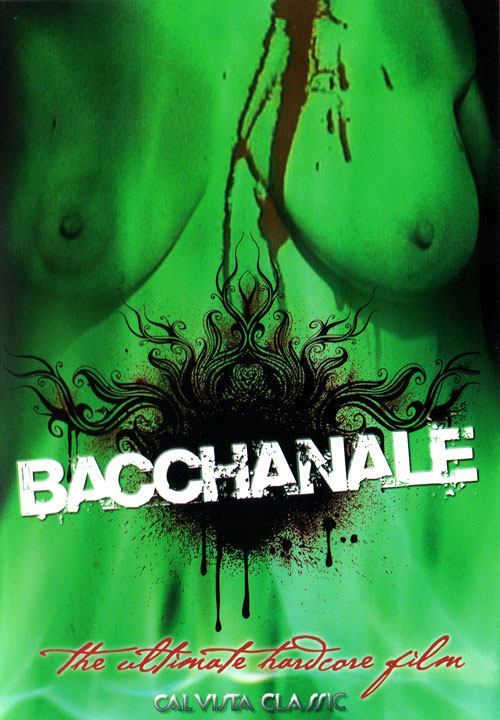
As an individual that is relatively disinterested in pornography as both an 'art form' and a pathetic masturbation aid, I cannot think of a greater hardcore flick than the dreamy celluloid LSD trip Bacchanale (1970) directed by John Amero and Lem Amero (Lusting Hours, Blonde Ambition). A virtual remake and cultural update of the exquisite cult flick Dementia (1955) aka Daughter of Horror, Bacchanale follows the seductive spirit of a lonely blonde beauty as she meets faceless "all-knowing" phantoms, revisits the more surly anecdotes of her licentious youth, and engages in phantasmagorical free love with a variety of anthropomorphic beings. With their subsequent work Blonde Ambition (1981) – a XXX-rated film with the outlandish tagline, "if you liked Deep Throat and Singin' in the Rain you're gonna love Blonde Ambition" – the Amero brothers proved they could do the seemingly impossible by paying film-literate homage to Hollywood comedies/musicals of the 1950s in pornographic form and with Bacchanale they did the same for classic cult horror films of the same era, except with a psychedelic twist. Starring the beautiful blonde bombshell Uta Erickson (Marcy, The Ultimate Degenerate) as the wandering and often naked protagonist Ruth, Bacchanale is a psychosexual psychedelic trip that is part-nightmare and part-romp, but never redundant, which is quite the feat for a vintage work of pornography. In fact, if one is merely looking for a kitschy and kinky porn flick that captures the aesthetic essence of a bygone era, Bacchanale – being just as every bit cinematic as sexual like the things vivid wet dreams are made of – may prove to be too much as it rivals (and often eclipses) the arthouse-sleaze works of Radley Metzger (Score, The Image), Tinto Brass (Salon Kitty, Caligula) and Walerian Borowczyk (Blood of Dr Jekyll, La Marge). 


 After falling asleep in a seedy motel room, Ruth’s spirit awakes and she wanders to an ultra-hip (to the point of parody) hippie costume party, but not before revisiting an incestuous sexual encounter she had with her dead brother Gordon many years ago. Despite the lurid and salacious past of the character she plays, Uta Erickson – with her natural breasts, fully intact labia, and all-American gorgeous looks – is quite elegant, thus making her much more appealing than the typical plastic cum-guzzlers with bleached, blown-out assholes that plague porn films nowadays. In fact, all of the performers/actors in Bacchanale – with their public hair, proportionate-sized penises, and lack of tacky tattoos – are totally organic in appearance, thus making the film all the more “fantastic” and “otherworldly” for modern day viewers. Contemporary viewers will also be happy to known that Bacchanale is hardly politically correct in its portrayal of pompous gay fashion designers (as best epitomized by a hysterical homo named “Go Go”) and its total lack of colored folks. Despite its lack of melanin-privileged folks, Bacchanale does feature a kaleidoscopic exhibition of hypnotic and psychotropic colors that further accentuates every cum-shot and blow-job featured in the film. On her pleasurable phantasmal pilgrimage, Ruth finds herself falling further and further away from reality but closer to orgasmic transcendence. When not jerking-off dead guys and performing stripteases for the grim-reaper in graveyards, Ruth is looking for the ghost of her dead brother, but she must endure the wrath of a sadomasochistic lesbian dictator and her slavish undressed underlings in a cave to find what she is truly looking for. As a forsaken fallen soldier of the Vietnam War, brother Gordon is the only man who has what it takes to give Ruth the solace that she so desperately needs. 


 Often regarded as the greatest film ever created by the anomalous auteur-pornographers Amero brothers, Bacchanale is most assuredly one of the most unprecedented and preeminent works in porn film history. For fan of Alain Robbe-Grillet (most specifically Eden and After and Successive Slidings of Pleasure), Alberto Cavallone’s Blow Job (1980) and Stanley Kubrick’s Eyes Wide Shut (1999), Bacchanale makes for a distinctly delectable yet debauched dream-story where erotic daydreaming and hallucinatory nightmares become one. That being said, take careful heed of the original 1970 poster: "If You Never See Another Adult Film, You Must See...Bacchanale.


-Ty E

Die Ausgesperrten


As far as made-for-television films are concerned, you probably won’t find a greater, more biting, and sickly sardonic one than the fairly obscure Austrian TV-movie Die Ausgesperrten (1982) aka The Excluded directed by Franz Novotny and based on the novel of the same written by the terribly pessimistic and nihilistic Nobel Prize winner Elfride Jelinek (The Piano Teacher, Lust). Also co-writing the screenplay and starring as one of the film's characters in her sole acting role to date, there is no doubt Jelinek certainly gave her ‘seal of approval’ to the makers of Die Ausgesperrten, but while the book mainly focuses on the characters contemplative thoughts, the film merely captures their everyday words and deeds. As an Austrian of ½ Jewish ancestry and lifelong committed feminist and card-carrying communist, Jelinek is internationally notorious for her anti-nazi and anti-bourgeois themes as they act as a crucial and innate quality of her work and the film Die Ausgesperrten is no exception. Following two seemingly well-mannered yet unsavory and sadistic siblings and their ‘recruited’ friends (two of whom are ironically named after pacifistic anti-nazi resistance ‘fighters’ Sophia and Hans Scholl of die Weiße Rose fame) as they frantically and regretfully ‘come-of-age’ in late 1950s Vienna, Die Ausgesperrten is a cinematic work that unsentimentally dwells on Austria’s National Socialist past and the irreparable affects it had on the post-WWII generation. Having a crippled and thoroughly sadomasochistic ex-SS officer as a father and a servile mother that ignores his blatantly abusive behavior against the entire family, the L'enfant terrible teens of Die Ausgesperrten take reactionary revenge against society by stealing, vandalizing, and even killing around the cosmopolitan city they call home. Curiously, Elfride Jelinek’s real-life father was a Czech Jew who remained unscathed during the Nazi era due to his talents as chemist, so one can only speculate whether or not he acted as an inspiration for the distinctly debauched father in Die Ausgesperrten. With a strikingly swarthy, Semite-like appearance on the level of aesthetic absurdity, it is quite perverse yet devilishly ribald to watch the father as he fondly reminisces over brutally raping countless Jewesses as a SS man as if he were the vaudevillian equivalent of Amon Goeth. In fact, throughout the entirety of Die Ausgesperrten, there is not a single character that would have made for the ideal Aryan poster boy, which was almost certainly a conscious decision made by the makers of the film. They may hate the Nazis and their parents, but the siblings of Die Ausgesperrten – being dedicated nihilists with violent anarchic proclivities – are certainly their father’s kids as especially testified by the film’s singularly brutal and marvelously macabre ending.


Being a doomed generation, at least in the metaphysical sense, the kinky kids of Die Ausgesperrten get their demagoguery kicks by engaging in loveless fucking in high school bathrooms, running over fellow teenagers with cars, brutally beating bourgeois gentlemen, and dreaming of America in a less than romantic fashion. Austria may not have a glorious future but it has an infamous past that acts as a foreboding reminder of the characters unpleasant birthright as a defeated people with a bloodstained history. Beginning during the year 1942, the turning point of the Second World War, with a scene of unimpressed SS officers looking bored to death as they view an anti-Semitic play featuring the father “Otto” playing a Rabbi and wearing a XXXL prosthetic hook-nose, Die Ausgesperrten immediately sets the tone for what is one of the most snidely comical and mirthfully misanthropic films ever made. Jumping ahead to the year 1959 in Vienna, Otto is now missing a leg, most of his hair, and his dignity, but at least his still has his dark sense of humor, which he passes on to his two cultured yet curiously callous children Peter (Paulus Manker) and Anna (Ursula Knobloch). In part, the behavior of the two turbulent teens somewhat resembles that of 12-year-old protagonist Antoine Doinel from François Truffaut’s The 400 Blows (1959) had the boy gone on to mature into a machinating maniac with an antipathy for all things relating to love and family. Forget the amazingly aberrant Aryan children of Village of the Damned (1960), the conniving kids of Die Ausgesperrten are the real children of the damned. Somewhat attempting to wear a mask of sanity among the general public (in between assaulting/vulgarizing/burglarizing them), arrogant anti-hero Peter has no qualms about announcing to his compatriots that “crime is pure will,” as if he is a Nietzschean of the anarchic-libertine Georges Bataille variety. In the public arena, Anna is a bit more forward than her brother, proclaiming to her priggish teacher (played by Jelink herself in an ostensibly ironic and humorous role) that, “The human has to give himself to those extreme actions commonly considered crimes or choose death.” Indeed, as the days pass and their father becomes all the more bestial in his sexual torture of the mother, the teens further embrace their pigheaded philosophy of active apostasy, of which the older Nazi generation has no understanding. In one particularly telling scene, a victim of the torrid teens calls them, “Goddamn surrealists!” as if he is on the brink of spewing a Nazi diatribe about the connection between Communism/Judaism and degenerate art.  It is only at the end of the film that anti-hero Peter interrogates his mother about his father Otto's behavior that he finally transcends nihilism and takes serious and decisive action in regard to his family's certainly uncertain fate.


Predating and ultimately anticipating the thematically brutal and nihilistic and aesthetically grim films of Austrian auteur filmmaker’s Michael Haneke (who later directed an adaptation of Jelinek’s The Piano Teacher), Gerald Kargl (Angst), and Paulus Manker (who incidentally plays the lead “Peter”), Die Ausgesperrten, despite its ridiculously obscure and neglected status even in its own nation of origin, is assuredly one of the most important works of post-WWII Austrian (and German-speaking) cinema. Not unsurprisingly, Paulus Manker would prove to be just as competent as a director as an actor with Weiningers Nacht (1990) aka Weininger’s Last Night, a film about one of Vienna’s most important and tragic intellectual figures, and The Moor’s Head (1995) aka Der Kopf des Mohren, a work quite comparable to Die Ausgesperrten that follows the slow but steady and shocking disintegration of an Austrian middle-class family. Although similar in theme to a lot of Michael Haneke’s films, Die Ausgesperrten – with its furiously farcical tone – is ultimately more palatable yet demanding than most of the Austrian filmmaker’s cinematic works. That being said, I do not think it would be an exaggeration to state that it is quite improbable that the films of Haneke and Manker would exist, at least in their present form, without the crucial influence of Die Ausgesperrten; a work that is quite arguably the greatest TV-movie ever made, at least in the German-speaking world. Undoubtedly, Die Ausgesperrten did for Austrian cinema what the cinematic works of Rainer Werner Fassbinder, Wim Wenders, and Volker Schlöndorff did for German cinema; giving a voice to ‘The Third Generation’; the Hitlerite era’s unwanted, discontented, and ill-fated progeny. Although considerably less well known and critically revered, Die Ausgesperrten is most assuredly Austria’s ‘Rebel Without a Cause’, but unlike the spoiled American youth of James Dean’s generation, Hitler’s spiritual grandchildren have something to be truly embittered and unruly about. 


-Ty E

Friday, September 7, 2012

Tearoom


With the tired deluge of faux “found footage” films over the past decade and more recently of a fantasy-driven supernatural variety like Cloverfield (2008) and V/H/S (2012), it is quite the relief when one gets to see an example of the real thing, especially if it is of a seedy and criminal/historical nature like Tearoom (1962/2007); a work featuring authentic footage taken by the Mansfield, Ohio police department during the summer of 1962 when they were trying crush the rampant anonymous male buggery in public restrooms. Originally launching the peculiar probe in an attempt to find an 18-year-old murderer of two young girls named Jerrell Ray Howell (who – incidentally – is more handsome than any of the ‘unconscious performers’ in the film), the police had no idea that so many men of differences ages, races, and creeds were engaging in the ancient art of spontaneous semen-swapping. Tearoom is filmed on color 16mm film stock by a hidden police camera man who used a two-way mirror to document the desperate acts of men with an unquenchable vice when AIDS was not a reality and taking a dick in the mouth and/or ass was considered the most deplorable and emasculating of unholy acts. The unintentionally candid acts of the carnal featured in Tearoom would result in all participating parties being charged and subsequently found guilty of sodomy, which during that time would result in a minimum of 1 year in a state prison; ironically, a virtual sanctuary for sodomy itself. While doing research for a documentary project, gay documentarian filmmaker (Finished, Is It Really So Strange?) and author (Halsted Plays Himself, Tearoom) William E. James randomly came across the footage from Tearoom and would eventually screen the film in its rough form (no sound, unedited) for small audiences at prestigious museums and film festivals around the world ranging from the Andy Warhol museum in Pittsburgh, PA to the Pornfilmfestival in Berlin, Germany. James described his agenda for screening the footage from Tearoom as follows in an interview, “My goal was to appropriate their film as something other than a pure instrument of domination, to make the film be about the men who are its subjects. I hope people can see more than oppression in TEAROOM.” Personally, what I noticed most consistently in the eyes and acts of the men of Tearoom is compulsive and ritualistic behavior performed by men who value their privacy, even if they are giving blowjobs and being sodomized in a public area. Before the time of internet porn and power gay political movements, Tearoom features fagdom before it was considered fabulous of which director W.E. James lamented, “I say that this is what gay sex looked like before porn. Now men look at porn and figure out how to fuck… These model images that we take for granted were not available to many men in 1962! TEAROOM is a representation of pre-porn gay sex, and in Mansfield, pre-gay bar sex, and for me that’s completely fascinating.” In short, Tearoom is ‘gay’ at its most unglamorous yet uniquely ‘human’ and for that alone, it makes for a worthwhile viewing.


What makes Tearoom all the more interesting is that many, if not most, of the men featured in the document were married and some even had kids, so one can only wonder what happened to them after their exceedingly embarrassing and disgraceful prison sentence. Naturally, getting sodomized by a random Negro in a public bathroom during the early 1960s was a tad bit taboo, thus making Tearoom – for better or worse – one of the purest expressions of voyeurism and scopophilia ever released in the history of film. One can owe this distinct honor (if one can actually find a copy of the film) to a police camera man named Spognardi and his assistant, of whom Tearoom presenter W.E. Williams provided the following insight, “From the way the camera moves, one can surmise certain things, e. g., that some subjects interested the police more than others… During screenings, there are many laughs when an attractive man enters the restroom, and the camera begins to move frenetically. Were the police cameramen gay?...only a straight man could allow himself to be involved in the outrageously perverse scenario of waiting in a closet unseen in the hope of seeing other men masturbate and have sex.” Somewhat surprisingly, police cameraman Spognardi described the whole opinion-changing experience behind Tearoom in the following terms: “I changed my whole thought on it, as far as two consenting adults behind closed doors…What people do behind closed doors is their business." Of course, the men in Tearoom were anywhere but behind closed doors, at least private ones, and this becomes more than obvious towards the end of the document when a little boy appears in the sandbox of sodomy, henceforth illustrating the complete and utter vulgarity of the underground sex station. While homosexuality has gained a lot of social acceptance and even political power in the form of ‘victim’-based special interest groups, it is highly doubtful that the perverse phenomenon of ‘cottaging’ that is featured in Tearoom has swayed over the years as testified by the 1998 arrest of popular British pop singer George Michael for "engaging in a lewd act" in a Los Angeles public toilet and the 2007 arrest of U.S. Republican senator Larry Craig for soliciting sex at a public Minneapolis,airport bathroom. After all, one of the main appeals of public sex – whether one is a flaming pansy or a hyper-heterosexual rapist – is the possibility of getting caught. Unfortunately, for the men of Tearoom, their sadomasochistic fantasies were fully realized and forever visually chronicled for the viewing (dis)pleasure of fanatic cinephiles, homophiles, libertines, and softcore sadists. 


-Ty E

Thursday, September 6, 2012

I Love You, I Don't


If there is anything more repellant and repulsive to me than Serge Gainsbourg’s bistered, apish face and Franco-Semitic hyper-aberrosexuality, it is his overblown and over-esteemed creative output, so I was not exactly delighted when I realized that I made the unconscious commitment to watch one of his cinematic auteur pieces. This month, I decided that it would be quite regaling challenge to view every single one of Joe Dallesandro's post-Warhol European period flicks (mid-1970s to early-1980s), so naturally I caved in and decided to view Gainsbourg’s directorial debut Je t'aime moi non plus (1976) aka I Love You, I Don't; a work starring the Italian-American junky hunk as a perverted Polak who decides to give women a try after a lifetime of unadulterated blue-collar male buggery. Undoubtedly, Dallesandro gave some of his greatest and most prestigious performances during his stay in Europa because, as he has stated in various interviews that unlike while working with Warhol and his mostly untalented weirdos – who saw him as nothing more than a beautiful brutish bohunk and unofficial factory bouncer – European directors treated him as a serious actor, hence his eclectic performances in such notable works as Vittorio Salerno’s Savage Three (1975) aka Fango bollente, Louis Malle’s Black Moon (1975), Walerian Borowczyk’s La marge (1976), Fernando Di Leo’s Madness (1980) and Jacques Rivette’s Merry-Go-Round (1981). Out of all of his European films, I Love You, I Don't quite arguably features Dallesandro at his most intimate, vulnerable and yet decidedly brutal. Also featuring Gainsbourg’s then-wife Jane Birkin in an unflattering yet notable performance that would get her nominated for a Best Actress César Award, I Love You, I Don't is a work of Arcadian libertinage where the conventions of sex and sexuality are mixed in a blender for a most potent, if slightly poisonous, ultra-erotic cinematic cock-in-tail. Originally banned in the UK in its uncut form upon its initial 1976 release, I Love You, I Don't is a cinematic work that is not so much infamous for its graphic nudity as it is for depraved sexual scenarios, recalcitrant relationships, and deluging lack of sentimentality. Unsurprisingly, featuring an unremarkable score and songs composed by Serge Gainsbourg himself, which proves to be one of the weaker points of the film, I Love You, I Don't – much like Godard’s Contempt (1963) – is one of those rare films where I was able to put aside my unwavering antipathy for the artist and judge the film somewhat objectively on its own merits. 


 Over two decades before rather rotund fanboy Kevin Smith directed what is arguably his most serious film, Chasing Amy (1997) – a reasonably ridiculous and infantile quasi-fantasy work about a lipstick lesbo who temporarily switches to smoking poles instead of licking labias – Serge Gainsbourg released I Love You, I Don't; a more-bitter-than-sweet love story about a sad-eyed Slavic sodomite named Krassky (Joe Dallesandro) who experiments with heterosexuality after he meets a girl that seems to be man-enough for his sexual druthers; or so s/he seems. Johnny (Jane Birkin) may not have a cock, but she does have a tight pink hole and that proves to be good enough for Krassky's knob, at least for brief period of time. In I Love You, I Don't, Polish Garbage truck driver Krassy and his beau boi Padovan (Hugues Quester) – a hysterical queen who is the absolute female in the relationship – make a pit-stop at a rural French diner where the two meet androgynous Johnny; a boyish-girl that seems intrigued by the mysterious muscular Slav. Johnny is warned by her coarse yet upright boss that the two Poles are bona fide poofers, but that doesn’t stop her from hopelessly crushing over the stoic yet swaggering homophile. Despite all the terrible biological odds against them, sassy Krassy and jejune Johnny eventually ‘hook-up’, but not in the conventional way as the homo Pole is unable to extend his pole when confronted with his lady friend’s wet womanhood. Instead, the couple gets entangled in a steamy liaison of debauched scatology which – to her credit – Johnny takes like a the man, even if her cries of extreme discomfort during anal sex stir outrage from various neighbors as neither of the two lovers have enough foresight to utilize the lubricating wonders of spit like the gay cowboys in Ang Lee’s Brokeback Mountain (2005). Heartbroken, hysterical, and horny due to his lover’s absence, prissy prima donna Padovan tries to find a rebound stud in the form of a well-endowed bestialist (played by Gérard Depardieu in a hilarious yet bewildering cameo role) with a predilection for penetrating horses. Thoroughly dismayed by his failed sexual conquests and totally humiliated by his lover’s newly found interest in the much more beautiful, fairer sex, pansified punk Padovan decides to take sadistic and spiteful revenge against Johnny with the most surprising of consequences for all three parties involved. Indeed, there are few, if any, more bizarre love triangles in cinema history than the one featured in I Love You, I Don't; a virtual romantic-comedy for fiendish fetishists, ardent anti-romantics, and depraved homophiles. Needless to say, I Love You, I Don't is not the sort of film one should show to a prospective lover on a first date, unless they happen to be someone like Sasha Grey or Genesis P-orridge. 


 It should be no surprise that swarthy Serge Gainsbourg was a bit startled by iconic hunk and authentic alpha-male Joe Dallesandro’s manly manhandling of his wife as the singer-turned-filmmaker was apparently stricken, “with jealousy during some of …Jane’s sex scenes with Dallesandro” as detailed in Sylvie Simmons’ biography Serge Gainsbourg: A Fistful of Gitanes throughout the production of I Love You, I Don't. Aside from fellow French auteur Joël Séria’s dubious uses of his soul-mate Jeanne Goupil in Marie-Poupée (1976) aka Marie, the Doll, I cannot think of another filmmaker who has so scrupulously humiliated and dehumanized his lover for the sake of cinema as Gainsbourg did with Jane Birkin in I Love You, I Don't, and for that alone it makes for an interesting and worthwhile cinematic work, but it is more than just a typically cheap French thrill as the film poses many serious questions; most specifically, compatibility between sexes, especially among those individuals with abnormal sexual tendencies. Although fairly forgotten nowadays due to his contemporarily unpopular ideas regarding the female sex and Judaics, Jewish-Austrian philosopher Otto Weininger proposed in his magnum opus Geschlecht und Charakter (1903) aka Sex and Character that all humans are more or less ‘bisexual’ (having elements of both femininity and masculinity) and that prospective lovers are attracted to individuals with complimentary sexual persuasions (e.g. a male that is 70% male/30% female would be best compatible with a woman that is 30% male/70% female), thus making Gainsbourg’s experiment in I Love You, I Don't seem relatively reasonable all the more provocative on hindsight, especially when compared to similarly themed works like Chasing Amy and Paul Verhoeven's Basic Instinct (1992). Ultimately, I Love You, I Don't is undoubtedly one of the most serious, valiant, uncompromising and incensing yet titillating looks at transgressive sexuality in cinema history that is bound to affect even the most jaded and perverse of cinephiles; and for that alone, Gainsbourg at least deserves a lengthy footnote in film history. If one can learn anything from I Love You, I Don't, it is that one should never piss of a poof, especially when their manhood comes into question, as few things can compare to the seething wrath of an exceedingly enraged androphile. 


-Ty E

Wednesday, September 5, 2012

Loft


Aside from possibly his charmingly callous hero-worship-gone-homicidal cult flick Der Fan (1982) and his superficially-stylized Americanized action-romance-drama flick Alpha City (1985), German auteur Eckhart Schmidt is a relatively forgotten, if somewhat deservedly so, filmmaker who has many more cinematic misses than hits, but he has created a couple works that deserve critical reevaluation and even a serious cult following, most specifically his rather bizarre and thoroughly engrossing cross-genre pseudo-arthouse work Loft (1985). Like a merry mongrel mix between the visual and audio aesthetic of Slava Tsukerman's iconic new wave sci-fi flick Liquid Sky (1982) and the visceral and psychotically playful brutality of Wes Craven’s popular exploitation flick The Last House on the Left (1972) and its Italian-clone The House on the Edge of the Park (1980) directed by Ruggero Deodato (Cannibal Holocaust), Loft is a curious cinematic work that is every bit as idiosyncratic, entertaining, and controversial (at least for its time) as it sounds, but it is also packed with ostentatious artistic pretensions and a glaring (non)socio-political message that has not aged gracefully, although these sometimes repelling cinematic flaws do add a secondary and wholly unintentional layer of character to the film that make it all the more noteworthy. Despite its blemishes, Loft is easily the most enthralling and unintentionally uproarious ‘horror’ film that I had the random pleasure of viewing this summer.  Also, like Tsukerman's Liquid Sky, Loft features a primitive and unhealthily addictive electronic score created by the director that further accentuates agitating ambiance of the film. If the Baader-Meinhof Group were anarchic punks with more of a proclivity towards creating gigantic sinister cock paintings, gently raping bourgeois bitches, and reciting pretentious poetry than being suicidal media whores, they might resemble the villainous art collective featured in Loft; a sensational and sassy celluloid shock piece that has the prestigious distinction of provoking much controversy in supposedly "artistically free" Germany upon its original release.


Set sometime in the not-so-distant future, Loft begins with narration from an unnamed individual about a neurotic and nihilistic era where – much like our present post-postmodern world – the Occident is on the break of total civil war and hedonism makes for a totally chic weltanschauung. At first, we are introduced to a bourgeois couple as they visit an avant-garde art exhibition located in a loft in some post-industrial wasteland. Raoul (Andreas Sportelli), a rich, cocky, and awfully pompous PBF (pretty boy fag) in his early-20s, lets his muse Raphaela (Rebecca Winter), a Mediterranean-like bitch with an emotional twitch, know that he is only attending the seemingly amateur art show so he can finally unbury the fleshly, earthly pleasure that is between her legs. Little do the two banal bougies realize that Furio (Karl-Heinz von Liebezeit), the lead ‘curator’ and Führer of the art collective – a debauched and nasty Nordic sadist who looks like he just walked off the set of William Friedkin’s Cruising (1980) – is watching the couple’s every move and he doesn’t take kindly to their apathy towards his would-be-audacious art. With topless girls chained to poles and phallocentric paintings adorning the walls, furious Furio has indeed set up quite the spectacle for his inhospitable guests and they repay him by frantically fornicating in a darkened room away from the art. After the art exhibition, Furio and his collective imprison the couple in the loft and treat them accordingly. In defense of his impassioned brutality, Furio vehemently states, "You attended our exhibition, but not one of you paid any attention to our pictures. We are our pictures, and they strike back when they're insulted." To be fair, before her boyfriend starting putting his hands up her dress, Raphaela seemed somewhat intrigued by the art, but she doesn’t feel the full force of Furio’s creative fury until he is forcibly plundering her panties while Raoul watches on defenselessly while imprisoned in a nearby bathroom. For the rest of Loft, the film resembles a cross between kitsch performance art à la Viennese Actionism-meets-New Romanticism and the puckish malice of the local yokels in Tobe Hooper’s The Texas Chain Saw Massacre (1974). Ending somewhat abruptly in a quasi-supernatural and inexplicably phantasmagoric fashion, Loft always thrills even after all of the kills.


Undoubtedly, Loft is my favorite effort from the anti-arthouse auteur Eckhart Schmidt who once had the audacity to state,"I would rather film a naked girl than a discussion of problems," in a country where kultur and artistic prudishness have always reigned. Indeed, Loft may not compare with a R.W. Fassbinder nor Werner Schroeter film in terms of artistic refinement, but it is indubitably one of the greatest and most innovatory dystopian rape-revenge flicks ever made and thus worthy of being mentioned in the same breath as Mark L. Lester’s Class of 1984 (1982), Liquid Sky (1982), and even James Cameron’s The Terminator (1984). In short, Loft is pulp cinema at its best; terribly trashy, morally ambiguous, infinitely quotable, succulently stylized, and – above all us – wickedly and utterly entertaining, but with a peculiar tinge of artistic merit.  That being said, it is interesting to note that Eckhart Schmidt seems to mock the artistic sternness and fanaticism of the villains of Loft, as if he made the film in part as a celluloid anti-love letter to Fassbinder and the rest of the overly genteel auteur filmmakers of the German New Wave.  If Loft makes any sort of political message, it is an 'apolitical' one expressing Schmidt's staunch disdain for all things politics, be it socio-political, realpolitik, or otherwise.  In the end, the upper-class is still at the top, and the anarchist artists and their art have literally faded into history, henceforth acting as Schmidt's final political statement on the futility of filmmakers and other artists in their vainglorious attempts to change the world.  Needless to say, Schmidt went on to direct films about voluptuous, bare-breasted mermaids (Undine) and softcore skinflicks (Motel Girls), but Loft provides copious, if crude and cryptic, evidence that the German auteur has more than just beautiful brunettes with marvelous mammary glands on his mind.


-Ty E