Wednesday, March 13, 2013

Deadlock


 As probably anyone who regularly reads this site knows, I have a general apathy towards Westerns of most persuasions, so any film that I do happen to like from this absurdly anachronistic and outmoded genre tends to be of the convention-exterminating, cowboy-less, and aesthetically antagonistic, acid and/or arthouse sort and the West German, psychedelic Western Deadlock (1970) directed by Roland Klick (Supermarkt, White Star) is certainly not the sort of cowboys and Indians movie your slaphappy grandpappy watched to get inspired to kill krauts during the Second World War. With endorsement from surrealist Acid Western master Alejandro Jodorowsky, who stated, “DEADLOCK is fantastic. A bizarre, glowing film,” it has the backing of a man who essentially raped and deconstructed the genre, but unlike El Topo (1970), Klick’s film is not shrouded in esoteric symbolism and messianic-like self-glorification. As a filmmaker who once vehemently stated, “We’re not supposed to make films like Alexander Kluge for the fine people in the ivory tower!” and someone who was disdained in his homeland by fellow filmmakers and film critics due to his intrinsically action-packed and anti-intellectual works, Klick was striving for something more ‘subconscious’ (his admitted initial approach when creating a film) and adventurous with his films and Deadlock does just that, but with a completely corrupted, counter-culture flare as if directed by a German working-class Donald Cammell. Although ostensibly set in Mexico on the border of California, Deadlock was actually filmed in Negev Desert, Israel during the chaotic aftermath of the Six-Day War in a rather rare case where a film set was a virtual battlefield, which Klick described as follows, “DEADLOCK...was one big incredible adventure. There had just been a war…They were still there, barrels pointed! Jordan was over here, Israel was over there…The mountains were full of cannons. And right between all that, in no man’s land, was our shooting location…We were really shooting right between two fronts! The whole venture..also because there wasn’t much money..an incredible adventure…I think this power really translated to the adventure onscreen. It’s a film of its own!” And, indeed, love it or loathe, Deadlock permeates an all-powerful, transcendental atmosphere that is somewhere in between Arcadia and the apocalypse as if Werner Herzog were attempting to remake Kenneth Anger’s Lucifer Rising (1972) as a Western, but decided to drop all the Thelemic/Crowleyite imagery and replaced it with a sun-washed babe named Mascha Rabben in a border-less abyss of desert decay. Featuring a highly complementary musical score by early krautrock group Can, Deadlock is a völkisch work of the psychedelic anarchist sort that proves that at least one kraut auteur was able to more than competently adopt the Western genre in an Aryan acidhead form, thereupon making Roland Klick the virtual Fidus of post-WWII Teutonic filmmaking, yet with an agile spirit no less impressive than Austrian adventurist auteur Luis Trenker.  A particularly penetrating piece of 'scorched earth' celluloid, Deadlock lets the viewer know that sometimes sun-worship can blur one's vision and mind, and can even cause sadism-stirring sunburn. Needless to say, John Wayne and John Ford would find themselves in hell (if they aren’t already there) were they to view Klick’s Deadlock – a positively potent post-totenkopf ‘trip’ ironically set in the Hebraic holy land. 


 A young American killer named Kid (kraut cult actor Marquard Bohm of Rote Sonne (1970) aka Red Sun and Fassbinder’s Beware of a Holy Whore (1971)) with a bullet in his arm lies dying in a barren and arid Mexican desert with a total population of three people. He and his comrade Anthony “The Old Killer” Sunshine (Scotsman Anthony Dawson of Hitchcock's Dial M for Murder (1954) and Dr. No (1962)) carried out a robbery that earned them a million dollars cash, but while making a would-be-great escape, Kid was shot in the arm and he believes his callous co-conspirator may have done the shooting, thus he fled to a depopulated desert via train-hopping where he believed no one would possibly look for him, but rather unfortunately, someone does find him during a moment of complete and utter vulnerability. While lying unconscious, Kid is discovered by a goofy guido-like fellow named Charles “The Rat” Dump (German-Italian actor Mario Adorf of The Tin Drum (1979) aka Die Blechtromme and Fassbinder’s Lola (1981)) who noticed the young man’s Mauser (the same model used to build Han Solo's blaster in Star Wars) and briefcase full of tons of cash. Mr. Dump is about to smash Kid’s skull in with a boulder and take the money and run, but the lanky, longhaired youth begins to move and the potential murderer has second thoughts. Dump – a rather pathetic and cowardly dolt with somewhat of a kind, albeit crude and corrupted, heart – takes the Kid back to his shack-like home. Dump conspires how he can take over the cash, but as a blatantly broken man who makes the baseless claim that he is in charge of the law of the land as a representative of the “North American Mining Company,” which is clearly dead as the desert soil, he is clearly no match for the Kid, nor his pernicious partner Sunshine. A ‘poor man’s Clint Eastwood,’ albeit more gritty and ugly, Sunshine is a stoic sadist who is looking for the Kid, so he can get the cash, but the lad and his new partner Mr. Dump are waiting for an inevitable showdown with a rather unpredictable outcome where one winner takes all. Dump may be the master of his derelict desert domain, but he also has a sexually repressed and belligerently bitchy old lady named Corinna (Betty Segal) – an erratic ex-prostitute with saddlebags for thighs that no one wants to screw anymore, hence her perverse proclivity towards flashing her grotesque racks of spoiled meat at Kid – and their salacious and super sensitive yet seemingly stupid spawn, a stunningly statuesque daughter named Jessy (Mascha Rabben) who is a naughty nymphomaniac that roams around his humble abode like a dog in heat. Dump’s personal dump of a home used to be an “Oasis in the Desert” with a wild whorehouse stock full of tasty meat and sand-side gambling, but the only thing left now is a couple dreary and dilapidated buildings and signs that constitute a desert ghetto and seem like a degenerate, ghost town version of Madame Kate’s pussy-peddling enterprise in East of Eden (1955) directed by Elia Kazan and starring James Dean. When Sunshine finally shows up, he tries to get doofus Dump to lure the Kid into a treacherous trap, but the tables are inevitably turned as the ex-pimp does not know how to keep his ‘cool’ and makes a number of failed attempts at coldheartedly killing and conning the old killer, which will ultimately cost him his life in the end.  Naturally, jackass Dump is no match for the two robbers as he has the decided disposition of a hyper-horny donkey with rabies. While Sunshine meticulously tortures Dump in a variety of ways, including using him for target practice and chasing him with his own beaten up truck, the Kid gets ready to make his move for the money in a battle between old school ‘cool’ and new school ‘cool.’ In Deadlock, the will to power and the struggle for survival go hand in a world of abject isolation of both the physical and psychological kind. 


 An aggressive ‘lone wolf’ at aesthetic civil war with the arthouse auteur filmmakers of New German Cinema, Roland Klick offered cinematic works that did not bore nor patronize the proletarian viewer, but instead offered instinctual, anti-intellectual cinema with hearty meat and bones that made stylish celluloid art and social controversy palatable for the masses, without making any artistic compromises in the process. In the documentary Das Kino des Roland Klick (1997) aka The Cinema of Roland Klick, Klick stated the following in regard to the perceived lack of 'German' character of his films, “And now the question would be: What is German? Why do films look German?...In essence, films look German for the following reason: They don’t take the risk of the unknown, of the unexplained, hence: of the magical, which is constructed by the imagination. They have the tendency to over-explain every element. Not only verbally, but also visually…I choose these locations subconsciously, at first…I’m a big fan of secrets.” And indeed, Deadlock is steeped with an innate mystifying character from the bloody beginning to the even bloodier end. A marvelously metaphysical work, although of the nihilistic and nefarious sort, Deadlock brings a soul to a badly beaten-to-death genre that, quite ironically, was only able to obtain artistic merit when it was imported to a foreign continent, with Klick’s Western being one of the furthest away in spirit from the likes of Irish-American propagandist John Ford. While borrowing thematic and aesthetic attributes from Spaghetti Westerns by dirty dago auteurs like Sergio Leone and Sergio Corbucci, Deadlock is its own beast and a blond one at that, dancing in the face of death and embracing human darkness, heart and soul, in the bitter yet ultimately stoical end. While Klick has been besmirched and condemned by his fellow countrymen for the perceived lack of ‘German’ character of his films, I would argue that Deadlock more than assertively permeates the forlorn Faustian spirit of the 6th Army (Wehrmacht) Stalingrad, but especially the Afrika Korps, as a rare work of post-WWII Teutonic cinema with an uncompromising masculinity and testicular fortitude of a seasoned soldier as opposed to the accepted defeat of an effete ‘auteur’ sitting in an ivory tower.  Most importantly, at least philosophically speaking, Deadlock is not a work that meekly wallows in pity, defeat, and forgiveness, but, on the contrary, is a renegade piece of relentless and poetic celluloid barbarism and Teutonic irrationalism that reminds the viewer to "never forgot" that life is a war and those not strong enough or willing enough to accept it are better off dead.


 -Ty E

Tuesday, March 12, 2013

Mother's Heart


While I have seen a variety of Brechtian sociopolitical arthouse films that I found to be quite aesthetically and intellectual intriguing, albeit at the same time tending to be emotionally vacant and mostly mundane mental masturbation, including Jean-Luc Godard’s Weekend (1967) and The Niklashausen Journey (1970) co-directed by Rainer Werner Fassbinder and Michael Fengler, none of these films have a soul as rich yet tragicomedic as the criminally neglected Italian work Mother's Heart (1969) aka Cuore di mamma directed by relatively forgotten Goombah auteur Salvatore Samperi (Stormtroopers aka Sturmtruppen, The Corruption aka La bonne). A particularly pessimistic yet strangely passionate film centering around a mute Hightalian mother who watches seemingly helplessly and speechlessly as both her family and nation breakdown in an absurdist fashion via stereotyped political pathologies of both the far left and far right persuasion, Mother's Heart is an insanely idiosyncratic film that seems like it was co-scripted by Sicilian ‘ultra-fascist’ philosopher Julius Evola’s more nihilistic brother and directed by a Ginny Wes Anderson were he more wanton and less of a pansy Philosemite. Featuring a suitably somber yet solacing musical score by none other than Italian maestro Ennio Morricone (The Good, the Bad and the Ugly, Days of Heaven) and starring the gorgeous Carla Gravina of The Antichrist (1974) aka L'anticristo, Mother's Heart is just as odd of a collection of Guido talent as it is an audaciously avant-garde arthouse work with no contemporaries. Centering around a divorced mother of three with fascist children (led by "Big Brother") who joins an anti-bourgeois terrorist cell and works at a blasphemous yet bookstore that recommends works by the Marquis de Sade to grade school kids, Mother's Heart sardonically shows what happens when a moratory, melancholy mommy who – aside from being far from a Mother Madonna-like figure, is certainly no Mary Magdalene either – gets involved with terrorism and class action warfare while nonchalantly watching her genocidal neo-fascist children come-of-age in a devitalized nation consumed with decadence and on the blatant brink of self-annihilation. Featuring child nudity and volatile, Tourette syndrome spiels coming from prepubescent mouths, as well as dubious situations between adults and children, Mother's Heart – for better or worse – is like nothing you have ever seen before, as the sort of film every kid would love to see, but that most adults would be at a loss to even begin to understand. 


 Depressed divorcee Lorenza Garrone (Carla Gravina) has some serious problems, but she is literally not saying a word as woman who may or may not be mute, but judging by the fact that people talk to her as if they are expecting her to respond, one can only assume that she has made the conscious decision to stop talking, even if her active vocalness could have easily prevented her pernicious eldest son from gassing his little sister, among countless other incidents of baneful behavior from the brazenly bad yet bright young buck. While her three children (the two oldest children being Gravina’s real-life spawn) are indubitably geniuses with intellects that far surpass most adults, they choose some rather peculiar intellectual proclivities that include rocket science, bio-chemistry, Lombroso-inspired Positivist criminology, eugenics, tattooing, hardcore fascist politics, and chemical murder methods. During the beginning of Mother's Heart, we are introduced to the terrible threesome, but especially the eldest, a dark-haired lad named Massimo (Mauro Gravina) who holds down the beautiful babysitter Berta (Rina Franchetti) by force and tattoos a beauteous rose on her wild working-class derrière, which is depicted in an exceedingly aesthetically pleasing montage during the opening credits of the film. A little lad who always sports a nice and shiny Nazi army helmet, ultra-macho preteen Massimo – a "Big Brother" in every sense of the phrase – is undoubtedly the master of his domain and the undisputed “Duce” among his siblings, maid, and babysitter and despite seeming rather intelligent, he also seems to suffer from coprolalia, copropraxia, and coprographia, not to mention sadomasochistic and homicidal tendencies, but he manages to channel all of these ‘character flaws’ in his flagrant fight for fascism.  After all, with a red-handed mother and an absent, albeit wealthy father, who else but macho and martial Massimo is fit to establish order at home. When Massimo notices his baby brother is not upholding the honor of his race and family, he bombards him with the followings slurs, “Enough is enough with this filth…Little wild pig, Negro of the Amazon, vile communist, cannibal, African!” The self-appointed gallant guru of his siblings, Massimo wastes no telling his sister Anna (Monica Gravina) that, “a parasite is a Negro, living on the shoulders of others,” when she asks him what a parasite is. The product of a divorce, Massimo clearly has to compensate for his ineffectual parents' lack of parenting skills and questionable morals. With a seemingly vapid and neglectful mother who can barely hold a job at a degenerate bookstore and who loves her sexy, Sapphic ex-sister-in-law more than her own children, it is only a matter of time before mini megalomaniac Massimo stars killing off his siblings in freak accidents of the stereotypically fascistic kind.


Upon her first appearance in Mother's Heart, it is quite apparent that Lorenza Garrone does not seem to care about anything, especially when it comes to her children and their apparent sadism, because after her son tells her that, “the skin of the butt burns in no time at all. Like paper” after tattooing the babysitter's buttocks, she does not even acknowledge it and merely proceeds to mindlessly watch television with the other Enfants Terribles. As lady Lorenza learns whilst listening to a political minister on TV, “Over time everything works out…we Italians have faith in time…It’s our great savior,” but things prove to be quite the opposite for the mirthless mother of three. After seeing an intriguing young hippie bastard in a pink shirt one day while at work, languid Lorenza finally seems alive and 'in the moment' and wastes no time leaving her job without warning and following the funny fellow around town. Meanwhile, while her children are left by their lonesome, Lorenza’s eldest son Massimo blows up the family cat in a failed rocket launch on the beach, but not before calling his baby brother an,“Ugly rampant pissing brat, shitter, disgusting incontinent, vicious, coprophiliac!,” after the wee blond babe defecates in his favorite swastika-adorned nazi helmet. Losing the fellow in the pink shirt (who happens to be a pinko commie bastard whose terrorist cell the monotone mommy will soon join), Lorenza reverts back to her intrinsic imbecilic state and slavishly goes back to her work, where the quasi-Marxist manager (who stresses social class sensitivity) of the bookstore recommends the Marquis de Sade’s classic lurid libertine novel Justine or the Misfortunes of Virtue (1791) to a mother for her 9-year-old child who is bedridden with mumps, which he describes as a ‘tearjerker,’ but the mother is called back home after hearing about the family cat dying in what her son Massimo eulogizes as being, “one who has died, sacrificed for the triumph of science. Struck down by secular idiocy and brutality.” Lorenza’s sassy ex-sister-in-law Magda Franti (Beba Loncar), who she is apparently carrying on a secret lesbian relationship with (for who knows how long), reveals a lot about the mute mother’s character when she states to her, “When I met you, you were a spoiled child...Taking your shower with your shirt on, I bet. What idiocy! I refused. I began to reject everything starting at age 6. I hate it when they tell me what to do…But you, you stay standing there, you don’t react, you let them guide you. First you were tamed by your father. Then the monster of perfection that is your husband – to watch him is to die from boredom. I’m his sister, but this does not prevent me from seeing him for what he is…You should pick up your life like I do…I say this just for you. You know I love you. Your life is so boring.” Indeed, with increasingly troublesome tragedies brewing at home, including the death of her blond baby boy via dubious bathtub accident and later the death of her daughter Anna via gassing by Massimo, as well as repeated reprimands and her eventual firing from her job at the bookshop, Lorenza gets all the more involved with a super stereotypical, slogan and statistic spouting, communist terrorist group whose members state things like, “The bourgeoisie has no other pleasure than to degrade all.” Ironically, a degraded bourgeois babe herself, Lorenza eventually decides it is time to payback her ex-husband by blowing up his prestigious pharmaceutical factory, thus consummating the physical and financial ruin of her entire family with a big bang.


A sardonic, semiotic window into counter-culture chaos of late-1960s Italy (as well as the Occident in general), Mother's Heart is a titillating and terribly tragicomedic work that uses a mute mommy as a charming and cute cipher for depicting sociopolitical abuse from both extremes of the political spectrum, but being set during the post-WWII era when fascism was already defeated, the film mainly focuses on the lunacy of the left and how such destructive politics are sired by nihilistic and impotent members of the upper-classes and especially the self-loathing  members of bourgeois. Being a bored blonde babe of the less than blessed bourgeois sort, plagued protagonist Lorenza naturally becomes a mindless victim of neo-bolshevik banality of the bomb making and planting sort, thus Mother's Heart ultimately managed to foretell real-life terrorist cells like the Baader-Meinhof Group in West Germany, which was comprised mostly of middle-class college students who were facing increasing feelings of alienation from their families and the capitalistic, 'democratic' way of life. As her son Massimo tells her before blowing himself up in another attempt at launching a rocket for the glory and triumph of Italian national science, “You, Mom, haven’t said anything, so you’re my accomplice. Silence indicates consent. After all, you have profited on all these things that happened. Now you’re free. You have your Magda, who is your love, but you can’t have all the profits for free. If you do not want me to go tell the police it was you who killed your children, you must help me kill Magda, because Magda is corrupting you. She’s a freak. I don’t want you to become like her, degenerate and communist. But we’ll talk again. We’ll have time to talk about everything.” Indeed, the boy, who acts as an exaggerated archetype for fascism as a nationalist extremist whose fascist fanaticism is stirred by an unquenchable desire to restore order in his family, which is symbolic of Italian nation itself, is right as his neglectful mother could have easily prevented her children’s deaths had she been more responsible, but instead, gives into her lesbian decadence and, as a last resort due to her guilt as an "accomplice" of her son's fascism, pinko terrorism. When Massimo perishes, once again a result of his mother’s pathological negligence, Lorenza is finally ready to completely throw away her reasonably plush personal life by becoming a full-time anti-Occidental terrorist and thus destroying her ex-husband’s pharmaceutical empire, thereupon symbolizing via one dysfunctional family, the downfall of Italy as a whole. An allegory for Italy and Europa’s decided degeneration as a result of cosmopolitanism and cultural Marxism, which has only gotten worse since the film’s release with the flooding and colonization of the nation with illegal and mostly hostile aliens from the global South (which began in 1962), the formation of the anti-European “European Union,” and the impending economic collapse, Mother’s Heart, albeit somewhat dated, is ultimately a work that is more important today than when it was first released over four decades ago. With the rise of neo-fascist groups in the Mediterranean like Golden Dawn in Greece and CasaPound in Italy, one can only assume what the true sons of Europe have in store for Mother Europa if the continent experiences a highly probable collapse in the next decade or so. 


-Ty E

Monday, March 11, 2013

Malina


If I have noticed any striking similarities in personalities between self-described ‘feminists,’ it is that the source of their oftentimes hysterical hatred of men is the result of an impenetrable hatred, fear, anxiety, and all-encompassing disdain for their daddy and such is certainly the case regarding Malina (1991) directed by Werner Schroeter – a celluloid psychodrama based on an autobiographical novel of the same name written by tragic Austrian author/poetess and proto-feminist Ingeborg Bachmann – that depicts the mental disintegration of an intrinsically incapacitated, albeit successful, woman who, in between dividing her time among two very contradictory men, is failing at attempting to write a novel she will inevitably never finish. Based on a screenplay written by Austrian feminist-Marxist playwright/novelist Elfriede Jelinek – a woman whose Jewish chemist father provided his services to the Third Reich, thus probably contributing to her dubious relationships with men throughout her life – that was adapted from Bachmann's sole novel Malina (1971), Schroeter’s less than literal cinematic adaption Malina, despite being the first and only film he did not write/co-write the screenplay for, would prove to be denounced as misogynist by feminists for its less than flattering, if not exceedingly empathetic, depiction of a woman in panic on the verge of subconscious suicide, as they felt that the film, as written by Michelle Langford in her work Allegorical Images: Tableau, Time and Gesture in the Cinema of Werner Schroeter (2006), "had reduced a figure of feminist emancipation to a mere stereotype of an intellectual woman suffering a pathological disorder." Like the unnamed character of the film Malina, Bachmann would go out in a literal blaze of (un)glory after apparently unintentionally setting her apartment on fire via a lit cigarette (or so the police assume), which resulted in a three week hospital stay that ended in her demise (some suspect it was the result of drug withdrawal of an undetermined sort as she was a compulsive pill-popper), thus, not unlike Sylvia Plath, earning martyr status among depressed feminist girls everywhere looking for a hero with a sharp intellect and a sad sob story of the seemingly mystifying kind. While the female protagonist of Malina works on a novel with the same name as the one Bachmann was working on before her death, audacious auteur Schroeter, in his typically idiosyncratic high-camp and operatic fashion, created a work that delicately, if not decidedly decadently, deconstructed the film’s source material and ultimately sired something intrinsically cinematic all of his own that transcends whatever message the source material may have conveyed and that was further accentuated via an avant-garde musical score by Italian composer Giacomo Manzoni Utilizing aesthetic and thematic techniques he introduced with Day of the Idiots (1981) aka Tag der Idioten and would subsequently develop to the furthermost degree with his exceedingly eccentric and esoteric 'biopic' Deux (2002), Schroeter explores the dichotmous nature of human nature (i.e. male versus female, rationality versus irrationality, love versus hatred, etc.) with Malina, a cinematic work that can be best summed up in its female lead protagonists personal confession, “I’ve never been happy, but I have seen beauty.”


The female protagonist (played by Isabelle Huppert) of Malina has some serious problems that revolve around her father (or "vater" as depicted by Fritz Schediwy) that go all the way back to her childhood as depicted in the first scene in the film when the character’s papa throws her off of a roof, but luckily her introverted and intellectual beau “Malina” (Mathieu Carrière, star of Young Törless (1966) and Egon Schiele – Exzess und Bestrafung (1980)) – a seemingly sexually sterile fellow with degenerated gray hair that seems to have nil sexual passion nor potency – is there not only to taunt, teach, and tease, but also to comfort her in a completely curious way with his dry wit and dandy persuasion. Although a relatively successful Wittgensteinian scholar and novelist, the protagonist of Malina is a woman on the verge of a total mental breakdown and who has lost touch with her senses and reality, so much so that she has to consciously tell herself, “I must breathe, I must breathe,” a number of times throughout the film. Of course, being a phantom-like being who appears during the protagonist's daunting delirious daydreams and nightmares, the sexually ambiguously named Malina does not really seem to be her live-in boyfriend, but her Jungian animus (the word “animus” even being literally used at one point in the film during an extra erotic tableau) – the unconscious of the female that is expressed as a masculine inner personality. As a male-minded intellectual who has all but completely sacrificed her innate femininity for fame and prestige among a mainly male-dominated field – a clearly deep-seated decision inspired by her rejection by a father she cannot remember, but appears in various sinister surrealist forms and guises – the protagonist is overwhelmed by Malina’s particularly pedantic and rather rational persona. Only in the masculine Ivan (Can Togay) – a father of young children who inspires fiery passions of the flesh in the seemingly frigid proto-feminist – does the protagonist find her womanhood and a flame to light her dormant female desire, but, like her father, Malina always seems to pop up and throw her further and further into existentialist crisis in a magnificent ménage à trios of misery that is largely of the mind or as the loony lady states herself, “Its always war…A never-ending war.” In one especially telling scene, the protagonist states to her phantasmagoric papa, “Father! This time you’ll listen to me!...Have you nothing to say?...I know you…He’s no father, he’s my murderer!,” while in the same scene, the seemingly deranged daddy of death goes from wearing a judge's robe to a bloody butcher’s apron to a Nazi uniform, thus personifying everything he was to her at one – her judge, executioner, and very literal Nazi (seeing as Bachmann was Austrian, it is likely her real father was a nazi, thus passing on the guilt to his daughter). In a number of scenes, the protagonist’s child self is murdered by her father, but neither she nor her mother succeed in saving the little girl, thus making for an audacious allegory for the annihilation of her femininity during her critical early childhood years and a fallen femininity that she pathologically tries to ‘pick up the pieces’ of and revisit via her fleeting romance with Ivan and her confrontations with her father, but, in the end, she comes to terms with the fact that her fecundity is forever forlorn.


Towards the conclusion of Malina, the female protagonist states, “I’ll know how a condemned man feels,” and, indeed, she does as a sort of female Nietzsche and ill-fated ‘woman within’ who suffers from an impenetrable introversion and an animosity-stirring animus who has so thoroughly taken over her personality that she can no longer differentiate between her ‘true self’ and the foreboding inner male that lives inside of her, hence the inevitable break in her personality and foreordained self-obliteration. Essentially, an inverse of Werner Schroeter himself – an effeminate homosexual and dandy, neo-Uranian – Isabelle Huppert’s character in Malina is certainly someone the director could identify as his "anima" of sorts, hence why the director probably decided to cast the actress to depict himself for his avant-garde autobiographical film Deux (2002), which would be the auteur filmmaker’s first film in over a decade after adapting the Bachmann novel. Although dividing film critics and most viewers and failing to win when it was entered into the 1991 Cannes Film Festival, Malina managed to win the German Film Award in Gold. Sort of like a Jungian adaptation of Repulsion (1965) as depicted from inside of the mentally perturbed female protagonist's menacing mind, albeit of the failed feminist flavor and minus the man killings, Malina is undoubtedly one of the most ambitious attempts at deconstructing the darkest abysses of the female psyche, thereupon making the cinematic work a celluloid goldmine for psychoanalysts, obsessive cinephiles, and lapsed feminist/born-again females alike, but will probably prove to be distressing to humorless feminazis, naïve women studies majors, Ingeborg Bachmann purists, and those with a general disdain for anything cinematically abstract. During the beginning of Malina, Huppert’s character states quite hysterically, “What quirk of fate brought me to this? It can’t be a stranger. It mustn’t be for no reason. It would be fraud. It mustn’t be true,” which is sort of how I felt after first viewing the film a couple years ago, but like most of Werner Schroeter's oeuvre, I cannot help but come back and revisit the cinematic work and get lost in a visual universe where beauty and brutality have found common ground amongst controlled chaos.


-Ty E

Sunday, March 10, 2013

Rent Boys


Veteran kraut queer filmmaker Rosa von Praunheim may have directed over 50 films (counting short and feature-length works) before he turned 50-years-old, but he seems to be a much better documentarian than an idiosyncratic auteur of flamboyant fictional films. With his first breakthrough work being the filmic fag-on-fag bashing docudrama/militant movie manifesto It Is Not the Homosexual Who Is Perverse, But the Society in Which He Lives (1971) aka Nicht der Homosexuelle ist pervers, sondern die Situation, in der er lebt, as well as his peculiar poofter propensity for candidly covering gay-related topics that even the most AIDS-ridden of homos would not touch with a latex-covered stick, like in Men, Heroes and Gay Nazis (2005) aka Männer, Helden, schwule Nazis – an innately incendiary and iconoclastic documentary work chronicling the history of homo Hitlerites and their contemporary cock-sucking equivalents – Praunheim has proven time and time again that he is a seedy soldat of cinéma vérité sodomite history and his rather recent work Rent Boys (2011) aka Die Jungs vom Bahnhof Zoo is no less brazen and authentically awe-inspiring. A documentary covering the history of male hustling in West Berlin’s busiest transportation center, Bahnhof Zoo train station – the superlatively slimy and sickening setting of Christiane F. – Wir Kinder vom Bahnhof Zoo (1981) directed by Uli Edel – Rent Boys is another explicit and equally inexplicable documentary work from von Praunheim that undoubtedly works more against the queer cause he has dedicated his life to than it does to further fagdom in the public’s eye, but it is an important work all the same. Beginning with vintage news footage from 1965 at Bahnhof Zoo of a nerdy newscaster that looks like he could have been one of the real-life public sex offenders of Tearoom (1962/2007) presented by William E. Jones, Rent Boys soon reveals that the Berlin transport station has been a hotspot for homos and hustlers for nearly half a century. Flash forward to the present and the public prevalence of bought buggery at the Bahnhof Zoo has far from waned as even the German government has now stepped in to provide free sexual contraceptives and HIV tests to the hustlers, even to illegal aliens of the Turkish, Kurdish, gypsy, Romanian, etc. persuasion. Indeed, if anything has dramatically changed over the past couple decades regarding the dick-peddling boys of West Berlin, it is the complexion of their skin and the language they speak. Needless to say, if Uncle Adolf were alive, it would be hard to tell what he would be more infuriated by regarding Bahnhof Zoo; the number of Aryan boys pawning their asses or the number of unhinged untermensch taking over the trade and selling at a discount price. 


 The first central subject featured in Rent Boys is an indigenous German fellow named Daniel – a blockheaded 28-year-old man-boy that bears a striking to kraut queer filmmaker Michael Stock; the writer/director/actor of the nihilistic new queer cinema flick Prinz in Hölleland (1993) aka Prince in Hell – who got into gay-for-pay prostitution after realizing it was much easier to peddle his prick than it was to steal a car or rob a house. Like many of the hustlers featured in Rent Boys, Daniel is a self-professed heterosexual man who came from a broken home where his idiosyncratically insane mother forced him to literally eat the skidmarks out of his underwear as a young child as punishment, thus he naturally hit the streets and the rest is history. A man who lives a double life, Danny boy never let the mother of his child know that he lets old men blow him for a couple bucks on a routine basis. The next fellow featured in the documentary is a nauseatingly brain-damaged ex-hustler of pure gypsy blood with a permanently disgruntled face and narcotic-haze that goes by the name Nazif (“Miro”), who is best known for writing a book about the sometimes highs but mostly lows of the hustler life. Like many Romani children, Nazif was taught by his parents to steal and beg for money from foreigners, but by happenstance, he was approached in his youth by a prominent Berlin pedophile with the more than apt name “Kids Carsten” (apparently, a well known pedo in the Fatherland) who talked the boy into selling his body to him at the mere age of 12, thus ushering in his long career as a popular street queer. Now on methadone and barely mobile, Nazif has had an ostensibly hellish life that includes prison sentences, but while in jail he learned to write and wrote his hit autobiography on sold sodomy, thus he is doing relatively well when compared to his family members, who are more than a bit hostile to their son’s trade. When Nazif’s father learned of his prodigal son’s poofter profession, he forced his son to strip naked, poured lighter fluid on his body, and literally lit his ass on fire. Another gypsy from Romania named Romica came to Berlin and found he was able to support an entire family by going gay-for-pay, even if his wife did not like it at first (he is filmed in the documentary sitting next to his wife and baby son while he talks openly about his faux-fag flesh-peddling). Originally, Berlin just had German and some Turkish/Arab hustlers, but with the fall of communism in Eastern Europe, the eastward gates opened and gypsy and Slav rent boys began to flood the streets with on sale semen, thus further validating the fact that poverty and prostitution go hand-in-hand as depicted throughout Rent Boys. Ionel is another gypsy who came to Berlin thinking he would be stealing, begging, and/or playing music to earn an income but he became a dollar-an-inch man instead, thereupon earning a ton of bread, which enabled him to support his family and buy hip clothes, but he also faced violence from violent Romanians (Romani and Romanians have a perennial hatred of one another), which almost resulted in death when one stabbed him in the face and chest. Like most of his callboy compatriots, none of Ionel’s friends and family know about his dick-peddling profession as nowhere else in the world is it more dedicatedly decadent and anti-family than the EU, thus foreign people from more 'traditional' backgrounds, no matter how poor and defeated, tend to shun such behavior. Undoubtedly, the most tragic and plainly pathetic individual featured in Rent Boys is an exceedingly effete German fellow named Daniel René, who was routinely anally raped starting at age 8 or 9 by a janitor at a commie Eastern Berlin school. Over time, René became a virtual sex slave in a large pedophile ring (which was not busted until over a decade later) and was pimped out at Zoo station (only getting a 30% cut of the money he earned and giving the rest to his sodomite slave master), but when he became an actual adult at age 18, the poor boy was thrown away by his dastardly homo handlers as they found him to be far too old for their preteen/teen tastes. Out of everything, René was left most broken by the fact that he was eventually rejected by the pernicious pedos as virtually his whole life revolved around these infantile sexual inverts, thus he felt alone and abandoned.  Indeed, there is not a single male hustler featured in Rent Boys that does not have warped idea of friends and family.


 Needless to say, the life of a hustler is no life at all, and the same can certainly be said of the Johns that patronize them. Surely, one of the most interesting aspects of Rent Boys is interviews conducted with high-profile Johns, the most famous being Austrian actor/director Peter Kern, but a neo-leather-fag who wears a gimp mask is not far behind. The first artist/trick interviewed is a German photographer named “Master Patrick,” a flagrant fag photographer who claims to have an archive of over 100,000 candid photos of nude men (many of whom are hustlers) and who always wear a trademark leather S&M mask, thus never revealing his true identity, at least in the physical sense. Master P lives in the same neighborhood as the gigolos he buys sex from and his daily life seems to be the dream of a smutty queer romance novel, thus acting in stark contrast to the perennially lonely Peter Kern. A man who has starred in around a hundred films, including works directed by Rainer Werner Fassbinder, Hans-Jürgen Syberberg, Daniel Schmid, Walter Bockmayer, Christoph Schlingensief, Werner Schroeter, and Ulrike Ottinger, a director of films starring none other than Helmut Berger, and a popular cult figure in his homeland of Austria, Kern is not a fellow that one would assume was eternally unloved and plagued by loneliness but as he states himself in Rent Boys, “Who wants to sleep with a monster like me? I was always…Whether I weighed 140 pounds or, like now, 350, I was always the fatso.” As should not be a surprise to anyone who has seen his films, Kern rather bluntly confesses, “I made Gossenkind [“Gutter Child”], a film in which a father is married and has a son, but he has a penchant for boys. Good, the one he likes is 15, so he’s really a youth. The tabloid press wrote: “Peter Kern, Child Molester.” As soon as you touch the subject, you get pigeonholed. I can’t say I’m into children, but I can say I’m into youths between 16 and 22 years of age.” As an unmistakably morbidly obsese man whose bulging belly extends a couple feet blow his crotch level as if he were a gigantic human beanbag, Kern quite valiantly, yet vulnerably and pathetically, admits, “I’m so lonely, so alone. I long for a relationship. When someone just rests his head on my shoulder, I’m in seventh heaven. I want the moment to last forever. Just his head and quiet conversation…That’s not offered to me; I have to buy it. I have to pay someone to rest his head there. For another hour, 50 or 100 euros more…For me, it’s not about fucking anymore; I’ve had that.” Judging by Peter Kern’s rather recent film Blutsfreundschaft (2008) aka Initiation, it seems like Kern would like nothing more than to take in a derelict neo-nazi skinhead boy from a broken home and convert him to 'spiritual sodomy' and vapid LGBT politics. 


 Ultimately, Rent Boys is a work that proves that in any consumerist capitalist society where people put commerce over community and flesh over family, everything has a price, including one’s personal dignity and sexuality. The fact that someone would be so decidedly desperate as to ritualistically pawn their body to a papa poof for a small monetary profit yet still claim to be heterosexual is the height of senseless self-degradation and desensitization in a city suffering from a malignant sickness of the soul akin to spiritual syphilis.  Another interesting and insightful element of Rent Boys that I am surprised that Rosa von Praunheim decided to include is the sad and sordid personal story of pedo-ring victim Daniel René as it indisputably proves that, indeed, there are certain groups of homosexual pedophiles and pederasts who aggressively and criminally seek to ‘recruit’ and create members of the poisonous ‘preteen-penetrating tribe,’ thus proving that some segment of the gay male population may not have been born homosexuals but were reared into it via ravaging of the rectum at an early age by a pedophiliac sex predator as depicted in Gregg Araki's Mysterious Skin (2004). Undoubtedly, if one learns anything from Rent Boys, it is that the life of a hustler is not nearly as ‘romantic’ as homophile auteur filmmakers like Gus van Sant (Mala Noche, My Own Private Idaho) and Bruce LaBruce (Super 8 ½, Hustler White) would lead one to believe. A mutually pathetic transaction between two equally pitiable people – one so desperate for money that, as a straight man, they will let a horny homo blow them for a couple bucks, and the other so sexually and/or romantically desperate that they have to buy it from shady street people that are oftentimes criminals (and have killed Johns and vice versa) – the realm of renting boys as depicted in Rosa von Praunheim’s Rent Boys is not only that of a very real yet semi-secret Sodom, but also an age-old part of human history that no one wants to recognize, not even many of the participants themselves. 


-Ty E

Saturday, March 9, 2013

The Opening of Misty Beethoven


When it comes to the ‘great’ works of the Golden Age of Porn, chances are megalomaniacal Hebrew pornstar/pornographer Jamie Gillis (Water Power, New Wave Hookers) is featured in it performing some ungodly sexual act on some seemingly naïve goy gals and/or guys and such is certainly the same, at least to some extent, in regard to Radley Metzger’s The Opening of Misty Beethoven (1976) aka Misty Beethoven; a loose (in more ways than one) and lecherous erotic adaption of Irish playwright George Bernard Shaw's play Pygmalion (1912), as well as the hokey Hollywood musical adaption My Fair Lady (1964) directed by George Cukor. A work following a psychopathically charismatic and wantonly wisecracking sexologist of the discernibly Semitic persuasion who in his unwavering narcissism believes he has the sexual skills to turn a prudish and erotically challenged wasp prostitute named Misty Beethoven (Constance Money) into the most wild, wicked, and desired whore of the posh pussy-peddling sort, The Opening of Misty Beethoven, whether intentional or not on the director’s part, as a whole, makes for an audacious allegory for the Hebraic influence over eroticizing and oversexualizing the Christian Occidental with its Semitic sexologist as the suave Svengali teacher of a neurotic Nordic babe who, quite symbolically, has the same Germanic surname as one of the greatest musical composers of human history, thus making its inclusion of three major Western cities (Paris, Rome, New York City) all the more meaningful and perversely penetrating. Directed by Radley Metzger (using the pseudonym ‘Henry Paris’), a man who got his start in the filmmaking world editing trailers for Janus films (the parent company of The Criterion Collection) of François Truffaut and Ingmar Bergman films but would become one of the greatest, if not the greatest, artsy fartsy pornographers who ever lived, and starring Jamie Gillis, the actor and director apparently had a connection that transcended the mere obsession of defiling blonde beastesses of the super sexy Shiksa sort. As Benson Hurst wrote in the liner notes of the DISTRIBPIX INC. DVD release of The Opening of Misty Beethoven, “Radley seemed to have a soft spot for Jamie. Though they hadn’t seen each other in years, they lived in the same city and would often ask after each other. They seemed content to conduct an invisible dance around each other, like two old Jewish compadres not wanting to break the magic spell of their separation.” Unsurprisingly, Constance Money (born Susan Jensen) – a woman who went from an A+ high school student and cheerleader turned a woman who had one of the most seen vaginas in the world (her stint in porn was mainly to help pay for her college tuition) – has less than fond memories of The Opening of Misty Beethoven due to the fact she made virtually nil money (she claims to have never signed a release nor got paid and hated Metzger) from starring in one of the most monetarily and critically successful porn flicks ever made, but also because she started an off-screen romantic fling with co-star Jamie Gillis that got a bit too sexually violent for her taste, thus acting in stark contrast to her character’s ‘last laugh’ at a former sex sage turned cuckold. 


 As Constance Money once stated regarding her experience with starring in The Opening of Misty Beethoven, “"Misty" is a good movie because it is real. The incidents in the film were happening to me at the time, especially my relationship with Jamie [Jamie Gillis]. Henry Paris [director Radley Metzger] made me that character. He told me I couldn't act, so I fit the part.” Indeed, as a woman who does not know how to apply lipstick without looking like a crack-addicted ghetto drag queen and soullessly advertises that she accepts compensation for her costly cunt in the form of credit card via an especially anti-erotic American Express t-shirt, Miss Misty looks and acts like a dead dud in bed would, but things change when super suave sexologist Dr. Seymour Love (Jamie Gillis) – who clearly studied at a different university than Magnus Hirschfeld and Alfred Kinsey due to his rampant heterosexuality and hypnotic playboy personality – takes up the challenge of rigorously training her to be the most sexy and salacious streetwalker in the world after seeing her give a haphazard handjob to thee Napoleon Bonaparte (whose less than bold boner is almost pulled apart, but he inevitably gets off) in a Paris movie theater. A libidinous lady’s man of the dually 'cocky' and devilishly charming conman sort, Dr. Love has a feisty female assistant named Geraldine Rich (Jacqueline Beudant) to help give Misty a more female yet fiery touch in the art of love in a rather rigorous sexual training that involves facials, blowjobs, handjobs, sodomy, girl-on-girl action, and just about everything besides standard vanilla sex because, after all, The Opening of Misty Beethoven stars Jamie Gillis; a semen demon of the bisexual, sexually versatile kind. As her guru of lascivious yet loveless sensuality, Dr. Love has Misty get some practical experience of the eclectically erotic sort, including giving hope to the homosexually hopeless by helping an impotent make-up-wearing art dealer (played by fashion model turned gay porn star Casey Donovan; star of Wakefield Poole's 1971 gay porn hit Boys in the Sand) of the poofter persuasion to achieve orgasm via juicy vaginal stimulation and performing a virtual magic act by causing a trio of dapperly dressed butlers to achieve orgasms simultaneously while standing in unison. After evolving into a masterful madam of the job, be it of the blow, hand, rim or otherwise, Misty steps things up by competing in a carnal knowledge contest at a wild porn party at the home of famed pornographer publisher Lawrence Layman (played by Ras Kean aka Ras King and modeled after Hugh Hefner) so she can be creamed and eventually crowned with the glorious title of “Goldenrod Girl.” Needless to say, Misty wins via her wild wantonness and develops an ego larger than the cocks she routinely polishes and thus turns the tables on Doc Love, leaving his dick in the dust as a professional playboy turned pathetic pushover who hopelessly lusts after a stupid Shiksa that he transformed into a virtual baroness of blowjobs and buggery. 


Despite being one of the most strikingly stylized and elegantly assembled porn flicks ever created, a relative 'honor' no doubt, The Opening of Misty Beethoven is oftentimes an exceedingly anti-erotic celluloid affair that would probably mostly appeal to sadomasochistic lesbians of the bourgeois persuasion, as well as cultivated cuckolds who prefer to be on the receiving end when it comes to copulation.  In short, The Opening of Misty Beethoven, although flagrantly farcical, is, like a good percentage of porno flicks, a fiercely fetishistic work that, in terms of its professed 'eroticism,' will mostly appeal to the sexually dysfunctional, hence its debauched lace curtain setting among the rich and sexually powerless.  Naturally, it takes a proletarian pussy to whip these blue-balled, bluebloods into shape.  Probably most famous/infamous for an extraordinarily emasculating “pegging” scene involving a butch bourgeois bitch with a dyke haircut named Barbara (played by then 46-year-old Gloria Leonard), Misty, and quasi-poof publisher Lawrence Layman (it has been said by his former bunny concubines that the real-life Mr. Hefner needs a steady diet of Viagra and gay porn to “rise to the occasion”); a fellow that is apparently powerful in the pornographic print world but whose idea of a good time is being anally penetrated by a social-climbing hooker.  The Opening of Misty Beethoven must have gotten some people hot and bothered, especially among passive men, as few adult films, even of the 'porn chic' sort, have developed so much prestige to the point of being the closest X-rated work to crossover into the mainstream and being taken seriously by film critics and academics.  On top of Radley Metzger winning the award for "Best Director" from the Adult Film Association of America for The Opening of Misty Beethoven, along with the film winning "Best Film" (and being one of the first films to be inducted in the XRCO Hall of Fame) Jamie Gillis (who was inducted in the XRCO Hall of Fame later as an 'actor' in 1985) won the award for "Best Actor" for his performance, but apparently the greatest honor he received for his work came from a random Rebbe at a Purim party. As Benson Hurst wrote, "The sign of true success is when art penetrates popular consciousness and appears in the unlikeliest of places. Mark Jacobson, writer, journalist and esteemed chronicler of New York life, recalls attending a Purim party with Jamie somewhere in deep Brooklyn...it turned out to be way wilder than any Hebrew school grad might have imagined...Rabbis were stumbling around with empty Jack Daniels bottles, their beards sopped with vodka. Several fights broke out. Jamie was a little amazed by this. "Jews! Drunk and fighting!" he kept saying, like a New York Post headline. As they stood there, one of these orthodox types hurtled himself in their direction, his thick, Torah-studying glasses flying off his face and landing right at Jamie's feet. Jamie picked the glasses up and handed them back to the man...The rabbi adjusted his glasses, taking care to flop his paises in the proper position. Now able to see again, he took one look at Jamie and said, "You! You I know! Misty Beethoven!" Then he stumbled happily toward the door," which is quite the Hebraic honor for a Jewish man who shares the same birthday with Adolf Hitler and is, in part, best known for playing an evil enema bandit who cleaned the intestinal pipes of unsuspecting goy gals.


 In its utilization of themes from works by George Bernard Shaw, Dali-esque set design, and art deco architecture, The Opening of Misty Beethoven is just as much of a sexual ravaging of European kultur as it was for Constance Money, which was created at a time where prostitution and smut-peddling had replaced empires and high art in the Occident due to the apocalyptic conditions spawned by the Second World War. After all, it is a grand tradition of conquerors to pillage the conquered people’s women and take them as corrupted concubines and the same thing can generally be said in the context of art. As Jamie Gillis’ onetime-roommate and fellow Judaic porn performer Robert Kerman aka R. Bolla (Cannibal Holocaust) once stated, “I hope that porn is the most unrighteous thing I do. If we go out of our way to be scumbags, that's the sin, when I do porn, I offend Shakespeare more than God,” and I think it is safe to say that Mr. Shaw (incidentally, the Greek mythological figure ‘Pygmalion’ that inspired his play also influenced Shakespeare’s The Winter’s Tale) would be less than enthralled to learn that his art was turned into sensually stylized cinematic smut of the Semitic sort.  Indeed, while the Hebrews certainly take the kosher cake when it comes to dominating ownership and propagandistic propagation of pornography, Aryans undoubtedly dominate when its comes to pulchritude and sexual stamina, or as the great antisemitic Semite Otto Weininger once wrote, "The Jew is always more absorbed by sexual matters than the Aryan, although he is notably less potent sexually and less liable to be enmeshed in a great passion," and the anti-climatic (at least for Dr. Love) conclusion of The Opening of Misty Beethoven, quite unintentionally I am sure, shares the same sentiment.


-Ty E

Friday, March 8, 2013

Killer Condom


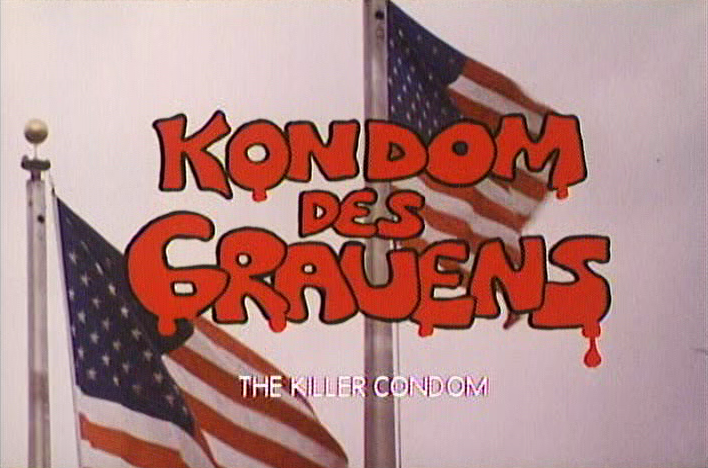
When I first saw the German homophile horror-comedy Killer Condom (1996) Kondom des Grauens aka Condom of Horror directed by Martin Walz (one-time boyfriend of Teutonic scream queen Monika M. from Buttgereit’s NEKRomantik 2 and Schramm) way back in middle school, I had no idea what the hell I just watched, but I was at least able to realize it was one of the most unrelentingly campy castration-anxiety-driven comedies ever made, so naturally the comicality of carnivorous contraceptives has grown on me as the years have passed, especially considering more personal disdain for schnitzel sheaths as they make sex superlatively less satisfying. Based on the comic book of the same name by popular kraut comic book creator Ralf König, Killer Condom is not as idiotic of a film as one would expect judging by its brazen, b-monster movie inspired name, as it is essentially a quasi-anti-American pro-fag flick that makes for more entertaining viewing when one learns to ignore its innately insipid and asinine political subtext and pro-poofter propaganda. A sharp satire of sodomite society and the large segment of mainstream America that despises it, as well as an intrepid tribute to classic 42nd Street exploitation films, Killer Condom is like an Andy Milligan movie on Viagra and a work that does for condoms, seedy hotels, and perverts what Street Trash (1987) did for cheap wine, wanton winos, and derelict liquor stores. Featuring special-effects (i.e. the killers condoms and cut-off cocks) by aberrant Aryan arthouse auteur Jörg Buttgereit (Nekromantik, Der Todesking) and a contribution from Swiss sick sensual-surrealist H.R. Giger as a “creative consultant,” Killer Condom is like a deranged cinephile’s dream and to some extent it is, albeit with brazen buffoonery and ball-biting buggery being more prevalent than sexual sadism and sicko special effects. Centering around a patently pessimistic NYC police detective named Luigi Macaroni (Udo Samel) who hates his city just as much as he loves young Adonis-like twinks, Killer Condom follows the butch, bear-like cop-sucking cop as he searches for the source of the carnivorous condoms that chomped one of his testicles off. Featuring a number of respected and serious German actors, including Ralf Wolter (Cabaret, A Love in Germany), Iris Berben (who was once on the cover of "Time" magazine as one of 36 "European heroes 2003"), Otto Sanders (Das Boot, Wings of Desire), Evelyn Künneke (Fox and His Friends, Flaming Hearts), Henning Schlüter (Ludwig, The Tin Drum), and Gerd Wameling (Faraway, So Close!, Stille Nacht), among various others, as well as German cult stars like Daktari Lorenz (the star of Buttgereit’s Nekromantik), Florian Koerner von Gustorf (film producer and star of Buttgereit’s Schramm), hack German-Jewish director Dani Levy (Meschugge, My Führer – The Really Truest Truth about Adolf Hitler) and members of the industrial group Einstürzende Neubauten, Killer Condom is a loony libertine hodgepodge of high and low brow kraut kultur in a strikingly sardonic and scatological form. Utilizing the much cherished Hollywood tradition of disregarding a nation’s official language, Killer Condom features a terribly trashy Teutonized Big Apple (most of the inside scenes were filmed in studios in Germany) where even naughty Negroes and hunk hustler’s speak Deutsch. 


 Ever since the day misanthropic detective Luigi Macaroni (Udo Samel) left his family farm in Sicilian, life has been nothing but bitter debilitating disappointment, monotonous misery, and pathological fudge-packing. As someone who describes his city as follows, “The streets are a stinking cesspool, a playground for perverts. Even goods girls from Oklahoma end up biting off some guy’s dick. As a cop you lose touch with reality. You see nothing but filth and scum,” one would think Macaroni is a parody of some bitter and deranged cop played by Harvey Keitel à la Copkiller (1983) and Bad Lieutenant (1992), and to a certain extent he is, but he also shares some qualities with Rainer Werner Fassbinder’s character Jansen from Kamikaze 89 (1982), except actually gay as opposed to just an overweight cock-sucking cop who jogs around in a leopard-printed suit. On top of having to deal with slimy criminals, Macaroni is constantly by his ex-beau Babette/Bob (Leonard Lansink); a hysterical cop-turned-tranny and menacing mental case who seems to be a parody of Erwin/Elvira Weishaupt from Fassbinder’s masterpiece’s In a Year of 13 Moons (1978). Things seem to be looking up for Macaroni when he meets a teenage twink hustler named Billy (Marc Richter) and the young man seems especially interested in the cop because he has a 32-centimeter (approximately 12.5 inches) cock, but their first attempt at hot hotel room sodomy is cut short when a killer condom bites one of the man in blues balls off. Of course, Macaroni is not the first and certainly not the last to have his member dismembered by ruthless, renegade rubbers. As a man who proudly comes from, “an ancient Sicilian family,” Macaroni vehemently declares to his uppity Negro Chief of Police (Ron Williams) that, “Nobody bites off a Macaroni’s jewels and gets away with it,” and being a wild wop of limited self-control, the decidedly dedicated man makes good on his word and searches every rotten corner of NYC to uncover the cacodemonic creator of the killer condoms. While his fellow police find his claims of cut-throat condoms to be dubious, Macaroni’s campaign against killer condoms becomes national news when a presidential candidate named McGouvern (Georg-Martin Bode) has his boner bit off by the sexual-organ-severing sheaths, thus resulting in the newspaper headline “dickless dick.” After following a couple leads, Macaroni discovers that a crazed and clearly sexually repressed woman named Frau Dr. Riffleson (Iris Berben) has a genius, albeit senile scientist named Professor Boris Smirnoff (Ralf Wolter) creating the Trojan with teeth in a subterranean lair hidden under an altar in a church. A holier-than-thou bitch who hates whores and homos, hence her perverse proclivity towards killer condoms, fierce Frau Riffleson pays Smirnoff in red jelly to design and create lethal latex. Needless to say, Macaroni deals with the anti-fag hag in a manner any honorable homo cop would. 


 Featuring a lame LGBT-style speech of poofer preaching at the conclusion of the film that is almost as embarrassing as Charlie Chaplin’s at the conclusion of The Great Dictator (1940), Killer Condom is at its best when using sickening scat humor and at an ultimate low in bad taste and entertainment when it turns into a grotesque celluloid campaign for gay rights. A nauseating bit of Negrophilia was also added to Killer Condom in the foul form of the Fugees’s "Killing Me Softly" being sung by drag queen Babette in a blatantly out-of-sync manner, but then again, such aesthetically disgusting noise probably makes for the perfect music film about pricks being pierced prophylactics. Indubitably, a high mark in cinematic eunuch entertainment, Killer Condom is a positively penetrating reminder why krauts only become the kings of comedy when dealing with castration, masculine trannies, racial stereotypes, and just about any sort of sexual perversion. Oddly, the New York City of Killer Condom bears a striking resemblance to Weimar Republic Berlin, thus showing a certain kinship of sexual degeneracy. As director Martin Walz and special effects mastermind Jörg Buttgereit have revealed (mainly on the audio commentary for the American Troma distributed dvd), many of the more bloody and offensive scenes of Killer Condom, including a scene of a condom spitting out a dismembered cock and a magical detached penis throbbing in a pretty prostitute's hand, were cut while a contrived 10-minute rant by well-known German actress Iris Berben (playing Frau Dr. Riffleson) was highlighted so that the film would be more marketable due to the actress’ popularity, but it was also in vain because despite having a large publicity campaign, including a full-color magazine, clothing and apparel, and novelty condoms, the film both failed to recoup its cost and was somewhat of a critical failure. Needless to say, Killer Condom could benefit from receiving an ‘uncut’ director’s cut where the scenes of detached dicks and pernicious prophylactics are reattached and certain ghastly and grotesque gay preaching is cinematically castrated. Described as a mere “dialogue comedy” by director Martin Walz, Killer Condom is evidence enough that even krauts make better postmodern scat comedies than philistine Hollywood heeb directors like Jason Friedberg and Aaron Seltzer.  Indeed, while Melvin James Kaminsky owes his success to cinematically satirizing boorish Germans, one must give credit to the makers of Killer Condom for shitting on the Italo-Semitico-Mongoloid muddied mystery meat third-world cesspool that is NYC.


-Ty E

Thursday, March 7, 2013

Alpha City


 Aside from possibly the killer and kitschy, kraftwerk-esque teen ‘horror’ flick Der Fan (1982) aka The Fan aka Trance, Alpha City (1985) aka ALPHACITY - ABGERECHNET WIRD NACHTS is undoubtedly anti-Neuer Deutscher Film/anti-intellectual German auteur Eckhart Schmidt’s most popular and commercially successful work. Although set in seedy and synthesizer-driven Berlin of some ostensible near-future, Schmidt himself has described Alpha City as being not a “Berlin movie,” as even Berliners had no idea where the film was set when it first premiered. In fact, very little about Alpha City is distinctly “German” aside from the musical score because despite being a 100% Teutonic production and its rather passionate romanticism, as the film was shot without sound and later dubbed in both English and German during post-production. A film about two men who fall in love with the same woman, one American and the other German, Alpha City also goes against expectations in that the American character (Al Corley, who being quite a popular New Wave musician in Europe at that time, also contributed to a good portion of the film’s musical score) looks totally Nordic and German, while the Berlin woman (Isabelle Willer) and her crazy kraut male lover (Claude-Oliver Rudolph) look totally Mediterranean as if they were the stars of some c-grade giallo flick from the same era. A traditional and no bullshit kind of guy, Schmidt created a very literal title for “Alpha City” as it is about two very different types of Alpha males who agree that the kraut metropolis is not big enough for the both of them, so the two duel it out with one another until one (or possibly both) of them is dead. As Hans Schifferle, the editor of the popular German newspaper Süddeutsche Zeitung, wrote in his article Cinema of Passion: A Portrait of Eckhart Schmidt, “Alexander Kluge once gave us a wonderful characterization of Schmidt’s film themes: referring to his wild love films, Kluge said that desire might be called a refined cannibalism. But Schmidt does not only have one theme: above all, he has a specific way of looking at the world, entering into the finest details. His style, with its tendency toward the extreme and an attractive desire for speculation, is characterized by a preference for ritual, style and ceremony over crude, theatrical “psychologizing“. He attempts to discover the secret from the surface, to recognize the truth in a moment.” Indeed, while Alpha City might be a convention-driven neo-noirish postmodern “Western” minus the cowboys and Indians and set in a New Wave, semi-futuristic sort of dystopian Deutschland, Schmidt does not share a trait typical of his Hollywood influences of pandering to his audience by opting for including a contrived optimism with a neatly packaged happy ending. Indeed, Alpha City could be described as a neo-romantic work, but one where coldblooded killers, prostitutes, and mentally defective piano players are hopelessly trying to consummate love in a wildly wanton world of innate destruction, moral corruption, and all-around cultural chaos. 


 Opening with footage of ghetto anarchist and piano player Frank (Claude-Oliver Rudolph) – a tall, dark, and handsome man with grotesque scars all over his chest – performing cunnilingus on a relatively bitchy prostitute named Raphaela (Isabelle Willer), Alpha City immediately establishes a mood of lechery over love and the female overpowering the male. A woman that makes her living peddling her flesh to perverts of the mostly posh and powerful sort a number of times a night, Raphaela does not seem like the sort of woman who is looking for a permanent beau, but Frank is about to try and change that or at least die trying. Described as a ‘man-eater’ by those that know her, Raphaela does not even bother to consummate coitus with Frank after her lily is lovingly licked until she reaches orgasm via the man that loves her. Despite (and probably because of) her lack of carnal reciprocation, Frank decides to follow Raphaela’s every ass-shaking move around the city and when he sees her in another man’s car, the perturbed proletarian piano player smashes it to pieces. After demanding that Raphaela get out of the car, an American gang leader (Al Corley, who aside from being a New Wave musician, is probably best known as the first actor to play Steven Carrington on the 1980s soap opera Dynasty) and his goons show up to see what all the commotion is about, thus ushering in the beginning of a brutal and bizarre love triangle that will end in belligerent and brazen bloodshed and bereavement. A lover and a fighter, Frank the tank manages to beat up and strike fear in virtually every high dollar John that has a ‘date’ with ravishing Raphaela, but one man, the American; a stoic yet bloodthirsty blond beast who has no problem murdering a couple dozen people in a night for mere monetary gain, manages to impress and undress the flesh-peddling femme fatale and, naturally, penetrates both her body and soul.  Frank, on the other hand, tells her himself, “I said I love you…I’d kill for you,” and indeed he would, but he also has no problem smacking Raphaela around when she runs her mouth too much, which she seems to rather enjoy, so it seems the American is dead wrong when he tells her she is, "not a masochist." As someone who admits, “I haven’t seen daylight in over two years,” Raphaela might be a bit delirious in her belief that she loves two men; one being a dilettante piano player who plays debauched clubs and illegal gambling halls and knows how to hit a woman and another who is a suave, albeit psychopathic, fellow who makes who makes a killing literally killing. Although enemies, there is a certain amount of respect between Frank and the American, as both seem to acknowledge one another’s “alpha” status in a world of banal beta bitches, but as they both agree, “There's not enough room for the two of us…there’s just no room,” thus a duel ensues at the fiery finale of Alpha City – one of only a handful of “New Romanticist” themed films with actual balls – where the two angst-addled anti-heroes and outlaws of love symbolically battle it out at the Berlin Olympiastadion; the site of the 1936 National Socialist Summer Olympics in a scene that Schmidt described as being shot from the "Führer perspective" (where Uncle Adolf sat and enjoyed the show). 


 As prostitute Raphaela states while standing on the roof of a Mercedes-Benz building, which was also featured prominently in an iconic scene from the West German cult classic Christiane F. – Wir Kinder vom Bahnhof Zoo (1981) directed by Uli Edel, with her freaky boy toy Frank, “Sometimes, I have this feeling that everybody down there, that all of them are working for me,” and, indeed, in a certain sense she is right. At the mere shake of her ass or accentuation of her ‘naughty bits,’ Raphaela can put any man under her spell, including two intrinsically individualistic Alpha types who answer to no one but themselves, at least until a certain saucy and sensual lady enters their lives and changes it forever. Indeed, Alpha City – a seductive yet savage cinematic work directed by a proudly untamed auteur who once famously admittedly, ”I would rather film a naked girl than a discussion of problems“ – is the sort of film both estrogen-deprived feminists and testosterone-deprived “pick-up artists” love to hate as it exaggerates the true source of ‘women’s power’ to the point of being quite preposterous yet positively penetrating, hence one of the film’s greatest appeals: its unwavering celebration of outmoded archetypes. A modern day Western/film noir hybrid for those that cannot stomach mute cowboys seeming to suffer from constipation and maniac midget gangsters with Yiddish NYC accents, as well as those who prefer sythnpop over cockrock, Alpha City is no movie masterpiece, but it tells a rather timeless tale in a stylish, new dark romanticist sort of way. While his other hit cult films Der Fan (1982) and Loft (1985) are rather original in their shocking pseudo-arthouse aberrancy, Alpha City borrows aesthetic ingredients from both of these films, but tries to tell a rather conventional, albeit completely corrupted, cinematic love story that concludes in a less than comforting manner that reminds one why Hollywood is run by odious and ostentatious optimism-peddlers as opposed to actual humanbeings. Of course, with unintentionally hilarious one-liners like, “I’ve always wanted to shoot the piano player” and “I didn’t murder him. I just helped him to commit suicide,” among countless other curious quotes, Alpha City proves that America was not the only place where rampant materialism sired absurdist melodramatics in movies, but unlike eternal juvenile John Hughes, Eckhart Schmidt had no problem admitting he had testicles and tireless Teutonic ones at that! 


-Ty E