Thursday, September 5, 2013
The Wicker Man (1973)
Probably most favorably described by Film magazine Cinefantastique as being “The Citizen Kane of horror movies,” The Wicker Man (1973) directed by British screenwriter/director Robin Hardy (The Fantasist, The Wicker Tree) is certainly deserving out its reputation as not only one of the best and most imaginatively idiosyncratic 'horror' films ever made, but also one of the best British films ever made period. A sort of thematically and aesthetically audacious anti-Hammer horror flick in its featuring of Hammer icons Christopher Lee and Ingrid Pitt but focusing on themes of old school Celtic paganism as opposed to the sterile old Semite religion of Christianity, The Wicker Man essentially created a new spiritual and cultural cinematic universe as a work that most specifically focuses on pagan sacrifice to the sun-god in a menacing yet mystifying manner that does not resort to Judeo-Christian finger-pointing and pseudo-spiritual mumbo jumbo of the conspicuously contrived New-Age sort. Adapted from the little known David Pinner novel Ritual (1967), which was originally intended as a film treatment for an unrealized work directed by Michael Winner (but was ultimately turned into a novel when Winner declined), The Wicker Man eventually began to evolve into a film when screenwriter Anthony Shaffer (who previously penned Hitchcock’s Frenzy (1972)) and actor Christopher Lee paid Pinner £15,000 (a little over $23,400) for the rights to the novel. Dropping virtually all of the comedic nuances of Pinner’s novel, Shaffer ultimately only used Ritual as a loose basis for the script for The Wicker Man and only came to find the major theme of the film when he “finally hit upon the abstract concept of sacrifice,” which eventually ripened into the iconic wooden ‘wicker man’ statue, hence the film’s title. Spawned from a single sentence in Julius Caesar’s Commentarii de Bello Gallico aka Commentaries on the Gallic War regarding his account of Celtic pagan Druids using towering wicker human-shaped statues for the purpose of human sacrifice by burning it in effigy, the wicker man became arguably the most important ingredient in The Wicker Man, but luckily screenwriter Shaffer, who was ironically Jewish (or not ironic considering the less than flattering depiction of self-flagellating Christ worship in the film), became obsessed with all things Euro-pagan and did meticulous research for the film, utilizing the groundbreaking work The Golden Bough: A Study in Magic and Religion (1890) by the Scottish anthropologist Sir James George Frazer as one of his most imperative frames of references. With the reasonably objective research and screenplay by Shaffer, director Robin Hardy was able to assemble one of the most hypnotic, culturally keen, and aesthetically pleasing pieces of celluloid heathenism ever made via The Wicker Man, a celestial and naturally kaleidoscopic cinematic work that manages to cinematically reintroduce the religion of the old Occidental world through the much maligned and oftentimes awfully artless horror genre. Probably the only film to make neo-paganism seem rather romantic and not the simply the delusional make-believe hobby of morbidly obese fanboy degenerates with bad skin who mistake their lack of self-control in regard to eating and sexual fetishism as a religion, The Wicker Man also happens to be the best film ever made about an unwitting fool who is chosen to be king for a day.
Sergeant Neil Howie (Edward Woodward) is a stoic and deeply religious middle-aged Christian who views everything in the world through a narrow Christ lens. When Howie receives an anonymous letter requesting that he go to the Scottish island Summerisle—a remote and quaint but wild and wonderfully scenic Scottish Hebridean island best known for its production of fruit despite its dead volcanic soil—to research the mysterious disappearance of a 12-year-old girl named Rowan Morrison (Gerry Cowper), who apparently disappeared a couple months ago, the lone and seemingly rather lonely cop personally flies there, not realizing that anti-Christ horndog heathenism awaits him there. Upon arriving on the island, Howie instantly realizes there is something off-putting and innately alien about the Summerisle residents, especially considering that no one, not even the girl’s own culinary artist mother, seems interested in answering his questions and finding little Rowan Morrison. When taking residence in a bar/inn aptly titled The Green Man Inn run by an exceedingly effete fellow named Alder MacGregor (mime/actor Lindsay Kemp) and his voluptuous and beauteous nymphet daughter Willow (Swedish actress Britt Ekland), he learns that the funny folks of Summerisle do not just enjoy getting drunk and jolly like the average Scotsman, but also having mass orgies in graveyards and grinding their genitals against tombstones. On his first night in the inn, Howie has a rather hard time controlling himself as wanton Willow attempts to seduce him with an orgasmic song and sensuality, but being a man who should have lost his virginity decades ago, he manages to maintain his cool and save his seed. The next day, Howie walks in on the local school teacher Miss Rose (Diane Cilento) stating to her preteen girl class regarding the maypole, “The phallic symbol. That is correct. It is the image of the penis, which is venerated in religions such as ours, as symbolizing the generative force in nature.” Naturally, Howie finally realizes that Summerisle is a proudly 'perverse', penis-worshiping pagan island where Christianity has been discarded like a putrid pair of feces-stained underwear, fresh young girls dance unclad around phallic poles for fertility rituals whilst dreaming of spawning sons and daughters, and graveyards feature dried up umbilical cords hanging from trees and headstones are inscribed with such salacious prayers as “protected by the ejaculation of serpents.” After discovering a tree (navel skin and all) where Rowan Morrison’s corpse is ostensibly buried, Howie pays a visit to a certain Laird (aka Lord) Summerisle (Christopher Lee), who has apparently been expecting the humorless cop. Seemingly holding nothing back, Lord Summerisle tells Howie about the history of the island and how his spiritually progressive Victorian scientist grandfather not only developed new strains of fruit that could survive and thrive in Scotland’s brutal climate and volcanic soil, but also introduced the local peasant populous to the old Celtic gods, which the conservative cop finds rather unsettling, but at least the lord grants him the authority to exhume Rowan Morrison's grave. Instead of finding a preteen female corpse, however, Howie is agitated to find a gutted bunny rabbit, which he takes by Lord Summerisle's estate and flings at the neo-Victorian pagan gentleman, accusing him of murdering Rowan Morrison in some bizarre pagan sacrifice.
After researching some documents and photographs regarding the previous year’s harvest and learning the crops—the only source of the island’s income—had failed, Howie comes to the natural conclusion that Rowan Morrison is very likely still alive and that the pagan islanders plan to sacrifice her at the annual May Day celebrations so as to ensure a fruitful harvest for the following year. While Howie plans to leave on May Day so he can get more cops and bust the heathens of Summerisle, someone has sabotaged his plane, which fails to take off, so being forced to stay on the island with time of the essence, he decides to look for Rowan Morrison all by his lonesome. After knocking innkeeper MacGregor unconscious and stealing his costume, Howie goes incognito by dressing as “Punch”, a central character in the May Day festival. Howie joins up with the rest of the islanders, who are also in costume, and manages to pass off the charade of portraying Punch, even becoming involved in eroticized but ultimately benign sacrifices to pagan gods, but he makes the fatal mistake of blowing his cover when Rowan Morrison is revealed tied to a pole. Quite the dashing hero with a softspot for virginal preteens, Howie knocks out one of the islanders and manages to free Rowan, but she leads him into a well orchestrated trap by taking him through a cave where Lord Summerisle and his merry minions are waiting for him on the other side. Lord Summerisle reveals to Howie that he, being a virginal man who came of his own free will with the authority of the king as a representative of the law, is merely a specially picked pawn in a pagan game and that the entire story of Rowan Morrison being missing was merely a pretense to get him to come to the island. While Howie was right that the Lord Summerisle and his Celtic compatriots were planning to make a human sacrifice for May Day in the hope that the coming year’s harvest would be a success, it is he and not Rowan Morrison that will be sacrificed to the sun in a scenario where the “hunter is hunted.” As Miss Rose tells the petrified officer, “You are the fool, Mr. Howie…Punch, one of the great fool-victims of history. For you have accepted the role of king for a day. And who but a fool would do that? But you will be revered and anointed as a king.” Since Howie ostensibly came of his own free will, is a mature virgin, and has “the power of a king - representing the law,” he apparently makes for a distinctly outstanding sacrificial offering to the gods and the best spiritual hope Summerisle has for having a fruitful harvest. Howie essentially tells the Summerisle residents that they are madly superstitious and the crops merely failed because they were not meant to grow on such a cold and infertile island, but they pay him no mind, strip off his clothes, cover him in a special monk-like ceremonial robe, and march him up a cliff with his hands behind his back where the wicker man stands. Totally petrified by the mammoth wicker statue standing before him, which also has various farm animals imprisoned in it, Howie is carried up and locked in the wicker man, where he will ultimately have the rare and dignified honor of dying a ‘martyrs death.’ After setting the statue ablaze, the pagans sing the medieval English folk-song “Sumer Is Icumen In” while Howie denounces them by self-righteously proclaiming that the Christian god has punished them for the past failed harvest due to the pagan faith and innately deceitful ways. As the wicker man burns, Howie recites “Psalm 23” from the Old Testament and prays to God to not forget him and to save a place for him in heaven. As the wicker man crumbles in flames, taking Howie with it, the final shot of The Wicker Man zooms into the sun that looks over the pagan people as the true harvester of all people and all life. In the end, the pagan cycle of death and rebirth is complete.
Made in the wake of the the popular hippie and counter-culture movements of the late-1960s where certain ‘enlightened’ individuals hanged up their rosaries and crucifixes and traded them in for New Age mumbo jumbo, including warped and water downed ‘feel good’ forms of neo-paganism and so-called ‘eclectic paganism,’ The Wicker Man is assuredly a spiritual slap in the face to posturing occultnik dilettantes and smug bourgeois bookstore witches who thought that by adopting minor elements and rituals of the ancient, more sex and nature friendly religions and disregarding the more unflattering elements of said religions that they could rationalize their self-absorbed hedonism and seem totally cool, chic, and enlightened while doing it. In a reasonably objective manner, The Wicker Man portrays the good, the bad, and the ugly of Celtic paganism without resorting to hocus pocus puffery, ridiculous romanticism, cliché Christian condemnation, or plastic parody, and for that reason alone, the film deserves a special place in cinema history. The only film ever made that is part folk musical, part Celtic völkisch flick, part celluloid ‘game’ and pseudo-murder mystery, part pagan parable, and part high-class intellectual horror show, The Wicker Man is nothing short of an ideally idiosyncratic cinema masterpiece that makes for a ‘magical’ marriage between arthouse and mainstream cinema.
Rather unfortunately and cinematically sacrilegiously, a feminist-fueled American remake of The Wicker Man starring Nicholas Cage was released in 2006, but thankfully even the most bottom of the barrel rabble among horror fans found the film to be nothing short of a patently pointless celluloid abortion. Undoubtedly, even more aesthetically tragic, The Wicker Man director Robin Hardly somewhat recently released a so called “spiritual sequel” entitled The Wicker Tree (2011) that I would even go as far as arguing is worse than the patently pathetic 2006 remake. At best, The Wicker Tree seems like a philistine-friendly parody of the original The Wicker Man directed by a man trying to cash in on the legacy of an unrivaled cinematic masterpiece he directed almost four decades earlier. Based on director Hardy’s own 2006 novel Cowboys for Christ: On May Day, The Wicker Tree depicts the ‘absurdity’ that occurs when a group of god-bothering redneck Texan Christian fundamentalists led by a revolting pop singer make the unwitting mistake of travelling to Scotland and attempting to convert heathens who worship the goddess Sulis. While centering on the theme of a metaphysical/physical clash between nature-worshipping paganism and nature-cuckolding Christianity like The Wicker Man, The Wicker Tree shamelessly wallows in cheap and tasteless sex, embarrassing pseudo-kosher comic relief, superficial and superlatively soulless social commentary, and an absolutely asinine aesthetic package that is a total insult to the original 1973 film. Apparently when discussing the mixed reviews The Wicker Tree received, director Hardy attempted to defend the film by stating, “The New York Times’s reviewer said it wasn't as gritty as the original Wicker Man, but it's a thousand times better than the remake. I was quite happy with that,” but when asked whether he preferred the original 1973 or the “spiritual sequel,” the only thing he could say was, “No, I really don't.” Of course, Hardy is not fooling anyone, not even himself. To further taint the legacy of The Wicker Man, Hardy is working on a third film entitled The Wrath of the Gods (2015), which will act as the concluding chapter of a totally pointless ‘The Wicker Man Trilogy.’ Apparently a ‘romantic black comedy” based on Twilight of the Gods aka Götterdämmerung, the final part of Richard Wagner's four cycle epic opera Der Ring des Nibelungen aka The Ring of the Nibelung where “the gods get their comeuppance,” The Wrath of the Gods will be primarily set in the Shetland Islands (though originally set in Iceland) and focus on Norse mythology. While I cannot say anything good about the 2006 remake nor the 2011 ‘spiritual sequel,’ the neofolk outfit Nature And Organisation led by British musician Michael Cashmore did an excellent cover (featuring Scottish singer Rose McDowall of Strawberry Switchblade on vocals) of the song “Willow's Song” featured in The Wicker Man written by Paul Giovanni (and sung by Annie Ross) for their album Beauty Reaps The Blood Of Solitude (1994), renaming the song simply, “Wicker Man Song.” While “Willow's Song” is undoubtedly my favorite song from The Wicker Man, American composer Paul Giovanni, who died from AIDS-related causes in 1990 at the mere age of 57, did an exquisite job with the entire soundtrack, thereupon adding an extra layer to the film's foreboding folkish atmosphere.
Only vaguely a horror flick (and almost insulting and certainly misleading to describe it as such!), The Wicker Man is nothing short of an amazingly thrilling and titillating piece of celluloid spiritual atavism featuring a charmingly curious esoteric realm that seems like a utopia to some viewers and an unhinged nightmare to others. Despites it Semitic screenwriter, The Wicker Man is as unflinchingly Northern European as films come and a piece of (for some perturbing) purity that reminds one how the world has decidedly degenerated since the abandoning of native paganism, adopting the Judaic desert religion of Christianity, and starting a worldwide campaign against nature. Featuring a practical execution of ideas not unlike those espoused by back-to-nature groups like the German Wandervogel groups, whose ideas were inevitably adopted by the National Socialists in various forms, The Wicker Man is probably most ‘horrifying’ today in that it makes spiritual blasphemy and sacrificing a virginal Christian cop once a year a small price to pay for living in a truly organic folk community with natural values as opposed to living in the culturally/racially mongrelized and spiritually sick ‘multicultural’ mainstream where sex and life are meaningless, everything has a price but no value, and an innate and all-encompassing ugliness pervades every aspect of life. A film where not only the protagonist, but also the viewer, is made a fool and king for a day via a mystifying metaphysical murder located on a breathtaking and beautiful island paradise populated by beauteous yet brutal people, The Wicker Man is the closest thing ever made to a Celtic pagan spiritual journey in celluloid form. On top of that, The Wicker Man is also the only film that has the grand distinction of featuring Sir Christopher Lee as a megalomaniac cult leader in völkisch drag in a role, performance, and film that the actor himself would declare the best of his career, which, I, for one, concur with as both a hater of Hammer horror and The Lord of the Rings film trilogy (2001–2003), but also as a fan of both horror and arthouse cinema. Indeed, The Wicker Man is probably the only quasi-musical ever made where one does not feel like they have been raped by a gang of rabid trannies after watching it, but more importantly, it is also one of the most chillingly charming and wickedly bewitching depictions of celluloid blasphemy and spiritual cuckoldry ever made.
-Ty E
By
soil
at
September 05, 2013
2
comments
Wednesday, September 4, 2013
Nosferatu the Vampyre
The German expressionist masterpiece Nosferatu, eine Symphonie des Grauens (1922) aka Nosferatu: A Symphony of Horror directed by F.W. Murnau will always remain permanently impressed upon my soul, not least of all because it was both the first silent film and first German film I had ever seen, but also because the film features what I consider to be the most physically grotesque yet strikingly iconic creature in film history. Needless to say, the idea of a remake of Nosferatu sounded like an interesting yet ridiculous prospect to me when I first came to this realization after seeing Murnau’s film while still just a preteen, even if the film itself was illegally adapted from Bram Stoker's gothic horror masterpiece Dracula (1897) and has been adapted in various, less impressive, and oftentimes more ridiculous forms from the blaxploitation Blacula (1972) to Paul Morrissey’s anti-communist satire Blood for Dracula (1974), yet the Bavarian filmmaker belonging to German New Cinema by the name of Werner Herzog (Even Dwarfs Started Small, Stroszek) managed to breath new life into the classic undead German expressionist flick. Indeed, Werner Herzog's version, entitled Nosferatu the Vampyre (1979) aka Nosferatu: Phantom der Nacht aka Nosferatu: Phantom of the Night, is not so much a remake of Murnau’s Nosferatu as it is an idiosyncratic adaption and tribute, or as the crazy old Southern kraut stated himself, “I never thought of my film Nosferatu as being a remake. It stands on its own feet as an entirely new version. It is like both Dreyer and Bresson, who made films about Joan of Arc: one is not a remake of the other. My nosferatu has a different context, different figures and a somewhat different story. It is a very clear declaration of my connection to the very best of German cinema…” And, indeed, Nosferatu the Vampyre—a work released more than half a century after Murnau’s version—is the closest thing to a postmodern neo-völkisch horror flick that, unlike most of the films and filmmakers of German New Cinema, takes pride in its cinematic ancestral heritage, whilst adding new ingredients, including krautrock music by Herzog favorite Popol Vuh, a perversely post-Spenglerian message that makes Nosferatu (1922) seem like a feel-good fairytale, and actors of mixed Germanic racial stock, including Klaus Kinski (of Polish descent via his father), Isabelle Adjani (of Algerian and Bavarian blood), and Bruno Granz (of German-Swiss and Northern Italian stock). As Herzog stated in an interview, “I have said many times that as children growing up in post-war Germany we had grandfathers but no fathers to learn from. Many men had been killed in the war or were in captivity. My own father was alive but not around for much of the time, and Fassbinder’s father abandoned his family very early on. As filmmakers coming of age in the early and mid-1960s, we were the first real post-war generation, young Germans with no one around who could give us points of reference,” thus he looked toward the grandfather generation, which was led by F.W. Murnau and Fritz Lang, deciding to cinematically adapt the former’s most popular film Nosferatu (1922), stating of the work, “For me, Nosferatu is the greatest of all German films, and feeling as strongly as I did that I needed to connect to this ‘legitimate’ German culture in order to find my roots as a filmmaker, I chose to concentrate on Murnau’s masterpiece, knowing full well it would be impossible to better the original.” Indeed, while I concur with Herzog that no one could top Murnau’s Nosferatu, it is hard to think of a ‘remake’ as respectful to the original while also authentic in its own right, yet immaculately tailored for the post-Hitler zeitgeist where there are no happy endings, but only the strangely hypnotic stench of death and destruction.
Beginning with eerie footage of real-life mummies on display at the Guanajuato museum in Guanajuato, Mexico that were victims of a 1833 cholera epidemic that director Werner Herzog personally took out of their glass display cases and propped against the wall, Nosferatu the Vampyre immediately establishes itself as a gorgeously grotesque work that unflinchingly wallows in death, decay, and madness. Set in Wismar, Germany (it was actually shot in Delft, Netherlands, but Herzog pays tribute to the original 1922 Murnau flick, if in name only, which was filmed in Wismar, though set in the fictional city of Wisborg), Nosferatu the Vampyre initially centers on the protagonist Jonathan Harker (Bruno Ganz), a gentlemanly real estate agent who loves his wife Lucy Harker (Isabelle Adjani) so much that he takes a dubious offer from his exceedingly eccentric boss Renfield (French-Jewish artist/writer Roland Topor, a founder of the Panic Movement) to travel eastward over the Carpathian mountains to Transylvania (although Herzog shot the scenes in what was then Czechoslovakia because the Ceaușescu regime prevent Herzog from filming in Romania proper) to meet with a seemingly nefarious nobleman named Count Dracula (Klaus Kinski) who wants to buy property in Wismar. Showing no inkling of fear for “wolves, bandits, and ghosts,” Harker makes his way east with his pack of deeds and documents that will be ostensibly used for Dracula to buy a house and on the way, the eager beaver estate agent stops at a village full of medieval-like gypsies, who warn him not to go to the Count’s apparently cursed castle. Indeed, it says a lot about a person and place when gypsies see it as horrifically evil, but Harker is no superstitious untermensch, so he makes his way to Count Dracula’s ruined yet lavishly decorated castle. Undoubtedly, Dracula—a pale as a ghost and greatly grotesque rodent-like being who seems perennially lonely and macabrely melancholy—makes Harker feel rather uneasy, especially after the Count sucks blood from his finger after the real estate agent cuts himself while eating, but luckily the aberrant aristocrat instantly decides to buy the home in Wismar, especially after realizing the Harkers will live next door (the Count seems especially interested after seeing a small portrait of the ethereal, lovely lady Lucy in Jonathan's locket). During the night, Harker suffers a number of perturbing phantasmagorical encounters with the Count, while simultaneously, all the way back in Wismar, Lucy is plagued by fierce and foreboding night terrors of the penetratingly prophetic fashion. When the sun rises, Harker goes to investigate around the Gothic castle and finds Count Dracula sleeping in a ruined coffin, thereupon confirming he is a vampire. Meanwhile, Renfield is unsurprisingly committed to a mental institution after biting a cow and attempting to attack a guard, all the while spouting nonsense like “blood is life” in between rampant bursts of maniacal laughter. At night, Count Dracula packs a bunch of black coffins with cursed dirt, rats, and himself and makes his way to Wismar via ship, thus siring in the pernicious plague that will ultimately obliterate the small Teutonic town.
Weakened by his stay at the horrifying home of the bloodsucking blueblood Dracula, Jonathan Harker feebly attempts to leave the castle but realizes he is locked in, so he creates a makeshift rope via bedsheets and attempts to climb out a window, but severely injures himself in the process, thus leading to the beginning of the end of his sanity. While sailing to Wismar, Dracula kills the entire crew of sailors manning the ship, making it seem as if the deaths are merely the result of the plague, but as the captain (Jacques Dufilho) notes regarding the dubious deaths in his ship log, “A rumor of a mysterious stranger on board scares everyone to death.” When the plagued ship of the dead finally arrives in Wismar with no one aboard aside from the corpse of the captain who has tied himself to the helm in a manner not unlike Stoker's source novel, Renfield announces from his cell that “the master has arrived” and a couple doctors, including vampire hunter Abraham Van Helsing (Walter Ladengast), decide to investigate the curious fate of the ghost ship, finding a ship-log in the process that reveals clues in regard to the dead sailors' fate. On top of bringing death in the form of Count ‘The Lord of the Rats’ Dracula, the ghost ship has also brought an ugly underground army of rodents that totally occupy Wismar, at which point darkness and destruction totally consume the town, killing virtually all of the unsuspecting inhabitants in no time. Meanwhile, Harker, who has a rather nightmarish stay in a Transylvania hospital, finally arrives in Wismar, but he is now deathly pale and his mind seems to have been replaced with that of a babbling old man with Alzheimer's disease. Seeming to suffer from amnesia, Harker no longer recognizes his wife Lucy, but Count Dracula certainly does and attempts to get some from the little lady, absurdly commanding to her, “Give me some of your love which you give Jonathan,” but she respectfully declines, stating, “I never will. I won’t even give that love to God,” for she is a woman that knows all too well the purity and faithfulness encompassed in true love, especially among soul mates such as herself and her now unfortunately brain-damaged hubby. Horrified by the Count’s sinister presence, Lucy suspects that Dracula might be involved with the deaths in Wismar and tries in vain to warn the townspeople, who pay her no mind as the mayor and all the government officials are dead and the rest of the people are more interested in burying the ostensibly diseased corpses and dining on fine wine in what they suspect to be their last feast as their very probable fate with the grim-reaper awaits. Probably the most selfless femme fatale who has ever lived, Lucy states to herself: “And if a pure hearted woman, diverts his attention from the cry of the cock…the first light of day will obliterate him” in regard to what she needs to do to rid the world of the vile vampyre. Making good on her statement, she lures Count Dracula into her bedroom and hopes to distract him until his undead immortality can be vanquished at dawn, but in the process, she sacrifices her own life when the creature drains her blood. Though dead, Lucy is victorious as the first beam of light of the day causes Count Dracula to collapse to his death and not long after, Van Helsing drives a stake through his cold black heart just to make sure atrocious aristocrat is dead. On his way out of the house, Van Helsing is stopped by Jonathan Harker, who has the good doctor arrested. Jonathan Harker is now a vampire himself, stating to himself “I have much to do. Now!” and leaves Wismar in a hasty manner on horseback to assumedly continue his master and maker Count Dracula’s work.
Rather ironically, out of all the films I have ever seen featuring Klaus Kinski, never has the infamously lunatic actor appear so subdued, sensitive, and sympathetic as his role in Nosferatu the Vampyre, even if it is portraying a ghastly bloodsucking humanoid parasite who resembles a rat-like death camp survivor, as it seems the sadistic star, who was indubitably a 'psychic vampire' in real-life, felt right at home as a conspiring creature of the night who drains people of their vital fluid at their most vulnerable moments. That being said, what largely thematically differentiates Herzog’s Nosferatu from Murnau’s original 1922 film is that Nosferatu the Vampyre ‘humanizes’ the vampire, portraying him as not merely soulless and insensitive but as an accursed walking corpse of sorts who, as he states himself, suffers in the following manner, “Time is an abyss... profound as a thousand nights... Centuries come and go... To be unable to grow old is terrible... Death is not the worst... Can you imagine enduring centuries, experiencing each day the same futilities?..” and is naturally willing to do anything to overcome his undying loneliness as an ancient aristocrat who has not had sun and sex in centuries. At the same time, Nosferatu the Vampyre also shows how a good man, Jonathan Harker, can degenerate into a brutal beast of pure, pernicious evil, thereupon making Herzog’s work a more thematically intricate film that is ultimately fittingly updated and more reflective of our more nihilistic and uncertain times, where parasitic 'blood-sucking' behavior is a given in the innately materialistic and capitalistic Occident. Of course, more than anything and most importantly, Nosferatu the Vampyre is a grand aesthetic achievement that, in the rather seemingly simple form of a hallucinatory horror film, manages to combine the best elements of Teutonic art and culture from the past couple centuries or so, including the music of darkly romantic compositions of Richard Wagner and celestial krautrock outfit Popol Vuh, a seamlessly hybridized hodgepodge of cinematic ingredients from German expressionist and mountain films by the likes of Arnold Fanck and Leni Riefenstahl of the 1920s/30s, but also the anti-heimatfilm of German New Cinema (which Herzog himself previously contributed to with his work Heart of Glass (1976) aka Herz aus Glas), and ethereal landscapes scenes echoing the paintings of German romantic painter Caspar David Friedrich and the dark otherworldly völkisch mysticism of symbolist painters like Karl Wilhelm Diefenbach, so it should be no surprise that director Herzog stated of his objective with the film, “What I really sought to do was connect my Nosferatu with our true German cultural heritage, the silent films of the Weimar era and Murnau’s work in particular. If his Nosferatu is a genre film then mine inevitably is one too. In many ways, for me, this film was the final chapter of the vital process of ‘re-legitimization’ of German culture that had been going on for some years.”
Undoubtedly, one of the great ironies of the career of Werner Herzog—a filmmaker who has always blurred the line between fiction and nonfiction and documentary and narrative cinema, and rarely acknowledges genres—is that one of the greatest and most iconic, if not the most iconic, films of his career, Nosferatu the Vampyre is a classic horror genre flick, yet still manages to be pure Herzogian in its ominous oneiric yet rapturously romantic essence as a cinematic work that could have only been realized by a man with a deep connection to nature as a radical Bavarian peasant artist who would become one of the most important German filmmakers of the post-WWII era. Herzog's Nosferatu the Vampyre was followed up with an in-name-only sequel entitled Vampire in Venice (1988) aka Nosferatu a Venezia aka Nosferatu in Venice, which was also based on F.W. Murnau’s Noferatu and starred Klaus Kinski, but the Italian production went through many directors (producer Augusto Caminito took over after director Mario Caiano quit due to being rather tired of Kinski’s insults and belligerent behavior) and is ultimately a mess that is just as aesthetically troubled as the film’s production itself. Indeed, as he proved with not only Nosferatu the Vampyre, but also Aguirre, the Wrath of God (1972), Woyzeck (1979), Fitzcarraldo (1982), and Cobra Verde (1987), Herzog was the only one that had what it takes to tame the blond polack beast Kinski. Undoubtedly, with the obvious exception of Murnau’s Nosferatu, Nosferatu the Vampyre is indubitably the greatest cinematic adaption of Bram Stoker’s Dracula ever made, even making the immortally iconic Dracula (1931) directed by Tod Browning and starring Bela Lugosi seem rather tame, banal, and contrived by comparison, but especially exposing Bram Stoker's Dracula (1992) directed by Francis Ford Coppola for the phony and truly ‘soulless’ pseudo-Victorian joke that it is. In his rat-like appearance and propensity for bringing the 'plague' (Jews were blamed for poisoning wells and spreading the plague in medieval times) from the semi-Asiatic east, it is no surprise the film theorists time and time again have recognized Nosferatu/Dracula as a sort of Jewish figure, so it seems a great irony that a Hebraic Hollywood director was never able to concoct the ultimate Dracula flick, but rather two very different krauts did so instead. Of course, after Nosferatu the Vampyre, it seems pointless for anyone to attempt Stoker's Dracula ever again, especially considering the sorry state of German cinema today.
-Ty E
By
soil
at
September 04, 2013
0
comments
Tuesday, September 3, 2013
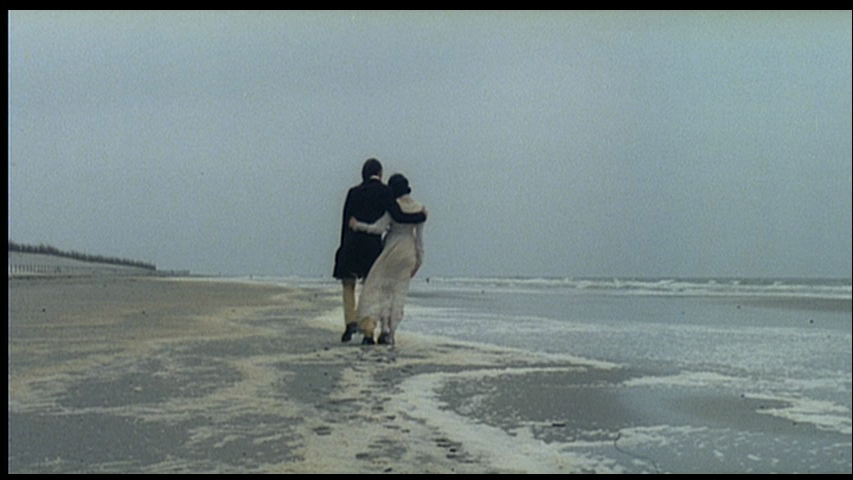
The Seventh Continent
As the years pass, I grow even more disillusioned with the films of Austrian auteur Michael Haneke (Funny Games, Amour) and cannot decide whether or not I hate his work more than I enjoy it, but, at the very least, his cinematic works—for better or worse—act as an ominous and foreboding expression of the (dead) Germanic soul and collective unconscious, which was already quite apparent in the filmmaker’s debut feature-length film The Seventh Continent (1989) aka Der siebente Kontinent. To be fair, Haneke already had worked in theatre and made a number of TV movies before his theatrical debut, yet one must admit that The Seventh Continent is a rare example of a novice filmmaker who had already developed a cinematic Weltanschauung for all his films to follow in his decided disdain for bourgeois life, condemnation of the Hollywoodization of Europa, acknowledgement of the existential crisis of the Faustian soul, and uniquely unsentimental and uncompromising depiction regarding the cultural, religious, and social stagnation of the world. Whereas the scatological subversives of Viennese Actionism made it their innately iconoclastic goal to destroy all traditional mores, culture, and religion of Austrian society, Michael Haneke’s works act as sort of minimalistic and materialistic postmodern postmortem celluloid autopsies of Austrian society, thus it is only fitting that the filmmaker’s first feature The Seventh Continent stagnantly chronicles the slow and grating suicide of a middle-class Austrian family. Taking its title from Australia—the seemingly luxurious and magical continent the ill-fated Austrian family lies about moving to in a letter (they opt for suicide instead)—The Seventh Continent is based on a true story that director Michael Haneke read about in the newspaper. An alarmingly audience-antagonistic film from its intentionally banal beginning to its quasi-anti-climatic climax, The Seventh Continent is essentially a paradoxically penetrating yet prosaic piece of anti-bourgeois aesthetic terrorism created by a self-loathing member of the bourgeois that was carefully crafted to infect the viewer with the same sort of metaphysical misery that eats away the film’s characters and, quite arguably, the director himself. A fundamentally anti-Hollywood work that acts as a sort of anti-escapism to the celluloid escapism of capitalistic culture-distorters like Steven Spielberg and even Quentin Tarantino, The Seventh Continent is essentially semi-abstract celluloid preaching without words that somewhat sadistically slaps the viewer across the face with the more than bitter and never sweet taste of reality, but never offers answers for the crisis of the modern Occidental world. The first chapter in Michael Haneke's “Glaciation Trilogy” (which was followed with Benny's Video (1992) and 71 Fragments of a Chronology of Chance (1994)), The Seventh Continent is nothing less than the first big statement by the filmmaker on the Austrian apocalypse, which was essentially prophesized by Austrian commie-feminist Jewess novelist/playwright Elfriede Jelinek and followed by associated filmmakers Franz Novotny (Exit... But No Panic, Die Ausgesperrten aka The Excluded), Paulus Manker (Schmutz aka Dirt, Weiningers Nacht aka Weininger's Last Night), Ulrich Seidl (Dog Days aka Hundstage, Import/Export), and Michael Glawogger (Slumming, Whores' Glory).
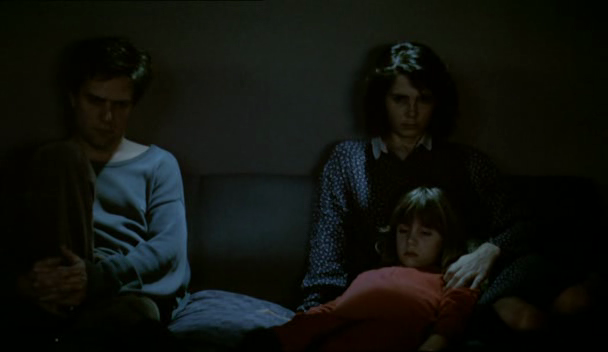
Divided into three chronological parts (1987, 1988, 1989), The Seventh Continent follows the slow burning and marvelously monotonous self-destruction of the Austrian middle-class Schober family from Linz comprised of a husband Georg (Dieter Berner), wife Anna (Birgit Doll) and young grade school daughter Evi (Leni Tanzer). By the end of the film, the entire family will be dead after the parents decide to kill their daughter—a brunette Heather O'Rourke-look-a-like—and subsequently themselves after existence becomes unbearable for these individuals suffering from sort of ungodly and all-consuming existential hell of no return. They may hate their lives but the Schobers are certainly not losers but an upstanding and seemingly normal middle-class family, as George is an engineer and Anna is an optician who co-owns an eye doctor business with her brother. Like most Haneke films, The Seventh Continent begins with a slow start where the viewer rarely gets a glance of the characters face for about the first 30 minutes of the film, only focusing on the banality and robotic-like nature of their devastatingly ordinary day-to-day lives, including riding through car washes (the very first scene in the film), brushing their teeth, making/eating breakfasting, doing homework and other daily rituals. The signs of familial meltdown are illustrated in minor moments of melodrama, including mother/wife Anna having an emotional breakdown while riding in a car through a carwash and daughter Evi lying to her teacher that she has randomly turned blind in what is undoubtedly a cry out for help to her optometrist mother that ultimately ends in further distancing and coldness between mother and daughter. After Anna learns about Evi’s lie, she confronts her daughter, asking her, “Look at me. Come on, tell me, did you pretend to be blind? Come on, tell me. I just want to know the truth. Come on. Don't be afraid, I won't hurt you. Is it true? Did you pretend to be blind?,” but when the little lady admits the truth, her mother maliciously smacks her in the face, thus further dividing the two. In another telling family moment, Anna’s brother Alexander (Udo Samel), who has previously stayed at a mental institution due to his debilitating depression, eats dinner with the family and, for seemingly no reason, begins to cry in what seems to be, aside from a cry out for help, an impotent expression of a man who knows something is not quite right with his sister’s family and feels totally powerless to help. Undoubtedly, powerlessness, impotency, and soullessness in the face of a contrived and seemingly pointless bourgeois existence ultimately seem the biggest contributing factors for the characters' inevitable self-designated date with death.
In the third segment of The Seventh Continent, which is set in 1989 and comprises the largest segment of the film, the Schober family leaves husband Georg’s parents' house and proceeds with the narration of a rather strange letter written by Georg the next day regarding him and his wife’s whimsical decision to quit their jobs, empty their bank accounts, sell their cars, and to ostensibly head to Australia to live a life of luxury. Of course, the letter is really a suicide letter and instead of going to Australia, the family eats a rather large feast in possible tribute to Marco Ferreri’s La Grande Bouffe (1973) and proceeds to destroy everything they have worked their entire lives to earn, including shredding all their records/LPs, smashing a large fish tank and killing the fish in the process, and flushing all their money down the toilet (including pocket change), thus demonstrating how all these material possessions were ultimately meaningless to them in the long run and that they could never fill the spiritual/emotional void that is a comfortable bourgeois life. Since daughter Evi admits to her parents that she is not afraid, the parents decide to end her life as well (although she does not take the killing of the family fish well), with Georg writing to his father in the suicide letter, “There’s only our little Eva left and we wondered for a long time if we’d take her with us or if it was better to leave her with you. As you can imagine, Mom, and certainly you too, dear Dad, our decision caused us both heartache and headaches because even though we’re sure of what’s best for us, it’s something else entirely to decide the fate of the one we love above all else….” While (symbolically?) watching a concert performance of Amero-Kraut-Jew Jennifer Rush’s “The Power of Love,” Evi’s parents feed her poison in a cup and the poor little girl states, “Dear Jesus, let me be a good girl so I can go to heaven” before she dies in a fashion not unlike that of the Goebbels children. After that, Anna kills herself the same way (ultimately going out with a death rattle) and fallen family man George follows, but scrawls on the wall names, date, and time of death of all three family members before he seals the deal on the family’s freakish collective self-slaughter. The Seventh Continent concludes with the following ‘post-game wrap up’: “The S. [Schober] family was found on January 17, 1989. Subsequent to a request from the wife's worried brother, the door of the apartment was knocked down. On February 20, the family was buried. In spite of the letter left for the parents, they refused to believe it was a suicide and filed a murder complaint against Parties Unknown. The police investigation following up on this suspicion was without results. The matter was filed as an unsolved case.”
In describing The Seventh Continent and his rationale for creating it, director Michael Haneke stated the following, “Every day we read stories about family tragedies. Every day families take pleasure in their alienation, contenting themselves with information and a life on the cheap. Every day they have less to decide about and hate themselves for their fear. Every day they suffer more from their lives. Every day many of them wear themselves out fighting this fact. Every day they speak less and laugh louder. Every day they become more perfect. Every day the gap widens between human beings. Every day they feel they need to make a decision in order to be able to breathe. This film is a chronicle, an account of these decisions. It does not intend to bear any judgment. It knows no answers. It questions the causes.” Indeed, luckily Haneke does not have any sort of outmoded Marxist answer, even if the ‘causes’ were probably similar to those that inspired West German students to rebel in 1968 and terrorism to become vogue not long after. Personally, I do not think Haneke is willing to accept why Austria, like much of Europe, has become such a culturally vapid and soulless place that inspires people to commit suicide because it would force the director accept the fact that Germanic national kultur, customs, and religion essentially ended in 1945. In the filmmaker’s later anti-Heimatfilm The White Ribbon (2009), Haneke stereotypically portrays a traditional religious Germanic upbringing as exceedingly evil, but such cultural ingredients were the things that made things worth living for people in the past. Like the Hollywood films and bourgeois culture Haneke cinematically condemns, the director’s films, not least of all The Seventh Continent, are lacking in soul and spirituality, thus making them every bit a symptom of the same degenerate cultural malaise, albeit minus the entertainment value.
-Ty E
By
soil
at
September 03, 2013
8
comments
Monday, September 2, 2013
Hunting Scenes from Bavaria
Like Hollywood with films like In the Heat of the Night (1967) and Deliverance (1972), German cinema of the late-1960s/early-1970s has its fair share of humorously hateful and cinematically libelous anti-redneck lynch mob flicks where rural southern folk persecute outsiders because their little itty bitty hick brains cannot handle being in the presence of weird folk, or at least that is what these films depict. In Germany, these films were described as anti-Heimatfilm/new Heimatfilm and are essentially a hysterical far-left/marxist reaction to the nationalistic Heimatfilm genre that was popular in Germanic countries like Germany, Switzerland and Austria from the late 1940s to the early 1970s and that depicted a sentimental and romantic view of peasant life, thereupon making these films cinematic poison for 'progressive' city folk and xenophiliac leftists. The first hit anti-Heimatfilm was Hunting Scenes from Bavaria (1969) aka Jagdszenen aus Niederbayern directed by Peter Fleischmann (Dorothea's Revenge, Hard to Be a God) in what would be the filmmaker's first feature-length film and adapted from a play written by Martin Sperr, who also plays the leading role in the film. Although chosen as West Germany's official submission to the 42nd Academy Awards for Best Foreign Language Film, Hunting Scenes from Bavaria did not receive a nomination for the award, but managed to earn two Bundesfilmpreise awards in 1969, including Filmband in Gold for Best Actor (Michael Strixner) and Filmband in Silber for Best Feature Film (Peter Fleischmann). Of course, considering it portrays Bavarians as barbarian untermensch bigots of the brazenly boorish and brutal beer-chugging sort, Hunting Scenes from Bavaria was not exactly popular with everyone in Germany, including the locals from the small village of Unholzing in Postau where the work was filmed, who apparently took a militant stance to the fact a leftist pro-fag/anti-redneck movie was being made in their hometown and denigrating the reputation of their tight community. As Fassbinder/German cinema scholar Thomas Elsaesser wrote in his book New German Cinema: A History (1989) regarding Hunting Scenes from Bavaria, “Like Katzelmacher, the film is less the portrait of an individual than the study of a community. It is comparable to a cruel Chabrolian picture of rural France, or to red-neck films about Appalachian hillbillies and Alabama sheriffs, and it recalls William Faulkner at least as much as it recalls Brecht.” And, indeed, Hunting Scenes from Bavaria is less a tribute to a victimized hillbilly homo than it is a pseudo-realist agitprop piece and a conspicuously callous and cynical condemnation of rural Southern German folk, who are unwaveringly depicted as nothing short of being Catholic-bred countryside cavemen who have the same hygienic standards and sexual appetites as the farm animals they slaughter. The story of a mild mannered and country-fried cocksucker who returns to the same village where he grew up and inevitably encounters hostile hatred from the people who he has known his entire life after they realize he is more homo than hick, Hunting Scenes from Bavaria lets the viewer know that the National Socialist ‘blood and soil’ is alive and well in bumfuck Bavaria as it is an innate part of the kraut country character that was there long before an Austrian peasant named Uncle Adolf came to town.
At the beginning of Hunting Scenes from Bavaria, the viewer is treated to a country Catholic church service where violent and bloody religious paintings are featured prominently, thereupon demonstrating the ostensible root for the Bavarian need to go hunting for homos and other unholy beings. After church, gay boy Abram (Martin Sperr) arrives at his hometown village via bus and everyone seems glad to see him except his mother Babara (Else Quecke), who will not even look him in the eye when he lovingly greets her because she seems to know something unsettling that the rest have yet to find out. Abram may be a fairy but he is a handyman of sorts whose repair talents are certainly needed in the town, even if the villagers find him a bit strange and passive. Abram is not the only misfit in town, along with the local whore Hannelore (German New Cinema darling Angela Winkler of The Lost Honour of Katharina Blum and Knife in the Head) who is constantly physically, verbally, and emotionally degraded by men who have no problem screwing her when no one is around. The local retard teenage Ernstl (Johann Lang) is also sometimes attacked, but he does most of the attacking, including pelting lumber at Hannelore and calling her a “whore.” The town also has a couple Turkish ‘guest workers’ who like describing the locals as ‘huns’ but, aside from being mocked for being Muslims and their lack of Catholic church going, are generally treated with respect and like the villagers and vice versa. Of course, things begin to turn bad one day when a beautiful blonde busybody named Paula (Fassbinder's leading lady Hanna Schygulla in her first feature-length film acting role) tells the villagers that Abram apparently does “dirty things with men.” One fine sunny day, Abram’s mother tells him, “see that you leave the village. Get lost!,” thus essentially disowning her boy in the process, but he respectfully replies, “I have the right to stay. Like you.” Clearly offended by the sheer audacity of her sinner sodomite son’s remark, Abram’s mother hatefully replies, “You have no rights. You don’t have rights when you’re contrary to nature. I hope they beat you until you leave voluntarily. I hope they chase you out of the village. I wish it. Here in the village it’s not like in town where that’s modern. I know people are down on you….Just say you’re doing it with men. Everyone knows it anyway.” Hannelore essentially admits he is gay and proud to his mother, which makes him a marked man in the neighborhood, but that does not stop him as he soon attempts to make moves on teenage town idiot Ernstl while giving him a ride on his motorcycle, which does not go down well with the boy’s parents.
Meanwhile, despite not providing any evidence for her claims, village whore Hannelore tells everyone that she is pregnant with Abram’s baby, which is rejected by many of the villagers, including a fellow that thoughtfully declares, “I’m not so sure that its Abram’s. First of all she’s a whore. And second Abram only does it from behind.” Since archaic villages are apparently full of sexually repressed old women who have not had sex in decades and have nothing to do but plot destroying people’s lives, Abram’s mother’s friend declares she is going to take down the town homo herself because, as she states regarding the village’s men, “Here they stand around, the men, and none of them does something,” so she ultimately decides to take matters in her own hands. According to a feeble old-timer with a horrendous hooknose regarding how the villagers would have dealt with Abram the abberosexual in the past, “We’d have cut off his willy in the old days.” Instead, Abram’s mother’s friend calls the police and manages to convince them to arrest Abram the next day. While Abram attempts to take the first bus out of town, he is a coward and allows a half-retarded redneck named Georg (Michael Strixner) and an elderly woman to pull him away from his one-way ticket to freedom, so he runs away like a little sissy girl. Hannelore follows Abram and when she finally finds him and tells him that he is going to be a father, he mockingly replies, “I have to throw up when I think of it…My child! You’re a whore. You do it with anyone. Get lost or I'll beat you up.” True to his word, Abram not only physically assaults, but stabs Hannelore to death after she refuses to leave him alone. Naturally, after killing the ostensible mother of his unborn child and said unborn child, Abram hides in the woods and a lynch mob, armed with rifles and Alsatian Wolf Dogs, goes hunting for him and eventually arrests him. In the end, after the death of pregnant whore Hannelore and the arrest of village poof Abram, everything returns to normal in the Bavarian village, including beer-chugging contests and a reelection speech from the village mayor, who simply states, “My election speech is very short….Everyone can drink a free beer on my account.” As Hunting Scenes from Bavaria sardonically demonstrates, when it comes down to it, it is not blood, soil, or even fascism that keeps a Bavarian peasant happy, docile, and reasonably harmless, but beer, beer, and more beer.
Almost as simplistically prejudiced and stereotype-driven as the barbaric Bavarian villagers it seeks to condemn and featuring a number of gratuitous scenes of farm animals defecating and fornicating as well as an extended pig-slaughtering scene, Hunting Scenes from Bavaria is essentially a patently pretentious, unintentional Hixploitation flick, thereupon making it ultimately much more entertaining than the typical anti-Heimatfilm, even if for all the wrong reasons. Marginally Herzog-esque/Korine-esque in its radical ‘realism’ and sporadically Schlingensief-like in its shameless stereotyping of kraut country bumpkins, Hunting Scenes from Bavaria only works today if approached like an absurdist satire work directed by anarcho-mystic Herbert Achternbusch (The Last Hole, Heilt Hitler! aka Heal Hitler!) because if taken seriously, Fleischmann’s film seems like far-left intellectual insipidity at its most innately idiotic. Of course, as demonstrated by his subsequent works Dorothea's Revenge (1973) aka Dorotheas Rache and The Hamburg Syndrome (1979) aka Die Hamburger Krankheit—a dystopian sci-fi flick that also incorporates elements of the anti-Heimatfilm—Fleischmann certainly has a sense of humor, even if of the sometimes sickening self-righteous leftist sort. Of course, Hunting Scenes from Bavaria is ultimately a film about so-called “everyday fascism,” depicting the hunting of a horndog homo by villagers as a metaphor for the SS cramming less than inconspicuous cocksuckers in concentration camps during the Second World. Undoubtedly, Hunting Scenes from Bavaria depicts the German peasantry as the ‘roots’ of fascism, which director Fleischmann and playwright Martin Sperr seems to think need to be ripped from the soil of Germany. Sort of the celluloid inverse of Jud Süß (1940) aka Jew Süss directed by Veit Harlan in its depiction of the German peasantry as opposed to money-changing Hebrews as the social plague of Germany society, Hunting Scenes from Bavaria is arguably the first big cinematic sign of how the Fatherland's new generation of filmmaker's had sided with the enemies and the victories of the Second World War and rejected their ancestral heritage, which still lingers on today in films like Michael Haneke's neo-anti-heimatfilm The White Ribbon (2009). Of course, when it comes to violent and racist tribalistic behavior and crimes, especially of the hateful prejudiced sort, in contemporary Germany, its almost exclusively carried out by non-white (illegal) foreigners, including Turks, Kurds, and Middle Easterners, but no indigenous German filmmaker would ever dare to depict such a politically incorrect reality, lest they ruin their careers.
-Ty E
By
soil
at
September 02, 2013
7
comments
Sunday, September 1, 2013
The Unknown Soldier
Undoubtedly, you have to wonder about a man who has not only dedicated his career to attacking his people and country, but also his own father, which has certainly been the masochistic thematic mainstay of far-leftist Bavarian auteur Michael Verhoeven (Die weiße Rose aka The White Rose, Das schreckliche Mädchen aka The Nasty Girl). While one of his least aesthetically ambitious works, Verhoeven decidedly deluded documentary Der unbekannte Soldat (2006) aka The Unknown Soldier: What did you do in war, Dad?—a pseudo-intellectual and Philo-Semitic agitprop piece of the superficially sentimentalist variety that libelously attempts to collectively condemn the entire German Wehrmacht (army) as war criminals that were no less evil than members of the Einsatzgruppen SS death squads—is essentially the thematic summation of an exceedingly ethno-masochistic filmmaker who seems to have dedicated his entire career to atone for the fact that his father Paul Verhoeven (of no relation to the Dutch Robocop director of the same name) was a National Socialist filmmaker. The fact The Unknown Soldier opens with the ridiculous inter-title “What did you do in war, Dad?” only goes to show Verhoeven’s vindictive and venomous lifelong Oedipus complex. Inspired by public controversy surrounding the 1997 release at the Hamburg Institute for Social Research of the so-called “Wehrmachtsausstellung” (German Army exhibition)—a largely fiction-based exhibition supposedly focusing on War crimes of the Wehrmacht committed on the East Front from 1941 to 1944 that was set up by German ‘antifascist’ communist historian Hannes Heer, who managed to acquire a rather lengthy criminal wrap-sheet during the 1970s as a left-wing agitator/softcore terrorist—The Unknown Soldier is a brazenly biased work that for the most part only focuses on showing images of kosher corpses and interviewing communist/far-left academics/intellectuals and Zionist Jews regarding the supposed crimes against humanity allegedly committed by the Wehrmacht. While barely touched on in The Unknown Soldier, the Wehrmachtsausstellung exhibit was taken down in 1999 due to the fact that, among other things, only ten percent of all the 800 photos of alleged war crimes were actually Wehrmacht crimes (most were those committed by the Red Army and other commie Slavs) as recognized by Hungarian historian Krisztián Ungváry. Like any red ‘true believer’, Hannes Heer, who refused to acknowledge criticism of the exhibit and his failure as a historian (and very possibly academic fraud), was fired from his position as the director of the Hamburg Institute for Social Research (where the original exhibition was setup) and excluded from being involved in a revision of the exhibition released from 2001-2004 and with The Unknown Soldier, director Verhoeven goes to great lengths to portray the commie shoah showman and falsifier of history as an honorable humanitarian and intellectual sage. Opening with stock-footage of a sign on the Eastern Front that reads “These Jews stirred up hatred against the German Wehrmacht” and proceeding to show a line of lynched Israelites with star of David badges hanging from a pole, The Unknown Soldier wastes no time in imposing absurdly sensationalized psychological warfare on the viewer, attempting to associate the common German soldier with genocide and the holocaust as if the entire Wehrmacht was led by Wotan.
Towards the beginning of The Unknown Soldier, a female newcaster from a news report dated Feb. 24, 1997 states that “The exhibit “War of Extermination – Crimes of German Armed Forces 1941-44” is opening at this very minute after a 4-year battle,” thus demonstrating that, despite being over half a century since the conclusion of the Second World War that the public promotion of suicidal ethno-masochism and self-flagellation has reached a totally new all time low in American-occupied and culturally homogenized Teutonland. Before the viewer knows it, they are introduced to discernibly dubious creator of the Wehrmachtsausstellung exhibit, Hannes Heer—a swarthy, gulky, and rather all-around repellant girly man with a pompous ponytail and prissy demeanor who proceeds to go on a self-righteous diatribe about how all Germans were brainwashed to kill and had an innate kike-killing Weltanschauung inspired by Uncle Adolf's infamous tome Mein Kampf that made the common kraut take a Terminator-esque approach to battle. Outside a Munich-based protest of the exhibit, various elderly proletarian Germans, many of whom fought in the Second World War, discuss their abject disgust and disdain for the misleadingly titled German Army exhibition. One German man makes the insightful remark regarding the exhibit, “Foreigners are running around here, plenty of them, look over there. They’re laughing about the Germans. They’re saying, “Those Germans are crazy,”” and, indeed, the German (leftist) mainstream does seem to have a special affinity for self-flagellation because, after all, since when has a Mongol felt bad about the legacy of Genghis Kahn, a Jew apologized for the genocidal class warfare of Leon Trotsky, or a towelhead apologized for the actions of Osama Bin Laden?! Of course, Michael Verhoeven managed to find as much as footage possible of seemingly nefarious neo-nazi skinheads and National Democratic Party of Germany (NPD) members acting like buffoons while listening to militant neofolk music at outdoor concerts, which then segues into an interview with a ‘holocaust survivor’ (she never actually stayed in a concentration camp) Charlotte Knobloch who, on top being one of the most influential Jews in Munich and being the President of the Central Council of Jews in Germany (Zentralrat der Juden in Deutschland), is also Vice President of the European Jewish Congress and the World Jewish Congress. Journalist Ralph Giordano—another holocaust survivor who never stayed in a concentration camp and later went on to become a communist after the Second World War and dedicating his life to writing propaganda against neo-nazis and Islamo-fascists—also weighs in on the wretched wrath of the Wehrmacht, even declaring that the average WWII-era German had the capacity to be a killer of women and children. All in all, most of the subjects featured in The Unknown Soldier seem to be reading from the same Trotskyite playbook of propaganda, though Christian Worch, an important neo-nazi who, unlike the typical Amerikkkan nutzi, seems rather rational in his opinion. In fact, before looking Worch up online, I assumed he was merely another cultural Marxist historian, albeit one with a much more objective understanding of history. Of course, like in most contemporary European countries, any individual that displays even the slightest pro-nationalist sentiments is looked upon as a potential nazi and homicidal Heeb exterminator.
As historian Jörg Friedrich—an ex-Trotskyite best known for his publication Der Brand (2002) aka The Fire, which details the Anglo-American Allied bombing campaign that was largely carried out to simply eradicate large percentages of the German populous, especially women and children—states near the conclusion of The Unknown Soldier, “No army will ever function if every subordinate first checks each order to verify its validity and legitimacy. If that were the case, the army would be lost already.” And, indeed, Friedrich’s remark seems to be something virtually every of the pencil-pushing far-left intellectuals in The Unknown Soldier cannot seem to realize the job of a soldier and chain of command, as if every single German soldier (no matter how low-ranking) was responsible for the comfort of every Jew and Red Army soldier. As an elderly man protesting the Germany army exhibit states, “It’s natural that people were captured who were partisans or had been, and that they were shot. That is the inalienable right of the Germans.” Ultimately, the Wehrmachtsausstellung exhibit is just another way for communists, vengeful Hebrews, feminists, and American globalists, and other enemies of the German people to shame Germans into guilt and to accept that their nation is turning into a multicultural sewer. Until Germans and other Europeans tell Zionist Jews, leftist intellectuals (aka Frankfurt School fetishists aka ethno-masochistic Philo-Semites), and Americans to fuck off and stop whining about the so-called holocaust, they are facing a very likely suicide as a people and nation as recognized by everyone from Pat Buchanan to French-German ‘New Right’ theorist Pierre Krebs. As director Michael Verhoeven admitted in an interview with indiewire.com, he was largely inspired to direct The Unknown Soldier in retaliation for nationalistic protest against the German Army exhibition, stating “You have to imagine that I am not a documentarian. All films I had made before were purely fictional. But on the 1st of March, 1997, a demonstration of 5,000 neo-nazis took place in the heart of Munich, at the St.Jakobs-Platz, where the Jewish Community Center is established. The neo-nazis came from all over Germany to protest against the exhibition about the crimes of the German "Wehrmacht." I spontaneously called camera teams to hurry to the St.Jakobs-Platz and decided to confront the neo-nazis with questions. This was the beginning of my work on that documentary, which started before I even had watched the exhibition. It was not only opposed by the right-wing of German society but as well by people of all levels and groups,” thus the documentary should not be approached as anything less than a senselessly sensationalized agitprop piece that gives Deutschland's most prestigious and vainglorious academic commies a platform to spew their fossilized anti-fascist rhetoric, a good percentage of which is inspired by Soviet propaganda (ironically, a large percentage of the photos from the original Germany Army exhibit were taken from Soviet propaganda files, including atrocities committed by the Red Army, but later falsely attributed to Germans).
For whatever reason, the imdb.com page for The Unknown Soldier does not list a single person interviewed for the documentary, nor does the documentary itself reveal these individuals' relatively extremist political affiliations, but virtually every one of them, including Hannes Heer, Oskar Negt (a Marxist theorist and friend of Alexander Kluge), Dieter Pohl, Charlotte Knobloch, and Ralph Giordano is a communist and/or Zionist Jew with a political agenda that does not promote peace as one would expect from the film's anti-war tone, but rather class warfare and genocide instead. While focusing on Jewish suffering at the hands of the average German, The Unknown Soldier fails to acknowledge that, aside from the fact that there were over 5,318,000 German military causalities in WWII (as recognized by German historian Rüdiger Overmans' extensive study titled German Military Casualties in the Second World War), more Germans were killed in World War II than Jews, not to the mention the upwards of two million Germans that were exterminated after the war during the Flight and Expulsion of Germans (1944–50) by the Soviets, who people like Wehrmachtsausstellung exhibition creator Hannes Heer support in spirit as commies who are traitors to their own people and nation. As stated by former German Chancellor Konrad Adenauer in April 6th, 1951, as presented towards the beginning of The Unknown Soldier regarding Wehrmacht criminals, “The percentage of those who are truly guilty is so insignificant and so exceptionally small that, I would like to say in this context, that they do not tarnish the honor of the former German Armed Forces.” Featuring incessant collage footage of evil Nazis goose-stepping and the same exact played out footage/photographs that are used in virtually every holocaust museum/documentary of starved Jewish corpses and lynch Judeo-Bolsheviks, The Unknown Soldier is just another one of the many examples of how the absurdly outmoded agitpropagandists of the far-left are starved for material in their one-dimensional propaganda war. A virtual porn flick for antifa activists and pedantic cultural Marxist academics/intellectuals, The Unknown Soldier is ultimately more revealing about how modern day Germany is run by traitors, cowards, and armchair commies than any sort of serious and intellectual stimulating discuss of German soldiers during the Second World War. Rather ironically, director Verhoeven admitted in an interview with the site indiewire.com regarding The Unknown Soldier that he largely learned his craft as a filmmaker from his National Socialist auteur father, stating, “I preferred the more psychological way of directing, which I had experienced with directors like my father and Kautner.” Of course, The Unknown Soldier is nowhere near as entertaining as a Nazi propaganda flick like Der ewige Jude (1940) aka The Eternal Jew directed by Fritz Hippler (who was of partial Jewish ancestry himself), but what else can one expect from a filmmaker who combined the aesthetically banal theories of Philo-Semitic kraut commie Bertolt Brecht with Hebraic vaudevillian style humor for his most popular film The Nasty Girl (1990).
-Ty E
By
soil
at
September 01, 2013
0
comments
Subscribe to:
Posts (Atom)
Soiled Sinema 2007 - 2013. All rights reserved. Best viewed in Firefox and Chrome.