Unbeknownst to most film fans, archetypical filmic psychopath Jack Nicholson—one of the few Hollywood actors that I think seems to have enough talent, character, and intelligence to become an ‘auteur’—has also worked as film director. Indeed, aside from being one of the five or so uncredited directors (which also included Francis Ford Coppola, Monte Hellman, and Jack Hill, among others) of the cheap Roger Corman-produced horror flick The Terror (1963) starring Boris Karloff and directing the forgotten cocaine-fueled comedy-western Goin' South (1978), as well as the unsurprisingly inferior ‘too-little-too-late’ Chinatown sequel The Two Jakes (1990), Nicholson tried to jump on the post-classical Hollywood ‘American New Wave’ bandwagon and direct a counter-cultured-themed quasi-arthouse work of the decidedly dark yet equally humorous and teenage-angst-ridden sort with his first ‘official’ directorial debut Drive, He Said (1971). While Nicholson became one of the most integral actors of the American New Wave due to his less-than-handsome “everyman” looks, completely natural “fuck you” attitude, and genuine acting talents, he also directed one of the most ambitious, subversive, pessimistic, and—in my opinion—underrated, if not somewhat flawed, films of Hollywood’s most revolutionary, experimental, and auteur-emphasized era. Of course, Drive, He Said did not do for the seemingly half-crazed actor turned nihilistic auteur what his comrade Dennis Hopper’s Easy Rider (1969) did for him, hence the film’s relative obscurity today. Somewhat loosely based on leftist literary icon Jeremy Larner’s 1964 debut novel of the same name about a confused counter-culture-brainwashed college basketball player who has become disillusioned with stardom and the American dream and who has a decidedly negative influence in the form of a commie revolutionary roommate who ultimately burns down their college, Drive, He Said was looked at as a reeking pile of bombastic anarchistic shit when it premiered at the Cannes Film Festival, received mixed reviews in the U.S., and did extremely poorly at the box-offices. Over four decades later, Nicholson’s misunderstood movie offers one of the most incriminatingly truthful depictions of its degenerate zeitgeist when a bunch of spoiled baby boomer brats brainwashed by The Beatles, Bob Dylan, Trotsky, and Marcuse thought they could change the world but ultimately debased the nation to the point where social disunity, race hate, loveless sex and bastard children, authoritarian educational institutions, gender disharmony, cultural impoverishment, political corruption, economic inequality, and spiritual retardation have become all the more malignant. A dark comedy the depicts the early stages of rot of a dying nation, Drive, He Said offers a great argument for the case that Jack Nicholson could have become more important as an auteur than an actor.
Monday, October 6, 2014
Drive, He Said
Unbeknownst to most film fans, archetypical filmic psychopath Jack Nicholson—one of the few Hollywood actors that I think seems to have enough talent, character, and intelligence to become an ‘auteur’—has also worked as film director. Indeed, aside from being one of the five or so uncredited directors (which also included Francis Ford Coppola, Monte Hellman, and Jack Hill, among others) of the cheap Roger Corman-produced horror flick The Terror (1963) starring Boris Karloff and directing the forgotten cocaine-fueled comedy-western Goin' South (1978), as well as the unsurprisingly inferior ‘too-little-too-late’ Chinatown sequel The Two Jakes (1990), Nicholson tried to jump on the post-classical Hollywood ‘American New Wave’ bandwagon and direct a counter-cultured-themed quasi-arthouse work of the decidedly dark yet equally humorous and teenage-angst-ridden sort with his first ‘official’ directorial debut Drive, He Said (1971). While Nicholson became one of the most integral actors of the American New Wave due to his less-than-handsome “everyman” looks, completely natural “fuck you” attitude, and genuine acting talents, he also directed one of the most ambitious, subversive, pessimistic, and—in my opinion—underrated, if not somewhat flawed, films of Hollywood’s most revolutionary, experimental, and auteur-emphasized era. Of course, Drive, He Said did not do for the seemingly half-crazed actor turned nihilistic auteur what his comrade Dennis Hopper’s Easy Rider (1969) did for him, hence the film’s relative obscurity today. Somewhat loosely based on leftist literary icon Jeremy Larner’s 1964 debut novel of the same name about a confused counter-culture-brainwashed college basketball player who has become disillusioned with stardom and the American dream and who has a decidedly negative influence in the form of a commie revolutionary roommate who ultimately burns down their college, Drive, He Said was looked at as a reeking pile of bombastic anarchistic shit when it premiered at the Cannes Film Festival, received mixed reviews in the U.S., and did extremely poorly at the box-offices. Over four decades later, Nicholson’s misunderstood movie offers one of the most incriminatingly truthful depictions of its degenerate zeitgeist when a bunch of spoiled baby boomer brats brainwashed by The Beatles, Bob Dylan, Trotsky, and Marcuse thought they could change the world but ultimately debased the nation to the point where social disunity, race hate, loveless sex and bastard children, authoritarian educational institutions, gender disharmony, cultural impoverishment, political corruption, economic inequality, and spiritual retardation have become all the more malignant. A dark comedy the depicts the early stages of rot of a dying nation, Drive, He Said offers a great argument for the case that Jack Nicholson could have become more important as an auteur than an actor.
Hector Bloom (William Tepper) is a college basketball star who is suffering from increasing cognitive dissonance as a result of being brainwashed by his good-for-nothing beatnik Bolshevik roommate Gabriel (Michael Margotta), demanding coach Bullion (Bruce Dern), and dubious romantic relationship with his hippie leftist cuckold professor’s beautiful wanton wife Olive (Karen Black) as well as his dread of being drafted into the Vietnam War. At the beginning of Drive, She Said, armchair revolutionary Gabriel—a swarthy babbling turd who seems to have raided the wardrobe of frog counter-culture actor/auteur Pierre Clémenti—stages a New Left publicity stunt at one of Hector’s basketball games with his moronic Marxist theatre troupe by shutting off the lights in the stadium, pretending to be members of the U.S. military and mock executing a sexually androgynous gook hippie. Of course, Gabriel gets his gang of pseudo-socialist skidmarks to ritualistically chant, “My name is Gabriel… I am a visionary… You have no power,” like acid-addled automatons while standing in a holding cell. When a Cop asks Gabriel, “How does it feel to be in jail buddy?” the brain-damaged pseudo-existentialist piece of untermensch excrement rather retardedly replies, “You’re in jail buddy. You’re in jail.” Luckily, one-too-many acid trips eventually take their toll on contra archangel Gabriel.
Right in front of the frail face of his ‘progressive’ leftist college professor Richard (played by Chinatown screenwriter Robert Towne), who cares more about Gabriel’s arrest than satisfying his undersexed wife, Hector carries on an affair with his cuckolded teacher’s wanton wife, Olive. Hector claims to love Olive, but there is no way their relationship can go anywhere. After being told by Gabriel that basketball is “jive” and that he should give a shit about Maoist hippie bullshit, Hector also begins screwing up his basketball career by blowing off practice, getting injured by playing in a half-ass fashion, and getting kicked out of a game for fighting. Hector also intentionally screws up an important meeting with some basketball bigwigs by spouting senseless hippie gibberish about the price of hotdogs. Meanwhile, gook-loving goofball Gabriel falls into some sort of drug-induced psychosis after being drafted and destroys a television with a sword while screaming “Viva La Revolution” while in the company of a scared blond toddler boy and an unclad hippie dame. Upon discovering that he might be kicked off the basketball team due to his senseless delinquent behavior, Hector becomes all the more dejected after his MILF mistress Olive reveals to him that she is pregnant with a kid that is probably his and ends their relationship. For whatever reason, Gabriel decides to pay his roommate Hector’s ex-mistress Olive a visit while wearing pantyhose over his head. After scaring Olive by letting loose birds around her house, chasing her with a knife, and screaming “you want me,” Gabriel begins molesting the whorish housewife and gets her to confess that she loves him and that he is “right.” After Olive manages to escape out the front door, Hector shows up in his fancy sports car and attempts to act like a hero, with cuckolded husband Richard showing up soon after. After Gabriel runs out of the house and makes some semblance of sense for the first time in the entire movie by stating regarding Olive, “She’s a bitch, man…She turns you on and then she backs off,” Hector and Richard get in an argument when the latter threatens to kill the former. In the end, Gabriel presumably achieves his dream of not having to fight in the Vietnam War after being institutionalized after showing up at his college completely naked and setting free all the animals, including snakes and lizards, in the science lab. Undoubtedly, it seems like Gabriel would have most likely suffered less brain damage and avoided spending his remaining years like Nietzsche did by mindlessly smirking like a buffoon in a mental institution had he grew some testicles, accepted the fact that he was drafted, and fought in the Vietnam War. As for disillusioned basketball star Hector, he learned the valuable lesson that it is best to stay away from acid-addled pseudo-philosophic draft-dodgers like Gabriel, who might ruin your life and/or influence you to spout inane hippie lingo.
A basketball flick that no self-respecting negro would ever watch, Drive, He Said ultimately makes for a strange synthesis of director Jack Nicholson’s love of b-ball and mixed feelings regarding the counter-culture movement he was a symbol of as a result of his iconic performances in Hopper’s Easy Rider and Rafelson’s Five Easy Pieces (1970). Of course, Nicholson’s film was meant to be the next big cinematic counter-culture hit, as a sort of spiritual brother film to Hopper and Rafelson’s films, but without the actor turned auteur starring in the film, not to mention its forlorn and patently pessimistic tone, it was almost doomed from the get go to be a celluloid bomb. Lead actor William Tepper, who never really went on to do anything notable after appearing in the film aside from appearing in Jim McBride’s 1983 remake of Godard’s Breathless, is one of the greatest weaknesses of Nicholson’s film, as he lacks charisma and charm and seems somewhat like a somnambulist merely sleepwalking through his seemingly confused and one-dimensional performance. Indeed, no charming leads and dejecting themes certainly make for unpopular films for the general public.
In the featurette, A Cautionary Tale of Campus Revolution and Sexual Freedom (2009), featured on the Criterion Collection DVD release of Drive, He Said, the film’s co-producer, Harry Gittes, states of the work and the decidedly degenerate zeitgeist it depicts, “It was about a very regretful time in history.” Most notably, at the end of the featurette, director Nicholson, who originally intended to make the film more scandalous with an opening featuring what he described as a “symphony of dicks” (the released film was stamped with an X-rating), states of the film, “The tragedy of the story is the problems in all free love.” Of course, there is nothing “free” about an aimless and nihilistic existence where you’re addicted to soulless sex, drugs, and shitty rock ‘n’ roll and Drive, He Said more or less lets the baby boomer generation know this, hence their bewilderment with the work. Indeed, with The Magic Garden of Stanley Sweetheart (1970) starring a then-unknown Don Johnson in his debut film, Nicholson’s film is most certainly one of the most undeservedly forgotten celluloid counter-counter items. After all, what other film features a cuckolded leftist college professor and a commie revolutionary who destroys his brain after one-too-many bad acid trips?!
-Ty E
By
soil
at
October 06, 2014
0
comments
Sunday, October 5, 2014
Maidstone
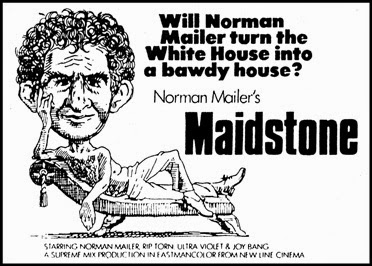
Although not exactly common knowledge, by proving that you can get away with and even earn critical and commercial success from creating absurdly amateurish and plot-less films with no editing and starring uniquely untalented drug-addled and appallingly narcissistic non-actors with next to nil talent or charisma, pop (con)artist Andy Warhol—a man whose greatest talent as an underground filmmaker was turning the camera on and off and who took credit for films he did not even direct—inspired a couple popular Jewish intellectuals and literary figures to try their own lot at becoming avant-garde filmmakers. While the films of sapphic Semite writer and feminist cultural critic Susan Sontag (Duet for Cannibals, Brother Carl)—a loony far-leftist lady-licker who despite once proclaiming, “The white race is the cancer of human history,” directed every single one of her films in the white home continent of Europa, as if the rich cultural legacy would somehow rub-off on her work—are all but totally forgotten, the films of novelist Norman ‘White Negro’ Mailer are slightly better known today, with the Criterion Collection releasing a two-disc box-set of his early films under their sister line Eclipse in 2012 under the title Eclipse Series 35: Maidstone and Other Films by Norman Mailer. As one might suspect from the name of the Eclipse box-set, Maidstone (1970) is considered Mailer’s ‘masterpiece,’ though it is far from a masterpiece of any sort, though it has at least one thing going for it. Indeed, the film is worth seeing for one reason alone and that is seeing Mailer being beaten up by mainstream actor Rip Torn (Men in Black, Marie Antoinette) with a hammer in front of his wife and young children in a totally real and unsimulated scene where the actor got mad at the would-be-auteur’s superlatively shitty ‘realist’ directing style. Mailer’s penultimate cinematic work and third feature following the rather poorly directed and largely incoherent works Wild 90 (1968) and Beyond the Law (1968), Maidstone is a somewhat autobiographical film where the novelist turned director plays a popular auteur filmmaker who is running for president during a dangerous time when most of the normal politicians have been assassinated. A more ‘bad bad’ than ‘good bad’ work of micro-movie megalomania where Mailer invented an cinematic alter ego that seems to fulfill his own failed political (he made a failed attempt at running for mayor of NYC in 1969 at the urging of feminist Jewess Gloria Steinem), masculine (he boxes and fights in the film) and filmmaking (the character’s filmmaking talents are absurdly compared to Fellini, Dreyer, Antonioni, and Buñuel) fantasies and dreams. Indeed, Maidstone is an ‘auteur’ work in the worst sense of the world.
The film opens with a British TV host named Jeanne Cardigan (Jean Campbell) telling Brit viewers how she is going to travel to the United States to follow the seemingly laughable presidential campaign of egomaniacal filmmaker Norman T. Kingsley (Norman Mailer). To add a sorry sense of substance to an innately incoherent and aimless film, Maidstone features various numbered titles to denote chapters, with the first chapter being titled “A Meeting of High Officials.” The ‘High Officials’ sit together in a luxury manor and discuss whether or not Mr. Kingsley is “ripe for assassination.” A human ‘melting pot’ that was spawned from a Russian-born father and a mother of largely Welsh descent with rumored gypsy, Irish, Jewish, and negro blood, Kingsley is as American as a rancid apple pie. Although Kingsley graduated from Princeton with a degree in architecture after receiving a scholarship, somehow he magically became a filmmaker. The High Officials also believe that he is gay (or what they describe as “Greek love”), which one might assume due to the fact he is a swarthy and considerably overweight middleaged man that walks around in leather-fag apparel, including a fascistic leather cap and a matching black leather vest, which he wears with nothing underneath. A filmmaker in the spirit of his Hebraic racial comrade Henry Jaglom, Kingsley/Mailer is a local misogynist who stylizes himself as a feminist, despite the fact that he is prone to viciously attacking women for seemingly no reason at all. While proclaiming to his actresses regarding his films, “I can’t believe in making sexploitation films, as they are called. I’m really a very squeamish man, as you’ll come to discover. I’m interested in sexuality…rampant and respondent, but also in some taste. I can’t bare bad taste. I’ll use each and every one of you in any way I can. I will never ask to do anything that will completely violate you. On the other hand, I may push several of you to find yourself in emotional and, dare I say, anatomical situations…,” Kingsley is indeed making a sexploitation film of sorts and he is willing to break a woman’s self-esteem just for the mere dignified pleasure.
When interviewing a negress for a role, the director states to her in a voice that sounds like it's somewhere in between a black preacher and a frog, “I believe that good acting comes out of tyranny…out of a sense of slavery, you understand? You’ll be enslaved if you want to be a good actor.” Of course, Kingsley is no less brutal with the blonde Aryan Shiksa babes. On top of telling one Nordic blonde she needs to get rid of her wrinkles, he calls another one a “dumbo” and “a big strong eager peasant” who is only fit to play a “cook for the whorehouse” in his film. After getting another Aryan bimbo to admit she would like to screw a negro and a mestizo, degenerate creep Kingsley gets rather aroused and begins defiling the little lady, even attempting to pull down her panties after randomly starting to makeout with her in an exceedingly repugnant fashion. Of course, Kingsley does not stop there, as he gets French-born Warhol superstar ‘Ultra Violent’ to fuck a pitch black negro. On top of that, Mailer hangs around black nationalists that hate his guts because he wants to seem ‘cool’ and ‘liberated,’ not to mention the fact that he wants their vote. Of course, Kingsley is proud of the fact that he is a scumbag and even goes so far as bragging, “I’m the male equivalent of a whorehouse madame” during a truly stomach-turning Jaglom-esque moment. When asked by British newscaster Jeanne Cardigan if he is running for president just to please his already inflated ego, the ‘messianic auteur’ proudly declares, “I am a narcissist by definition. I’m an actor…a director…I’m fascinated with exposing myself to multitudes.”
At about the one hour mark of the film, the work degenerates into ludicrously laughable failed celluloid art experiment featuring a variety of spastic yet somehow marvelously mundane montages that Mailer probably thought were moments of pure cinematic genius. During one of these superlatively sorry scenes, newscaster Cardigan falls into what seems to be a rabid state while her tits hangout her dress and declares her hatred for Kingsley while playing with a bloody baby doll. In what is arguably one of the most mindnumbingly mundane and moronic scenes in celluloid history, footage of people slowly walking in a field like zombies is juxtaposed with audio of a woman moaning during sex. During one of the few highlights of the film a micro race riot breaks out at a ball in a segment misleadingly titled, “The Grand Assassination Ball” featuring Kingsley and his comrades sporting aesthetically vulgar gray suits with matching tophats. After a negro seems to suffer a seizure after attacking a cracker, the ball degenerates into a hippie ‘happening’ involving the ritualistic burning of American money, braindead beatnik bastards dancing like zombies on PCP to generic psychedelic music, and some dumb drugged out bitch talking about “freedom” and asking people if they are “black or white.” In a rather incriminating scene involving his significant other, Kingsley hatefully berates his wife Chula Mae (played by Mailer’s real-life wife Beverly Bentley) for ruining his fun (she insults his goofy tophat) and proclaims that it is the first time in 15 years of marriage to her that he has felt freedom.
Of course, Mailer saves the best for last in a segment entitled “The Silences of an Afternoon” that features the (in)famous scene where Rip Torn (playing the role of Mailer’s character’s brother ‘Raoul Rey O'Houlihan’) attacks Kinsley/Mailer with a hammer. After hitting Mailer in the head with a hammer, Torn comes out of character and declares, “I don’t want to kill Mailer, but I must kill Kinsley in this picture.” Indeed, in a film as torturously tedious as Maidstone where the actor/director wallows in his own egomaniacal excrement, it is a true, transcendent act of spiritual liberation. Clearly high on some sort of chemical substance, Torn is still cognizant enough to know his actions were warranted, stating to Mailer after giving him a much deserved beating, “I had to do that, you know that” and “The picture doesn’t make sense without this, you know.” In an absolutely horrendous scenario of unhinged female hysteria, Mailer’s wife declares, “I’ll kill you” and attacks Torn in a patently pathetic fashion. Of course, Torn probably best sums up Mailer and his cinematic persona when he rhetorically asks the novelist turned director, “You’re just a fraud, aren’t you?!”
About at the halfway point of Maidstone, Rip Torn declares in a jolly face, “The acts of the man make the man.” By using Torn’s logic to analyze the director, one easily comes to the conclusion that director Normal Mailer is a misogynistic megalomaniac who attempts to style himself as what he is not. Indeed, while Mailer portrays himself in the film as a rampantly heterosexual macho stud of the considerably charming and charismatic sort and exceedingly eclectically talented Renaissance man, he comes off in the film as a small effeminate dork and alpha-male of the artistically vacant sort who gets a kick out of venomously berating impressionable young women and filming negro bucks carnally defiling desperate Aryan broads. Mailer’s equivalent to Dennis Hopper’s epic experimental failure The Last Movie (1971), Maidstone is aimless semi-autobiographical metacinema at its most sickeningly self-indulgent and I say that as someone whose favorite directors are typically described as “self-indulgent.” A mostly pointless film with somewhat of a pay-off in the end, Mailer’s film is like the cinematic equivalent of an impotent elderly cripple with diabetes masturbating for about two hours and somehow climaxing in the end in a rather sloppy, self-degrading mess. While I think Mailer is a candy ass kosher pansy who thought he was an alpha-male because he took cheap shots at effeminate rich faggots (e.g. Gore Vidal) and beat and even attempted to kill women (in 1954, the novelist got drunk and stabbed his then-wife Adele Morales twice, puncturing her pericardium, thus resulting in emergency surgery), I will give him credit for including the rather unflattering scene of himself getting beat up by Rip Torn, who was certainly no fine muscular physical specimen, at the end of Maidstone.
Interestingly, in a candid interviewed featured in the book Film Director As Superstar (1970) by Joseph Gelmis, Mailer confessed that one of his main interests in film was that it was an artistic medium that could not be conquered by his ostensibly genius Hebraic intellect, or as the writer/director most notably stated himself: “The greatest intellectual pleasure I have is carrying an experience I can’t dominate with my mind. Because I come out of a tradition of people who are born to dominate life with their minds. The Jews are the greatest intellectual machines of any species of man on earth. I think that’s really the reason, beyond any other, why the Jews are next to universally detested by people who don’t understand their fine, war, tender, loving, and forgiving sides. The reason why every farmer alive, why every redneck, instinctively distrusts the Jew is because the Jews are intellectual machines. And they are, you know, more than anyone else. I grew up in that tradition.” Indeed, not unlike his equally anti-Occidental racial kinsmen Marx, Freud, Trotsky, Adorno, and Sontag, who all dedicated their careers to undermining the white Christian world, the self-proclaimed “intellectual machine” used his ostensible Judaic genius to defile the white goyim with the Europid-pioneered art of cinema as his tool via Maidstone, which is nothing but an infantile celluloid jerk-off piece where the aberrant ‘auteur’ tried in vain to defile everything that white Anglo-Saxon America holds sacred, yet failed miserably as demonstrated by its lack of true cult status as a piece of pretentious twaddle that even Mailer fanboys despite. Indeed, when Mailer absurdly described the work as “a revolutionary film,” he meant in the Trotskyite anti-Aryan-goy sense, hence its stereotypical Hebraic hodgepodge of blonde-Shiksa-defiling by vulgar Heebs and negroes, black nationalism fetishism, pornographic imagery thinly disguised as female liberation, loveless sex depicted as ‘free love,’ and kosher cognitive dissonance presented as avant-garde art. Still, I am glad that Maidstone was made, as Mailer's pathetic beat down during a pansy girly fight has been forever immortalized, which is certainly the next best thing to seeing Trotsky taking a Stalinist icepick to the back of the skull.
-Ty E
By
soil
at
October 05, 2014
0
comments
That Boy
The closest thing to a real-life living and breathing Narcissus, gay Aryan sex icon Peter Berlin was so obscenely enamored with his own blond beast beauteousness that he acted as his own photographer and would not allow anyone to take portraits of him, aside from the occasional guest like Rick Castro (who is probably best known in the cinema world for co-directing the 1996 cocksucker cult classic Hustler White starring Madonna’s one-time ‘kept man’ Tony Ward). With that being said, it should be no surprise that he would also direct himself in his own quasi-hardcore fag fuck flick, That Boy (1974), under the pseudonym ‘Peter Burian’ (Berlin opted to adopt his current pseudonym after a Hollywood actor named Peter Burian threatened to sue him). Born in 1942 as ‘Armin Hagen Freiherr von Hoyningen-Huene,’ Berlin came from a poor Prussian aristocratic family that lost all of its money and possessions during the Second World War when the future sex icon’s young father was killed in battle and the family's eastern estate was stolen by the Soviets occupiers. A relative of Baltic German fashion photographer George Hoyningen-Huene, who was also gay and worked with Hebraic Hollywood homo-auteur George Cukor (The Philadelphia Story, My Fair Lady) and acted as a color consultant on his film A Star Is Born (1954) starring Judy Garland, Berlin may be somewhat of a dumb blond, but he also has an innate talent for photography, or at least so much is clear in That Boy, which features a number of the iconic kraut cocksucker's iconic portraits spliced in throughout the film. Starring Berlin as his alter ego ‘Helmut’ (one reviewer speculated the name might be a tribute to Helmut Berger and/or a reference to his ‘warhead’ of a cockhead) in a role where he becomes infatuated with a newly blind boy because he “seems so different from all the other street people” and “lives in a world all his own,” the film is ultimately the most bizarre example of the star/director’s rather intricate and bizarre brand of post-WWII Teutonic fairy narcissism and vanity. The second and final film Berlin starred in before directing a couple obscure shorts and dropping out of filmmaking and acting altogether, That Boy is the height of homo vanity in quasi-avant-garde form as a sort of west coast equivalent to the Warhol/Morrissey films, albeit minus any sort of irony, cynicism, or sociopolitical context, thus making for a seriously silly cinematic work that is distinctly charming due to the fact that it is completely unintentionally humorous despite its sentimental ‘humanistic’ aspirations as a rather ridiculous tale featuring camp elements (including middle-aged tranny hippie homos!) about a glamorous gay boy who falls in pseudo-love with an equally ‘side-pipe’ plagued blind boy. In the world of Peter Berlin, nothing else exists except him and his many horny admirers, who, at best, only are allowed a mere tiny taste of the muscular Teutonic twink. While dead serious in an almost poetic fashion, That Boy is also a superlatively side-splitting depiction of the delusional beauty of an exceedingly eccentric gay dude with a silly Dutch boy haircut whose personal weltanschauung is self-worship and self-glorification. Indeed, if nothing else, Berlin is the ultimate unrivaled ‘Übermensch’ of sod sex icons, but of course, no one ever had to tell him that.
As a Blind Boy (Arron Black) narrates regarding the hypnotic sexual allure of protagonist Helmut (Peter Berlin) at the beginning of That Boy as the Aryan alpha-homo cruises down south of the Market and Polk Street areas of San Francisco as various people admire him: “Showing off that huge pleasure organ of his…everyone would stare at him…weird people, boys, girls, young men, freaks…everyone staring at this cock, doing anything to get his attention. Still, he ignored everyone…there was nothing anyone could do. I suppose he knew they’d follow him…anywhere, everywhere…just to get one more look at his cock. I followed too. I followed him…watched him everyday…strolling along the street…showing off his fine muscular body. I watched others look at him…pass him by as he stood on the street corner and take another look. Often, they would return…planning how they could lure him from his isolation.” While Helmut rebuffs every single glaring girl and boy that passes his magnetic gay gaze, he develops a soft spot for the Blind Boy because he cannot imagine a life where one is deprived the sight of physical beauty, especially his own. Indeed, Helmut worships himself and derives the greatest satisfaction from being wanted by others who cannot have him. At the most, Helmut will let someone play with his cock and he might occasionally allow someone access to his poop-shute, but other than that he is a mere cockteasing cocksucker who does not even care about sucking cocks. When Helmut turns down some degenerate with a leather-fag mustache and Nazi hat, the unhappy fellow calls him “jack off” and hatefully proclaims, “you will be sorry bitch.” Of course, Helmut barely even acknowledges the bitchy street sod and goes on his merry way, as he only has eyes for the poor Blind boy.
Ultimately, That Boy is comprised of a series of Anger-esque montages that are divided into a couple segments based on different SF street people that worship Helmut, which include an S&M photographer (who literally puts Helmut on a pedestal!), an exercise-obsessed high yellow negro twink, a urine-and-whip-loving ‘power bottom’ in a campy gay bar, and of course the ostensibly tragic Blind Boy character. And why is this Aryan hunk so obsessed with a Blind Boy? As Helmut narrates, “This boy intrigues me because he dresses so well and cares so much about his appearance.” Apparently, the Blind Boy lost his vision the year before in an accident and is well aware of Helmut’s appearance. Their ‘relationship’ begins when Helmut walks up to the Blind Boy and, while not saying a single word, helps the visually challenged twink cross the street in a hilarious scene where the bulges in each characters' pants is glaringly apparent. Surely, Helmut seems aroused by the fact that the Blind Boy must be dependent on him. As Helmut concludes at the end of the film regarding his new relationship: “I think I really found a friend. Someone I can talk to. Someone that can talk to me. Someone I can give protection to. Someone who, in return, can provide warmth and understanding when warmth and understanding are needed. Someone who will talk to me without fear and will listen in return. Someone who will share my fantasies and dreams without making demands while accepting help. I think of his fantasies…his dreams…and enjoy being with him. His mind is so much different…so much purer than the rest…he’s willing to understand and to listen…because there’s a joy in knowing no matter what events may occur, he will always hold me in his memory as I am now…as I was for him in these fine days.” Indeed, being the harmless pathological narcissist that he is, Helmut is most intrigued by the fact that the Blind Boy—being unable to see and all—will always remember him as the immaculate Aryan twink that, in terms of sod sexual magnetism, dominated the entire modern Sodom that is San Francisco. Notably, in real-life, Berlin's longtime lover had a deformed leg, thus the sex icon's fetishism for the handsome yet crippled is completely genuine and not something he incorporated in the film to make him seem like some morally righteous queer who was altruistic enough to give handicapped homos sympathy fucks.
Unquestionably, aside from the strange scenarios of seeing a masochistic man lick beer off Peter Berlin’s crotch while being whipped by a biker, a tiny muscular negro twink working out in a gym naked, and other fiercely foul examples of retrograde fetishistic faggotry, That Boy is a mighty awkward yet hysterically humorous experience simply due to the fact that it is full of so much pseudo-sensually narrated bad poetry. For example, Herr Berlin somberly narrates regarding the Blind Boy: “What a shame the boy can no longer see the color of the streets he dreams about” and “if only he could see.” When the credits roll, the hilarity still does not end, as the film gives “Special Thanks” to what I assume are hippie fellows as demonstrated by their names ‘Cardinal Mahdi Mahatma’ and ‘Crown Prince Jesus Christ Satan.’ Admittedly, for a directorial debut, Berlin’s work holds up, albeit for all the wrong reasons, as a virtual celluloid catalog of outmoded fag fashion and fetishes. I think John ‘The Pope of Trash’ Waters probably said it best when he described Berlin as a sort of walking and talking sex organ.
When it comes down to it, it is not Berlin but his uncut kraut cock, which gets all the great close-ups in the film, especially when he is walking down the street in his signature “saran” wrapped white pants (in fact, Berlin was given the nickname ‘Saran’ due to his perverse proclivity towards walking around town with his cock bulging out of his white pants). Notably, in the rather worthwhile documentary That Man: Peter Berlin (2005) directed by Jim Tushinski (I Always Said Yes: The Many Lives of Wakefield Poole), Berlin reveals that he derived the greatest sexual gratification from luring guys in the street and then blowing them off right before they thought they would have the opportunity to blow him. Indeed, instead of being gay, it seems that Berlin was more in love with himself and his own body as an innate narcissist who puts the men of James Bidgood’s classic cocksucker cult flick Pink Narcissus (1971) to shame in terms of self-worship and glorification. Indeed, even with their Cocteau-esque use of allegorical imagery involving mirrors and what not, Michael Zen’s classics, Falconhead (1976) and Falconhead Part II: The Maneaters (1984), cannot compare to the absolutely stupefying gay vanity of That Boy, which may be the most unflatteringly sincere yet paradoxically stereotypically gay film ever made. In that sense, it is probably for the better that Berlin never directed another feature, as it would have never been able to top his directorial debut, which probably said everything that the sex icon had to say about his life, philosophy, and personality in 80 minutes or so.
The spiritually prodigal son of a young Wehrmacht soldier whose Halstatt Nordic good looks and physique he passed on to his progeny before dying tragically in the Second World War while apparently saving a comrade in battle, Peter Berlin is, in many ways, a sort of symbol for the death of the Occident, as a man who, not unlike Fassbinder's Lebensborn-bred boy toy Armin Meier, would have gone on to do much greater things, like be a prestigious SS officer of an Aryan utopia covered in Berlin-esque Arno Breker statues, had World War II ended differently. Indeed, such is certainly a tragic fate for a man who was born with the name Armin Hagen Freiherr von Hoyningen-Huene and was probably destined to live in a castle, yet instead chose the suggestive porn name ‘Peter Berlin’ and preferred living in an American urban hippie gutter. In more than one way That Boy is a fitting title, as it depicts the striking mensch who was, psychologically speaking, a perennial boy whose narcissism, like many gay men, was comparable to that of an infant, thus hinting that he never got the proper maternal nourishment during his first critical years (after all, he was born during the middle of WWII in 1942, not much earlier before his father was killed). Like the first film the sex icon starred in, Nights in Black Leather (1973), That Boy demonstrates that fascistic aesthetics (which were partly inspired by Berlin's hero Tom of Finland's drawings) were quite chic among homos in the 1970s, thus symbolizing a certain sick irony of fate in Berlin's life as the spiritually fallen son of a Teutonic father and Fatherland. Indeed, That Boy demonstrates that 1970s San Francisco—with its tranny homo hippies, lurking and lecherous leather-fags, and bellbottom-wearing power-bottoms—was a sort of Weimar 2.0, with Peter Berlin being its unofficial prince, thus, in a sense, he did live the life of the the born aristocrat that he was after all.
-Ty E
By
soil
at
October 05, 2014
2
comments
Thursday, October 2, 2014
Baby Sitter (1982)
You can pretty much guarantee that when a filmmaker enters the forbidden realm of pornography, his career is more or less coming to a bitter and truly degenerate end of no return, both artistically and professionally. Indeed, aside from the rather rare exceptions like Wes Craven, who left a comfortable job as an English professor and entered the more lucrative pornographic underworld where he apparently made “many hard core X-rated films” under various pseudonyms (even working on Gerard Damiano’s 1972 crossover hit Deep Throat, though the actual role he had in the mafia-backed film is still unknown to this day) before he directed his first feature The Last House on the Left (1972), the filmmaker who begins directing porn is more or less a dead filmmaker who is whoring himself out just to pay the bills. While Guido artsploitation auteur Alberto Cavallone (Man, Woman and Beast aka Spell – Dolce mattatoi, Blow Job – Soffio erotico) did enter the final stage of his career when he began directing fuck flicks under the ‘classy’ pseudo-aristocratic pseudonym ‘Baron Corvo,’ his career is interesting in that a good number of his ‘classic’ films were released in alternate pornographic cuts well before he the director ever became a full-blown pornographer. Indeed, Cavallone’s singularly aberrant cult classics Zelda (1974), Blue Movie (1978), and Blow Job – Soffio erotico (1980) were all released at various stages with pornographic inserts, though this should be no surprise to anyone that has seen the original non-pornographic cuts of these works, as they are ultimately more subversive and perverse than the fuck flicks that were being made at the time, even if they were less sexually explicit. Indeed, while ‘subversive’ sex has always been a major theme of Cavallone’s oeuvre, the director mostly chose to depict carnal pleasure in a decidedly ‘anti-erotic’ and even deranged fashion and this is, somewhat ironically, most apparent in his straight fuck flicks. In that sense, Cavallone was a sort of poor man's Pasolini, albeit rampantly heterosexual and much more nihilistic.
Directed under the name ‘Baron Corvo’ (a pseudonym he borrowed from gay English novelist, artist, and would-be-priest Frederick Rolfe), Il nano erotico (1982) aka Baby Sitter aka Being Captured aka Il nano e la strega aka Petites fesses juvéniles (pour membres bienfaiteurs) reflects Cavallone’s rather reluctant attitude in regard to directing his first ‘straight porn flick’ (though his previous work, the 1980 ‘erotic thriller’ La gemella erotica is assumed to have been shot ‘hardcore’), which is about as sexually appealing as syphilis as a work featuring a demented dago dwarf in a thong raping a young girl with giant dildos to meta-kitschy sounds of disco music. A sort of Guido take on the superlatively sleazy American-Danish coproduction The Sinful Dwarf (1973) aka Dværgen directed by Vidal Raski, which depicts a depressed and lonely yet equally deranged and deadly Danish dwarf running a white slavery and heroin ring with his mother, Baby Sitter depicts the insane, if not largely inane, Italo-degeneracy that ensues when a young girl comes to work as a babysitter for a young couple, only to find that baby is really a full grown, phallus frenzied, dildo-wielding dwarf who enslaves her and dementedly defiles her. Needless to say, Cavallone’s dumbfounding Dwarfsploitation flick is for initiates only. In other words, if Werner Herzog’s Even Dwarfs Started Small (1970) aka Auch Zwerge haben klein angefangen made you squirm with abject disgust at the sight of devilish little people doing depraved and destructive things, Baby Sitter will prove to be the ultimate anti-aphrodisiac, especially if you’re a member of the fairer sex, as a nihilistically wanton work of whimsical derangement where a swarthy and perennially giggling achondroplastic dwarf pulls out a suitcase of large dildos and inserts them in the various holes of a naïve teen as if he is an Asperger-addled toddler experimenting with building blocks.
Exotic 19-year-old redheaded babysitter Sabrina ( Sabrina Mastrolorenzi) loves her boyfriend Johnny so much that she gently jerks him off while riding on his Honda crotch-rocket, but she is put off by his indomitable jealousy and she questions whether he really loves her or not. Luckily, a nightmare day involving debauched dwarfs and dildos will ultimately prove to Sabrina that Johnny does indeed love her after all. After giving Johnny fellatio in a scenic field and stroking his main gear while he gives her a ride on his super cool Jap motorcycle, Sabrina is, to the chagrin of her boy toy, picked up by a wealthy middle-aged blonde babe named Dominique (Dominique Saint Claire) and her swarthy mustache adorned chauffer in a white Mercedes so that she can carry out her latest babysitting job. As Dominique explains to her, Sabrina will be watching a little boy named ‘Willy,’ though little does he realized that she will be ravaged by the ‘child’s’ Willy. Indeed, soon after Dominique leaves Sabrina at her plush countryside home that is just a couple miles outside of Rome, the baby sitter discovers she has been locked inside the house and soon after that, Willy aka ‘Peeping’—a discernibly dago-like achondroplastic dwarf (Petit Loup) in a classic children's sailor outfit—abruptly appears from his baby bed and pierces the young lady with a blowdart with tranquilizer on it, thus knocking her out instantly.
When Sabrina awakes, she is tied in bondage to a fireplace and wearing nothing but a tiny thong. While she was asleep, little Willy took the liberty of stripping her of her clothes and providing her a rather unflattering thong similar to his own. After pulling out a suitcase full of various large dildos, Willy begins probing Sabrina’s nether-regions in a rather perverse fashion. Meanwhile, Dominique and the Chauffer have sex while watching Willy defile Sabrina via security footage. When Willy goes down shoving dildos in Sabrina’s various flesh-wounds, he ties her to a footstool and begins whipping her in a savage fashion. Ultimately, Willy gets Sabrina to ‘voluntarily’ do anything he wants, so long as he agrees to let her go at the end of the night. After proclaiming, “I am very eccentric,” Willy has Sabrina sit on top of him reverse-cowgirl style and jerk him off. Meanwhile, Sabrina’s boyfriend goes looking for his girlfriend, as he seems to rightfully suspect that Dominique is a demented bitch with uniquely unsavory intentions. Eventually, Willy confesses to Sabrina that Dominique is his wife and in reciprocation for him allowing her to fuck any man she wants, she calls babysitting agencies and tricks stupid young girls to come to their home so that he can kidnap and defile them. Of course, one would assume that the rather odd couple would have been caught by now, but as Willy brags to Sabrina, he kills all the babysitters when he gets bored with defiling them. Indeed, Willy plans to kill Sabrina by giving her a poisonous enema, but just before he invades her anus, she hits him in the ribs and manages to escape. While the Chauffer runs out and attempts to capture Sabrina at the demand of deranged bitch Dominique, boyfriend Johnny arrives at just the right time. In the end, Sabrina confesses to her boyfriend, “This has been an experience I will never forget” and, to the delight of Johnny, agrees that she will never babysit again.
Believe it or not, Baby Sitter was not the last XXX debauched dwarf flick that Albert Cavallone directed. Indeed, the director followed the film with the supposedly somewhat superior work, Pat una donna particolare (1982), the same year which, aside from featuring most of the same ‘actors’ from the previous film, also once again starred petite pervert Petit Loup. Interestingly, both of the films were shot at the same villa a couple miles outside of Rome where Rosso sangue (1981) aka Absurd directed by Joe D'Amato (as ‘Peter Newton’ aka ‘Aristide Massaccesi’) was directed the previous year. As someone with a small softspot for small people, I somehow managed to enjoy Baby Sitter more than most Cavallone fans, even if I found myself forwarding through some of the overlong sex scenes. When it comes down to it, the film is essentially a strangely humorous nihilist comedy directed by a disillusioned auteur who seemed like he wanted to take revenge against the film world by directing one of the most distinctly unsexy and just plain debasing fuck flicks ever made. In that regard, Cavallone is a lot like American artsploitation auteur Roger Watkins (The Last House on Dead End Street, Shadows of the Mind), who directed three masterful and strikingly artful, if not discernibly anti-erotic, misanthropic, and nihilistic dark blue movies—Her Name Was Lisa (1981), Corruption (1983), and Midnight Heat (1983)—under the Teutonic classical music inspired pseudonym ‘Richard Mahler.’ As Roberto Curti noted in his excellent 2007 essay Alberto Cavallone: Story of an Eye, Cavallone’s son Giulio offered the following speculation as to why his father directed porn: “Alberto did them for money, I wouldn’t say negligently, but doing things his own way, just to piss off the producer […] You know, this is a compromise that could have made sense in Alberto’s logic: 'You don’t let me do the film I want to do and instead you almost force me to make shitty hardcore porn? Well, that’s what I’m gonna do. I’m gonna shoot these films but I won’t put my name on them, and I’m gonna do them my own way!'"
A work I can only recommend to Cavallone completists, sadomasochistic dwarfs, and/or morbidly masochistic individuals who get off to being debased by the unnatural sights of a malevolent midget defiling a young dame, Baby Sitter is nothing short of a sick celluloid joke at the expense of both pornophiles and the Italian film industry. With his purported masterpieces, Maldoror (1977)—a lost adaptation of pseudonymous French poet Comte de Lautréamont’s late-19th-century proto-surrealist poetic novel Les Chants de Maldoror aka The Songs of Maldoror, which was also unsuccessfully adapted by cine-magician Kenneth Anger and successfully adapted by Japanese auteur Shūji Terayama—never being released as a result of distribution problems and a number of his other films negatively affected by everything from suicidal producers (e.g. Blow Job – Soffio erotico) to being completely aborted (e.g. Il ragazzo che fece fumare il Vesuvio aka The Boy Who Made the Vesuvio Erupt), Cavallone had every right to be aesthetically vengeful, thus one could argue that Baby Sitter and Pat una donna particolare are almost just as much ‘auteur’ pieces as his early works, as they reflect the filmmaker at his most incendiary, iconoclastic, and misanthropic. Indeed, what other man would take aesthetic revenge against society by making a fuck flick where a beautiful young girl is defiled by a dildo-wielding dwarf?!
-Ty E
By
soil
at
October 02, 2014
2
comments
Wednesday, October 1, 2014
Boots & Saddles (1982)
From Kenneth Anger’s homoerotic bike boy classic Scorpio Rising (1964) to Italian auteur Liliana Cavani’s tragic yet titillating S&M themed dark romance The Night Porter (1974) aka Il portiere di note to totally tasteless exploitation excrement like Ilsa, She Wolf of the SS (1975) to the Danish-Swedish skinhead-themed gay drama Broderskab (2009) aka Brotherhood starring popular Danish actor Thure Lindhardt, Nazis and Nazi imagery have more than proven their worth in terms of filmic fetishism, so it should be no surprise the shadow of Uncle Adolf’s 12-year-long millennial Reich would also darken the gay pornography world, especially in regard to the leather-bound sadomasochistic realm. Indeed, a typical yet somewhat standout example of this is the gritty fag fuck flick Boots & Saddles (1982), which is the third film of a four part tribute to gay porn icon ‘Scorpio’ by Cream of the Crop Entertainment that should not be confused with the 1975 homo hardcore flick by Zachary Strong of the same name. Directed by the sexually flexible pornographic auteur John Amero of the Amero brothers (Christopher Street Blues, Killing Me Softly) under the pseudonym ‘Francis Elise,’ this sub-low-tech porn piece depicts what happens when a bourgeois bitch boy falls prey to the decidedly depraved desires of a long-haired neo-Nazi lunatic with a foul fetishism for brutally beating strangers with big black dildos and raping the mouths beta-boys while posing in a Breker-esque fashion next to his beloved swastika flag. If Amero and his straight brother Lem (Checkmate, R.S.V.P.) somehow managed to turn New York City into a foreboding psychedelic Gothic nightmare for his masterful heterosexual experimental blue movie Bacchanale (1971), he opted to utilize the sleaze, slime, and true grit of the rotten Big Apple to give Boots & Saddles a rawer and more realistic vibe. Starring old school porn icon ‘Scorpio’, who previously starred in Amero’s morbid male-only chamber piece The Death of Scorpio (1979), as a sadistic neo-Nazi that cruises local gay bars for potential victims that he can bring home, tie up, and bugger in front of a large portrait of Hitler and a swastika flag, Boots & Saddles is surely a sicko classic that reminds the viewer that maybe William Friedkin was not that out of hand when he sparked protest with his absolutely savage sodomite slasher flick Cruising (1980). The closest thing to an urban gay revisionist western and the perfect companion piece to Friedkin’s Cruising, Amero’s film was made at a time when the gay porn industry had still had some testicular fortitude and was not afraid of scaring queens with depictions of unhinged masculinity. The most warped and sexually perverse reworking of the western genre since Neuer Deutscher Film alpha-auteur Rainer Werner Fassbinder's underrated racially-charged work Whity (1971), Boots & Saddles certainly makes the few gay erotic westerns that exist like Song of the Loon (1970) seem like castrated sentimentalist celluloid swill.
Beginning with a shot of a pair of Gestapo-esque boots sitting in front of a white background, Boots & Saddles—a film that borrows its name from the name of the bar that the characters regularly ‘cruise’ for urban cocksucking cowboys—then cuts to an shot of sadomasochistic gay neo-Nazi ‘Karl’ (Scorpio) walking down a New York City street while sporting a maroon bomber jacket (the typical ‘uniform’ of neo-Nazis), black leather boots, and a National Socialist iron cross necklace. Indeed, for whatever reason, Karl has a rare “Spanish Cross” aka “Spanienkreuz” in silver, which was awarded to German troops who participated in the Spanish Civil War on the side of the nationalist general turned Spanish dictator Francisco Franco. Somewhere, not far away, an effete bourgeois type from Albany named ‘Bob’ (Chip Kingsley) visits the apartment of a female business associate, but as he learns from her exceedingly extroverted neighbor Jack Wrangler, who is outside sweeping in an uncommonly jubilant fashion, the woman moved away three months ago. When Bob asks Wrangler where he can get some “good Irish coffee,” he says, “yeah, right up stairs,” and then the two proceed to dine upon one another’s bodies upon entering the rather messy flat. While the two men share oral pleasure via 69, fuck, and cum again, Bob freaks out when he finds a letter while looking for matches sitting around the apartment revealing that his new joy boy has a venereal disease. When Wrangler asks him if he found the matches, Bob replies in a bitchy fashion, “I sure did. Thanks for nothing, I hope” and then proceeds to run out of the apartment in fear that he might have contracted an STD. Ultimately, Bob decides to head to a gay bar called ‘Boots & Saddles’ where he will inevitably meet a menacing psychopath with a fetish for swastikas, iron crosses, and bound boys.
While hanging out the bar, Bob watches as the Bartender’s hustler boyfriend (played by Roy Garrett) enters the bathroom followed by a cocksucking cowboy who proceeds to suck him off to the fitting sensual sounds of “Like an Eagle” by gay porn star turned disco singer Dennis Parker aka Wade Nichols. Naturally, the Bartender gets rather pissed by his Hustler’s boy toy’s “riding” of the cowboy and complains to him, “Listen, you dumb bitch…where do you get the balls to fuck around right in front of my face? When we moved in together, we agreed that you would hustle and I would bartend. Well, your ever faithful lover wants a piece of it and he wants it now!” Indeed, the Bartender and Hustler go up stairs and bang next to a bunch of boxes of Heineken beer. Eventually, Scorpio arrives at the bar and wastes no time cruising Bob and coercing him to come back to his apartment with him. Despite the fact that he thinks he has probably just contracted an STD, Bob has no problem blowing Scorpio. Meanwhile, Wrangler calls around looking for Bob and discovers that he was spotted at the Boots & Saddles bar. When Wrangler arrives at the bar and asks about Bob, he learns from a bartender that he left with “that crazy one with the cross.” After complaining that “Karl…that fucking Nazi” has taken his beloved new beau Bob, he naturally makes his way to the fag Führer’s swastika-adorned apartment.
When Bob notices the portrait of Hitler and the Nazi flag that are hanging in Scorpio’s apartment wall while being sucked off by the sadistic would-be-SS-man, he complains, “You know, I don’t feel so good. I think I better go” and attempts to make his great escape, but he does not get far. After telling Bob, “You’ll leave when I’m through with you and not a moment before,” Scorpio handcuffs his victim to a chair and forces him to fellate him while he wallows in pleasure and glory next to his swastika flag. To the grating sounds of Marlene Dietrich singing in German, Scorpio perniciously penetrates Bob’s man-cunt. After blowing his load on a meager untermensch, Scorpio begins beating Bob with a giant black dildo (!) and states to his victim in a sinister fashion, “this should help you get your rocks off.” Of course, Wrangler soon shows up at the apartment and yells, “open up you twisted bastard!,” while beating on Scorpio’s door. After breaking down the door, Wrangler knocks out Scorpio, calls him a “twisted bastard” again, and rips his swastika flag off the wall, thus causing a fire to start when the flag lands on a candle (since Scorpio is a sadistic creep, he likes to have tons of candles lit while ritualistically raping men in an almost satanic fashion). When Scorpio becomes conscious again, he gets in a physical struggle that results in his balls and bunghole being burned. Ultimately, Wrangler handcuffs and leaves him in the middle of his apartment so that his landlady will find him. As a completely humiliated would-be-Übermensch who has been beaten and defeated, Scorpio cries out, “Mein Gott” in German. In the end, Bob and his hero Wrangler discuss living with one another. Indeed, as it turns out, the chivalrous Wrangler apparently no longer has a STD and only kept the letter as a “souvenir.”
While depicted as a brutal ‘blond beast’ of the savagely sexual and marvelously masculine sort in Boots & Saddles and various other fuck films, Scorpio was apparently an effeminate mamma’s boy in real-life who worked as a hair stylist after retiring from porn. Of course, Scorpio was also as far from a National Socialist as a person could be, as a sort of gay chauvinist who even refused working with “gay for pay” porn stars, as demonstrated by his remark, “I'd rather work with a complete gay cast, instead of straights. I don't like straight people in a gay film. I want someone that's going to reciprocate. I don't need a 'do-me queen.'” As he described himself in the documentary Wrangler: Anatomy of an Icon (2008), Jack Wrangler was a quarter Jewish (his paternal grandfather was a Jew) and he somewhat identified with his Judaic side, thus his role in Amero’s film as a heroic character who saves his beloved from a nefarious neo-Nazi and then literally burns the balls and buttocks of said neo-Nazi had more personal significance to him. In fact, that is not the only way the film had personal meaning for Wrangler, as his half-Jewish father Robert Thurston Stillman was a Hollywood film and TV producer who produced a western-themed TV series called Boots and Saddles (1957-1958), hence the assumed tongue-in-cheek origin of the title of Amero’s film, as well as its unconventional use of genre conventions. Indeed, any John Ford fan would know almost immediately upon watching Boots & Saddles that is a sort of wanton reworking of the western genre, albeit set in urban NYC instead of the rural Wild West and featuring neo-Nazis instead of Indians as villains. After all, one of the main settings of the western genre is a saloon, which is largely where Amero’s film is set. Of course, with the appearance of a rowdy and raunchy urban cowboy who uses a hustler like a cowgirl, Boots & Saddles also gives a cynical nod to John Schlesinger’s Midnight Cowboy (1969). With its curious cocktail of Nazi leather-fags, gay disco music, hustler-humping cowboys, men with mustaches, and seedy gay bar inhabited by rugged men, Amero’s film features a virtual catalog of vintage gay stereotypes and clichés, thus making it mandatory viewing for any self-respecting fan of porn chic era fuck flicks.
-Ty E
By
soil
at
October 01, 2014
1 comments
Subscribe to:
Posts (Atom)
Soiled Sinema 2007 - 2013. All rights reserved. Best viewed in Firefox and Chrome.