Sunday, January 4, 2015
Brain Damage
I am fairly convinced that the Drug Abuse Resistance Education (D.A.R.E.) program and anti-drug PSAs are designed to get kids interested in using and abusing drugs, as they are so preposterously patronizing and agitating to the juvenile mind that they could only inspire any self-respecting kid with a natural aversion to authority to want to smoke a joint, pop a benzo, snort an oxy, and/or huff some glue in protest against such patently pathetic propaganda campaigns. On the other hand, ostensibly anti-drug flicks like Danny Boyle’s Trainspotting (1996), Darren Aronofsky’s Requiem for a Dream (2000), Jonas Åkerlund’s Spun (2002) romanticize the addict lifestyle in a nauseatingly naïve way, as if such a non-existence is constantly exciting and full of magical wonder and intrigue, even when suffering from major withdraw as reflected in the unintentionally absurd dream-sequences in these rather retarded works, hence why so many diluted dope addicts love these dumb ass films, as it makes them suffer the delusional that they are part of some super secret arcane world that can only be adequately understood and appreciated by the truly initiated. Indeed, I certainly can only think of a handful of films that might dissuade someone from trying junk, like the decidedly dejecting and equally degenerate Finish doc Reindeerspotting: Escape from Santaland (2010) directed by Joonas Neuvonen (who, ironically, is currently surviving jail-time for drug trafficking), but probably the most bizarre and counter-intuitively effective anti-dope flick I know of is the nice and nasty little ‘neo-exploitation’ flick Brain Damage (1988) directed by self-described “exploitation” auteur Frank Henenlotter (Basket Case Trilogy, Frankenhooker). A sort of absurdist anti-drug allegory in a bawdy and ballsy ‘body horror-comedy’ package, Henenlotter’s darkly comedic piece of highly conscious low-camp kitsch depicts the strangely hypnotic homicidal hilarity and excess-ridden eccentricity that ensues when a young and rather dumb dude begins a mutually dependent relationship with a parasitic phallic-like creature named ‘Aylmer’ that gives him a truly transcendental high via a direct injection of meta-narcotizing blue fluid into his brain in return for procuring the pathologically sassy micro-monster a steady supply of fresh human grey matter. Unquestionably the most wonderfully and wickedly warped take on the deleterious effects of dope on human brain chemistry since Slava Tsukerman’s stylishly sleazy sci-fi cult classic Liquid Sky (1982), Brain Damage is easily the most fun can have while dealing with anti-drug themes, which might say much considering the banality of the topic, but then again the film's greatest appeal is that it is a Henenlotter flick, thus guaranteeing the sort of feverishly fucked filmic facetiousness that will only appreciated by the truly initiated and/or criminally insane.
Brain Damage begins unpredictably enough with the introduction of two over-educated married old farts named Morris (Theo Barnes) and Martha Ackerman (Lucille Saint-Peter) that live a semi-hermit-like existence in a crummy NYC slum apartment that is strangely decorated with primitive tribal art and exotic warrior masks, thus hinting they might be cultural anthropologists and certainly xenophiles. For whatever reason, the old odd couple also have a dozen are so fresh brains sitting on their kitchen table as if they are being prepared to be fed to some sort of large bloodthirsty beast that eats ten times more than a large adult male. The brains are for something or someone named ‘Aylmer’ (voiced by old school horror host John Zacherle aka ‘Zacherley’) and when the mysterious creature disappears from the eccentric elderly couple’s bathtub, Morris and Martha suffer a major histrionic freakout to the point where they rudely barge into the apartment of an uppity negress (Beverly Bonner, who played the scary black tenant in Basket Case) to check her bathtub for their missing little friend, which they fail to find. Ultimately, Aylmer makes his way to the apartment of handsome yet hapless protagonist Brian (soap opera actor Rick Hearst) while Morris and Martha are lying on their apartment floor and foaming at the mouth as if suffering from a seizure as a result of super hellish drug withdraw. Indeed, the Ackermans are elderly junkies and their choice of drug is the venomous blue juices of Aylmer, who is a repugnant yet strangely charming and eloquently spoken creature with goofy beady blue eyes that looks somewhere in between a dried up donkey turd and a burnt crisp STD-ridden black cock. Aylmer survives and thrives off of a steady diet of raw brains, but he is tired of animal grey matter, so he decided to escape from the Ackerman stronghold and he ultimately wisely chose dullard boy Brian—a proud yet seemingly unlikely fan of punk, thrash metal, and goth music as demonstrated by The Cramps, Slayer, and Bauhaus posters hanging on his wall—as his new host. After blowing off a date with his girlfriend Barbara (Jennifer Lowry) and brother Mike (Gordon MacDonald) due to feeling more than a little bit under the weather as a result of his body being invaded by a penis-like parasite, Brian goes back to sleep and later awakes to find a large blood stain on his pillow. After going back to asleep again, Brian awakes to a bright light in the form of an entrancing glowing eyeball on his ceiling, as well as a deluge of translucent blue fluid engulfing his entire room and eventually his body in what will ultimately give the protagonist a heavenly otherworldly high that he will never again be able to top, though he surely will try as he is now the servant of a hostile, albeit good-humored, entity that lives to kill.
After unwittingly getting high for the first time on the hardest and most natural ‘psychedelic painkiller’ in the world, Brian soon discovers grotesque foot-long creature Aylmer popping out of his body in a fashion that seems to mock Ridley Scott's Alien (1979). Ultimately, Aylmer makes a Faustian pact with Brian, calmly assuring him in a most devilish fashion like some sort of charlatan cult leader that, “This is the start of your new life Brian…a life without worry, pain, or loneliness…a life instead full with colors, music, and euphoria…a life of light and pleasure” and “I am you, Brian…I am all you’ll ever need.” Aylmer gets Brian high by directly injecting his brain with his blue juices via a needle-like tentacle he has located inside of his mouth. The blue juice gets Brian so high that Aylmer is able suck the brains out of human victims while in his presence without him even remembering the brutal murders ever occurred. Indeed, Aylmer’s first victim is an authoritarian Nordic-like negro security guard at a junkyard and while Brian hallucinates seeing glowing kaleidoscopic totaled cars while high as a kite in outerspace, Aylmer drains the brain of the spade victim. At first, Brian and Aylmer’s symbiotic relationship seems perfect, at least as far as they are concerned, but after the former discovers that he has a giant bloodstain on his underwear that is clearly not his own, he begins to realize something fishy is going on. Unbeknownst to Brian, he wandered into a punk club called “Hell” while he was high and met a big bosomed slut who tried to give him a blowjob after grabbing his cock and excitedly stating, “feels like you got a real monster in there,” but instead of receiving a meaty member in her mouth, the sensual slut fellated a ‘real monster’ that sucked her brains out. Eventually, old man Morris Ackerman catches up with Brian and tells him he is a total moron for feeding Aylmer human brains, as it has made the creature too strong and has enabled him to easily gain the upper hand over the protagonist. After Morris reveals during a hysterical rant that ‘Aylmer’ is an old English name for “the all inspiring famous one” and that he paid for the ancient creature with “money and blood,” Brian decides to confront his phallic-like pal and learns that he has indeed been the unwitting accomplice is a series of grisly murders. Eventually deciding like so many drug addicts that “I have to be in control,” Brian decides to take Aylmer to a seedy apartment where he will try in vain to control the cock monster and withdrawal from dope, not realizing that his brain chemistry has changed drastically as a result of his recreational drug use. Needless to say, as Aylmer tells him he would, Brian begins begging the creature for his blue fluid after going through a truly haunting cold turkey withdrawal where he hallucinates seeing his ear fall off and buckets of blood pouring out of his head. Ultimately, Brian is forced to procure victims for Aylmer before the creature will agree to soothe his raging withdrawal symptoms. While Brian finds Aylmer a nice big buff naked guido (as perfectly personified by Joseph Gonzalez, who later played the meathead pimp in Henenlotter’s 1990 feature Frankenhooker) in a humorously awkward homoerotic scene where the viewer almost expects the protagonist to be brutally anally pillaged, the turd-like brain-eater opts to eat a defecating high yellow negro horror fan who was minding his own business while reading a horror magazine while on the crapper.
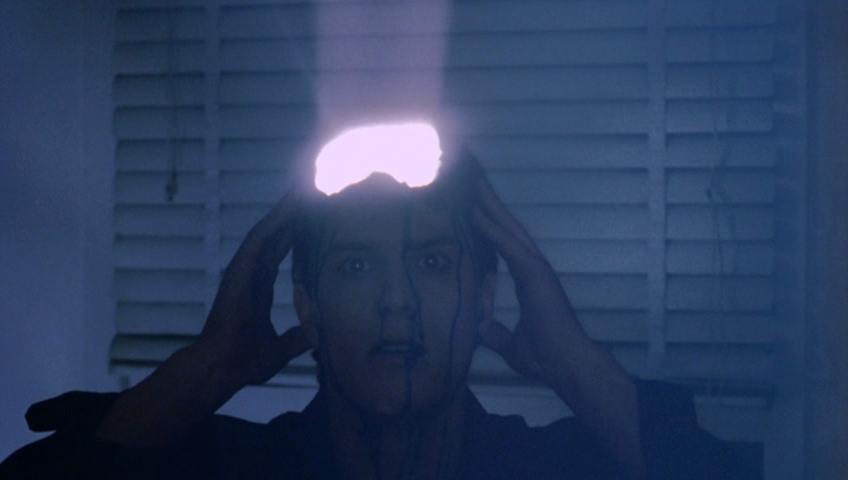
While Brian was busy getting high and acting as a slavish accomplice to various murders, his brother Mike was ‘comforting’ his girlfriend Barbara by catering to her insecurities and vulnerabilities while putting up the false front of being a ‘nice guy’ who has selflessly come to the aid of a lovelorn lady in need. Indeed, after Brian decides to go back to his apartment, he overhears his brother boning Barbara, but he is far too high and disoriented to give a damn. After hallucinating that he has black rectum-like orifices on his stomach and he has eaten Barbara’s brains during an imaginary borderline incestuous quasi-threesome with her and Mike, Brian catches his brother and girlfriend naked in bed together, but instead of getting mad he altruistically attempts to warn them to stay away from him so that he does not accidentally kill them during one of his deadly dope-addled stupors. Not listening to reason, Barbara, who does not seem the least bit guilty about the fact that she has just cheated on her boyfriend with his brother, follows Brian to a subway in the hope that she will be able to salvage their broken relationship. In a sadistically farcical scene of bittersweet anti-romance, Brian kills his girlfriend after she states, “I don’t want to lose you” and gives him a kiss that naturally result in her brains and inwards being drained out. Although Brian does not seem to be too upset over the fact that he has just played an unconscious role in murdering his beloved girlfriend via literal brain drain, he is gracious enough to lie her corpse down on a couple subway seats in an exceedingly delicate fashion as if he is putting a sleeping baby in it's crib. When Brian gets back to his apartment building, old man Morris confronts him with a German luger while his wife Martha wife pulls Aylmer off of the protagonist’s back. Of course, Aylmer soon drains the brains of the two elderly old farts, though, unbeknownst to the penis-like parasite, Morris does not die. While Aylmer is attaching to Brian’s brain to reward him for all the delectable cerebral cuisines that he procured him that night, Morris randomly emerges and pulls the parasite off of the protagonist’s brain just before it properly injects it's host's grey matter with the blue fluid. After Morris ends up strangling Aylmer to death in a fit of rage before succumbing from his brain injuries, Brian begins suffering a serious reaction as a result of his botched high that results in his head mutating in a warped fashion and blue juice squirting from his mouth and nostrils. Like many disillusioned drug addicts who have thrown in the towel on life and given up on their fight against addiction, Brian decides to commit suicide by blowing his brains out with Morris’ luger, but instead of dying, a heavenly light begins beaming from the area of his head that he had blown off in a shockingly ambiguous transcendental ending that seems to be Henenlotter’s own equivalent to the conclusion of Stanley Kubrick's 2001: A Space Odyssey (1968).
In its grotesquely exaggerated depiction of both the physical and metaphysical hell that is full-blown drug addiction, Brain Damage ultimately manages to contain more truths than any of the obscenely overrated pseudo-artsy (anti)drug dramas like Requiem for a Dream and The Basketball Diaries ever could. Indeed, anyone that watches Henenlotter’s film and still finds themselves fantasizing about using drugs might as well quite while they're still ahead and take a lethal injection of junk, as there is surely no hope for them. I certainly cannot think of another film where the dope-addled protagonist is so far gone in his junk-addled somnambulistic stupor that he mindlessly listens without even the most minute worry or hint of jealousy while his scheming brother passionately penetrates his girlfriend, among countless other similarly disturbing, albeit oftentimes humorous, examples. Of course, while Brain Damage features a preternaturally potent anti-drug subtext that it is certainly singular in terms of the mostly mindless (sub)genre(s) it belongs to, that does not mean the film is not pleasantly plagued with the sort of mirthfully unhinged moral retardation and superlative sleaziness that one expects for any genuinely worthwhile exploitation auteur. Unquestionably, it certainly takes a certain degree of uncompromising cultural cynicism mixed with rampant moral bankruptcy to sire a darkly comedic body horror parable about the particularly pernicious effects of narcotic addiction in a work that would surely be much appreciated by the more discerning pothead. For fans of Henenlotter’s distinctly debasing oeuvre, Brain Damage is notable for feature a tongue-in-cheek cameo from Duane Bradley and his basket-bound mutant twin brother of Basket Case fame during a subway scene near the end of the film. Rather humorously, Duane gets creeped out by the discernibly deranged parasite-possessed protagonist and runs away with his basket. While I am not sure I would describe Brain Damage as director's crowning achievement as so many Henenlotter groupies seem to do, I do have to admit that it is unequivocally a masterful miscreation of a movie in relation to the particular dark, slimy, and scum-ridden cinematic ghetto that it belongs to. Indeed, what other movie features a lecherous lady of the night giving a sloppy deep-throat blowjob to a phallic-like brain-devouring parasite. If you ever get the urge to shoot junk or smoke rocks, just watch Brain Damage and remember the wisecracking cock-turd with teeth named Aylmer and you might be brought back to your senses, or at least cause you to crack a twisted smile that might make people think you're some sort of scheming pervert.
-Ty E
By
soil
at
January 04, 2015
3
comments
Saturday, January 3, 2015
The Mozart Bird
Like many artists who do not go out of their way to put women on a pedestal and depict them as somehow morally superior to men and/or perennial victims of the pernicious patriarchy, South African auteur Aryan Kaganof aka Ian Kerkhof (Ten Monologues from the Lives of the Serial Killers, Western 4.33) has been accused of being a dreaded misogynist. Indeed, after doing the seemingly unthinkable by receiving the prestigious Golden Calf—the Dutch equivalent of an Oscar—for his low-budget feature-length directorial debut Kyodai Makes the Big Time (1992), Kaganof would follow up his hit film with a work that would be somewhat less well received, The Mozart Bird (1993) aka De Mozart Bird, which was attacked in the press, including by the director’s friends, as somehow not being gynocentric enough for feminists. For instance, in his review of the film with the less than thoughtful title “A Shoddy Film Difficult to Take Seriously,” Kaganof’s self-professed pal Jeremy Dowson wrote regarding the work and its creator: “It comes as little surprise that THE MOZART BIRD, an attempted study of a man’s destructive relationship with his lover, contains much of everything I’ve ever taken issue with him about: misogyny and pretention in the form of smart-arse nods, not only to the likes of Nietzsche but to his own “filmic oeuvre” […] I cannot take seriously this shoddily edited, ramblingly scripted, stiltedly acted, over-long 16mm exercise in Boy’s Own intellectual masturbation.” Of course, Kaganof is not the humorless pretentious twat that spiritual eunuch Dowson makes him out to be as demonstrated by the fact that the filmmaker humorously decided to use the negative review as the cover-art for the DVD copy he sent me. Notably, the cover of The Mozart Bird also features the wonderful words “a film about cunt cuntness cuntility cuntissue,” thus guaranteeing not only cunts, but fun to anyone with an actual sense of humor. A comfortably claustrophobic chamber piece divided by shots of post-industrial architecture and urban decay in gloomy Amsterdam about the rise and fall of a hot, heavy, and eroto-philosophical romance between two slacker expatriates of the overly educated and considerably self-indulgent sort who spend most of their time fucking, fighting, and pseudo-philosophizing when they should be looking for jobs, Kaganof’s work is the film that Richard Linklater’s pseudo-existentialist celluloid excrement Slacker (1991) and Before Sunrise and the miserable Mumblecore abortions by infantile would-be-auteur dildos like Joe Swanberg wish they were, as a visceral and even vicious, albeit oftentimes devilishly humorous, no bullshit look at romance and relationships during the age of Occidental nihilism and rampant bourgeois degeneracy. Far from misogynistic, The Mozart Bird, not unlike the works of Rainer Werner Fassbinder, does not hold back when it comes to dissecting and prodding at the idiosyncrasies of both genders, as the sort of ruthless work that would make the man-children that direct Mumblecore malarkey piss their skid-mark-stained Superman panties. Described by Kaganof around the time of its initial release as follows, “It's light! It's uplifting! It's THE MOZART BIRD! My new improved formula feature film. See Howard sulk! See Selene throw a temper tantrum! See people just like you doing all the stuff nobody thought was worth making a film about! See another film about very little...(slowly),” this super subtly tragicomedic and shamelessly lurid (anti)love story ultimately manages to find quaint pulchritude in the fine art of mis-romance and emotional immaturity.
Howard (Argentinean actor Daniel Daran, who also appeared in Kaganof’s first feature) and Selene (Stacey Grace, who later appeared in Kaganof’s third feature The Turner Revelation (1995)) are two over-educated expatriate lovers that look like brother and sister who talk a lot but don’t say much and suck off the teat of the Dutch welfare state, hence why they have so much time to chatter and chatter about nothing. As a couple that is afraid of being a couple, their romance is doomed to fail. Their relationship began when Selene ripped off Howard’s “best summer shirt in front of ten thousand anti-racist demonstrators,” which he saw as “an invitation for a fast and furious fuckaboo,” so he naturally followed the dame back to her apartment where they spent about ten minutes of pseudo-philosophizing in the dark before having sex. After that first night, Howard basically never left and made Selene's apartment his own. Howard has pretensions towards being some sort of great writer of erotic novellas in the spirit of Alain Robbe-Grillet and approaches life in a soulless and pedantic fashion as a sort of ‘perennial observer’ and bohemian Don Juan who is afraid to get truly emotionally involved with anything, especially women, who he tends to use until he gets bored and then throws them away. To Howard's minor credit, Selene has rode many different cocks in her life and seeing as she lives in Amsterdam, she has a pretty good idea of the typical bedroom behavior of the native Dutch population, which she describes as follows, “They’re not really into eating it [pussy]. The Dutchman is like an in-and-out business like fuck. He likes it without the trappings…as straightforward as possible.” Of course, Howard, who is short and swarthy, is certainly no Dutchman and has no problem committing to cunnilingus, even after his girlfriend has confessed to him that she wet her panties after another man stared at her in a seductive fashion, but it is the least he can do since Selene literally worships his feet and has no problem fellating his feet (!), thus reflecting her masochistic side. While Selene more or less prays to Howard’s prick, she does not think much of her lover's writing talents, even at one point asking him, “You actually see yourself as a writer? I mean, someone that can contribute to the tradition…to the canon,” to which he naturally replies, “God, you’re a bitch. A real cunting bitch.” To Selene's chagrin, Howard will ultimately make her into a character in one of his shitty erotic novels just like he does with all of his sexual conquests, which was her greatest dread, for as she reflects after their relationship concludes, “I still hold onto the idea that being with me was different from everyone else,” yet he ultimately treated her as just another token lay for his extensive literary ‘research.’
While The Mozart Bird is for the most part in chronological order as a work divided into long and emotionally grueling dramatic sequences in a fashion that is not all that different from an Ingmar Bergman flick, the work is sprinkled with post-relationship narration from Selene in regard to her mixed feelings on her failed romance and how she just feels like another one of Howard’s fuck objects yet at the same time yearns for him to call her. It certainly seems that part of the reason the relationship failed was because Selene was not all that good at stroking Howard's precious little hipster playboy ego. While lying in bed together, Selene compares Howard’s behavior to Nietzsche’s (failed) attempt to escape from the banality of his sterile existence via the “flight into art” and eventually the “flight into knowledge” and then berates her beau by stating, “if you don’t let yourself get hurt, you’re going to suffer real emotional damage in the long run. You use your life like some small scale reenactment of the mythical dramas you know you’re not capable of writing about,” to which loverboy angrily replies, “You know what I find so sad about you? You think you’re so god damn original.” As Selene later accurately states to Howard regarding their hopelessly banal and somewhat phony relationship, “Did you ever listen to us? Our conversations are like some schoolboy’s conception of self-referential dialogue and the ultimate postmodernist urban wasteland serial. You know, littered with name-dropped debris. We don’t talk, we unclutter.” Indeed, the only time the two lovers seem like they’re not bullshitting is when they are screwing because otherwise they sound like two babbling automatons that have been lobotomized by too much postmodern theory. When Selene does attempt to be more of her real self by discussing her love of Howard the Duck comics and Alan Moore's Swamp Thing series, Howard seems to get turned off, as if such things are beneath him and his towering intellect. Towards the end of the film, Howard forces Selene to read some of his latest writings, but she is more interested in talking about the dubious state of their relationship and remarks when her self-absorbed boyfriend complains about her lack of interest in his work, “you want a standing ovation? I never took you for a couple’s guy, Howie. All that cunt and bitches bullshit…it was all just special effects, like your writing.” Like every time they fight, Howard chalks up Selene's bitchy mood to ovulating, but little does he realize that it is the beginning of the end of their relationship, which merely fizzles out as opposed to going out in a blaze of glory.
Towards the conclusion of The Mozart Bird right before the two lovers break up for good, Howard readily admits he is a total literary fraud that has always been looking to make the big time, or as he arrogantly states himself, “I have always been looking to sell-out. No one was buying then.” When Selene attempts to compliment him by stating, “You’re the first man I ever met that actually enjoyed talking about sex […] I loved the sound of your voice,” Howard makes the smart-ass yet totally truthful reply, “I didn’t have much to say. Still don’t. I just play around with words. Everything that needs to be said has been said and no one noticed.” As for romance, Howard describes it as a, “means to an end: fame and wealth; what else,” thus reflecting his nihilistically materialistic and superlatively shallow view of life and love. Although Selene “fell in love with a man that didn’t care about money,” it never occurred to her that that man never existed and that Howard was merely putting up a false front to protect his ego in regard to his sorry lot in life when they were together. During the final scene before the credits, Selene and Howard sit with their backs against a window for a couple minutes while not saying a single word to one another in a scenario reflecting the complete bankruptcy of their romance, which has now reached an exceedingly emotionally impoverished point where the two lapsed love birds no longer even have the desire to talk to one another, not to mention the fact that they no longer seem to like to fuck. When Selene goes to pick up her things from ‘her’ apartment (Howard moved into the place and ultimately took it completely over, with Selene being the one that had to move out) after their relationship has fizzled out, Howard barely acknowledges her presence and says some typical phony cliche bullshit about how they should remain friends. Needless to say, that never happened and the two went their separate ways without ever looking back. It is dubious as to whether the two ever even really loved one another in the first place as indicated in Selene's confused confession, “There really were a few moments that I felt both of us felt something. I don’t know if it was love…but something. Maybe that was why he could infuriate me so much…because I felt he was trying so hard to cancel out those moments…so afraid to just let them be.” Selene does not seem to realize that people that are truly in love do not have to question it, as they feel it, thought it is clear that she took the relationship more serious than her less than devoted ex-beau, who was cheating on her with a chick named Robin while they were still together. After the credits scene concludes in The Mozart Bird, the viewer is treated to an extra scene where Selene and Howard bump into one another at a bar. Howard is now a successful novelist and absolutely infuriates Selene by proudly letting her know that he has “immortalized” her by using her likeness for one of the characters of his latest hit novel. Indeed, in the end it becomes clear that their relationship was ultimately nothing more than research for Howard’s book. Of course, when Howard got successful, he no longer needed Selene anymore, as he was able to obtain much younger and hotter babes. Needless to say, Selene gets a little bit bitchy when Howard introduces her to his new hot young Guido girlfriend. In a singularly memorable ending, The Mozart Bird concludes in somber yet completely cathartic fashion with Irish singer Roz George (aka Rosalind George) appearing from the back of the bar and walking towards the camera while singing a lament with the biting lyrics, “...my thoughts shall be with you.”
After watching The Mozart Bird, I can only see it as baffling that anyone could interpret the film as being in any way misogynistic, as the male (anti)hero ultimately comes out looking like a soulless parasite and psychic vampire that drains women of their emotions and exploits their vulnerability just so that he can have material for his hack novels. Indeed, what male would not appreciate a woman that was able to fall in love with a man that did not care about money. Despite the somewhat sullen and somber tone of the film, I oftentimes found myself laughing, especially during the borderline graphic sex scenes which, although fairly realistic as demonstrated by Selene's completely sweaty sex-drenched body and the numerous shots of the characters going down on each other, would probably turn off most viewers, especially those expecting some sort of pseudo-chic Radley Metzger-esque fuck flick. Kaganof must have found an excellent folly artist, as I have never heard such loud and scratchy ‘slurps’ during blowjob scenes before, as if the female lead was performing fellatio on a metal pipe covered in cum. In an assumed attempt to mock the contrived naturalism of certain avant-garde filmmakers, Kaganof included a number of extended under lit scenes lasting upwards of ten minutes where virtually nothing can be seen. As his short The Dead Man 2: Return of the Dead Man (1994) demonstrates, Kaganof is a master of mise-en-scène and would not shoot such an exceedingly underexposed scene unless it was completely intentional. Indeed, from the ritualistic cunnilingus scenes to the barside Celtic laments, everything about The Mozart Bird is carefully calculated to the point of cryptic self-deprecation where Kaganof mocks his own dialogue and previous ‘romance’ flick Kyodai Makes the Big Time. Described as ‘Last Tango in Amsterdam’ by various reviewers upon its original release and described by Kaganof himself as an installment in his “urban wasteland serial,” the work does what most similarly themed European arthouse works fail to do be expressing the cold hard truth regarding empty relationships based on soulless sex, pathological posturing, and innate dishonesty as personified in shallow characters that cannot even be honest with themselves, let alone a lover. Surely, more so than Bernardo Bertolucci's somewhat overrated Brando vehicle, The Mozart Bird eloquently expresses the death of true selfless love and romance in Europa, which is surely not surprising for a corpse of a continent that hates itself and has become more or less a tourist attraction/museum for the United States and a colony of the third world and lazy western expatriates. Notably, the film also playfully pokes fun at the fact that the two protagonists are leeches of the Dutch welfare state whose own romance is literally ‘funded’ through the generosity of the patronizingly liberal Dutch (as an expatriate himself, Kaganof probably knew this all too well). After all, had the characters actually had to work, they probably would not have had time to waste on dead-end romances and banal intellectual twaddle. Despite being carefully marinated in melancholy and cynicism, The Mozart Bird is ultimately a work that somewhat surprisingly concludes with a sort of Bressonian catharsis that reaches its zenith during Ms. George’s haunting lament, which is certainly something that cannot usually be said of most real-life relationships.
-Ty E
By
soil
at
January 03, 2015
2
comments
Friday, January 2, 2015
Casotto
Aside from the fact that they are both aberrosexuals, one would assume that there were no real connections between Italian poet/auteur Pier Paolo Pasolini (Accattone, Salò, or the 120 Days of Sodom) and mainstream Hollywood Academy Award winning actress Jodie Foster (The Silence of the Lambs, Panic Room), yet they have one notably secondary link in the form of the fairly underrated and unique Italian (anti)sex comedy Casotto (1977) aka Beach House aka The Beach Hut aka In the Beach House. Indeed, the film stars an almost amorous, teenage pre-dyke Foster and on top of being directed by Pasolini’s only true cinematic protégé and heir Sergio Citti (Il minestrone, Happy Hobos aka Due pezzi di pane) and starring his brother Franco Citti (who regularly appeared in Pasolini's films), the film was made at the very same beach, Ostia, where the Salò director was mysteriously brutally murdered and run over with his own car multiple times five years before in late 1975. Notably, Citti’s directorial debut, Ostia (1970), which was co-penned and was originally supposed to be directed by Pasolini, ends in an exceedingly eerily prophetic manner with one of the protagonists being brutally murdered on the beaches of Ostia in a fashion not unlike how the great Italian Renaissance man would perish five years later. Of course, although compulsively crude and even grotesque in parts, Casotto is fairly lighthearted in comparison to the beauteous brutality of Ostia, which is steeped in allegorical religious imagery and is quite dark despite its fleeting moments of classically Citti-esque comic relief. Sergio Citti and his brother Franco were members of Rome’s sub-proletariat and grew up in a slimy Roman slum where they were discovered during the 1950s by Pasolini, who called the former brother the “lexicon of the Roman dialect,” as he helped him write the dialogue for his first two films Accattone (1961) and Mamma Roma (1962) and eventually became his assistant director on important works like Porcile (1969) aka Pigsty, Medea (1969), The Decameron (1971), The Canterbury Tales (1972), and Salò (which was apparently originally Citti's idea). As Sergio would later remark regarding Pasolini’s imperative influence on his life, “If I hadn't met Pier Paolo I'd have probably ended up as a delinquent.” Instead of becoming a small-time con, Citti transferred his subversive vulgarian tendencies to the screen by directing what one might describe as ‘proletarian arthouse’ works that feature pathologically perverse and oftentimes tragicomedic themes, albeit in a sort of Pasolinian style. For example, after his debut Ostia, Citti directed the four-story ‘castration comedy’ Storie scellerate (1973) aka Bawdy Tales characteristically starring the director’s brother Sergio in one of the lead roles. Casotto was Citti’s third and arguably most ‘idiosyncratic’ and internationally successful work, as a film featuring not only a rather young and nubile Jodie Foster, but also French diva Catherine Deneuve. Featuring a wealth of cock jokes and about 100 minutes of people in the most unflattering and compromised positions while getting undressed, among other things, in a public beach changing room, Citti’s frolicsome flick is surely the best fun you will ever have at the beach without actually going into the water.
Early in the morning the beaches of Ostia just outside of Rome seem like a quiet and serene place located on the furthermost tip of the world, but as soon as the armies of exceedingly extroverted squawking Guidos arrive, the place turns into a virtual improvised comedy show of the superlatively sleazy and fetish-fueled sort. After Pasolini’s man muse Ninetto Davoli uses the beach changing room door to spark a match to light his cigarette, people begin storming into the yellow and blue shack to change into their bathing suits and do much less savory things. After a morbidly obese authoritarian gym coach that resembles an elderly pug dog marches his team of nubile teen beauties into the beach hut like they are soldiers in boot camp, a goofy looking dude with red muttonchops knocks on the door and informs him that they are using the wrong room. After the coach and his teenage concubines exit the building, muttonchops man drops his shorts while changing into his swimming trunks and reveals that he has two cocks (!) and a virtual jungle of pubic hair. After mutton mensch leaves the building so that he can read in peace and quiet on the beach, two goofy pussy-starved pals that work at a gas station together, Gigi (Gigi Proietti) and Nando (Franco Citti), enter the building with two borderline homely guidettes who are literally trying to use the two dimwitted dudes to get a free lunch. Indeed, redhead Gloria (Julia Sebastyan) and dark-haired Jole (Clara Algranti) are two unscrupulous skanks scheming for free food but they are not willing to give up any poontang to get it and one of the girls even goes so far as to insult Gigi’s dead mother after he asks to see them undress in a semi-joking fashion. Since the two less than ladylike ladies have no bathing suits and are apparently wearing transparent underwear, Gigi and Nando are forced to buy them bathing suits, but the two girls are soon stolen by two arrogant and seemingly ambiguously gay blonde Nordic-like Milanese military men. One of the them has a borderline micro-penis (which, like the double dick, is clearly fake and made out of cheap prosthetic material), so he stuffs his speedo with tissues to make his bulge seem bigger. The same Milanese micro-penis fellow also absurdly carries around a white Chihuahua named ‘Zaza’ like he is some old queen. Needless to say, the Chihuahua eventually defecates in the beach house and a couple of the beach patrons, including the man with two penises, have the hilarious misfortune of stepping in it.
Of course, love is also in the air at the beach house, as especially personified by a candy ass cherub-like middle-aged mamma's boy with a chode (which, unlike the other two abnormal cocks, is real) named Carlo (Carlo Croccolo) and his secret young and rather petite redhead girlfriend who he has been hiding from his parents for over a year and cannot wait to screw seeing as he seems like a virgin. Carlo and his girlfriend plan to commence coitus in the beach house, but people keep interrupting them every time they strip their bathing suits off and go to seal the sensual deal. Two prostitutes also attempt to hustle money out of a pudgy would-be-suave insurance agent named Alfredo Cerquetti (Ugo Tognazzi of Marco Ferreri’s La Grande Bouffe (1973) and Édouard Molinaro’s La Cage aux Folles (1978)) by offering him their reasonably enticing bodies, but they eventually learn that he is wearing a locked chastity belt, as he has been cuckolded by Catholicism and believes that his abstinence is part of god’s plan because, as he self-righteously proclaims, “Paradise exists, and it will be my reward.” Luckily, the two career whores manage to get Cerquetti’s chastity built off, as well as some of his money. When Jodie Foster finally appears in the film, the viewer soon discovers she is a newly pregnant teenager whose grandparents want to pawn her off to her half-retarded cousin Vincenzino (Michele Placido) so that her unborn child is not born a complete bastard. Aside from being a mentally challenged fellow who never seems to realize that his testicles are hanging out of his bathing suit, Vincenzino is a sexual invalid who describes to his cutesy blonde cousin Teresina Fedeli (Foster) how he has failed to ever be aroused by a woman. Luckily, moronic pervert Gigi will eventually take Teresina out of Vincenzino’s impotent hands.
When Gigi bangs his head on a small boat that a couple people are carrying after running full speed out of the beach house like a spastic dunce, he eventually begins having fantasy dreams involving nine unclad Nordic babes, as well as his face becoming the image of the million aka ‘miglione’ lire bill. After becoming the miglione man, Gigi is greeted in his dream by a blonde bombshell named ‘Naivety’ (Catherine Deneuve), who proclaims her love to him but he initially rejects her since he thinks she is lying to him since a pulchritudinous babe like her could never be interested in an ugly swarthy moron like him. In revenge for Gigi rebuffing her love, Ms. Naivety absurdly attempts to commit suicide by holding her breathe, which inspires the gregarious Guido to come to the aid of the dream damsel in distress. When Gigi eventually awakes from his strange slumber, his oneiric rendezvous with Naivety will eventually come in handy for Teresina’s grandparents, who pawn their granddaughter off to the unwitting gas station attendant. Indeed, Gigi almost immediately falls for Teresina, especially after she lies to him and tells him that she has never kissed a boy before, thus making him think that the knocked up teen is a virgin who only he will have the distinguished honor of deflowering. Gigi’s giant black dog ‘Rocco’ also gets lucky at the beach house, as he finds dinner in the form of the white Chihuahua Zaza whose defecating bothered the cannibalistic canine. Naturally, when it begins raining and pouring outside, everyone at the beach immediately heads inside the beach house and begins getting dressed. During all the commotion, it is revealed that the man with two pricks and muttonchops is actually a priest, thus making his duo of dicks a total waste. After crying about losing his ticket to paradise after being defiled by two abnormally aggressive money-grubbing whores, Alfredo Cerquetti finally gives into sin, cheers up, and decides to leave with the two lovely little lecherous ladies. Of course, the last person to leave is Ninetto Davoli who, overall, seemed to have a fun day in the sun because he drilled holes in the beach house walls and spent most of his time playing peeping tom and watching the girls in the teenage swim team getting undressed and ritualistically combing their pubes.
Admittedly, as someone that lives at the beach and fell in love with my greatest love largely around my oceanside town, I could not help but rather enjoy Casotto, even if we do not having those huts like the ones in Citti’s film where I live. Unquestionably, there is a certain singular ‘humanity’ to Citti’s raunchy and ribald humor that the sort of scatological comedies starring the likes of unsufferable Zionist jackasses like Seth Rogen and Jonah Hill that Hebraic Hollywood regularly plops out certainly lack. While Casotto is very Guido-ish in terms of its comedy, the film also has a pure and unadulterated ‘proletarian’ essence about it that would make the film palatable to even the lowest of perennial lumpenproles, namely Americans, though I suspect that they might find some things lost in translation. Indeed, Citti’s work is probably the only feature-length celluloid quasi-chamber piece I can think of that mostly relies on crude cock jokes and absurdist nudity scenarios, as a 100-minute film that almost entirely takes place in one single room. Of course, Citti does not deserve all the credit for the film's overload of merry degeneracy, as the work was primarily written by Vincenzo Cerami, who would go on to script hit Roberto Benigni flicks like Life Is Beautiful (1997) and The Tiger and the Snow (2005). In fact, Benigni played the protagonist in Citti’s underrated dago ‘trash classic’ Il minestrone (1981), which was also co-penned by Cerami. Casotto is also notable for featuring Jodie Foster at her least frigid and most seemingly sensual, as surely no one that saw Citti's charmingly tasteless and bawdy celluloid beach party when it was originally released would have suspected that she would grow up to become an alpha-carpet-muncher. The film also reveals Citti's fetish for tall statuesque Nordic blondes, as reflected in the fact that most of the unclad ladies in the film are of such a pedigree (notably, both the director and his brother Franco were married to Swedish women with the name Anita). Undoubtedly, one of the aspects of Casotto that I found most intriguing is its anti-Milanese sentiments, which reflect the age old racial/cultural tensions between the more Germanic northern Italians and Romans (and especially southern Italians, like Sicilians). Of course, Lina Wertmüller's Swept Away (1973) aka Travolti da un insolito destino nell'azzurro mare d'agosto tackled similar themes, albeit in a more banal intellectual sort of way. Indeed, when comparing the films of a Northern Italian auteur like Michelangelo Antonioni to that of the works of Citti and a film like Ettore Scola's Brutti, sporchi e cattivi (1976) aka Ugly, Dirty and Bad, it is almost like comparing Leni Riefenstahl to some third world filmmaker like Ousmane Sembène. Ultimately, Casotto is the arthouse equivalent of junk food, as a film that certainly tastes good and is easy to devour but is probably not all that good for you, though at least, unlike the beach, the film won't give you skin cancer or a sunburn.
-Ty E
By
soil
at
January 02, 2015
6
comments
Thursday, January 1, 2015
Silvester Countdown
I have never really cared for celebrating New Year's Eve aside from when I was like 5-years-old because it was the only time my parents would let me stay up past midnight, but for some reason, I decided that I wanted to see if I could dig up one single film revolving around the bullshit holiday that was semi-decent, which ultimately rather predictably proved to be a hopelessly frivolous and tasking non-goal of the ultra banal sort with next to nil pay-off. I considered watching the second-rate slasher flick New Year's Evil (1980) directed by Emmett Alston (who, incidentally, was the cinematographer behind the metaphysical pseudo-arthouse abortion Moonchild (1974) directed by Alan Gadney) but then I realized that I was not in enough of a masochistic mood to watch such pointless celluloid dreck. I also thought about watching the short Arthur Schnitzler adaptation Silvesternacht - Ein Dialog (1978) aka New Year's Eve co-directed by Douglas Sirk and Hajo Gies and starring Fassbinder diva Hanna Schygulla and Hebraic-blooded perennial screen Nazi Christian Berkel, but I was not in the mood for some heavy Sirkian melodrama, even in such a small dose, so I opted to watch some immature 1990s kraut quasi-arthouse trash instead. Indeed, I ultimately decided to watch Silvester Countdown (1997) aka In With the New directed by Teutonic enfant turd Oskar Roehler (Agnes und seine Brüder aka Agnes and His Brothers, Atomised aka Elementary Particles) as I felt in the mood for a combination of failed celluloid art and sleazy nihilistic trash. Although No Place to Go (2000) aka Die Unberührbare—a quasi-expressionistic work depicting the director’s Marxist novelist mother Gisela Elsner’s suicide as partly inspired by the German reunification and the death of her dream of a commie Krautland—is oftentimes described as Roehler’s debut feature, he directed a couple of mostly forgotten mid-length and feature-length films before that. Somewhat notably, Roehler’s directorial debut was the rather politically incorrect 60-minute work Gentleman (1995) starring the somewhat obscure German cult figure Konradin Markus Leiner aka QRT aka “Fascho-Kurt”—a sort of ‘postmodern’ fascist junky philosopher and neo-dandy who overdosed on heroin not long after the film was released, but not before penning a 500-page tome called Drachensaat aka Dragon's Seed: The Way to the Nihilist Hero influenced by everyone from Ernst Jünger and Otto Weininger to alpha-Beat William S. Burroughs—engaging in unsimulated drug use (i.e. shooting up heroin) and killing unclad sluts. Roehler also directed hedonistic trash like the grotesque feature-length work Gierig (1999), as well as the TV movie Latin Lover (1999) co-penned by bank robber turned novelist/actor Burkhard Driest (Stroszek, Cross of Iron, Querelle), yet Silvester Countdown still seems like the work of a formative auteur who has yet to fully develop his true style. Like Gregg Araki hetero-kraut style on speed meets would-be-titillating MTV-approved Euro-techno trash, Roehler’s darkly comedic New Year's Eve nightmare is a plot-less and obscenely aesthetically outmoded jerk-off piece of the plodding yet sometimes playful sort that depicts the troubled relationship of two young Berlin-based lovers who fuck like rabbits, but spend most of the rest of the time fighting and emotionally tormenting one another over the most trivial of things.
The somewhat ironically named ‘Romeo’ (portrayed by actor/director/producer Rolf Peter Kahl of artsploitation trash like Angel Express (1998) and Bedways (2010)) and ‘Julia’ (Marie Zielcke of Christian Zübert’s Lammbock (2001) and Doris Dörrie’s Am I Beautiful? (1998)) are two erratic lovers that live in a mostly vacant and unfurnished apartment in Berlin that resembles a sterile doctor’s office. Julia likes to dress in vulgar costumes mostly involving unnaturally colored wigs, a pleather trench-coat, neon underwear and goofy glasses to surprise Romeo, who seems to rather enjoy such seemingly silly role-playing as demonstrated by the impassioned sex sessions that ensue, but after the fucking all hell breaks loose, as the two foredoomed love birds do not seem to get along otherwise and tend to rebuke one another over the most moronic of (non)infractions and (pseudo)problems. Probably to reflect their infantile mentalities, the couple's apartment is adorned with children’s toys like tricycles and superhero paraphernalia, as if the two are living in a perennial state of childhood and would find it to be much too bourgeois to decorate their living space with family photographs, antique furniture, and proper home appliances. While Romeo is some sort of degenerate photographer that takes trashy pinup photos of generic-looking models, Julia is a less than serious college student who flies into rages anytime her beau demonstrates his care and concern for her by reminding her to go to class or study. Julia is so emotionally volatile that she even flies into a violent rage after Romeo eats something off her plate to the point where she throws the dish of food at her boyfriend and threatens to leave him. In fact, Julia does a lot of threatening to leave, but she does not dare to actually follow through with her threats as it would probably be detrimental to her hedonistic lifestyle of lecherous loser living. Unquestionably, the couple are spontaneous and thrill-seeking, but this seems to be more the result of their lack of self-control and maturity than any sort of true virtue. When Romero’s old buddy Franz (Robert Viktor Minich of Hans Weingartner’s Free Rainer (2007)) invites him and Julia to hangout with him after hearing about his pal's new hot girlfriend, the two lovers take an ultimately disastrous trip to Poland that demonstrates how truly toxic and ultimately terminal their relationship really is.
On the train ride to Polackland, Julia expresses to Romeo her concern that he always ruins her mood and then explains how he once mocked a postcard of two lovers on a platform at Vistula valley in Poland and how she is only partly excited about going there now as a result of his negative attitude. Ultimately, the two end up hanging out with Franz and his very Aryan-looking Polish drug addict girlfriend Jessica (Juliane Werner) at Vistula valley and Romeo ends up bitching the entire time because he has a hard time treading through the snow and is jealous of the fact that his old buddy is shamelessly flirting with his girlfriend, who seems to lap up all the attention just because she knows that it pisses her overly jealous boy toy off. When Julia spends too much time flirting and smoking hash with Franz, Romeo gets all moody and broody and leaves abruptly, but not before bitching out his friend after he does nothing to help out his girlfriend Jessica after she passes out after she swallows one too many pills. While in public, Romeo seems jealous of every man that looks at Julia and even goes on a bizarre irrational rant about how he would love to shave off one guy’s mustache and glue onto a woman’s pussy after suspecting the guy has checked out his girlfriend. After their failed rendezvous with Franz and Jessica, the couple decides to head to Warsaw where they have spontaneous sex in dark alleyways in between bickering and bitching to one another. When the two go to a sleazy peepshow joint, Romeo demonstrates his complete and utter moral bankruptcy by remarking regarding one of the strippers, “Look at the eyes. Totally dead! What a turn-on” and then makes the dubious decision to encourage his girlfriend to strip in one of the peepshow booths. Of course, Romeo ultimately gets exceedingly pissed after seeing Julia strip, especially after the swarthy Slavic scumbag manager of the establishment remarks regarding his girlfriend, “German girls are really first class and she’s a #1 dancer.” To make Julia feel like a cheap slut, Romeo tries to talk her into screwing the manager of the peepshow joint, which enrages her so much that she runs out of the building and almost gets hit by a car in the process. After that, the two attempt taking various cab rides back to their hotel, but due to their pathologically antagonistic and highly irritable personalities, it ends each time with them having to be driven back to where they originally started, which is symbolic of the hopeless vicious circle nature of their relationship and lives in general.
When Romeo and Julia finally get back to Germany after five grueling days of tragic-comedic hell, their contempt for one another has only grown all the stronger, with the fights only becoming all the more hateful and frequent and sex becoming virtually nonexistent. Indeed, Romeo begins failing to assert himself sexually and towards the end of their rather ridiculous relationship, he masturbates in bed while lying next to Julia shortly after they have a fight in what is easily one of the most pathetic ‘sex’ scenes in all of cinema history. While more or less a stupid little girl who has no idea what she wants in life, Julia finally wises up to the fact that her catastrophic relationship with Romeo is irreparably broken, with sex—the one thing that kept them together—no longer even working. The chaos of their bitter romance is reflected in the fact that their flat becomes covered in tons of trash, dirty clothes, and various other forms of cluttered junk, with Julia beginning to physically and mentally resemble a rambling drunken hobo who looks like she might explode at any minute. Of course, Julia eventually leaves for good, thus forcing Romero to suffer alone while wasting away in his trash-covered apartment, which has turned into a virtual fortress of proto-hipster loserdom. At the end of the film, Romero absurdly jerks off to a nude photograph of Julia while standing in front of a mirror in a scene symbolic of the character’s corrosive and self-destructive masturbatory narcissism. As for Julia, one can only assume that she discovered the error of her ways and found a less than attractive but monetarily successful older man who she could become a stay-at-home wife to.
Notably, auteur Oskar Roehler once remarked regarding the two unloving lovers of Silvester Countdown that, “Neither of them are mature enough for love and maybe never will be,” thus highlighting the fact that the director is in no way sympathetic to the deplorable couple in his film, though I am sure that he can at least relate to their plight as a fellow from the very same ‘lost’ generation and aimless subculture that the film depicts in such a deplorably decadent fashion. As the unwanted progeny of two self-absorbed card-carrying commie novelists who was pawned off to his grandparents and never knew a normal family upbringing, Roehler grew up a broken individual and many of his largely autobiographical films like No Place to Go (2000), Atomised (2006), Lulu and Jimi (2009), and Sources of Life (2013) aka Quellen des Lebens reflect his considerably dysfunctional and screwed up background (which he discussed in some deal on the German TV channel DW), with the latter film being based on an autobiographical novel entitled Herkunft spanning three generations of the director’s own trouble family. Ironically, while Sources of Life portrays Roehler's far-leftist ‘progressive’ parents as horribly narcissistic and abusive individuals, the director's ex-Nazi grandfather—a one-time supporter of Strasserism, the ‘left-wing’ branch of National Socialism that was promoted by Hitler's rivals Gregor and Otto Strasser—is depicted in a rather sympathetic light. Undoubtedly, Silvester Countdown depicts the sort of screwed up individuals that Roehler's parents and the later 68er-Bewegung generation produced as a result of their ostensibly liberal, far-left anti-bourgeois weltanschauungs. While Roehler may not be a Fassbinder or even a Herzog, his films are important for the simple fact that they offer a window into the sort of decidedly deleterious effect that far-leftist brainwashing and non-parenting had on an entire generation of Germans. As the director has explained in interviews, he had the opportunity to experience the mentalities of both the pre-WWII and post-WWII generations as someone who was shuffled between his father (his mother was completely out of the picture) and both sets of grandparents during his erratic childhood. Silvester Countdown was clearly made at a point in Roehler’s life when he was still a young man and had probably failed to develop any sort of meaningful romantic relationship that actually transcended sex. I can certainly relate to a relationship with great sex but plagued fighting, but my personal problems certainly seem completely insignificant compared to those of the couple in Roehler’s film whose incessant bickering literally brought nausea to my stomach, which was only further accentuated by the film’s bombastic and terribly plastic pseudo-hip soundtrack, which sounds like what you might expect to hear in a gay night club in hell. Indeed, if I had eaten the normal New Year's Eve junk food while listening to the grotesque song “Shut Up (And Sleep With Me)” by Sin with Sebastian (fronted by obnoxiously vulgar quasi-tranny kosher cocksucker Sebastian Roth), I would have probably projectile vomited on my computer screen. In terms of sights, sounds, and general essence, Silvester Countdown would probably be best described as an anti-nostalgic celluloid fever dream that vividly demonstrates why the 1990s were such an aesthetically aberrant and culturally vacant zeitgeist that surely reflected the curious collective unconscious of the people of that time. Of course, considering this is the New Year and all, I have to conclude that, judging by Silvester Countdown, people are not sticking to whatever bullshit resolutions they have been making each year, as people have only grown more vapid, hedonistic, immature, and autistic since the film was released nearly two decades ago.
-Ty E
By
soil
at
January 01, 2015
10
comments
Subscribe to:
Posts (Atom)
Soiled Sinema 2007 - 2013. All rights reserved. Best viewed in Firefox and Chrome.