Friday, August 7, 2015
The Wild World of Lydia Lunch
Out of all the filmmakers in cinema history, very few probably can compare to Rainer Werner Fassbinder when it came to his personal love life being closely intertwined with the films he made and the people he cast in them. Indeed, Fassbinder largely made his quasi-psychedelic avant-garde anti-western Whity (1971) in the futile hope of vying for the attention of his married black Bavarian boy toy Günther Kaufmann by unsuccessfully attempting to turn him into a film star (the film was never even distributed theatrically and was rarely seen until relatively recently when it was released on DVD). Apparently, when Kaufmann fell out of favor at a certain point, Fassbinder decided to fire him from the lead role of Der amerikanische Soldat (1970) aka The American Soldier and replaced him with Karl Scheydt (though Kaufmann sung the film's theme song “So Much Tenderness”). Ultimately, Fassbinder would immortalize his rather rocky and one-sided doomed romance with his mulatto beau with his early masterpiece Die bitteren Tränen der Petra von Kant (1971) aka The Bitter Tears of Petra von Kant, though he would obscure reality by transsexualizing himself and his ex-lover in Sapphic high-camp form. While Fassbinder’s films and their background histories expose a seemingly romantically accursed man who could be both a venomous sadist and pathetically meek masochist, none of it quite compares to the patently pathetic and just plain repugnant lengths that the Cinema of Transgression anti-messiah Nick Zedd (They Eat Scum, Geek Maggot Bingo or The Freak from Suckweasel Mountain) went through to direct the superlatively shitty celluloid anti-love-letter The Wild World of Lydia Lunch (1983). While I certainly try to stay away from any film that features anti-Renaissance woman Lydia Lunch, my curiosity got the best of me after watching the documentary Blank City (2010) directed by Celine Danhier and learning that Zedd made the film to document the proudly cunty eponymous subject breaking up with him. Certainly an (unintentionally?) ironically titled work that makes Lunch seem like a disgruntled toddler who made a seriously botched attempt at giving herself a haircut while high on Ritalin and makes Zedd seem like a obnoxiously self-pitying little poser punk cuck who probably enjoys it when fat women step directly on his testicles with high-heels, The Wild World of Lydia Lunch is a truly cringe-worthy and Fremdsham-inducing example of phony yet pathetic art imitating phony yet pathetic life. As Lunch stated regarding the film in Blank City, “it’s a homemovie of me walking around with a ‘fuck off, leave me alone’ cassette I sent him in the mail as a soundtrack. I was not happy with this.” Despite being particularly pointless and of absolutely no interest to anyone aside from the ‘artiste’ and maybe the star, Zedd apparently felt it needed to be made, stating in Danhier’s doc, “I wanted to put something on film that would capture that moment in time,” thus revealing that he must be a morbidly masochistic mangina who seems proud of the fact that he was dumped by a decidedly dirty dame that has more testicular fortitude than him. Of course, the question is why would any self-respecting man want to make a film in tribute to his girlfriend breaking up with him featuring said girlfriend walking around aimlessly juxtaposed with an intricately bitchy audio breakup letter?! Apparently, the same sort of man that would somewhat ironically write like a teenage megalomaniac in a (micro)manifesto, “We violate the command and law that we bore audiences to death in rituals of circumlocution and propose to break all the taboos of our age by sinning as much as possible. There will be blood, shame, pain and ecstasy, the likes of which no one has yet imagined. None shall emerge unscathed. Since there is no afterlife, the only hell is the hell of praying, obeying laws, and debasing yourself before authority figures, the only heaven is the heaven of sin, being rebellious, having fun, fucking, learning new things and breaking as many rules as you can. This act of courage is known as transgression. We propose transformation through transgression - to convert, transfigure and transmute into a higher plane of existence in order to approach freedom in a world full of unknowing slaves.” Indeed, quite tough words for a man that makes such mundane art, as the only subversive thing about The Wild World of Lydia Lunch is that celluloid sped Zedd would actually try to pass off such a patently pathetic Super-8 turd as a real film.
Shot in Ireland and England in the summer of 1983 while Lunch was there with the intention of starring in some film directed by Irish experimental filmmaker Vivienne Dick (She Had Her Gun All Ready, Guerillere Talks), The Wild World of Lydia Lunch ultimately seems like it was made so that Zedd could capitalize off of his (ex)girlfriend’s marginal fame as a slutty punk anti-princess and so-called ‘spoken word artist.’ Indeed, as someone that made the dreadful mistake of reading Lunch’s almost psychopathically written whore memoir Paradoxia: A Predator's Diary (1997) where she blames her degenerate vacuum-cleaner-peddling father and the fact that he supposedly molested her as the reason for her legs being perennially spread (or as she wrote herself in the book, “So twisted by men, a man, my father, that I became like one”), I immediately recognized her gratingly and distinctly emotionally vacant prose being vomited in the film. It is no surprise to most people that many artists tend to suffer from certain narcissism related personality disorders, but Lunch is a real unsavory crusty cunt with psychotic tendencies that is in a league of her own and Zedd’s abortive 23-minute doc reveals why she somehow absurdly believes that she is god's gift to men and that the world revolves around her unflatteringly fat ass. Indeed, even the greatest of menschen are willing to suffer a certain amount of ceaseless bitching, self-absorption, and irrationality from the so-called fairer sex, but any man that would dare to date the less than lushly lecherous spunk-soaked (un)lady Lunch is a major masochist and sub-beta-bitch, among other things. After watching a mere two minutes or so of the shockingly plodding pseudo-experimental doc, I was hoping that at least a dozen members of a biker gang would emerge from a dark alley and senselessly sexually ravage Lunch so that she would shut the hell up (but then again, she would probably enjoy it and I can only imagine the hideous hog sounds she makes during sex).
Undoubtedly, probably the only marginally entertaining aspect of The Wild World of Lydia Lunch is that a large part of Lunch’s rant involves bitching about whether or not the film is actually going to get made and that Zedd will have to fend for himself if he dares to take a trip over the pond to the UK. In fact, after listening to Lunch’s seemingly lethal pathological bitching, the viewer is left shocked that it was, rather unfortunately, actually completed. Of course, the film was probably assembled in a couple hours while the ‘actress’ and ‘auteur’ were stoned as a result of sniffing glue, so that would probably explain why the film is so piss poor even by Zedd's standards (notably, when the film was originally released on VHS, the tape also included Zedd's short The Bogus Man (1980) as if to remind the viewer what kind of director he really is). In what is ultimately the most disgruntled pity party ever featured in cinema history, Lunch narrates via her self-described “a fuck-off-and-leave-me-alone recording” at the very beginning of the film, “Nick, nothing is working out as planned. I am in total despair…disrepair […] I have had some of the grisliest days of my life wondering what to say or what to do to you.” Of course, Lunch deceptively starts out the audio break-up letter in such a melodramatic way to portray herself as a damsel in distress so that she can kill Zedd softly and elicit phony sympathy for him while kicking him to the curb. In what might be considered borderline anti-Semitism by Hollywood standards, Lunch proceeds to bitch how her Hebraic manager Robert Singerman screwed her out of money and now she cannot pay for Zedd’s trip as she apparently originally intended to. In a shot featuring Lunch lurking in a dark stairwell like a poser Goth dyke, we hear the pseudo-spooky slag complain, “I feel like fucking off in the distance for a six month disappearance. After I have been believed for dead, maybe my high hopes, ignorance, and trouble-making will be forgiven and forgotten. Maybe I will be dead. I am in a permanent state of morbidity.” Somehow I doubt that, despite her pseudo-sullen bitch stares and Siouxsie Sioux haircut, Lunch is as morbid and hopelessly desperate as she portrays herself as, but I do not doubt that she is lying when she claims that she is comforted by, “the most morbid man the world has left alone” because, to quote her, “he is undoubtedly worse off than me,” as she is clearly a sadistic bitch who creams her festering stained panties every time she experiences schadenfreude
If the doc has any comedic value whatsoever, it is when Lunch spews pseudo-poetic barf like, “I’m at a loss of everything. I can barely move. I do not want to think or do anything…lethargy and apathy have placed their print at the base of my brain. My heart ran away with the moon and I’m left ugly and lonely. Although I tried to pursue, I don’t want to be left with the burden of finding us support.” Indeed, if there is anything more infectious than her daddy-defiled downy-bit, it is the acidic word viruses that she regularly excretes from her odious facial orifice. If Lunch has anything that can even remotely be described as an admirable attribute, it is that she actually admits that she is a nasty little narcissistic bitch, narrating in her anti-love-letter to avant-garde sped Zedd, “I am, due to necessity, becoming more self-concerned […] do not misinterpret this for anything other than self-preservation.” As for her comatose romance with Zedd, Lunch finally gets to the point when she cynically states regarding their shattered love affair, “What once was is never again. How sad…but not really.” Somehow, I doubt someone like Lunch has the capacity to love, hence why she uses her gash to make cash. Apparently, Zedd is no more optimistic about their love affair, as Lunch complains, “Your last letter depressed me irreversibly…so callous yet so true.” Alluding to the fact that she is NYC’s most routinely used cum-dump, Lunch also complains, “Anyway, I really need some fucking time off, I feel like a goddamn rag that’s been used to wipe up after one man from the next. You may or may not understand this condition.” Of course, as a seemingly masochistic man who tends to date bargain bin anti-babes and derelict divas that have less than effeminate faces than he does, Zedd probably can understand Lunch’s curious condition in some strange way.
As to why Lunch is breaking up with Zedd, she states in a considerably cold and callous tone, “I guess I just want to be relieved of any and all responsibly for and of your emotional, physical, and financial well-being. I do not want the hideous suffocation of any sort so capable of being readily reproduced with any relationship, even ours. My selfishness exceeds itself at this point, but if it doesn’t I would simply be forced to wither and die away at the fatal hands of repetition.” Like so many little girls who dump their little beaus, Lunch claims that she still wants to be friends with Zedd, even declaring during a superficially misanthropic pseudo punk rant that surely screams of juvenile posturing and gross insincerity, “…above all, I hope you’re my true friend. My cohort…in this unending and ugly garbage bin—the world—where self-denial and self-suppression is the key taught since day one. We go against this grain and we live for truth. The ugly fucking truth.” Of course, Lunch would not know the “ugly fucking truth” if an AIDS-ridden Detroit negro-beast bit her on her saggy semen-soaked ass. At about the halfway point of the doc, Zedd himself makes an appearance and cuckishly admires Lunch as if he is completely infatuated with her essence while she chews on a piece of grass while looking at the filmmaker as if he is a sad and pathetic nuisance who does not have what it takes to truly pound her putrid puss. After Lunch self-righteously declares to Zedd, “I need a vacation from all the fucking hassle I’ve gone through to make some stupid dreams come true and I have been try…I am racked […] You speak of the ruination of your life as you knew it; I speak of the death of mine,” the audio breakup letter has finally concluded and the rest of the film the viewer watches the eponymous gutter grade femme fatale doing pointless things like aimlessly walking around and standing on street coroners while locals look at her as if someone has flung a steaming pile of feces across her face.
In a vaguely intentionally humorous segment of the doc that clearly demonstrates that she lacks even the slightest inkling of maternal qualities, Lunch pushes a happy little boy on a swing while maintaining her signature disgruntled bitch facial expression. While the film does not feature the sort of nudity and lechery one would expect from a film titled The Wild World of Lydia Lunch (indeed, I bet Zedd came up the title strategically in the hope that more people would buy it on VHS as a result of assuming it was a Kern-esque blue movie) and starring a street slut that has no problem sucking cock on film, the viewer can see Lunch’s baloney nipples in a couple scenes where she is wearing a white dress that is far too elegant for such a rather unrefined gutter wench. In one of the few scenes where she actually seems genuinely happy and excited, Lunch plays catch with a dog who cutely sees her off when she rides away on a motorcycle with some random leather-clad lowlife. In what is indubitably the most pretentious scene in the film, Lunch smashes a small mirror that she is staring into, as if she hates being the female Narcissus of the Cinema of Transgression movement. In the end in a mellow yet vaguely Gothic pastoral scene that seems borrowed from Jean Rollin, Lunch enters a gated path, shuts said gate, and then disappears from the frame, thus assumedly signifying the end of her romance with Zedd. Notably, the doc concludes with the inter-title “Film Stolen by Nick Zedd,” thus making it seem like that the film was actually indeed shot by Vivienne Dick (for anyone that has seen any of her short films with Lunch, the aesthetic similarities are unmistakable) and that Zedd stole the footage and merely edited it together. Either way, The Wild World of Lydia Lunch is not the sort of film that any self-respecting auteur would want to claim as their own.
As someone that probably would not even have fucked Lydia Lunch when she was at her prime (sorry, but short and pudgy girls with shitty haircuts and attitudes really just do not do it for me), The Wild World of Lydia Lunch proved to be nothing short of an abject aesthetic torture test of the odiously obnoxious sort and, in that sense, it may be the most obscenely offensive thing that Nick Zedd—a less than sophisticated would-be-agitator and failed enfant terrible who thinks it is edgy to film burn victims licking titties and ugly fat chicks displaying their damaged goods—has ever directed. Naturally, when an obnoxious and emotionally stunted hipster brat like Zedd actually attempts to direct a film with a semi-serious and even emotional tone as he did with his Lunch doc, it has uniquely ugly consequences, but I never expected what probably can be best described as a singularly pathetically incriminating and self-denigrating vanity piece (of course, it is impossible to gauge whose vanity piece it really is). As a fan of Kenneth Anger's Eaux d'artifice (1953) and early Werner Schroeter flicks like Eika Katappa (1969) and Argila (1969), I certainly have no problem with plot-less films featuring melancholy girls doing nothing but posing and walking around, but Zedd's film is about as aesthetically delectable as pus-covered potato chips. Apparently, Zedd has claimed that he made the film as a means to get revenge against Lunch for dumping him by making money off of her, yet the eponymous subject has mostly good things to say about the film and filmmaker, starting regarding the auteur and his debasing doc, “That he was bold enough to come and track me down anyway is a testament to his stubborn dedication to his art.” Personally, I think the film is more of a testament to how lazy, pathetic, uncreative, parasitic, and stupid Zedd is as an artist, but I actually have respect for Lunch for agreeing to allow her bitchiness to be exploited in such a shamelessly sleazy fashion that demonstrates that the filmmaker probably could have had a serious career in reality TV. Indeed, if Zedd should be awarded any sort of honor for The Wild World of Lydia Lunch, it is that he has probably directed what is the most embarrassing film ever made and I cannot even blame an insufferable cunt like Lunch for dumping his weak ass. As can be expected, Zedd has only become all the more emasculated over the decades, as he is now a stay-at-home dad who spends his days doing laundry for his Mestizo son and assumedly taking orders from his much more masculine Mexican baby-momma. While I am sincerely happy for Zedd that he has now settled down and has his own family, I pray that he does not make a homemovie in tribute to them in the vein of The Wild World of Lydia Lunch. As for Lydia Lunch, thank god she has never reproduced.
-Ty E
By
soil
at
August 07, 2015
9
comments
Monday, August 3, 2015
Last Chants for a Slow Dance
Out of all the filmmakers that have been associated with the hermetic aesthetic autism of so-called ‘Structural film,’ Jon Jost (Angel City, The Bed You Sleep In), who to his credit does not actually associate himself with the movement (in an interview with Jonathan Rosenbaum, he stated candidly regarding Structural film, “I’ve hardly seen any. What little I’ve seen strikes me as technical exercises, so I end up not being too interested—or I’m interested only if there’s some technical thing I can learn from it”), is probably the only one who has directed cinematic works that would appeal to more people than just actual Structural filmmakers and certain pedantic film theorists that consider Stan Brakhage a right-wing ‘reactionary.’ A self-taught auteur and born rebel who had to temporarily put his filmmaking career on hold in 1965 after only directing a couple shorts because he had to serve over 2 years in prison at the behest of U.S. authorities for adamantly refusing to cooperate with the Selective Service System by burning up his draft card (ironically, the filmmaker was a military brat), Jost is a rare true lone wolf of cinema who is not part of any avant-garde movement or the mainstream, though, unlike a lot of his underground contemporaries, he actually desired be part of the latter. Indeed, as his distinctly gritty and visceral (anti)road movie Last Chants for a Slow Dance (1977) vividly demonstrates, Jost’s most accessible works also tend to be his greatest, which is a sentiment that top American film critic Jonathan Rosenbaum also seems to share as reflected in his book Film: The Front Line 1983 (1983) where he wrote, “At once the easiest and most disturbing of Jost’s features, and to my mind the best, LAST CHANTS conceivably gets closer to the mentality of the alienated and seemingly motiveless killer than either Mailer or Capote.” A delectably disturbing and refreshingly confrontational work that was written, directed, shot, and edited by Jost on a mere budget of $3,000, this truly radical road movie, which was notably the auteur's first excursion in narrative feature filmmaking, easily comes closer than any other cinematic work that I have ever seen in terms of depicting the innately nihilistic life of an authentic everyday psychopath. Indeed, while people typically think of them as lawyers, bankers, CEOs, Hollywood producers, and genocidal dictators, the average psychopath is actually an ill-restrained, irresponsible, sexually impulsive, and parasitic emotional void and perennial lowlife loser that essentially drifts through life with no real long-term plans and typically relies on the generosity of the weak and/or inordinately empathetic to survive, but of course Hollywood would never dare to make a film about such a hopelessly humdrum individual and instead makes quasi-tributes to such unsavory individual like Martin Scorsese did with Zionist swindler Jordan Belfort via his keenly kosher big budget Bacchanalian celluloid Shylock bugger The Wolf of Wall Street (2013). Inspired by the loser life of American killer Gary Gilmore (who was executed the same year the film was released and who was formally diagnosed by a prison psychiatrist as suffering from antisocial personality disorder with intermittent psychotic decompensation) and the sort of degenerate hardened criminals that Jost met during his prison sentence for draft-dodging, the auteur notably described his objective with the film as follows to Rosenbaum, “I tried to make an honest picture of a small segment of American society.” Of course, there is no glamour in Jost's America.
A sort of Wrangler Jeans ‘realist fever dream’ that would probably make even the driest of feminist cunts wet due to its depiction of what misandristic she-bitches regularly refer to as “toxic masculinity,” Last Chants for a Slow Dance is chilling in a manner comparable to when you are having an awkward conversation with a fellow that you know has actually murdered or raped someone. To a European, sheltered bourgeois pansy, or NYC Jewish intellectual who has nil experience with or understanding of America’s white working-classic, Jost’s film might be misinterpreted as a portrait of the typical Montana neo-cowboy ‘everyman’ who thinks that John Wayne is the greatest American who has ever lived and who enjoys watching the pseudo-hillbillies on Duck Dynasty, but it is really a candid depiction of a lumpenprole psychopath who lets his family suffer while driving aimlessly in his truck and living life more or less off the grid. In terms of counterculture road movies, Jost’s film makes Monte Hellman’s existentialist cult classic Two-Lane Blacktop (1971) seem like the prototype for the dreaded The Fast and the Furious (2001) franchise by comparison. Indeed, a sort of more eccentric yet calm celluloid cousin to Werner Herzog’s Stroszek (1977) as a work that depicts America and its people and landscapes in a way that is usually more typical of European arthouse filmmakers, Last Chants for a Slow Dance features an outlaw man in an outlaw land where sex, death, and alcohol are the only available ingredients for making life worth living, especially if you’re an emotionally, spiritually, and economically bankrupt loser who will do anything to avoid confronting the reality of your dead-end (non)existence. Featuring an original dark and dejecting yet sometimes lyrically ironical country-western soundtrack composed by Jost that seems like something Ed Gein might have basked in while suffering a melancholic episode while confronting the loss of his beloved mommy, the film is not only the most organic of existentialist road movies, but also a completely stripped down modernist western where the cowboys has a truck instead of a horse and just kills to kill in a most cowardly and inexplicable way that reminds the viewer that there is not much left of the great wild American frontier, as all the injuns have been defeated and the only real rebels left are pacifistic pansy hippies who take pride in living off the government and banging the girlfriend of some sorry sap who is overseas in some nightmarish third world country fighting for an America that hardly has his interests in mind. The first film in Jost’s ‘Tom Blair Trilogy’ preceding Sure Fire (1990) and The Bed You Sleep In (1993), Last Chants for a Slow Dance features the hidden America that makes Hollywood producers question whether or not they should permanently relocate to Israel.
After opening with a black screen with the film’s title flashing across the middle of the frame, Last Chants for a Slow Dance dissolves to footage of scorching Montana asphalt juxtaposed with a man saying, “We’re on the road again,” thus making the viewer think that Willie Nelson will unfortunately soon start singing, but nothing of the sort happens, as the viewer is soon subjected to the incessant self-pitying ravings of the disturbingly loony yet sometimes crudely charismatic lead character. The man talking off-screen is perennially unemployed blond antihero Tom Bates (drama teacher Tom Blair) and he is incessantly running his mouth off to a dirty young longhaired hippie hitchhiker who he complains to, “No, I never did think about where I was going. I can hardly remember where I’ve been. Shit, it’s like life’s too complicated, you know?” Without the hitchhiker even asking him a single question, Tom more or less tells him the abridged version of his pathetic life-story, including how he was regularly whipped by his parents as a child and how he remembers it “really good.” Ostensibly on the road to find a job, working-class antihero Tom oftentimes ran away from home as a kid and now he is a deadbeat dad and less than loyal husband who has no problem admitting, “I’ve always been that way I guess, like…too much, too much inside my head, you know…and some of it I just had to get out, you know…just go off and drive and drink beers and get laid, you know.” Obviously, Tom's ceaseless driving and traveling is an ultimately futile way for him to both physically and emotionally escape from personal responsibility and the patently pathetic nature of his life in general, yet somehow he has not realized that he is really trapped and has nowhere to go.
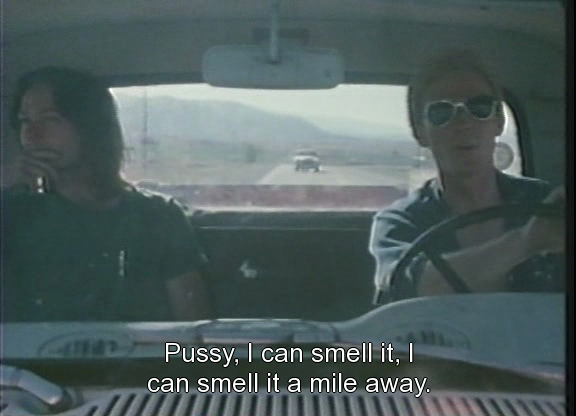
Despite having two young sons, Tom has no problem admitting to the hitchhiker, “I never wanted any kids, I never did, I never wanted any kids. And I got two of them, two of them. For not wanting any, that’s a whole lot,” hence why he is never home. Tom has been driving around for two months while pretending to look for work, yet he has the gall to say regarding his wife, “Of course Darlene is on my back, fucking bitch.” It is only when Tom begins speaking about his favorite subject, “pussy,” that he begins to tone down his grating self-pitying rants. Despite having a reasonably attractive wife that has sired two healthy sons, Tom still seems to think he is a young bachelor and tells the hippie hitchhiker, “Pussy, I can smell it, I can smell it a mile away. If I was blind I could smell it a mile away, I can smell it see. Smell that? There’s some pussy out there, you smell that? Gimme pussy! Fuck I’m horny, there’s some pussy around.” When Tom asks the hippie, “Hey, you got pussy waiting for you?” and he somewhat meekly replies, “I got a girl. I don’t think of her like that,” the mentally perturbed protagonist begins acting irrationally agitated and attempts to accuse his passenger of being a queer, stating, “Hey sunshine, all girls are pussy. You got me?” and asking him, “You one of them god damn funnies? That’s it, you’re one of them…what do you call them?” When the hippie complains regarding rural Montana, “everything is burnt up” and “…a lot of people will be in trouble if they don’t get some rain,” Tom gets even more ticked off and bitches, “What’s that got to do with me? […] I don’t see that shit, I don’t load that shit. There’s nothing there. There is nothing out there.” Naturally, when the hippie responds to Tom’s prideful and hostile ignorance by remarking, “You’d have to be blind not to notice that,” the protagonist decides that the hitchhiker is an enemy and soon kicks him out of his car, but not before the young man accuses him of being crazy. Unbeknownst to the hitchhiker, he is lucky that he survived the car ride, as Tom will soon kill another man for a much pettier reason.
Naturally, after randomly showing up at the house without so much as calling once over the course of the past six weeks, Tom is forced to face the wrath of his emotionally neglected wife Darlene (Jessica St. John of John Cassavetes’ Ted Allan adaptation Love Streams (1984)), who frankly states to her emotionally estranged hubby while applying make-up in the mirror, “You come home all lovey dovey trying to honey me up…and get you a piece of ass. I’m not dumb Tom. That’s one thing I’m not.” After Darlene complains about the fact that people look at her strange while she is at the grocery store because she has been reduced to using food stamps to get groceries since he refuses to work and properly provide for his family, Tom demonstrates his deep sense of psychopathy by refusing to accept guilt and instead angrily retorting, “Fuck. You think this is gonna help Darlene? I mean, you think this is gonna make me want to stay here and put up with all your shit? I mean, what? This is supposed to make me want to get a job…this is supposed to make me get up in the morning and make money…and what? Drive that fucking truck down in that fucking hole for Anaconda?” (apparently, Tom used to work as a miner). When Darlene tells Tom that he is “really fucked up,” he somewhat humorously replies, “I know that, I admit that. But you just have to say it again and again and again,” thus demonstrating that he is less perturbed by his defective mind than the fact that Darlene reminds him of the fact that he has a defective mind. Of course, Tom is not too happy when Darlene reveals that she is pregnant and then threatens him by asking him, “Am I gonna have to D-I-V-O-R-C-E you?” and then laughing in an almost sadistic fashion. Naturally, after his disharmonious conversation with Darlene, Tom decides to get back to doing what he does by best by wandering aimlessly on the open road.
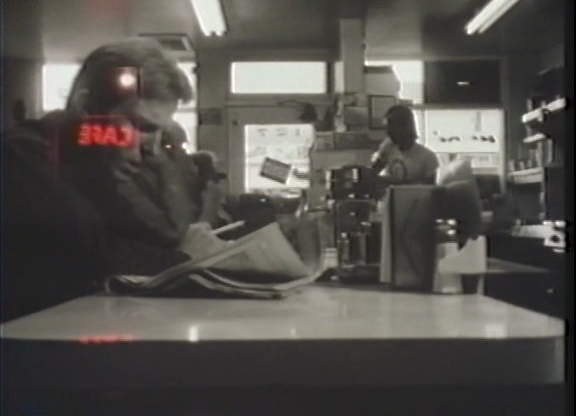
After driving around aimlessly all night, Tom goes to a diner where he unwittingly exposes his morbid mind by asking a swarthy hippie slob sitting next to him if he has read a letter featured in a tabloid newspaper where a woman complains that her husband forced her to soak herself in bath water for a long time so that she would resemble a wrinkly corpse while they had sex on their honeymoon. After self-righteously proclaiming that the newspaper is “nothing but garbage,” the idiotically idealistic hippie goes on a paranoid rant that somewhat intrigues Tom where he states, “It’s all bullshit. You know, these rags are put out by the government just to pacify people so that they forget about their real problems.” A deluded hippie bum that proudly lives off the government, the hippie espouses a sort of bullshit pseudo-back-to-nature philosophy and tells Tom, “If you just quit reading that stuff and do as the animals do, you’ll be alright.” Of course, for Tom, everything goes back to pussy, so he cannot help but ask the hippie about his sexual experiences with college girls. While there is no way in hell he would ever consider seeking a formal education and having to suffer listening to some bombastic beta-male liberal professor spouting off esoteric anti-reality theories about how to transform the world into a pan-sexual multicultural collectivist utopia, Tom is at least happy to hear from the hippie regarding the sexual proclivities of college girls that they are, “as willing as they get.” Undoubtedly, the diner scene with the hippie emphasizes that, despite his unyielding arrogance, Tom can get along with certain strangers, so long as they are just as morally bankrupt as he is, hence why he did not get along with the young dirty bohemian at the beginning of the film who was offended by his pathological use of the word “pussy” to describe women.
With his wife denying him her naughty bits during his brief stop at home, Tom soon goes on the prowl for young pussy at a local bar and soon begins somewhat awkwardly hitting on a 22-year-old dame named Mary who he foolishly accidentally calls “Sarah” while plying her with cheap beer and shallow flattery. Notably, it seems to take all of the energy that he has for Tom to pay another person a compliment and muster up the courage to say to Mary, “I’m guess I’m trying to say…I think you’re real pretty,” which the young lady is absolutely delighted to hear, but of course pussy is one of the few things that the protagonist is willing to make a ‘sacrifice’ for. When Mary playfully remarks that he is drinking too much, Tom almost botches his chance at young gash by getting somewhat angry with her and grunting, “I don’t like women telling me how to drink.” Like virtually all psychopaths, Tom cannot handle any form of criticism, even if it is in the form of a silly flirtatious joke. Of course, Tom eventually seals the deal by going back to Mary’s apartment and getting some pussy in a long 14-minute scene where The Tonight Show Starring Johnny Carson plays while the two characters have remarkably quiet and seemingly lackluster sex in the other room. Somewhat absurdly and inconsiderately, Tom makes the careless decision to call his wife Darlene in the same exact bedroom where he had sex with Mary not long after coitus has commenced. While Mary is lurking around the corner and listening to every single stupid thing that he says, Tom ends his phone call with his wife by calling her a, “Fucking bitch.” Although Mary heard a good portion of the phone conversation, including the antihero reciting his wife’s name in a nagging fashion, Tom treats his one-night-stand like a stupid fool and lies to her face by claiming that he was talking to somebody “about a job.” When he finally realizes that he can no longer keep defending his stupid half-ass lie, Tom's inner-psychopath rears its ugly head and, as a man that refuses to accept any form of responsibility and culpability, he blames Mary for his extramarital affair by saying to her, “I don’t remember being asked about a wife last night.” In fact, Tom goes so far as to accuse Mary of being a lecherous bar whore who was looking to catch herself some cowboy cock, stating to her, “Last night you would’ve taken on the whole goddamn bar.” Ultimately, Mary asks Tom to leave her apartment by saying “okay, bye,” to which the protagonist replies, “Fucking shit…wherever you go. I don’t have to listen to this bullshit […] Hey, no hard feelings.” As a psychopath that completely lacks empathy, Tom is never wrong, so it is only natural that he will inevitably up the ante in terms of his mean bastard behavior.
While Tom tells his one-night-stand “no hard feelings” after being a complete and utter asshole to her, it is clear by this point in the film that he is about ready to give up any pretense of humanity that he might have pretended to have before and begins studying the case records of various criminals, as if to compare himself with their backgrounds and to see if he has what it takes to be just like them. Indeed, Tom seems like he is admiring the funny page of a newspaper while reading the criminal profile of a 21-year-old high yellow negro named Roosevelt Green from Minter, Alabama who committed armed robbery, kidnapping, rape, and murder. Unlike the real-life people that he interacts with on a daily basis, Tom seems to feel a special kinship with these violent criminals and drifters just from reading their criminal records. In a scene where Jost seems to insinuate that it is not much of a leap for a country boy who hunts and kill animals to become a coldblooded murderer (Structural filmmaker James Benning seemed to use a similar technique in his feature Landscape Suicide (1987) in a scene where the dismembering of a deer is abstractly connected to the necrophiliac crimes of Ed Gein), a live bunny rabbit is not only depicted being clubbed to death, but also decapitated and then completely dismembered while its limbs are still moving. Immediately after the hare is hacked into pieces, Tom is depicted pulling off the road in his truck to assumedly help a somewhat overweight fellow whose car has just broken down. Upon talking to the man, Tom learns that his name is Fred Wilson and that he is also from his hometown of Butte, Montana. While Tom initially acts fairly cordial with Fred and intentionally asks him if he has children (which he does), he is merely putting up a false front as his motives are certainly less than savory.
After agreeing to take a look at Fred’s broken down car, Tom goes back to his truck under the pretense of grabbing some tools so that he can grab his trusty revolver. After shooting the shit a little bit more with Fred in a extremely comfortable and relaxed way that would make one assume that they are longtime best friends, Tom randomly declares, “Well I guess it’s time…it’s time, as good as time as any. Fred, I got something to tell you” and then points his revolver at the poor unwitting family man, who just happened to be at the wrong place at the wrong time. As reflected in petty remarks he makes, Tom is jealous of Fred because he is a fairly successful family man who owns his gas station and whose loving wife just bought him a new car (even if it is a piece of junk that broke down on him). Even though Fred only has a couple dollars on him, Tom demands all of his money, stating with a sickening sense of self-pity, “I’ll tell you why I have to have this. See…I haven’t got a goddamn job or a goddamn thing, Fred. You just bought this car…and you got a goddamn gas station. See this? [points to gun] This is all I got left. Now, I ain’t ever going home so it don’t much matter to me.” After taking his money, Tom leads Fred to the woods with his gun and deceptively attempts to calm the unfortunate gas station owner's fears by claiming that he only plans to tie him to a tree, adding, “ain’t nothin’ gonna happen to ya.’” Of course, Tom is lying and not long after the two men enter the depths of the woods and disappear from the frame, two gun blasts can be heard. Ultimately, Tom runs out of the woods by himself and seems somewhat excited by what he has down. In the end, Tom is depicted driving with a vacant expression on his face while occasionally picking his nose for about five minutes in a scene that potently reflects the antihero’s complete and utter lack of guilt in regard to killing a man. At the very conclusion of this final sequence, a rather fitting inter-title pops over Tom reading “(Dead End),” which is a perfect summary of the character’s life as a lone drifting loser of the psychopathic sort. Judging by how he executed the craven killing of Fred with such gleeful ease, the viewer can only assume that Tom has just begun his murderous reign of terror. Indeed, it seems that Tom has more than just pussy to look forward to now.
It is not very often that I watch a film and then completely forget that I had ever seen it, but that is exactly what happened to with me Last Chants for a Slow Dance, which I originally viewed about three years ago and rather enjoyed but completely forget about until rather recently after deciding to checkout Jost’s oeuvre and instantly gravitating towards wanting to watch his slow-burning psychopath road movie. Undoubtedly, upon watching the film for the second time, I genuinely felt like I was catching up with an old enemy. Personally, I think that I completely forgot about viewing the film because it felt more like a real life experience than a piece of vintage fictional celluloid art that I watched from the comfort of my living room. Indeed, the film’s antihero Tom Blair reminded me a lot of an undiagnosed psychopath that I have known for most of my life who has spent a good portion of his distinctly deplorable existence figuratively and literally wandering around in an aimless fashion while destroying various lives in the process just so he can have some temporary relief from the barrenness of his truly dead-end life of perpetual (self)destruction and nihilistic excess. Indeed, if someone were to ask me to recommend a film about an ‘everyday psychopath’ that lacks the gross romantic glorification of such psychologically forsaken individuals that is typical of Hollywood films like The Silence of the Lambs (1991), Cape Fear (1991), Basic Instinct (1992), and The Good Son (1993), among countless other examples, I would unequivocally name Jost’s masterpiece, which the auteur hoped would be seen by more mainstream audiences as indicated by his remark to Rosenbaum, “I mean, there’s no reason why LAST CHANTS FOR A SLOW DANCE shouldn’t book as well as a lot of Fassbinder. It’s certainly no less accessible.” It is interesting that Jost mentions Fassbinder, as the only film that I can really compare to his flick to is Warum läuft Herr R. Amok (1970) aka Why Does Herr R. Run Amok?, which is also a fairly minimalistic work with long static takes about a fairly mediocre mensch who commits a shocking and completely senseless act of violence in the end after getting fed up with the banality of his life and no longer being able to ignore his deep resentment towards his family. Certainly, aside from more or less reinventing cinematic storytelling, Jost was also able to make the psychopathic mind accessible to virtually anyone with his film which, although carefully constructed and exquisitely nuanced, never resorts to asininely arcane avant-gardism. Despite the director's clear dislike for certain aspects of the American West, Jost's respect for the landscape and kind simple folk of the area also bleeds through the film in an entrancing manner that you would never find in a Hollywood movie, so it should be no surprise that the auteur once stated in relation to Last Chants for a Slow Dance and its production, “I had lived in Oregon and Montana for five years, and the rural West was very real and familiar terrain to me, a place in which I felt at home and comfortable, nevermind its many rough manners. Despite the gun racks, the macho sexism, and the overall conservatism of the West, it is generally a place where people are genuinely friendly and helpful. For shooting a no-budget film like LAST CHANTS it was ideal: ask for a bar, you got it, no questions asked, no money exchanged. Aside from Tom Blair, whom I’d met when living near Kalispell when he was the theater department of the local community college, and Jessica St. John, a type-cast hooker sort in Hollywood TV productions who I’d met in LA, the rest of the cast were locals who I gathered in the space of a week. Places, trucks, people—what little I needed fell easily in my hands for the asking. True West.”
While not exactly the sort of film that one can expect the Criterion Collection to release anytime soon (though the company did include the documentary short Godard 1980 (1980) co-directed by Jost as an extra feature with their DVD/Blu-ray release of Sauve qui peut (la vie) (1980) aka Every Man for Himself), Last Chants for a Slow Dance did manage to make it into the fairly popular film reference book 1001 Movies You Must See Before You Die (2003) edited by Steven Jay Schneider where film critic Adrian Martin argues regarding Jost’s film, “The best index of its ambivalent sensitivity to the real world it traverses are its constant songs, simultaneously soulful and ironic tunes (“Hank Williams wrote it long ago,” runs one chorus) that take us far deeper than the smarmy musical pastiches in Robert Altman’s NASHVILLE (1975).” Indeed, aside from being thankfully devoid of the left-wing nihilism of Altman’s epically long-winded anti-musical, Jost’s film makes John McNaughton’s Henry: Portrait of a Serial Killer (1990) seem like a Herschell Gordon Lewis flick due to Jost's cultivated true grit approach to a lone psychopathic cowboy in America’s ‘Land of the Shining Mountains.’ Ultimately, the film seems like the sort of work that the dilettantes of Dogme 95 hoped to make but mostly failed miserably at. If there is any benefit to going to prison, Last Chants for a Slow Dance certainly stands out as a notable example, as if it were not for Jost’s real-life experience with hardened lowlifes while he was in the slammer, it is dubious at best that he could have created such an intriguingly insightful cinematic work that should be made mandatory viewing for any prospective police officer or film student. Of course, the irony is that Jost must have had an inordinately high capacity for empathy for him to understand the psyches of the less than empathetic psychopathic inmates who acted as the inspiration for the antihero of his film. One can only speculate the sort of war film that Jost might have assembled had he not been a draft-dodger and actually fought in the Vietnam War. As Jost’s hero Jean-Luc Godard once stated regarding his great contribution to cinema, “He is not a traitor to the movies, like almost all American directors. He makes them move,” and in nowhere does he move further than in his truly radically rugged road movie Last Chants for a Slow Dance.
-Ty E
By
soil
at
August 03, 2015
4
comments
Saturday, August 1, 2015
They Eat Scum
Maybe because I have not fried my brain on speed or acid, don’t have a fetish for pale chubby chicks with shitty attitudes and equally obnoxious black hair dye jobs, have not been obsessed with punk rock since I was a teenager, like a tad bit of substance and technique from my trash cinema, loathe highly derivative cinematic works that purport to be subversive and iconoclastic, and/or cannot tolerate filmmakers who have yet to learn how to properly use a simple tripod after decades of filmmaking experience, but I have to admit that I have always found the so-called Cinema of Transgression movement to be fairly worthless and irrelevant and I cannot for the life of me understand why it was ever regarded as any sort of cutting edge avant-garde movement. More or less the second wave of New York City filmmakers associated with the similarly overrated but somewhat more idiosyncratic No Wave Cinema scene, the movement emphasized philistinic shock value and pointless sex and violence and lacked the fairly more eclectic approach of their predecessors (for example, the No Wave filmmakers made war films, sword-and-sandal epics, sci-fi flicks, musicals, etc.) and, despite the fact that the group's tiny 438-word official manifesto declares that, “all film schools be blown up and all boring films never be made again,” virtually all of the so-called transgressive filmmakers associated with it subscribed to a sort of unofficial collective conformity involving low-camp ‘lo-fi’ post-Kucharian degeneracy and both literal and figurative juvenile masturbation that involved heroin, shitty third rate punk rock, ugly and out-of-shape girls with guns and physically and mentally weak men that like taking it in the ass, and all-things sexual dysfunction. Over the past decade, I have made various valiant attempts to get through a single film directed by the pretty boy messiah of the movement, Nick Zedd (The Wild World of Lydia Lunch, War Is Menstrual Envy), but I failed every single time as I found each of these works to be so hopelessly banal, intolerably technically inept, absurdly adolescent, and shockingly unoriginal that I just could not bring myself to suffer such superlatively stupid celluloid silliness in it's entirety. Indeed, I could not even bother to finish watching Zedd’s early 11-minute short The Bogus Man (1980) as it only took me a couple minutes to get tired of the plodding punk rock posturing and rather retarded visuals, so naturally I never thought that I could ever endure an entire feature-length film directed by the would-be ‘Prince of Puke’ (indeed, it seems Zedd was striving to be the next John Waters) yet I shocked myself the other day after managing to endure all 73-minutes of his directorial debut They Eat Scum (1979) and somehow I even founds parts of the crud-covered celluloid work to be quite funny and memorable, even if in a magnificently witless quasi-Troma-esque sort of way (in fact, Zedd is so avant-garde and/or desperate for work that he appeared in alpha-smut-speddler Lloyd Kaufman's Terror Firmer (1999)).
Somewhat seeming like it was directed by the piss poor Asperger-addled punk anti-lovechild of John Waters, Jack Smith, and Sid Vicious, the dimestore dystopian flick They Eat Scum tells a moronically labyrinthine and superbly spastic tale of hopelessly American apocalyptic cultural autism that features, among other things, albino negroid nerds, tranny poodle-penetrators, self-castrating eunuchs and skanky groupies with sewed up twats, cannibalistic negro-eating punk automatons, third rate fascistic heroin-addicted female punk rock vocalists, and various other forms of patently pointless sub-subhuman trash that only a unrefined nihilist hipster man-child like Mr. Zedd would bother to cinematically dream up. Indeed, watching a Nick Zedd film is like encountering a schizophrenic hobo masturbating with the aid of his own feces as lubrication while discussing the failed state of the democratic two-party system. Very much a fetishistic fantasy scenario for the filmmaker, the film was partly inspired by how the mainstream media portrayed the punk subculture as a serious societal threat and depicts the mirthful mayhem that ensues when a female junky punk rock singer from an ostensibly Evangelical Christian family incites her followers to engage in mass cannibalism and cause a nuclear meltdown so that she can takeover NYC and become the first cannibalistic Nazi-punk cunt queen of the super shitty city. While the title may be in reference to a group of thoroughly brainwashed punk automatons that cannibalize normal folk, They Eat Scum certainly can also be seen as reference to the viewer, who is forced-fed incessant primitive images by the sneering alpha-scumbag autistic-garde auteur. After watching the film, I could not help but think that Zedd is the kind of guy who enjoys regularly getting his ass kicked so that he can brag about it to his equally infantile lowlife buddies, but then again one could not expect anything less for a NYC underground untermensch that would be masochistic enough to fuck a swarthy slag like Lydia Lunch. Needless to say, They Eat Scum stars a Lydia look-alike she-Führer who naturally lacks the elegance, charm, and good-breeding of the eponymous blonde beastess of Ilsa: She Wolf of the SS (1975).
If you need irrefutable evidence of the fact that the culture-distorters in Tinseltown have been more successful than any other group in human history in terms of demonizing a people when it comes to their unwavering smear campaign against the National Socialists and Germanic people in general, just watch They Eat Scum and see how many times underground mental midget Zedd incorporates the swastika as a conspicuously childish form of shock value that could only be effective on the average American or any other viewer that has had a Hollywood lobotomy. In fact, when asked in an interview featured in the book Art That Kills: A Panoramic Portrait of Aesthetic Terrorism 1984-2001 (2011) about his fetish for the almighty Hakenkreuz, Zedd proudly confessed, “Yeah, Swastikas are always a good way to get a knee-jerk reaction, to piss people off. A timeless symbol. Anything to shock and offend or confront a complacent audience, and anything to be anti-art.” Rather unfortunately, Zedd gives the swastika the potency and depth of the McDonald's golden arches logo, which is to some extent fitting as the film is the avant-garde cinema equivalent of fast food, as it is cheap, digests poorly, and is prepackaged with the sort of expertise that one would expect from a ghetto-dwelling petty criminal who will do anything to avoid having to learn a real trade. Luckily, Zedd’s film also attacks the Jews and their spiritually and culturally cuckolded Zionist Christian allies. Unlike his mostly negrophiliac predecessors in the No Wave movement, Zedd is also no more kosher what it comes to poor colored folk, as he even had the gall to exploit the absolutely accursed genetics of a Woody Allen-esque bug-eyed albino negro who seems to suffer from a terrible case of ADHD. Zedd’s zanier than sick obsessions also include Romero-esque flesh-eating, self-castration, mass infantilism, live punk rock shows at popular clubs like CBGBs and Max's Kansas City, the dysgenic and genetically mutated, retards and freaks, Mr. Rogers, kitschy religious icons, and other things that make the director seem like a quasi-heterosexual John Waters wannabe who whored out his scrawny pimple-ridden ass to the Kuchar brothers. Centering around a suburban motherless family with an evangelical Christian father, loser transvestite son with a precarious poodle fetish and murderously misanthropic identical sisters who both attempt to takeover NYC and turn it into the most genocidal and chaotic place since Haiti, They Eat Scum is ultimately a ‘feel-good’ film for fiercely fucked people who like their lowbrow humor to be completely devoid of morality and good taste, among other things. In other words, the film is not a bad way to waste 70 minutes or so, especially if you're itching for some punk-tinged toilet humor that somehow paradoxically reminds the viewer that American culture was slightly less shitty a couple decades ago.
For whatever reason that is probably only known to doper Zedd himself, They Eat Scum opens with a sickeningly spastic and exceedingly retarded four-eyed cripple mutant sporting ‘whiteface’ being spoon-fed what looks like liquid diarrhea, which is ultimately what the anti-auteur plans to figuratively do to the viewer with his darkly jovial and aesthetically nihilistic film. Notably, the over-extended introductory sped-feeding scene is juxtaposed with a disturbingly sappy Mr. Rogers song that somewhat fittingly concludes with the line regarding the benefits of being a child as opposed to being an adult, “You can do many things that grownups can’t do anymore. For one thing, you can pretend you’re all grown up.” Of course, Zedd does not even pretend to want to be an adult and the film ultimately seems like an intricately frivolous and ultimately incoherent argument as to why growing up sucks and should be avoided at all costs. After the insanely inane intro, the viewer is transported to Brooklyn, NYC where eccentric fat old Evangelical whackjob Mr. John Wesley Stain and two of his three distinctly mentally disturbed children (the third ‘kid’ is not revealed until much later in the film). Demonstrating that he is a good little Christian cuckservative, patriarch Stain loudly recites to his ugly tranny son Jimmy aka ‘Jim’ and junky punk daughter Suzi Putrid (Zedd's then-girlfriend Donna Death of Rachid Kerdouche’s Final Reward (1978) and Zedd’s Geek Maggot Bingo or The Freak from Suckweasel Mountain (1983)) during a seemingly improvised dinnertime prayer, “Blessed be our neighbors [undecipherable] hapless Jewish immigrants, and mighty lord Abraxas, Menachem Bagel, pray…bless us and...” After the somewhat botched prayer, Daddy Stain informs his daughter that he has set her up with a scientist’s mechanic named Herman Barbell and he wants her to give him an “extra special welcome,” but little bitch Suzi immediately becomes extremely agitated and moans in an insufferable fashion, “Shit, not another nerd, Pap. I’m getting tired of all those nerds you keep sending over.” Jimmy is also not too happy with his papa's sleazy matchmaking scheme as he is jealous of his sister’s regular gentlemen callers and complains in an obnoxiously whiny fashion, “What about me and Polio, Pap? Me and Polio never get any visitors.” Of course, as a less than charming chap that has less testicular fortitude than his own sister and resembles a tranny serial killer à la Buffalo Bob of The Silence of the Lambs (1991), Jimmy boy does not have much to be happy about. Since he is a sexually confused “blasphemer” and unrepentant zoophile that is literally in love with his pet poodle Polio, Jimmy is simply told by his father after complaining about his lack of male visitors, “My son…I pray for you. A day doesn’t go buy where I don’t pray for you. Someday, the good lord will answer my prayer…I hope.” Luckily, the entire family will soon be put out of its misery as a result of the cunning conspiratorial schemes of the dead matriarch’s particularly perverted and no less demented crypto-cross-dresser brother.
When Jimmy makes the foolish mistake of leaving a used condom sitting around the house, his father, who points at his son while curiously wearing the semen-soaked rubber on a couple of his fingers, accuses him of being a “smut-peddler” and harshly punishes him by taking away his beloved pooch Polio and locking him in the bathroom for a week. Unfortunately for Jimmy, Mr. Stain puts poor Polio in Suzi's sadistic hands. Meanwhile, Suzi’s gentleman caller Herman shows up and completely disgusts the young lady because he is an autistic albino negro nerd whose eyes are virtually popping out of his head and who attempts to compliment the punk princess' black books by comparing them to a West African black fly, which he gleefully describes as being able to deposit worms under your skin while they suck your blood. In fact, Herman is so autistic and ADHD-addled that he does not even notice when Suzi walks out of the room will he continues to express an almost amorous delight in discussing the pernicious essence of the black fly. Just like his daughter Suzi, Mr. Stain is mentally enslaved to his dead wife’s distinctly debauched brother Mr. Wizard (aka ‘Little Simon’) and even follows his order to put 100% his will in his name. A sicko sadist that killed his sister so that he could steal her prized dark green dress and ultimately assume her identity, Mr. Wizard is in love with a tranny blow-up doll, which he romantically whispers to, “It doesn’t matter that you have a rubber brain. When it comes to lust, they’re all the same.” As a man on a rather ambitious malefic mission, Mr. Wizard got his niece Suzi addicted to heroin so he could brainwash her into brainwashing the fans of her popular ‘deathrock’ group Suzy Putrid and the Mental Deficients, which also acts as a quasi-mystical cult that inspires its braindead fans to indiscriminately murder people for sport. Indeed, while performing on stage with her punk band at CBGBS, Suzi demands that her mindless fans become abstinent mass murderers, arguing that they should kill everyone, be they, “Black or white…Young or Old…If it moves, kill it.” As for sex, Suzi seems to hate it even more than she loathes dressing like a female, proselytizing to her adorning fans, “Remember, fucking is for animals. There will be no sex. If you can’t control yourselves, cut off your cock…sew up your cunts…or better yet, let me do it, for I am your god.” Naturally, as starstruck automatons that are even dumber and more deleterious than GG Allin’s groupies, Suzi’s fans immediately oblige her and soon begin murdering and cannibalizing random people on the streets of Brooklyn, including negro gangsters, Hasidic Jews, and other forms of rather repellant ethnic rabble that once acted as the inspiration for the anthropomorphic monsters in the horror stories of H.P. Lovecraft.
Now in control of her brother’s beloved doggy Polio due to his week-long banishment to the family bathroom, Suzi decides to bring the poor pup to a decrepit doggy whorehouse that gentleman Jim frequents and blackmails the drag queen madam named Mrs. Wanger into giving the dog rabies with the threat that she will tell the dreaded SPCA about her “sordid business.” Naturally, as a successful business owner that charges $100 per her hour for prospective clients to get more than platonic with man's best friend, Mrs. Wanger follows Suzi’s deranged demand. Meanwhile, Father Stain regularly taunts his son Jimmy by standing outside the bathroom door that he is imprisoned inside and incessantly repeating, “You’re an underachiever, Jimmy.” After complimenting her performance backstage at CBGBs by telling her that she has a talent for “asserting a vice-like grip on the crowd” while she shoots junk into her arm right next to him, Mr. Wizard recommends to Suzi that she kill her entire family and she replies, “Mr. Wizard, you have all the answers.” Of course, Suzi gets all the more pumped up for familicide after learning from a terribly pedantic Uncle Tom newscaster on TV while simultaneously reading a “Penis Enlargement Techniques” magazine whilst lying panty-less in bed that her band Suzy Putrid and the Mental Deficients inspired a number of local violent crimes, including acts of vampirism. Indeed, some of Suzi’s fans gorge on some street negroes while a four-eyed white dork intentionally has himself run over by a car while “Good Vibrations” by the Beach Boys is humorously blasted in the background. Like many punks (and probably Nick Zedd), Suzi’s fans are resentful failed members of the bourgeois who have decided to wage war against the society that rejected them, so they like saying silly and unintentionally hilarious things like, “Everyone’s trying to be middleclass, even the Puerto Ricans.” To demonstrate their hatred of their middleclass, Suzi and her gang of punk rock goons kidnap a scantily dressed young girl, tear off all of her clothes, shove a rat down her throat like it is a giant cock, and then dismember her body, especially her tits, with an electric saw and then collectively devour her limbs and organs in a ritual act of Romero-esque punk rock paganism. When Jimmy kicks the bucket after releasing rabid pup Polio in the family home, Father Stain decides enough is enough and is not only provoked to kill the family dog by blowing it away with a shotgun but also his beloved daughter who he hoped that he could one day pimp out to a wealthy gentleman caller. In fact, Mr. Stain is so bloodthirsty that he actually commits the blasphemous act of entering the unholy demonic grounds of Max’s Kansas City and then slits his daughter’s throat in front of all of her adoring fans. Needless to say, Suzi’s fans respond to Mr. Stain’s uniquely unpardonable sin of punk rock deicide by ripping the old man to shreds, or so the viewer assumes (his death is not depicted onscreen, but instead simply reported by the Uncle Tom news anchor, thus hinting that Mr. Zedd probably ran out of special effects money at some point during the film's production).
In an assumed mockery of Jesus Christ’s resurrection, Suzi is subsequently featured in a coma at a mental institution after her death via paternal filicide as if she somehow managed to come back to life, though it ultimately proves not to be her but her estranged identical twin sister ‘Poxy’ who fell into a deep eight year sleep after being brutally raped by her unhinged uncle Mr. Wizard. Although initially seeming both saner and tamer than her dead twin upon miraculously awaking from her coma as a result of Mr. Wizard apparently electrocuting her body, Poxy becomes completely bat-shit crazy upon being reunited with her unhinged uncle, who not only raped her as a little girl but also killed her mom by causing her to get impaled by the horns of a bovine named ‘Bessie the Cow’ after pushing her out of a barn window. Confusing Poxy for her sister, Suzi’s fans rescue her from the mental institution and take Mr. Wizard hostage. Almost immediately after being rescued, Poxy becomes a bigger mass-murdering megalomaniac than her dead sister and even proudly declares upon being shown two fans that mutilated their genitals in tribute to her, “These are not fans. These are loyal subjects…slaves who surrendered their entire universe to my authority.” When Mr. Wizard attempts to coerce Poxy into telling her fans to let him go, the deathrock diva vehemently screams in his face while displaying an overwhelming thirst for bloody vengeance, “You, Mr. Wizard, are the lowest form of human life…You spineless, perverted parasite! You killed my mother…you raped me when I was 8…you turned my sister into a heroin addict and my whole family into a row of corpses. You, Mr. Wizard, are an obscenity on the face of this earth. The viciousness of your crimes can only be avenged in one way: On the surface of my super-deluxe-outer-space turntable.” As punishment for his crimes, Mr. Wizard is decapitated after Poxy straps him to a gigantic record player. As reflected in her decided delusions of grandeur and ludicrously lofty ambitions, not to mention her unquenchable lust for blood and castration, Poxy seems to have ironically inherited the same genetic taint as the uncle that she loves to hate, thus it is only a matter of time before she botches her plans and is murdered in a fashion that is no less disgraceful than that of Mr. Wizard and her many victims.
After liquidating Mr. Wizard, Poxy murders the Uncle Tom newscaster on live television and then stares into the camera and self-righteously declares to the populous of the city, “My name is Suzy Putrid and you, New York, are the scum of the earth. All you listen to is disco…you deserve to die and before this broadcast ends, you’ll begin to feel effects of a disease for which there is no cure.” Indeed, Poxy has her fans cause a core meltdown at a nuclear power-plant in New Jersey that is only 24-miles north NYC, thus causing 100,000 people to die instantly and many more to succumb to slow and painful deaths as a result of radiation poisoning. After radiating a good portion of the city’s population, Poxy declares herself the ruler and ‘Death Queen’ of the multicultural metropolis, secedes from the union, and fittingly renames the area ‘Necropolis.’ Of course, like most big plans, Poxy's radiation epidemic has some less than ideal unintended consequences that involve the birth of a race of monstrous anthropomorphic mutants who ultimately do not take too kindly to her reign of terror. Flash forward 20 years later and murderous mutant rebels are revolting against the Death Queen and her nihilistic neo-Nazi dictatorship. Ultimately, Poxy dies a dishonorable death via giant mutant cockroach after refusing to listen to her queen-ish queer adviser. As the mutants raid Poxy’s headquarters, “YMCA” by the Village People plays triumphantly in the background (it should be noted that Poxy's adviser describes the classic cocksucker song as “the sound of revolution” and “mutant disco”). Ultimately, the film concludes with a narrator rhetorically asking questions like: “Will the normal cockroach outlive man?” and “Is man a disease?” In a potential nod to the conclusion of They Eat Scum, Mexican-born Cinema of Transgression figure turned academic Manuel De Landa might have been inspired to direct the short Judgement Day (1983) aka Massive Annihilation of Fetuses, which features a number of real-life cockroaches being tortured to death and was described by the director as, “...my tribute to the real master race that will soon inherit the planet [...] Cockroaches have not only invaded the flip side of my house (i.e., the back of my kitchen, the other side of my walls, etc.) but they have also taken over some areas of my unconscious….Since I started the film the structure of my nightmares has changed, almost as if I had violated their laws and they were getting ready for revenge.”
Notably, in his The Cinema of Transgression Manifesto that was printed in a 1985 issue of the fanzine The Underground Film Bulletin under the unsurprisingly moronic pseudonym Orion Jeriko, Nick Zedd wrote regarding his self-stylized celluloid pseudo-religion, “All values must be challenged. Nothing is sacred. Everything must be questioned and reassessed in order to free our minds from the faith of tradition. Intellectual growth demands that risks be taken and changes occur in political, sexual and aesthetic alignments no matter who disapproves. We propose to go beyond all limits set or prescribed by taste, morality or any other traditional value system shackling the minds of men. We pass beyond and go over boundaries of millimeters, screens and projectors to a state of expanded cinema,” yet They Eat Scum, like many films associated with the movement, fails to slaughter a single sacred cinematic cow, lacks any seriously subversive or sensible political messages, is innately derivative (notably, Zedd once even went so far as to steal images from German auteur Ulrike Ottinger's avant-garde epic Freak Orlando (1981) for an ad for his film Whoregasm (1988)), and is almost completely devoid of the sort of graphic sexuality that such similar works are (in)famous for. Indeed, if you want to see a truly anarchistic and strikingly strange film associated with the Cinema of Transgression movement, checkout Manuel De Landa's distinctly directed and decidedly discombobulating anti-noir micro-epic Raw Nerves: A Lacanian Thriller (1980). At best, Zedd's film is like the NYC underground equivalent to a Hollywood stoner comedy like Half Baked (1998) and it certainly seems superlatively softcore compared to the doc Hated: GG Allin & the Murder Junkies (1993) directed by Hebraic Hollywood hack Todd Phillips (Starsky & Hutch, The Hangover franchise). In a world where Hollywood openly backs pedophiles like Roman Polanski and Woody Allen yet blacklists bad goyim like Mel Gibson simply for saying something less than positive about god's chosen tribe or expressing a religious objection to two sexually promiscuous fairies pretending to be husband and wife, They Eat Scum now feels like a playful diversion that was directed by the hipster equivalent of an inebriated fratboy who gets a cheap narcissistic thrill out of lighting his farts on fire while in the company of his frat comrades. Indeed, mainstream America has become far too debauched, eclectically moral bankrupt, and spiritual retarded for Zedd to be relevant nowadays, not to mention the fact that fellow Baltimore-born filmmaker John Waters did much more subversive things in the same vein many years before with works like Pink Flamingos (1972) and Desperate Living (1977). Luckily for Zedd, Waters is a fan of his debut feature, or as he stated in the documentary Blank City (2010) directed by Celine Danhier, “I like the whole idea of the movie…I mean, THEY EAT SCUM, which is still maybe one of my favorite titles in the history of titles.”
In Blank City, Zedd more or less revealed his dubious objective as a filmmaker when he stated regarding They Eat Scum, “The front-page of The Wall Street Journal called it, ‘the vilest and most revolting performance I have ever seen…Please do something to stop it.’ And I was quite elated to get this kind of attention…and this kind of outrage.” As his comment transparently demonstrates, Zedd is not a serious artist by a carny dilettante and punk rock prankster with a cheap Super-8 camera who pointlessly seeks attention for attention’s sake and does not have much more to offer. Indeed, it oftentimes crossed my mind while watching his debut feature that Zedd is internally imprisoned in a perpetual state of adolescence where he is trying in vain to receive the attention—be it positive or negative—that his parents assumedly denied him as a child. Although one of the more humorous running jokes of the film, I could not help but think that when the evangelical Christian father John Wesley Stain says to his son, “You’re an underachiever…Jimmy,” Zedd was depicting his own father and the way he treated him. In a great example of Zedd’s own delusional and megalomaniacal overestimation of his own films, the filmmaker actually had the audacity to argue in the documentary Llik Your Idols (2007) directed by Angélique Bosio as a defense for why no one gives a shit about his work, “The more hidden and marginalized something is, the more subversive and revolutionary…and, in the future, more and more people will become aware of what I’ve done. It’s just that now I’m sort of buried alive.” Of course, history has proven the opposite, as Zedd has become less and less revered among cinephiles as the decades have passed while fellow subversive avant-garde filmmakers that also utilized cheap Super-8 cameras like Teutonic aberrant-garde blond beast Jörg Buttgereit and especially Nordic Canadian auteur Guy Maddin are becoming more and more popular, even though the former more or less abandoned filmmaking for about two decades. Notably, in Llik Your Idols, Zedd’s comrade Richard Kern demonstrates that he is more humble and sensible in regard to his place in cinema history when he states, “As a filmmaker with The Cinema of Transgression, it was just an involvement based around getting high and making movies…and having fun. I didn’t think anything would come of it.” Ultimately, They Eat Scum works best as a punk prank at the expense of bratty man-child hipster Zedd and the NYC underground as a whole, as it is a work that strives for artistic greatness but ultimately features the artistic integrity of one of Jack Smith’s cum-covered AIDS-ridden farts. Still, a constantly comical piece of filmic feces that has the gall to mock a uniquely ugly and rodent-like Israeli terrorist like Menachem Begin by having a half-crazed Christian cuck refer to him as ‘Menachem Bagel’ cannot be all bad. Indeed, Zedd may subscribe to the politics and aesthetics of punk rock puke, but at least he is not a politically correct pansy or self-loathing negrophile like the majority of people that have ever been historically described as New York City avant-garde filmmakers. In fact, if I were to credit Zedd with any notable accomplishment, it would be helping to put the final nail in the coffin of NYC avant-garde with his innately derivative celluloid senselessness and absurdly infantile approach to anarchy and nihilism. Certainly with They Eat Scum, cinematically vomited on every underground NYC auteur that came before him by reducing their motifs and beliefs to unintentional parodies, thus it is a work that should be seen by any serious self-disrespecting cinephile or lapsed hipster hobo.
-Ty E
By
soil
at
August 01, 2015
8
comments
Subscribe to:
Posts (Atom)
Soiled Sinema 2007 - 2013. All rights reserved. Best viewed in Firefox and Chrome.