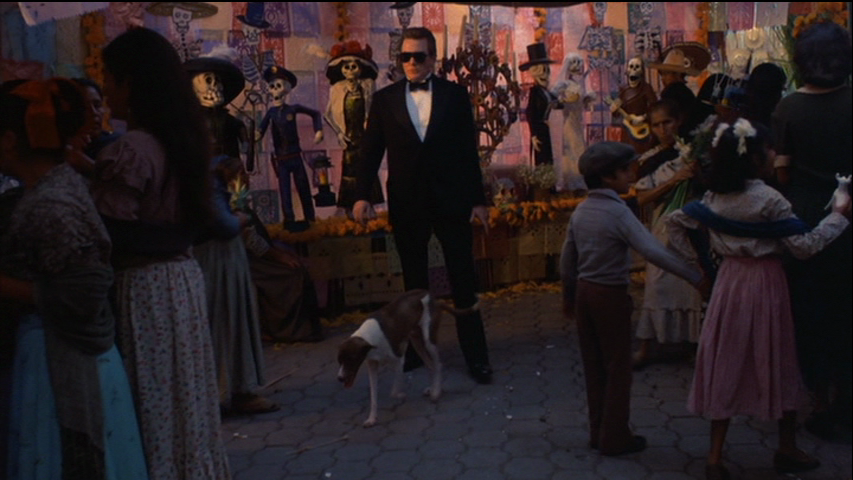
As a filmmaker from a strict Dutch Calvinist background that makes intellectually oriented films about supremely fucked-up and oftentimes self-destructive individuals who once confessed that he was finally able to learn how to properly touch and have normal relationships with woman by hanging out with very touchy-feely oriented gay men, film critic turned screenwriter turned cinematic auteur Paul Schrader (Mishima: A Life in Four Chapters, The Canyons)—arguably the last worthwhile and fairly untainted filmmaker of the so-called New Hollywood movement—does not exactly seem like someone that would be suitable for directing a lavish tragic romance with a sort of classic Golden Age Hollywood style yet he did just that and naturally it is one strange and sometimes baffling cinematic monster that makes love seem like a morbid mental illness that consumes the soul. Indeed, Schrader’s self-described “beauty film” Forever Mine (1999) is, in many ways, not only the director’s most bizarre work, but also his most overt artistic disaster as a shockingly ambitious flick that is ultimately, quite unfortunately, less than the sum of its parts, though nonetheless certainly worth seeing at least once, especially for those that already have an appreciation for the auteur (after all, the film is superior to a number of the director's other works, including Blue Collar (1978), Light Of Day (1987), Witch Hunt (1994), Touch (1997), Dominion: Prequel to the Exorcist (2005), Adam Resurrected (2008), and the studio-destroyed The Dying of the Light (2014)). In fact, I would almost argue that the film is a cinematic tragedy, as a would neo-Sirkian romantic epic that was supposed to seamlessly weave elements of a Scorseseian guido gangster flick and a De Palma crime-thriller, yet ultimately does not completely work as it was supposed to due to various reasons, not least of all lead Joseph Fiennes' glaringly uneven performance in a dual role. As Schrader has described in interviews, Fiennes had the impossible tasking of playing “Leonardo DiCaprio in TITANIC and Pacino in CARLITO'S WAY in the same movie.” As for female lead Gretchen Mol, she demonstrates that she was a cold yet compulsively cute cunt long before her role as the always charming son-fucking whore murderess Gillian Darmody on Boardwalk Empire (2010-2014).
Originally written by Schrader in the late-1980s for producer Alan Ladd (not to be confused with the tragic actor of the same name) at MGM and later brought to Columbia Pictures where Patrick Swayze of all people was originally scheduled to play the lead role, Forever Mine was ultimately put on the backburner for over a decade until after the director began filming his minor masterpiece Affliction (1997) in Montreal and he randomly met a Sri Lanka-Born conman named Damita Nikapota—a supremely shady fellow that was later imprisoned for using dead film producers' identities and producing imaginary films with titles like ‘The Flying Scotsman’—who luckily agreed to raise funds for the film. While Schrader finally managed to complete his dream romance flick, it succumbed to a similar sorry fate as many of his other films and ultimately made its debut on the Starz! cable channel instead of theaters after the film’s production company went bankrupt and its assets were taken over by its Dutch insurers, who did not seem too keen on even promoting the film. Described by Schrader himself as being, “…nineteenth-century schmaltz: the formerly-thought-dead lover comes back in altered form, that Count of Monte Cristo/Heathcliff thing. I was trying to tap into the old sense of melodrama, with very lush visuals, and make a retro movie,” Forever Mine is indeed an oftentimes pleasantly pulchritudinous yet mean-spirited and even misanthropic piece of rather refreshing filmic fluff with a dark and demented romantic edge that questions the sanity of individuals that completely submit to pure love, especially when it involves a treacherous woman that has proven beyond a reasonable doubt that she can never ever be trusted. In short, the film more or less portrays men that devote themselves to one single woman as recklessly self-destructive fools with their heads in the clouds who do not know when to quit and women as petty and callous and almost wholly glacial creatures that tend to prefer being with a wealthy and powerful man who cannot even get their pussy wet to a modest man that they love and have an otherworldly sexual relationship with.
Featuring an original score by David Lynch regular Angelo Badalamenti, Schrader's rather artistically ardent film depicts in a somewhat aesthetically schizophrenic way the internal purgatory a young lovelorn man is trapped in after finding his one-true-love in a sunny beach paradise, only for said one-true-love to betray him in a nearly deadly fashion that results in both his physical and psychological transformation in what is ultimately a rare relatively contemporary American movie that demonstrates in a largely allegorical way the sort of misery that a woman can afflict on her lover, especially when monetary concerns are involved.


As made quite clear in Easy Riders, Raging Bulls (1998) by Peter Biskind, Schrader is anything but a lady’s man and when he was getting his start as a young screenwriter in Hollywood during the 1970s, no woman wanted anything to do with him, or as one excerpt from the book reveals, “Women didn’t like Schrader, didn’t appreciate his finer points. He had a crush on [Margot] Kidder. One night, the two of them were driving along Sunset in his car to meet Brian [De Palma] at a screening. ‘Kiss me! Kiss me!’ he implored, out of the blue. She pulled away […] Paul was crushed, felt like he must display the mark of Cain. She slept with everything in pants—except him […] Like Kidder, Sandy Weintraub couldn’t stand Schrader: ‘Paul was a very messed up human being. When he left his apartment, he went to a bar and sat there and drank all night.’” Indeed, when not bonding over guns with Hebraic ‘Zen Fascist’ John Milius and hanging out with his cocksucking comrades in a cocaine-fueled gay party scene, Schrader was failing badly with the ladies and it was only when he became an established filmmaker that things began to slightly change. For example, while working on his first self-described “beauty film” Cat People (1982), Schrader began a short-lived ‘romance’ with lead heroine Nastassja Kinski that ended with a failed marriage proposal and the filmmaker traveling to Europe to chase his love interest, who ultimately terribly humiliated him by stating, “Paul, I always fuck my directors. And with you it was difficult.” Like Cat People, Forever Mine features a Dante and Beatrice motif, though it is clear that Schrader, who went on to marry and have children with actress Mary Beth Hurt, has grown quite cynical as the years have passed in regard to pure love, especially when it comes to seemingly immaculately beauteous young women whose physical allurement is in stark contrast to their minds and souls. A sort of gleefully genre-bending romance-crime-drama-thriller that updates the theme of classic ancient Occidental myths like Tristan and Iseult and Orpheus and Eurydice in regard to love and sexuality compatibility not exactly always making for the most perfect of relationships, Schrader's artistically enterprising experiment in narrative construction is a sort of romance flick for cynics who have given up on love yet still have nostalgia for past loves.


Schrader’s first film shot in CinemaScope, Forever Mine is somewhat of an unintentionally eccentric aesthetic enigma as a cinematic work that transforms from a sort of candycolored beachside fairytale into a bourgeois Victorian Gothic erotic thriller, with early Fassbinder style dilapidated apartment scenes, flagrant Scorsese-esque Catholic imagery, and post-industrial ruins thrown in for good measure. Indeed, the film might by a mess of a movie in various ways, but it is a surprisingly enthralling mess of a movie with an oftentimes unpredictable yet absurdly improbable storyline that defies all sense and logical to the point of being embarrassingly addictive, even on subsequent viewings (in fact, I have watched the film four times and it holds up each time). Featuring stereotypically boorish and moronic garlic-marinated guido gangsters with fragile egos, a shamelessly and psychopathically corrupt politician that find romantic poetry to be the language of a raving retard, an Anglo-Saxon college student that magically transforms into extremely wealthy disfigured Latino black market ‘banker’ with connections to Contras and the South American drug underworld, and a fine ass female protagonist whose insufferable frigidness can only be penetrated by the protagonist’s prick and incessant flowery poetic pronouncements, the film may have various dubious ingredients that have about as much as chemistry as Godiva chocolate and sun-fried dog shit, but it never fails to enthrall and surprise. Undoubtedly, another intriguing element of the film is that it features a sort of Dionysian hero that makes insanely irrational and oftentimes highly deleterious decisions for love and an Apollonian antagonist that is a cruel and calculating politician who specifically loathes the protagonist because of his talent for lurid love poetry and absurdly romantic Weltanschauung. Indeed, to the scumbag antagonist’s credit, the protagonist is nothing if not a ludicrously lovesick fool who practically invites his own death not once but twice just so that he can prove to himself that his “love is pure,” hence his vocal willingness to die for love.


After beginning with the somewhat fitting yet slightly pretentious Walter Pater quote, “It is the addition of strangeness to beauty that constitutes the romantic character in art” and an opening credit sequence featuring an almost obscenely pink fantasy castle that is ultimately revealed to be a hotel (in fact, the hotel in question, Loews Don CeSar Hotel in St. Pete Beach, Florida, was also used in Robert Altman's HealtH (1980) and Sergio Leone's Once Upon a Time in America (1984)), the film cuts to a shot of a man with a disfigured face named Manuel Esquema (Joseph Fiennes) sitting on an airplane next to his friend and body guard Javier Cesti (Vincent Laresca) while looking particularly forlorn, as if he is haunted by something and/or someone from his past. The year is 1987 and Esquema—a WASP pretending to be a Latino that has literally created a totally new identity for himself—is flying from Miami to New York to confront his past in the form of both the woman he loved who betrayed him and the man that thought he killed him. The last time these two people saw Esquema, he was a poor bum with big romantic dreams that lived in a dirty dilapidated apartment, but now he is an extremely wealthy international financier that does business with banks from all around the world, especially dirty ones. Flash back “14 years earlier,” the same man is depicted riding a bus to a Miami, though his name is not Esquema but Alan Riply and he is a terribly naïve yet passionate 23-year-old college student that has come to the coast of southeastern Florida to work as a lowly cabana boy at a luxury castle-like hotel with his somewhat hyperactive Hispanic homeboy Javier. While Javier attempts to coerce Alan into getting into the drug dealing business with him, the protagonist has his mind on somewhat more savory and romantic things, especially after he randomly spots a blonde beauty named Ella Brice (Gretchen Mol) emerging from the water one day while he is working on the beach. Using his job as a cabana boy as a reason to immediately introduce himself to her, Alan almost immediately becomes wax-poetic around Ella, who seems intrigued with the protagonist’s somewhat idiosyncratic way with words, radiating charms, and inordinate kindness and empathy. Of course, as a seemingly long-suffering wife in a lonely one-sided marriage with an up-and-coming New York politician who clearly is more interested in his work than her tits and ass, Ella cannot help but be smitten with the cute and charming cabana boy, who has her complete and undivided attention. As Ella will later confess to Alan, she, like many women, only married her husband Mark Brice (Ray Liotta) for his power and money, as she was previously a poor secretary that was ashamed of her humble background and cheap clothes. Needless to say, when Ella ends up falling in love with the poor cabana boy, she has a hard time fighting her natural female instincts towards hypergamy and cannot possible fathom dumping her successful husband for an eccentric hopeless romantic who speaks in riddles and does not have a penny to his name.


Naturally, as a man that seems to believe that he fallen in love at first sight and is convinced that he must dedicate every moment of the rest of his life to one single woman, Alan—an obsessive romantic that spends his free time in his scantly decorated one-room apartment staring at a photo of his love interest—almost immediately begins borderline stalking Ella and when the heroine soon realizes this she becomes both fearful of and infatuated with the eccentric young cabana boy. Indeed, after strategically recommending that her husband Mark go to the hotel’s nightclub one night, Alan shows up to said nightclub to spy on Ella while lurking in the shadows like a shy Don Juan that has yet to completely cultivate his romantic moves. When Ella leaves the club alone, Alan follows her home to declare his love for her, stating, “I think you’re extraordinary,” but she coldly replies, “There’s always another woman.” While Ella blows Alan off and tells him, “If my husband even saw us standing here—he doesn’t think anything is innocent,” she is clearly intrigued by the protagonist and voyeuristically gazes at him from her hotel window after they part ways, as if she regrets not immediately jumping on his cock. Indeed, one gets the impression that Ella got extremely wet as a result of the short conversation with Alan and immediately diddled her clit upon entering her hotel room. The next day, Alan is quite delighted when Ella approaches him on the beach while carrying a pink bikini and boldly declares to him in an overtly salacious fashion, “I was wondering what it would be like for us to kiss.” Not only do the two soon kiss right there on the beach, but Alan also manages to coerce Ella into faking sick as a way to blow off a boat trip with her husband so that she can spend the evening with with him instead. Needless to say, Alan and Ella immediately make otherworldly orgasmic love that clearly penetrates the heroine in a fashion that she previously never felt possible. After the lovemaking session, the two go to a local bar where the two act like completely innocent youthful high school lovers and Ella states to Alan in an unintentionally incriminating fashion during a rare moment of vulnerability, “Sometimes it just amazes me. We’re all so self-centered. And then you look around and you see everyone else. Everyone is the main character in their lives. They all have a story.” Of course, as the trophy wife of an insanely arrogant and self-centered opportunistic asshole who does not take her seriously, Ella barely has a life and she makes for an awfully banal and passive main character in her own story.


Despite everything being so perfectly magical during their wild and wanton day of fucking, Ella demonstrates that she might be a tad bit bipolar by randomly turning into a cold bitch that same exact night. Indeed, after cynically stating that her hotel is nothing more than a “fantasy castle” and that she is in “fantasyland,” Ella tells Alan her sob “story,” stating in a somewhat bitchy fashion, “I was in the secretarial pool…Xeroxing, getting coffee, guys making jokes about me, the way I dressed. I didn’t have any money. We didn’t have any money. We moved from place to place. And then…guess what? The boss started asking me out. Everything changed. Then I became…Mrs. Mark Brice. So…you like my story? Are you disappointed?” While Alan attempts to get Ella to leave her husband for him by simply stating with supreme confidence, “You will never be loved the way you are now. You never have been, and you never will be,” her transformation into an ice queen is already complete and she declares, “I’m leaving tomorrow, it’s over!” Naturally, being someone that was previously a working-class broad, Ella cannot fathom going back to living a life of lame lumpenprole stagnancy and describes Alan’s plan as simply “impossible.” While Alan stoically declares, “Refusal to love is just an excuse for cowardice. Emotional cowardice,” Ella is just too damn feminine to have any intrinsic understanding of cowardice and will later betray her true love in such a pathetically pusillanimous fashion that it almost results in his death. Like most women, Ella is very concerned with her future security, yet what happens to the man she loves never really seems to cross her mind.


When Ella leaves the hotel with her husband to go back to the sterile suburbs of New York after their vacation is over, Alan immediately quits his job and borrows his homey Javier’s car so that he can drive to his beloved's hometown where he plans to relocate permanently. Indeed, Alan wastes no time in acquiring an entry level position at a bank and renting a dilapidated one-room apartment in a quaint ghetto. While Ella is excited when she learns that Alan has moved nearby to be with her and the two once again have great sex after she sneaks out of her house to pay him a visit, the heroine once again morphs into a quite cunty ice queen during a post-coital conversation involving cheap Chinese takeout where she expresses her abject disgust with his crummy apartment (where the protagonist has notably written “Give All To Love” across the wall) and how she cannot bear the thought again of having to live in such a lowly fashion ever again. In short, Ella, like many women, is unwilling to settle for hypogamy and tells the protagonist that there is no way that she could ever considering divorcing Mark and getting with him, stating like the most fiercely frigid of quasi-lesbianic public school administrators, “Think, Alan. A person just can’t wake up and start over.” Of course, Ella can do whatever the hell she wants and is just making excuses for the fact that she has been hopelessly despoiled by her nice and laid-back bourgeois lifestyle.
Quite unlike Alan, Ella is petrified of spontaneity, uncertainty, and selfless devotion, thus making her a sort of archetype for the worst qualities that members of the so-called fairer sex have to offer, though the protagonist seems to be in total denial of this. After going to a Catholic confessional where a busybody priest persuades her to stop betraying her husband and break off her relationship with Alan, Ella unwisely decides to tell Mark everything while crying seemingly phony tears as if she is some sort of victim that needs to be rescued instead of an adulterous liar. In an assumed classically feminine attempt to garner sympathy while attempting to project all of her guilt solely onto the protagonist, Ella cries to her husband in regard to Alan, “I wish I never met him.” Of course, what Ella really means when she says that she wishes that “never met him” is that she hates that she has been forced to acknowledge the fact that Alan made her come to the bitter realization that she is in a soulless sham marriage and that she could be so much happier with someone else, but she is too weak and materialistic to devote herself to the man she loves. Needless to say, Mark immediately decides that he has to do something about the “lovesick cabana boy” and uses his political power to get Alan arrested on trumped up charges by having a couple corrupt cops plant drugs on him. While Alan is in prison, Mark pays him a visit and, somewhat surprisingly, offers to have his charges “dropped on a technicality” if he agrees leave Ella alone, but of course the protagonist adamantly refuses and proudly proclaiming, “Everything has a purpose. Everybody has a purpose. It is my purpose to be with Ella. Nothing can change that. Not you, not the police, not the courts. It’s just a fact…like plants turning to the sun. Or death. Or taxes.” Needless to say, Mark is less than impressed with Alan’s way with words and hilariously states to him in a condescending fashion as if he were talking to a mentally challenged child, “What is this gibberish and asks “Are you crazy? Nobody talks like this. Make sense […] There are two types of people in this world: assholes and pricks. You’re an asshole. And I’m a prick. Do the math. Ella’s mine.”


When Mark eventually discovers that Alan has been writing absurdly arcane love letters to Ella from prison, he becomes exceedingly enraged, decides he must have his romantically unhinged rival liquidated, and ultimately has his short-tempered guido body guard Rick Martino (Myk Watford) setup a staged prison break that involves fugitive inmates dragging the protagonist to a construction set where he is shot and dropped in a large hole. Needless to say, when Mark boasts of Alan’s dubious death, Ella, who is drunk, breaks down and accuses her husband of killing him. Needless to say, Mark gets a little annoyed with Ella's back-talking and slaps her across the face so hard that she falls to the floor. After confessing to her priest, “I was a…coward,” Ella completely loses her faith and never steps back into a church ever again. Meanwhile, after somehow magically surviving a shotgun blast that badly damages both his arm and half of his face, Alan manages to crawl back to Miami while in a half-dead state where he immediately pays his loyal friend Javier a late night visit. After pleading that he needs “money to buy a new life,” Javier informs him that he can earth both $5,000 and a great underworld reputation by killing a man for a powerful drug cartel. With nothing left to lose as a man that has been robbed of his lady love, pretty boy good looks, and entire future, Alan manages to gather the courage and morally bankruptcy to kill a man that he does not even know named Manuel Esquema while the poor bloated beaner is quietly defecating in a public restroom. In a strange but somewhat fitting twist, Alan opts to adopt the name and identity of the man he so ruthlessly murdered and ultimately transforms himself from an all-American WASP into a sly Latino gangster. Indeed, Alan even contrives a preposterous pseudo-poetic sob story that he later uses on Mark and Ella about how he was born deformed to a poor but loving family that taught him to be the highly successful career criminal that he is today.


At about the halfway point of Forever Mine, the film finally catches up to the present with Manuel/Alan finally arriving in New York to initiate his long awaited reunion with Ella and her hubby. Naturally, Alan has a personal vendetta against Mark and after discovering that his nemesis is now an ex-councilman that is about to be indicted by federal prosecutor for serious criminal charges, he decides to use his new identity as ‘Manuel Esquema’ and power as a powerful international financier to execute his quite cleverly constructed revenge plan. Indeed, with a completely new appearance, accent, and speech pattern, ‘Manuel’ has no problem convincing Mark that he is someone else and that he wants to help him get out of his legal bind, so long as he willing to pay a ‘fair’ amount for his services. Needless to say, Alan intends to take Ella as part of his payment, though Mark will not find this out until the services are rendered. Of course, Alan also his new identity as Señor Esquema as a means to get close to Ella who, despite everything, he still loves. When Mark invites Esquema over to his house for dinner after their first business meeting, he gladly accepts the offer as it provides him with the opportunity to see Ella for the first time in fourteen years. Not surprisingly, Ella seems totally phony when Alan arrives at her house, as if she is doing her best to the mask the perennial misery, guilt, and regret that plagues her quite posh yet pathetic life of perpetual bourgeois banality. As it turns out, the only thing that Ella has done over the past fourteen years is take pointless college courses and volunteer her time to reading to elderly people at a retirement home. When the protagonist asks her what her favorite book is, Ella rather revealingly declares with great joy that it is Gustave Flaubert's debut novel Madame Bovary (1856), which hints that the heroine is probably nostalgic about her past romance with Alan and has even considered committing suicide, as the book deals with the adulterous affairs of an eponymous protagonist who decides to have extramarital affairs because she hates her bourgeoisie life and who ultimately kills herself in the end. Rather shocked that anyone would have any sincere interest in what his spouse has to say since he clearly considers her nothing more than a trophy wife that he used as an aesthetically pleasing prop for his political career, Mark remarks to the protagonist while he is listening intently as Ella talks, “I can’t believe you’re really interested in this.” During the same conversation, Ella also unwittingly reveals that she is rather unhappy with the fact that, although long married and quite financially secure, she is a barren woman by abruptly stating with a sense of pathetic hopeless excitement, “Oh, if I had a child I would love that child.” Indeed, while it is a natural female instinct for a woman to marry a wealthy and successful man so that she will have a good provider for her children, Ella did not even get any kids out of her sham marriage, thus all the more underscoring the absurdity of her decision to betray Alan and stay with Mark. While Alan gives small hints of his true identity and wastes no opportunity to make Mark feel uneasy, the unhappily married couple surely does not believe that people come back from the dead and thus never suspect that the protagonist is anyone aside from an preternaturally poetic Latino weirdo with tons of money and a vulgar fashion sense.


When Alan has Ella meet him at a NYC bar under the dubious pretext of needing to find important information from her that will supposedly help him with her husband’s criminal case, the protagonist almost immediately causes her to leave the taproom abruptly after he less than tactfully declares, “I just wanted to talk to you alone.” When Ella asks him, “What do you really want?,” Alan cryptically replies, “I think you know.” Shortly after his fairly uneventful encounter with Ella, Mark’s guido bodyguard Rick intentionally crashes his car into the back of Alan’s vehicle while he is parked at a gas station pump and then threatening states to the protagonist and his friend Javier, “You guys, you think you’re really something, don’t you? You slick Miami spicks come up here to fleece these dumb New Yorkers? You go sneakin’ around, behind the boss’ back, spyin’ on his wife? Well, you think I’m on medication, huh? Just ‘cause I’m white don’t mean I’m dumb.” Of course, Rick is probably pissed off over the fact that Alan previously embarrassed him by calling him a “guido” during a business meeting in front of his boss and other important men. Somewhat ironically for a man that loathes “slick Miami spicks,” Rick is ultimately brutally murdered that night while getting a fake tan at a tacky tanning salon called ‘Miami Bronze.’ Indeed, Alan’s #2 guy Javier has a showdown with Mark’s #2 guy Rick that involves the former torturing and killing the latter while he is trapped in a tanning bed while wearing nothing but whitey tighties. Before putting a bullet in his brain, Javier states to Rick what is ultimately a rather lame pun in reference to Ripley's Believe It or Not! amusement museum franchise, “Alan Riply, believe it or not.” Meanwhile, Alan breaks into the Brice’s home and waits for Ella while hiding in the shadows of her bedroom like an awkward vampire. While Ella is initially petrified when she enters her house becomes she knows that Señor Esquema is waiting for her inside since his car is parked in her driveway, it is clear that she is just as excited, as if she is entranced by his erotic magnetism but does not know what to expect and is afraid of the consequences. When Ella shouts out his name and threatens to call the cops, the protagonist emerges from the shadows of her bedroom and reveals his true identity, thus resulting in very long-and-coming makeup sex that involves the heroine fucking the protagonist on the very same bed that she shares with her hubby. After the carnal passions have climaxed, Ella states to Alan while the two are still in bed during a classic moment of stereotypical female post-coital disclosure, “I’ve lived my life in regret.” When Ella asks if he had sex with her out of revenge, Alan confesses, “Even when I thought I no longer cared for you, I still do” and foolishly agrees to not murder Mark like he had originally planned to. At this point, Ella finally declares that she wants to “start over again” and begin a new life with Alan.


During their final business meeting, Esquema informs Mark that he has setup a plea bargain where he will plead guilty and only have to serve 10 months at a comfortable white collar prison. While Esquema tells Mark that he can keep his house, car, and $300,000, he demands $600,000 for his services. Considering the severity of his charges, Mark is quite happy with this deal and begins to celebrate by calling for champagne, but the celebration comes to a swift and bitter end when Esquema states calmly yet confidently adds, “There is one other condition…your wife.” At this point, Mark predictably goes completely berserk and begins shouting obscenities at the protagonist, who responds by calmly and quietly exiting the room while his somewhat unhinged adversary continues to scream his head off. After all, Mark cannot believe that Esquema would have the gall to imagine that immaculate blonde Aryan beauty Ella would be interested in a horribly disfigured third world gangster, even if he is a politician and thus knows that every pussy has a price. When Alan informs his comrade that he no longer wants him to kill Mark, Javier gets annoyed and remarks, “Nothing like love to screw up a good thing,” though the two longtime friends part on happy terms. During a classically Schrader-esque of keen cultural cynicism where the auteur more or less likens American capitalism and U.S. political systems to that of a third world whorehouse, Esquema recommends that Latino killer Javier, who is probably an illegal alien, donate money to a college since it might earn him an honorary doctorate and a school building being named after him.
After coming up with the decision to obtain a new “all-American identity,” Alan picks up Ella and the two head to the a remote wooded area where they start a new life in a log cabin. Naturally, as a man that has lost virtually everything, including his wife, career, dignity, and pretty much his entire life, Mark has nothing left to live for and thus has his lawyer find Alan and Ella’s whereabouts so that he can exact his revenge. Indeed, Alan gets quite the shock when he gets out of the shower one day and discovers that Mark has broken into his cabin and has come to kill him, Ella, and himself. In regard to his planned bizarre love triangle oriented murder-suicide pact, Mark states to Alan in a joyously deranged fashion after shooting him in the thigh, “We’re all gonna die for love. See? I’m a romantic, too.” When the protagonist dares to vocally doubt Mark’s love for Ella, the romantically autistic antagonist becomes exceedingly enraged, shoves his gun in Alan’s face, and shouts, “How dare you judge me, you lovesick little nobody! I love her in my own way!” When Alan retorts, “Love is not your own way. It’s either pure…or selfish,” Mark asks the protagonist if his love is “pure” and when he affirmatively replies “yes,” the sadistic villain shoots him in the neck and then goes outside to wait for Ella. When Mark confronts Ella and implies that he has killed Alan, the heroine cries, “I will not lose him.” Although Ella attempts to go inside the cabin to see if Alan is ok, Mark grabs her, puts a gun to her head, and then demands that she say “I love you” one more time before he kills her. Luckily, before her lovelorn hubby can blow her brains out, Alan emerges from the cabin and begins brutally bashing Mark’s head into a cement floor until he is dead. In the end, Ella attempts to keep Alan conscious while he is succumbing to his wounds by reminding him about how they first met. In the end after a series of flashback scenes, the film concludes with protagonists' saying the titular words: “Forever Mine” in what is ultimately a beauteously bittersweet conclusion to a beauteously bittersweet movie.


While Forever Mine concludes in almost infuriating ambiguity, auteur Schrader has hinted that the protagonist dies in the end, or as he stated in the audio commentary for the MGM DVD release of the film, “If anyone would ask me, ‘Did he live or did he die?,’ I would always say, ‘Well, he lives…in her memory,’ which I guess is an appropriately romantic answer for this oddly romantic film.” Indeed, “oddly romantic” is a pretty good way to describe the film, especially considering the reputation of the man that wrote and directed it, yet despite it’s sometimes almost oneiric fairytale essence, Schrader’s decadently aesthetically pleasing dark romance reveals more insights in regard to the absurdities of love and it’s oftentimes senselessly tragic consequences than probably any of the shiksa-obsessed films that superlatively sexually dysfunctional Hebraic romcom maestro Woody Allen has ever made. Although oftentimes exquisitely ethereal in terms of visuals, Forever Mine is hardly a cinematic work that attempts to romanticize the pangs and perils of romance, as the film is like a sensitively written love letter that was penned with the blood of a stillborn babe and placed in a pretty pink envelope that is laced with anthrax and cheap Cuban cologne. Indeed, to any sane male, the love affair depicted in Schrader’s film would seem like a deadly curse, as if the protagonist came under the spell of an inordinately gorgeous autistic witch that was not even totally conscious of her own sinisterly seductive sexual powers, thereupon making her all the more deleterious to her male victims. While Gretchen Mol's character might have a face and body that suggests she is an immaculate angel that sired with god's greatest materials, I would go so far as to argue that she is actually that true villain of the film, as a sort of bourgeois femme fatale who destroys both the protagonist and antagonist and whose treacherous and manipulative actions against both of these characters is inspired solely by her desire to avoid even the most mild of emotional and material discomforts. Undoubtedly, there is no question that Schrader thinks very little of the film heroine as he makes a joke in his audio commentary where he points out the fact that the “ice queen” is ironically standing next to a polar bear statue. Of course, the brilliance of Schrader’s film is that he never dares to demonize or ridicule the heroine, but instead subtly depicts how, due to pathological passivity and supreme cowardice, she more or less stands by and watches as her one-true-love is destroyed. Not surprisingly, it is only in the end when the protagonist has become much wealthier than her husband that the heroine finally agrees to ditch her jail-bound hubby and get with him, so I must admit that I felt a little bit of schadenfreude when said protagonist assumedly dies in the end and she is left with nothing but her own regret.


Notably, in her classic text The Manipulated Man (1971), antifeminist Jewess Esther Vilar has a fun little dictionary of sorts where she exposes what women, who typically delight in obfuscation, really mean when they say certain things. For example, in one decoding that certainly pertains to Forever Mine, Vilar claims that when a woman says, “A man must be able to protect me,” what she really means is, “A man must be able to spare me from all forms of discomfort.” Undoubtedly, this is one of the central conflicts of the film, as the heroine refuses to leave the husband she loathes for the man she that loves and has seemingly immaculate emotional and sexual compatibility with because she fears the prospect of poverty and, in turn, material discomfort, among other relatively petty things. Of course, this is one of the main innate timeless differences between men and women, as whereas a man is usually happy enough to just be with a woman that he loves, a woman always wants more and starts to loathe a man that has not dedicated his life solely to making her life easier. Another rather repellent feminine characteristic that the film highlights is the tendency of women to be more concerned with superficial appearances and the opinions of others than their and their lovers’ own personal happiness, as the the film’s rather vain and superficial heroine cannot bear the social repercussions of leaving her successful spouse for a poor young man with no reputation and instead stays in a completely loveless and childless marriage with a seemingly sociopathic political parasite whose wealth has been at least partially obtained via criminal means. Not surprisingly, not once in the film does the heroine express guilt over the fact that her husband is a criminal except when he ostensibly kills the protagonist. In an assumed attempt to spare herself personal guilt, the heroine also makes the fatal mistake of coercing her lover into not killing her scumbag spouse, thus giving said scumbag spouse the opportunity to kill both him and her. In short, Forever Mine is a film where love-crushes-all as a sweetly venomous and sometimes elegantly cynical cinematic work where an adulterous dame who married for money incites a fourteen year blood feud between two very different men that ends with both of their violent premature demises.


While I was only somewhat impressed when I originally watched Forever Mine nearly a decade ago, I have discovered with my recent re-watching of it that, like many of Schrader’s films, it is a subtly intricate flick that made me come to the realization that its creator is a mentally accursed man that sees murder-suicide pacts and deadly game of cross-class adultery as deeply romantic, but I guess one should not expect anything less from the man that created the autobiographical antihero of Travis Bickle. I also recently came to the bitter and slightly embarrassing realization that I could empathize with the film's male protagonist in his self-destructive and masochistic quest to devout all to the love of his life. Like the film’s protagonist, there is a certain woman in my life that I probably should loathe, but I just cannot find it in me, at least for long. While I have been in relationships with various beautiful women, I can safely say that I only still love one of them and I still pretty much have the same exact feelings for her that I have always had. Thankfully, unlike the film's protagonist and a lot of men in general, I do not take comfort in being some bitch's bitch, or as Vilar noted in regard to the self-delusion that many men have when it comes to marriages and romantic relationships, “As a result of ‘love,’ man is able to hide his cowardly self-deception behind a smoke screen of sentiment. He is able to make himself believe that his senseless enslavement to woman and her hostages is more than an act of honor, it has a higher purpose. He is entirely happy in his role as a slave and has arrived at the goal he has so long desire.” Undoubtedly, if there is anything to learn by watching Forever Mine, it is that one should never trust any woman, especially the sort that regularly lies and cheats on her husband. Additionally, any woman that marries a man that she does not love wholly deserves the abject metaphysical misery and grand sexual dissatisfaction that typically accompanies such a sham relationship, as she has robbed both herself and her spouse of true happiness due to both greed and/or cowardice.
-Ty E