Thursday, September 30, 2010

Monsters


Setting flame to SXSW this year is Gareth Edward's Monsters, an independent hell-on-earth science fiction film seating both the aspirations of the best of District 9 and The Mist. What Monsters does is quite energy-efficient and relaxing, taking a big budget ideal and producing the film for a mere $15,000 using natural lighting, two reoccurring cast members, and a slew of volunteers to partake in this interstellar experiment in outwards community film-making all on location without too much permission. Refusing to view any trailers for a promise of a fable that I'd appreciate more with no prior indication of the events to transpire, Monsters came as quite a shock once I discovered how passe the realization of extraterrestrial Cthulhu life was for mini-budget Edwards and his DV dreams. The realization of the creature design and the likening effect that they produced on camera blew my expectations out of the water. If Gareth Edwards could create such an airtight romance surrounded by alien-organic infection then surely SyFy could fund something with double the cost besides a sweeping retelling of Sharkdactyl vs. Dinosloth only to appease autistic B-movie "fans." To put it simply, Monsters is in most regards a symbiotic epic, in which taking in the cost of shooting, provides a vast amount of appreciation reserved for the surprising skill of acting Scoot McNairy and Whitney Able are convinced to convey. Not to mention the conspiracies between disillusioned Mexican film viewers, their rage towards a theorized "final solution" to border patrol by deploying alien life in their zone of dusty squalor.


With much zeal does Gareth Edwards sidestep from adapting either of the films it's been convicted of "stealing" from. While The Mist does carbon-copy the same tentacled beasts imagined by Lovecraft, the only charge Monsters is guilty of is presenting us with face-time to these gorgeously animated octopi. Whereas Darabont's The Mist ended on such a note of helplessness while we acknowledge such large beasts compared to a quaint and rusted station wagon. Monsters doesn't feature the alien apartheid that District 9 is commended for, adorning its label with awards and praise which in a similar situation, Monsters might not be as soaked with praise but victim to argumentum ad infinitum. District 9 is made for the action connoisseur and racial inequalities put to the test of bizarre alien weaponry while Monsters captures an entirely desolate and benign world of limitless terror at every turn. In a bold strike to extinguish pacing and the needlessness of a constant quick pace to further the flow of visual stimuli, Monsters dutifully takes its time to create a stream of animated creature consciousness rivaled by the chaotic preachings of the creatures starring time in the unfairly maligned Cloverfield. The one ideal to grasp onto is that the final verdict for your enjoyment of Monsters is left up to your imagination as much of the terror and mystique is derived from the unknown. 


Amidst the chaos is where Monsters finds the tale of our two and only characters. Not to disregard the mentioned roles of fiance and father but Monsters caters to a bond grown over mistakes and mildly genial embrace of the possibility of death. I often found myself bound between loving the film purely for creature-feature antics but then often sat in a quiet embrace with a glass of brandy waiting for one of these classic lovetypes to further the romantic congregation. Not to expel my "man card" but Monsters was a quality monster film while at the same time digressing towards a womanly atmosphere, a monster film in which both genders could embrace as their own. Quite an impressive achievement for someone who created this particular shortcut towards destruction of body and society on a laptop. Other than the technical achievements that Monsters documents in the smegma-stricken underbelly of what's considered "indie" in this day and age, a fragile and simple story is told with a fervor for science. Reportedly, Edwards was inspired by both Jurassic Park and the possibility of life on one of Jupiter's moons, Europa. Title card mentioned NASA probe with findings broke apart over Mexico infesting forests with sentient fungi and spaghetti monsters, hardly the makings of a science-fiction classic but surprise is a dish best served vegetated. 


Monsters is far from perfect but given the budget and the lengths that this amateur film maker went to capture his vision of escort-love-suicide betwixt a jungle of mysterious monsters, Monsters preforms favorably with still so much steam in its veins. A theatrical experience might be recommended for maximum Mexican anarchy but Monsters is definitely a film in which you must rewatch the beginning after the end unless you retained the brief semblance of a conclusion thrust in your cerebellum at the dawn of the film experience. Even breathtaking moments such as the border cross reveals a terror in stucco that seems to be a fantasy including this "American dream" we live out to our full extent. The vulnerability that we are actually victim to is enough to drive a striking narrative into even the sleaziest horror film e.g. Zombi 2 and Jason Takes Manhattan. Believing that an extraterrestrial force could overrun our land of the free and the brave is enough to drive even the most liberal-minded into a schemata of insanity. Pointlessly poetic and honest, Monsters rivals most science fiction to be released this year and I hope this euphoric brain chemistry never leaves the star-crossed lovers Andrew and Sam despite their pragmatic plight.


-mAQ

Tuesday, September 28, 2010

The Killer


Strolling through the decadent and backwoods gas station rental oeuvre, I'd see selections after selections of films that I'd be able to watch effortlessly, however, only with age. Finding it in myself to pick up Ghoulies Go To College seems like such a far cry from my habitual rental of Tremors or The Kindred. Other than the typical action films, I'd frequent Face/Off and Broken Arrow, respectively, and their Hong Kong predecessors were virtually unknown to me. Had I known this Eastern-Western director created 2 bodies of work that are complete mirror opposites of archetype and rival every action film released in the states (in terms of bullets and psychotic violence), I would have converted to Wooism years ago to save me the embarrassment of my friends goading me for not seeing John Woo's The Killer and only until this year, Hard-Boiled. The tale of an introverted and valiant assassin is something that most every subject has glanced at, their tales sweeping the screen in the lingual form of French, Korean, Japanese, and Chinese. What really spikes The Killer above the enamored expectations alongside Leon: The Professional is the chemistry between Ah-jong and Inspector Ying, while border-lining male romance, the obsessions they carry differ in routes but never-the-less scrawl to many climactic confrontations.


Having watched both The Killer and Hard-Boiled within the span of a sweat-soaked evening, Chow-Yun Fat has fashioned himself to be an indecently versatile actor, harnessing giddy-boy in Hard-Boiled as the "serious-when-he-needs-to-be" Tequila and channeling an intensified yet poetic hitman whose heart is too big for the sordid expectations of him and his weapon. In The Killer, Chow-Yun Fat plays past his genetic baby-face and manages to shed that image upon the opening shootout scene which gives birth to the wonderfully important subplot of a blinded lounge singer named Jennie whom, out of guilt, Ah-jong decides to follow, protect, and love, tenderly, with plans of a final job to afford her cornea transplant surgery. Simple basis enough with a dash of betrayal and healthy amounts of gun play for an excellent HK splurge. Not necessarily the post-meditated state on violence that Hard-Boiled unabashedly hurls you into wondering who is on which side, however. Through all the environmental carnage, it's hard to discern who is shooting and what exactly is getting lit up with slugs. The Killer is much more distinguishable as an action/thriller though not without heavy doses of detective narcissism and a terrible score to topside the action with primordial jazz.


Acting as ringer for the entire project, The Killer only becomes the legend that it is due to the raw, shocking nature of the ending and how utterly hopeless you feel after the credits roll. Brought to a simmer, this tale of brotherly obsession and acceptance of dreary philosophies on the wielder of guns, killers and cops, crawls to a conclusion that will no doubt burrow in your mind as you can't help but feel sick over the fates of all three characters. Thinking I had the course of predictability down to a "T", what a fool I was and left bewildered staring at the screen with a guttural hankering for affection and co-dependency. Ironically enough, The Killer has been hailed as Woo's "magnum opus" but with great evidence to back upon these claims. To think of it, this might even be a near perfect film if the soundtrack was recycled and refined. Sadly so, there is not much to say about this film and the festering hatred that is spawned by the tragic finale. All thoughts and impressions can all be retraced back to the solemn, iconic scene of Ah-jong letting a cigarette slowly burn out; pure visual existentialism. That and the heroic bloodshed nature of idolizing the power of weaponry as phallic extensions of machismo. As I stated, a perfect companion piece to Hard-Boiled for any particularly sleazy night.


-mAQ

Wednesday, September 22, 2010

Act Da Fool


When you’re black, one must be a fool or at least act da fool, for the world expects it. Little swarthy Jewish auteur filmmaker Harmony Korine was searching for cinematic truth(s) when he directed the short Act Da Fool starring a unconsciously charming debutante Negress and her home girls. Despite being one the best moving picture pieces Harmony Korine has ever directed (surely better than the entire film Mister Lonely), he made this Negrophile short film for the Woman’s clothing and accessory company Proenza Schouler, known for making deals with high-priced Hollywood cunts like Kirsten Dunst, Julianne Moore, and Korine’s ex-girlfriend Chloe Sevigny. One can only wonder whether or not Korine decided to direct a group of 40oz. malt liquor drinking and horsehair-weave-wearing black girls sporting ultra-hip femme wear in hopes of tainting the name of Proenza Schouler and those ladies (especially Sevigny) who just happen to dress in that kind of crucial corporate-gal clothing. If Harmony Korine were to be critiqued solely in regards to his ability as a creative advertiser, he has given Proenza Schouler a certain authenticity that seemed next to impossible and has given evidence that a true artist can make good use of even the most dubious of projects.


One of the things that makes Harmony Korine a standout auteur is his ability to capture American truths and trends in places most Americans, especially film directors, consciously (and subconsciously) ignore. Whereas some bigwig blockbuster filmmaker hack like James Cameron puts tons of money into an aesthetically-synthetic film to make it look “out of this world” usually resulting in a movie that is unrelentingly boring, Korine takes the most common and realistic subcultures of America (especially rural America) that are so bizarre they border on the surreal, creating true Americana art on a welfare budget. In the short film Act Da Fool, we are introduced to a black girl who talks about aspects of her day-to-day life. She and her skinny black girlfriends have very long legs, like those of a doe deer that are further accentuated by a pair of high-heeled shoes that resemble hooves. This girl proclaims, “I like the way animals hangout in the trash in parking lots,” and she does the same with her friends, representing a true display of walking-the-talk.


Despite acknowledging her admiration and respect for the way animals hangout in trash in parking lots, the black girl also states negatively of herself and friends, “We can act like wild animals, we can do some messed up shit.” To the girl and her friends credit, they do not kill people or smoke crack in the parking lot, they merely drink 40oz. Malt liquor and tag graffiti on the side on dumpsters, making use of the few very things they have in life and creating their own postmodern nihilistic (not even knowing what the word means) realities. Despite what some spineless whites see as negative stereotypes in Act Da Fool, one would have to be a fool not to see Korine’s objective neutrality, if not total respect towards these black girls. Personally, I have never found any black girl to be appealing in my life but in Act Da Fool it is apparent that Korine made sure to find the best crème of the crop Negro genetics, the kind of healthy Negroid phenotypes a person can only find in rural America. I am afraid it seems that most city blacks have ruined their gene pools by partaking in crack, social welfare, government housing, and the worst junk foods imaginable (or at least more so than their rural brothas). 


Harmony Korine has certainly followed in his Jewish Godmother Diane Arbus’s legacy of capturing the wonderful and vibrant realism that is often ignored in America. Not that I can say I am a connoisseur of Rap/Hip-Hop videos but with Act Da Fool Harmony Korine has given the ultimate justice to the young Negress and her own distinct beauty, especially when one considers that not one gigantic shaking ass (like your typical Rap video) is shown in the short film because Harmony Korine ain’t no fool but a documenter of a world very few people have a personal perceptive lens for and that is harmful Harmony’s greatest gift as one of America’s greatest modern auteur filmmakers. Apparently, the black church used to be the backbone and support network of the Afro-American community, as the great black Reverend James David Manning has stated time and time again. The female narrator of Act Da Fool states passionately, “I ain’t goin’ to church no more, church can suck it.” Instead of the Church, these blacks girls now have a parking lot and instead of holy water they have the liquid golden calf of malt liquor. These Negresses may be living in the time of collective Negro-nihilism and regressive degeneration but as the young narrator states, “The stars ain’t never gonna leave us.” 


-Ty E

Tuesday, September 21, 2010

Piranha 3D


I watch horror films for two reasons, both harkening back to childhood.  One reason is to get in touch with the primal, sleepless night-inducing fear of, say, watching The Texas Chainsaw Massacre for the first time (the day before Halloween, 1995, aired on a local television station. Being nine and naïve the opening ‘based on a true story’ crawl narrated by John Laurequette had me convinced I wasn’t watching a ‘scary movie’ but true crime along the lines of Helter Skelter.  By the end of the scene where they pick up the hitchhiker I was nearly in tears).  On the other hand, there is the “Do you like see-food?” appeal of films that, while not particularly scary, appeal to the twelve year old in all of us who lived for nothing more than throwing bricks at the dead cat behind the cafeteria dumpster after school to see if we could dislodge some maggots before skulking over to a friend’s house to thumb through his older brother’s worn copies of Hustler. Flicks that are big, dumb, gross, and awkward as we were when stuck in the painful expanse between our childhood perception of what constitutes cool (roadkill, fighting robots, armpit farts) and our young adult perception of what constitutes cool (girls) and all that entails (mostly masturbation, humiliation, and acne scars). Flicks that one must put away with the childish things if one ever wants to know the love of a woman (Corinthians 13, I think), but can indulge in every once in awhile to satisfy the adolescent weirdo with the peach fuzz ‘stache that resides at the base of our brain.


Of course, you can always indulge and wear Fulci Lives shirts and argue on message boards about how the laserdisc of a Blind Dead movie omits a second-and-a-half transitional scene and blare Cannibal Corpse on your way to your graveyard shift retail job, but this will ensure that in the odd event your penis ever lands in a vagina and you aren’t paying for it that said vagina will belong to a woman that outweighs you considerably and is every bit the nerd you are and you’ll despise her for it and feel like you’re slumming and she’ll feel the exact same about you but you’ll stay together because no one else could possibly be interested in fucking either of you because you prattle on for hours like a couple of fucking Aspies about meathooks going through breasts and Goblin soundtracks but never bother to expand the scope of your interests beyond something someone that rides a bike with a baseball card in the fucking spokes would think is “pretty siiick.” A more successful approach? Watch movies with substance, subtitles, and/or subtlety. Watch stuff that you could imagine girls you’ve always wanted to cum in might enjoy or at the very least tolerate, but which won’t make their vagina's arid at the mere mention of.  Respect cinema as an art form and appreciate the nuances of a particular director or camera movement or something, anything beyond “dude, he removes their kneecaps and then sews her mouth to the one girl’s butt and then that girl’s mouth to the guy’s butt and…”  I guess what I’m trying to say is it is more than okay to like something puerile and disgusting, but don’t let that be the sum of your interest in movies because (a) you aren’t twelve years old and (b) being a movie nerd, or nerd of any kind really, stacks the odds pretty high against you in terms of getting laid by anything remotely human in appearance, but being a nerd whose development peaked at twelve years old, i.e. horror geek, comic book guy, etc, you are pretty much guaranteeing yourself a life of quiet desolation, disappointment, and actually attending conventions and shit.  Grow the fuck up.  It is okay to like comic books or horror movies, but if you are 35-going-on-12, no one wants to fuck you.  Did girls want to fuck you when you were twelve?  Of course not, and they certainly won’t want to now that you wear a hockey jersey as “going out” wear and use a goatee to disguise how fat you’ve gotten since you dropped out of community college eight years ago.  The only people that want to fuck twelve year old boys are creepy old men, and even they don’t want to fuck you because while you are emotionally stunted at an age when things made sense and you didn’t have to slave away all night cleaning chili dispensers and selling smokes to tweakers to afford your Fangoria subscription you don’t possess an untapped butthole and pimples and puppy tails or whatever the fuck it is pedophiles are into because you are an adult man, you fucking fuck.  I don’t know who to pity more, the washed up “horror icons” who have to stand arm in arm with you for a photo op at the convention center or you for having to part with twenty-five bucks for such a unique privilege.  Ultimately I pity your parents, anything with self-esteem low enough to allow you to wiggle around your puny pecker inside of it, society as a whole, but mostly yours truly for having had to endure so many terrible conversations with so many of you fucking losers over the years. 


Okay, so perhaps this (maybe) misguided rant is the result of my (definitely) misguided attempt to discuss movies with a guy at work wearing a Friday the 13th shirt whose eyes glossed over whenever I’d mention a movie that didn’t feature disembowelings and grotesquely augmented breasts, the guy who thinks Argento is a hack because Fulci “brought it” in terms of gore and who looked completely dumbfounded when I mentioned anything remotely outside that of which could constitute Necro lyrics.  We did, however, find some brief common ground in my most recent adventure to the multiplex, Piranha 3D.  My friend had just been fired from her job under the worst possible circumstances.  Said friend needed some cheering up, and nothing cheers one up better, if you ask me, than putting adult notions of good taste and responsibility to the side and enjoying some disembowlings and grotesquely augmented breasts for about an hour and a half, even better if it’s in 3D.  Of course, like Lifetime movies or greasy post-hangover grub, this is the kind of empty calorie awesomeness that is best enjoyed sparingly, but taken in the right frame of mind (drunk, high) really hits the spot. 


Piranha 3D, like the Joe Dante flick on which it is based, is essentially Jaws helmed by someone who doesn’t want to fuck twelve year old boys (or be Peter Pan or whatever the fuck Spielberg’s deal is) but rather by someone who understands what twelve year old boys want to see, in this case Alexandre Aja (director of the overrated Haute Tension and The Hills Have Eyes, maybe the gold standard against which all other horror remakes should be measured).  As was the case with The Hills Have Eyes, Aja recognizes what worked in the original film but is able to improve on it both stylistically and in terms of gore.  With The Hills Have Eyes, Aja was able to translate the Vietnam-era anger of Craven’s first films into a political parable that was less preachy than just really lean, mean, and jarringly brutal.  With Piranha 3D, Aja knows as well as you and I do that there is nothing intelligent to mine from a flick that existed solely to improve on Jaws by way of blood and titties, so he goes the exact opposite route of Hills and injects Piranha 3D’s scant running time with wall-to-wall ass, titties, gore, moronic humor, and a couple of great cameos, all of this again, in three glorious dimensions.  Steve McQueen’s grandson is the Pixies-shirt clad good guy, who blah blah likes this girl yadda yadda his mom is the sheriff and an earthquake dislodges prehistoric cannibalistic demon fish from an underwater lake just in time for Spring Break and Jerry O’ Connell plays a thinly veiled Joe Francis of Girls Gone Wild infamy (here called, if I remember correctly, Wild Wild Girls) so Steve McQueen’s grandson gets on board with the girl he likes as a tour guide and the fish eat everyone you’d expect them to eat and a “twist” ending sets it up for a sequel but don’t stick around for the end credits because all that happens is a skull floats by so fuck that. 


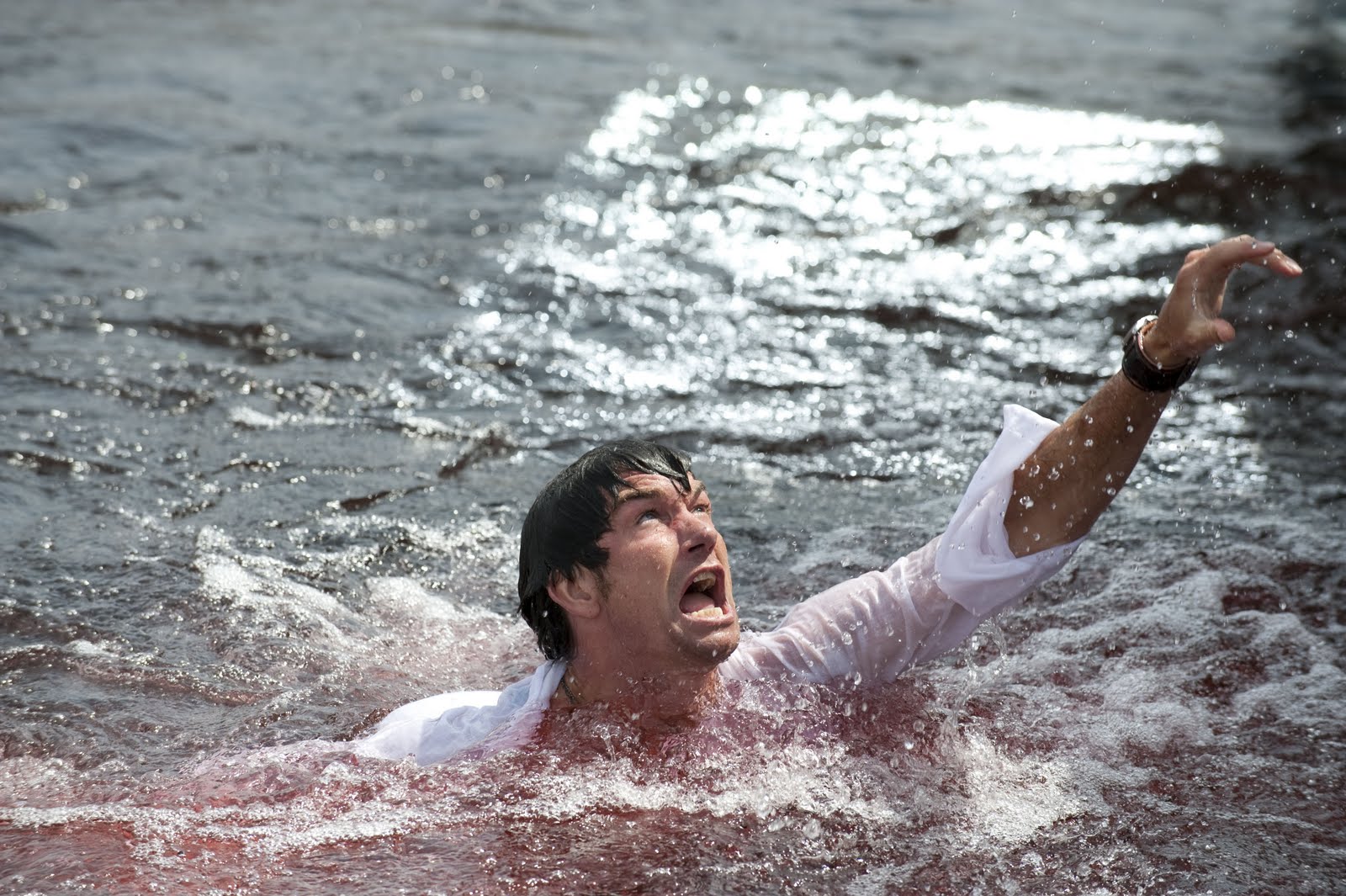
There are two things I really took away from Piranha 3D, or rather, two things I still remember about it (aside from that we had a great time and laughed and guffawed and made “bo-o-o-i-i-ing” sound effects to represent our boners throughout). One is the genius of casting Jerry O’Connell as Joe Francis. Spoilers abound, but when O’Connell’s coked out, obnoxious character bites the dust, we are treated to the spectacular sight of his severed penis floating past our face, being swallowed by a piranha, and then coughed out over our heads before being bitten in half.  As the fat kid from Stand By Me and Joe Francis should be at the top of anyone’s list of people who should never be allowed to procreate, this is crowd-pleasing at its finest, plus it is refreshing to know that we live in an age where hundreds upon thousands of dollars will be spent to realistically thrust severed cocks in the faces of moviegoers. The other thing I can recall about this movie was the big climactic massacre scene where Spring Break is interrupted by bloodthirsty piranhas but because the 3D process kinda makes a lot of the underwater stuff a bit murky, the best deaths are caused by humor error, including one death-by-hair-caught-in-boat-motor that is so great it belongs in a hastily-edited, grindcore-scored Youtube video along with clips from Dead Alive and Guinea Pig films or something.  I’m sure the guy from my work is hard-at-work compiling it as you read this. Did I mention that he declared this the best film he’d seen all year?  Like, really?  I mean, it was fun. The nude underwater ballet scene where two chicks with tits bigger than, well, the guy from my work’s tits, is pretty amazing, and the Spring Break massacre, O’Connell cock- it all added up to a very satisfying, imminently forgettable timewaster.  It will satiate your inner-adolescent appetite for mayhem and female nudity (also 3D vomit), but it isn’t something you’ll ever really consider watching more than once, or sober, or at home even (at least I wouldn’t - if Jerry O Connell’s meat isn’t plastered to your forehead, it really isn’t the optimal Piranha 3D experience).  


That said, Aja continues to be a capable director, my friend seemed sufficiently cheered, and the lack of anything substantive to say about the flick itself has allowed me to tackle one of my least favorite archetypes at length, so if it is still in theaters, check it out, and if the DVD comes with little 3D glasses or something check it out or if you find a torrent and can skip to the above mentioned scenes, by all means, but don’t buy it or think it is some kind of masterpiece or invite an attractive co-worker to dinner and breathlessly recount your favorite parts of the movie with your fucking mouth open (see? food! haha) while she recoils in (actual) horror and wishes someone, anyone would text her so she can make an excuse to get away from you but you’re so convinced you’re getting laid tonight that you are already plotting how to get through the hallway and past mom and dad’s room without waking them and are forming a mental picture of a post-coital snuggle sesh in which she’s wearing your favorite death metal shirt watching Nekromantik but really this will be like every other night of your life since you were a pre-teen and you’ll masturbate furiously, cluelessly into a tubesock and feel curiously empty and fill the void by clicking Buy It Now and now you’ve gotta make room on your wall for another autographed Bruce Campbell poster - fuck. 


-Jon-Christian

Bullet Ballet


Existing on the fringes of cinema is Shinya Tsukamoto, the Japanese nothing-but-an-auteur who (arguably) developed the resolute be-all end-all body horror in its finalized and post-cocooned state. With such a bevvy of silver horrors underneath his exasperated arms, Tsukamoto set out to tackle the Japanese youth rebel boom of the 90s. Following in the wake of the mutinous children, Bullet Ballet, Battle Royale, and much more were created to chronicle the horrors of moonlighting young killers. Ordinary teenagers by day with jobs beneficial to the community of Tokyo as a whole (or so they thought), only to turn into rough-tough muggers, looters, and overall monsters who seek a supposed rapture of youth through sex, drugs, and violence. Supposedly Tsukamoto was mugged by a gang of the aforementioned. Like the absolute madman that he is, he didn't resist or pity himself. Feigning confrontation even with his peak physical condition, he observes their actions, their emotions, possibly the wild excitement in their eyes. This is the same voyeuristic approach from Tsukamoto that I'd expect nothing less of, especially from the famous Japanese auteur with his disillusioned peace-in-rebellion mindset. After the dust and fear settle, Bullet Ballet is born . . . in a frenzied statement and fictional documentation on the addicting pleasures of anarchy. But every rose has its thorn, as Douglas Jerrold put it, free from context. The question is, does Bullet Ballet qualify as entertainment?


First and foremost, Bullet Ballet is as wonderfully in touch with the flickering brilliance of black and white as demonstrated in A Snake of June and the better half of Tsukamoto's poetic yet fluctuating career. Chu Ishikawa marks his frequent return in most of all Tsukamoto's works and doesn't disappoint with the resurgence of his trademark twisting and hammering metal in a noise-punk admittance of layered guitar additions. With the aesthetic dissected from Tetsuo and the better half of his early Super8 shorts, Bullet Ballet looks and feels the way a black & white film regarding the regression of anger but cannot fit the part of a classic example of experimental Japanese filmmaking. The story revolves around a self-centered television executive who stumbles home in a stupor only to realize that his girlfriend of ten years committed suicide. Unable to come to grips with the resonating fact that her death is at the hands of his oblivious and domicile nature, Goda becomes enraged and seeks to find the exact model of gun, the .38 special, so he too can commit suicide. This was the plan, however, until he gets mixed up with a gang of youthful and irritable speed-freaks.

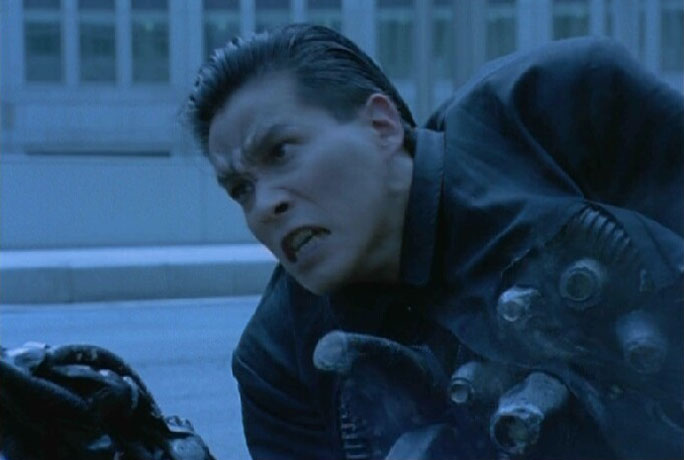
(Tetsuo: the Iron Man)
(Bullet Ballet)

Rather than sticking straight with the fetishism of metal and the likes, Tsukamoto hones it down to a specific artistry of steel - guns. The gun metal fixation from Goda presents some very serious symptoms of Taxi Driver melodrama with the scene of phallic extensions from his self-goading in the mirror to the shirtless pantomime trigger-teasings, it's obvious that Bullet Ballet was made with a special significant nod to the Western cultures while steadily embracing the Eastern side of things, mainly referring to the great lengths and difficulties Goda endures to finally land his hands on his prized possession, whereas it's remarkably easy to purchase a weapon in the states. After stumbling upon a young punk named Chisato, whom Goda rescued from falling on the subway tracks days earlier, Goda is tormented by her and the gang religiously, being mugged and beaten over the course of the entire run time. Strangely, I feel no sorrow towards Goda in the slightest making Bullet Ballet seem like a nicely shot student film with a budget fit nicely behind it. Perhaps it's this or the wistful fact that Chisato reminds me of an old flame - so blindly wrapped in selfish exploits proceeding a future fueled by "art" and circlejerk meditation on photography, all the while juggling men to both extremes of friendship and romantic entanglement. These ample musings of the hipster millennium crowd are the driving force behind my indifference to the character of Chisato and her fate.


Many flaws surround Bullet Ballet, whether it's the pedestrian filling surrounded by an excellent opening and climax, the events transpiring in the midst of this dark drama are ultimately forgettable and not worth even viewing. For lack of a better description, Bullet Ballet is a lost idea, wandering alone on a desolate stretch of highway with no real place to go but to follow asphalt. Following the temperament of Tetsuo: the Iron Man, the camerawork becomes frenetic during periods of high volume, so much that what action and throttled stress does compose within Bullet Ballet is strewn across the screen wildly leaving me bewildered and wondering what just happened. Rather than dismissing Bullet Ballet as the weaker film of Tsukamoto's art archives, I find myself able to compassionately appreciate this ill-received film as an exorcism of conflicting ideas of youth and violence and violent youth.


Only in the final ten minutes does Bullet Ballet even out and become a moving work of beauty. The mistakes we make and the consequences we hope to escape are brought to the stand. Tsukamoto created this rapid descent in quality with a fervor that I must commend and in part to his signature promise of bringing it all together in the end. If not as a rousing piece of entertainment, then certainly Bullet Ballet can be transcribed as an ill-sought meditation on the aggravated assimilation into the violent underbelly of the mutinous city inhabitants. Bullet Ballet is perhaps his weakest solid effort, not counting the visual afterbirth that is Tetsuo II: Body Hammer, but regardless of the quality (or lack thereof) Bullet Ballet is still a consequential ceasefire to the rampant youth of Japan. What better way to retaliate upon a large group of people than to construct a film showing them in their most instinctive and amorous state.


-mAQ

Tetsuo II: Body Hammer


With a lack of continuity and a thematic indulgence in reincarnation, Shinya Tsukamoto returned to his esteemed cyberpunk steam which spread like a panicked wave through cult and arthouse circuits with the smithy-porn Tetsuo II: Body Hammer. The idea on paper reads as such, juxtaposing itself alongside the original homoerotic male rapture aided with fleshy physicality that we all know as Tetsuo: the Iron Man, Body Hammer concerns itself as a allegory on reincarnation if you will, same characters grown up with different connections and an all too similar string of genetics. Perhaps lay blame on the subversive assimilation into one rusted being at the climax of the original. Both the roles of Tomorowo Taguchi and Shinya Tsukamoto as the salaryman and Yatsu, respectively, are reprised by the same actors from the original Tetsuo film. The metal fetishist, however, is given a name and a past. Branded as Yatsu and adorning the same shirt with an "X" emblazoned upon it, Yatsu is the skinhead leader of a group of bodybuilders who seek the scholarly fortunes of an elderly scientist in order to create the godlike body mechanics artificially. Or something along those lines.


As Tsukamoto and top film analysts would spread it, Body Hammer isn't a sequel but an evolution of both character and the regurgitated-and-not-improved aesthetic used within, which sadly, siphons most of the originals mark left upon the initial viewing. The stakes were certainly raised with the promise of a sequel, both on and off the set. With a salaryman confined in a sterile and concrete building instead of a sweaty shack, the bourgeois household and family matters are put to work quite efficiently. That is, before Tsukamoto bleeds this sequel like a stuck pig expecting expectations to be forgotten and weeding every promising aspect in favor for a sordid creature feature towards the end with coherence and narrative despite the successful nature of the sensory-overload that is the Iron Man. Not just the notion of ousting black and white in favor of a smeared color palette yet to be perfected, but for removing the blatant sexuality of the original in an attempt to channel pre-Tokyo Fist idealizations of macabre masculinity.


Foremost, color was never meant to be existent in the universe of Tetsuo. The grainy and obscured visuals of steaming coils, leaking faucets, and wire-rotting junk atop sordid soil was breathing the monochromatic horrors that Tetsuo: The Iron Man effortlessly exposed in a daring and culturally unheard-of fashion. The addition of hues flattens the lucid transgressions of the oddity that was the Tetsuo namesake. To set further in motion and to evolve my previous argument of narrative, Tetsuo II is more of a film than the original film ever aspired to be. With theories of gangs turned to manifesting flesh alchemy and the surplus scenes of tripe chest-piece manipulations with body cannons exploding with roadside sparklers and soaked fireworks, Body Hammer is not to be taken as a serious project. Perhaps a foot in the door as an aspiring film maker and not just an extended music video project for Chu Ishikawa's incredible hammer-to-anvil noisemakings, our pal Shinya has (decidingly) created some stale, albeit enjoyable, creations but Tetsuo II: Body Hammer finds no time to entertain except for a handful of scenes. Proving to be a failure on near all fronts, Ishikawa's return to scoring the post-science world of the Iron-beings is a haggard attempt at "evolving" the now "advanced" prototype of real industrial. Given inspiration from a poster with frogs(?), Ishikawa's ideal representation of the soundtrack to Tetsuo II sounds more as if a Super Nintendo track was recorded in midi format under several feet of water.


Tetsuo II: Body Hammer lives up to neither the title of Body Hammer or Tetsuo. As later experienced in the break-up masterpiece Tokyo Fist, Tsukamoto's obsession with bulging and grotesque muscles was still premature in the womb. With the exception of a couple of training montages, Body Hammer's addiction to the physique is quite absent and is perhaps rotting somewhere on a cutting room floor. The skinheads involvement in the film is quite absent and serves as a preinvention of the parable, Tokyo Fist - the perfected worship of dripping machismo. Body Hammer opens a note of remote tangency compared to the affable circus-scud of the predecessor. A salaryman in his marble chamber, a solid life in contrast to the squalid exploits of Taniguchi past. To break formation and sing some praise, the first 40 minutes is wholly better than the terrible drivel that makes up the climax and Tsukamoto is best to reference the first sequel as a portfolio for some terrific arm mutations and exquisite practical effects in an era that is overrun by the need for computers and technology to run rampant over expression. That being said, if you admire the audacity of the groundbreaking precursor, avoid at most costs. 


-mAQ

Tuesday, September 14, 2010

Cool World

 
Being redirected by splotches of classic memories of Cool World, I decided to revisit the sudsy noir-typed gonzo inspirations found within the vault of Ralph Bakshi's return to feature films. After Fire and Ice, it just seemed that Bakshi retired all too soon to the measly slave-tracks that is syndicated television. But before you knew it, a new film was announced to predate the repopulated live-action/animated musings of Space Jam. Cool World stars Brad Pitt before he hit the spotlight with his best roles to date (Kalifornia and True Romance) and Kim Basinger playing herself for the seductive and manipulating Holli Would; lending voice to toon and likeness to "Noid." Imagine my surprise when I discovered this magical land that filled my head with throbbing fetishes as a child turned out to be a spoiled script behind even more rotten directing, not to mention the animated population of Cool World to be less-than-Crumb fantasies of bizarre slapstick and catty chubbies with heaving breasts. Things aren't all bad in Cool World, however as life is cheap and women are even cheaper.


Taking an aimless road, Cool World opens with Frank Harris, a WWII veteran returning home to his lovely Ma with a personal gift to the both, a motorcycle. After one fateful accident minutes later, Frank Harris is thrust into an animated paradoxical world of cigarettes, twisted subsurreal architecture, and boozy women. Coincidentally, some 40+ years later, an animator played unconvincingly by Gabriel Byrne creates Cool World and is too sucked into some strange, incoherent wormhole that leads to the place of his creating. Funny thing about this is that this portal to Cool World opens on golden opportunities and never without plot progression in mind which connects even more wildly to the theory that Cool World is just the hidden fetishes coming to fruition within a possibly comatose Frank Harris' mind. Once we are introduced to the 3 - 4 reoccurring characters that highlight the faceless world of cool, we are met with a femme fatale blonde bombshell by the name of Holli Would, who kills the shit out of Jessica Rabbit in terms of evoking youthful sexuality to bloom prematurely. Throughout the entirety of the time spent in the radical degeneracy of Cool World, sporadic looped footage of a doodle mob parades slowly across the screen obscuring the sights and sounds that Cool World has to offer. This mental onslaught is yet another cheap tactic that Bakshi employs in what is possibly the worst in his career. The amount of zero mentality looped footage alone is staggering and impossible not to pick up on.


One of the only merits that Cool World has to offer is terrific background visuals in a wild neon mess that houses oversexualized Saturday morning cartoon fodder. The "doodles" in their reverse beat generation are all broad shouldered or teeming with unsubtle cleavage. In regards to the decade of the 90s and the video rental boom, I must digress that Cool World must have had something to do with the current generation's obsession of Japanese animated women and their almost always incestuous relationships. Cool World didn't invent the fanatical subversion of animated fantasy but it sure as hell broke it out into the mainstream by planting seeds within children's minds. For me growing up, the plot of Cool World escaped me. I simply had memories of scrambled scenes that held no continuity other than Brad Pitt smoking and bimbo cartoons. After committing myself to the institution that is Cool World, I feel that this is one of those rare occurrences in which the memories lasting within the stems of past viewings are more favorable than the current result. Re-watching Cool World certainly rotted the core of my past recollection and the only safe tiding I can manage is to envision this film as the inhibitions of a comatose soldier returned home. That certainly spices up the frequent shortcomings and inconsistencies littering this animated abortion.


As with most of Bakshi's work, there are fragments of inspired genius and Cool World is not without these brilliant minerals but treading through the run time seems like an infinite purgatory. Perhaps Bakshi had developed a lazy senility which would certainly explain the looped alienating segments of crude illustrations. Seems as if scrapped storyboards were used as a sensory overload to stimulate the mind into processing all of which this film doesn't offer. But what Cool World does offer is a terrific mondo metropolis realized by screaming and twisted branches mutating off cityscapes. Furthermore, Cool World recycles most of Bakshi's previous successful avant-garde animations e.g. Fritz the Cat and Hey Good Lookin'. Inspired so, the costumes of many-a-citizen of Cool World seemed idealized by that same whisper that Bakshi fell victim to during conception of the 50's extravagance. As it is, this is a venture into live-action/animation that I'd prefer to avoid in favor for the multicultural exploitation that is Space Jam or the more successful greasy noir that is Who Framed Roger Rabbit?. While Roger Rabbit didn't have such gratuitous and delightfully harmful sexuality, it encompassed the desperation and dinginess of film noir so much better than the shattered product of Cool World. In praise to Cool World, it was one of the few examples to reach viral hall of fame with the rare event of "desecrating" the Hollywood sign by constructing a 75 foot tall Holli on top of the letter "D". I  suppose the legacy of Cool World is destined to perish among an elusive photograph of such and the bargain begging price of five dollars. To put it rather simply, Cool World is just another disappointing debacle of squandered talent - should have been reserved for art galleries and not cineplexes.


-mAQ