Sunday, September 25, 2011

Egon Schiele - Exzesse


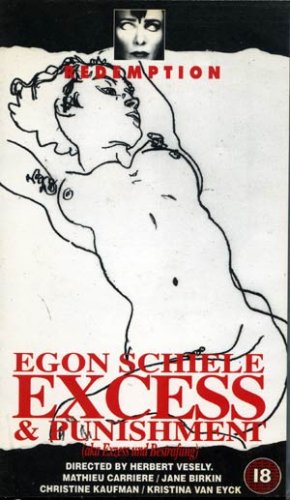
Without question, my favorite degenerate painter is Egon Schiele; the young protégé of Gustav Klimt who – like Jesus Christ himself – was publically crucified (in the symbolic sense) and would never live to see his thirtieth birthday. When I describe Schiele as a degenerate artist, I mean it not in a derogatory manner but in a literal sense as the early Zionist leader Marx Nordau described the Austrian painter as a pornographer in a later edition of his infamous tome Degeneration (1892); a work that blames Europe’s cultural decline on so-called artistic degenerates (including Friedrich Nietzsche, Richard Wagner, Oscar Wilde and Leo Tolstoy) yet totally disregards (while condemning "antisemitism") the wealth of wretched subversive anti-European works created by his fellow Asiatic kinsmen. In fact, if it were not for Nordau's libelous work (in a way, he was the "Tipper Gore" of his time) stirring up the European intellectual world, it is doubtful that Schiele would have ever had to face trial in the first place.  Needless to say, when I discovered the somewhat forgotten film Egon Schiele – Exzesse (1981) aka Egon Schiele Excess and Punishment directed by Herbert Vesely – a work that chronicles the life of Schiele from his criminal trial to his early death as a result of contracting the Spanish flu (which also killed his wife Edith and their unborn child) – I made it my priority to watch it. Of course, like any other film about a real-life historical figure, I had many doubts in regards to the factual authenticity of the work, especially considering the potential for heavy-handed eroticism and exploitation due to the keenly sexual nature of the Austrian artist's work. Indeed, like the paintings of Egon Schiele; the film ambiguously blurs the line between art and pornography, thus the work makes for a worthy tribute to the artist and his somewhat small body of work. Unfortunately, like Egon Schiele, Egon Schiele – Exzesse seems to be a “work in progress”; a piece that could have been a masterwork but lacks the refinement and cohesion so commonly associated with artistic and aesthetic greatness. At times the film seems like it uses the oversexed life of Egon Schiele as a mere pretense for close-up beaver-shots and seemingly underage nudes but at other times the work feels like a brilliant piece of cinema that documents an imperative period of groundbreaking change in European art. If one thing is for sure, Egon Schiele – Exzesse will keep the viewer wholly engaged like they are in a sexual act from the foreplay-ish beginning to the lonely climax.


 In Egon Schiele – Exzesse, German actor Mathieu Carrière plays the role of anti-hero painter Egon Schiele. One of Carrière’s first film roles was as the lead in Young Törless (1966) directed by Volker Schlöndorff; the cinematic adaptation of the Robert Musil’s novel of the same name. Like his portrayal of Thomas Törless in Young Törless, Carrière gave an extremely notable performance in Egon Schiele – Exzesse. Not only does Carrière bear a striking resemblance to the real Egon Schiele but he also exhibits a subtle intensity that one would expect from a serious artist who has totally deracinated himself from the general population and has suffered great loss. The real-life Egon Schiele was a protégé of the somewhat controversial Viennese Symbolist painter Gustav Klimt but the student would prove to break his own new ground as one of the earliest subversive expressionist artists. Of course, Schiele's audacity as an artist would prove detrimental to his personal life as so vividly expressed in Egon Schiele – Exzesse. Schiele was arrested and charged with seduction, abduction, an exhibiting pornography to minors; the latter being the only “crime” he was ever convicted of. As so vividly portrayed in Egon Schiele – Exzesse; Schiele was charged under false accusations given by a teenage girl that the artist had became obsessed with. Of course, Schiele’s real crime was offending the mores of polite conservative Austrian society, henceforth foretelling the libertine expressionist and Dada artists that would become quite popular in Europe during the early twentieth century. In fact, had it not been for Egon Schiele, it is undoubtedly quite dubious whether a film like Egon Schiele – Exzesse could have ever been made.


Both the artistic works of Egon Schiele and the film Egon Schiele – Exzesse are a testament to the refined and tasteful manner as to how Europeans have handled nudity and eroticism when compared to American and Hollywood's handling of similar subject manner. With the virtual destruction and cultural degeneration of Europe after World War II came a flood of erotic European films. In a sense (and a somewhat glaring one), Europe became a virtual prostitute of America. For mostly monetary reasons, Europa churned out a wealth of adult arthouse films (Bernardo Bertolucci's Last Tango in Paris (1972) is probably the most popular example of this phenomenon) during the second half of the twentieth century; Egon Schiele – Exzesse being a more subtle example of this somewhat depressing but equally stimulating trend. In fact, if it were not for its somewhat popular cast (including Golden Globe Award winner Christine Kaufmann, Serge Gainsbourg's muse Jane Birkin, Gainsbourg himself, and filmmaker Marcel Ophüls), soundtrack (featuring tracks from Brian Eno and Felix Mendelssohn), and abstract drama, I would lump Egon Schiele – Exzesse in the same category as films directed by erotic auteur filmmakers like Radley Metzger and Tinto Brass. I would be lying if I did not admit that the film would probably be of interest to those individuals who have no clue as to who Egon Schiele was, as the film features enough nude beauties to appease your typical perverted cinephile, thus Egon Schiele will be of interest to two different types of viewers; pervs and pretentious art-fags (and a combination of the two). Out of all the nudity featured in the film, I found the scene where Egon Schiele is inspected by the military upon being drafted into the Great War to be the most unsettling. Although convicted of corrupting a minor, Schiele's deeds pale in comparison to his virtual molestation via a group of clearly enthusiastic Austrian military elders. I think most Egon Schiele fans will agree that Egon Schiele – Exzesse will remain the definitive cinematic work about the prematurely deceased Austrian artist. Despite its many flaws, Egon Schiele – Exzesse is certainly more delectable than anything Hollywood could ever hope to vomit up about the infamous painter. 


-Ty E

Sunday, September 18, 2011

Mosley


Out of all the fascist leaders from the first half of the twentieth century, Sir Oswald Ernald Mosley, 6th Baronet, of Ancoats, the Anglo-Irish founder of the British Union of Fascist (BUF), was possibly the only one who is not remembered today as the definitive and gross epitome of reprehensible evil. One of the reasons for this is that, unlike Adolf Hitler and Benito Mussolini, Mosley failed to assume the leadership of his nation, thus, he was never able to prove to his extremity and brutality as a dictator nor contract a significant amount of "blood on his hands." Also, unlike Hitler and Mussolini, Mosley came from a well bred aristocratic stock (he was the fourth cousin of Queen Elizabeth) and was not a self-made man but a natural born gentleman whose social status was confirmed long before his birth. Unlike most of his aristocratic elders, Mosley was a visionary who foresaw a changing England that was threatened by the diabolical twin-head of materialistic international finance and culture-destroying communism. In the 1998 television mini-series Mosley, the viewer is introduced to the political career Oswald Mosley; beginning at his bachelor years as a young and ambitious army officer during World War I and concluding during the middle of World War II when his potential as the Duce of Great Britain began to sway in a most humiliating and career-destroying manner. It should be no surprise to readers of Soiled Sinema that I have seen my fair share of fascist related flicks and I must admit that Mosley is easily the most sympathetic post-World War II portrayal of a fascist figure that I have had the proletarian pleasure of viewing. Although most forms of nationalism began to be looked on in a negative manner in Europe and Great Britain due to the triumph of communism in the East and democracy in the West and Uncle Adolf’s infamous legacy, the Brits still manage to produce exceptional public television and the Channel Four Television produced mini-series Mosley is certainly no exception.


Mosley is based primarily on the books Rules of the Game and Beyond the Pale; both of which were written by Oswald Mosley’s son Nicholas Mosley, thus one can speculate that Mosley has a certain authenticity that most fascist biopics tend to lack. Ironically (or not so ironically), Nicholas Mosley also wrote the book (which was adapted into a movie that same year) The Assassination of Trotsky (1972); a book about Stalin’s assassination of his former commie comrade Leon Trotsky; the genocidal judeo-bolshevik revolutionary who spent his remaining days exiled in Mexico after losing the power struggle for leadership in the Soviet Union with the man of steel. Although I can’t say I have read Nicholas Mosley’s works on his infamous fascist father, it seems that Mosley screenwriters Laurence Marks and Maurice Gran and director John Alexander utilized his works to the fullest degree as the mini-series presents the blackshirt Führer as a multifaceted man of exquisite charm who enjoyed subversive politics as much as he had a weakness for beautiful birds and expensive bourbon. One also must commend British TV actor Jonathan Cake as he seems to be the next best thing to the real man in his exuberant and totally believable portrayal of Sir Oswald. As portrayed in Mosley, Oswald Mosley was a man that truly loved his nation and thus saw Benito Mussolini’s successful revamping of Italy as an imperative guideline for restructuring England. I was also surprised to see that the mini-series accurately presented Oswald Mosley and the blackshirts as being more often the victims of crimes and violence than the actual perpetrators. Despite his somewhat moderate take on fascism (at least, at that time), the real-life Oswald Mosley and the British Union of Fascists often found themselves verbally heckled and physically assaulted by various communist and Jewish groups (among others). In fact, during the so-called “Battle of Cable Street” (which took place in Cable Street in the East End of London), Mosley and the BUF were so overwhelmed by hostile antagonists (the area itself being heavily concentrated with Jews) that Sir Philip Game, the local Police Commissioner, aborted the blackshirt march. Naturally, real-life scenarios like these make for some of the most interesting scenes of Mosley.


What sets Mosley apart from most films that portray fascist leaders and movements is that it gives fascism a human face. Whether one is a fanatical fascist of the unrelenting murderous kind or a tranny s/he bitch of the third kind, it is likely that that viewer cannot help but be somewhat empathetic towards to plight of the Oswald Mosley presented in the mini-series.  I cannot say the same for the deplorable Italian mini-series Benito (1993) starring Antonio Banderas; an excruciatingly long and exceedingly banal portrayal of young Benito Mussolini and his love affair with his elder Jewish communist mentor Angelica Balabanoff.  The Canadian mini-series Hitler: The Rise of Evil (2003) is nothing short of being a work of tabloidesque pseudo-history with an aesthetic that pales in comparison to the most mediocre of Nazi-exploitation films.  On May 23, 1940, Oswald Mosley and his wife Diana (of the eccentric aristocratic Mitford clan), who advocated a peace campaign with Germany, were imprisoned at a house on the grounds of Holloway prison. Personally, I cannot help but wonder what would of happened during World War II (had the war even started in the first place) had Mosley been the leader of the now defunct British empire. If one thing is for sure, it is that tens of millions of lives would have been spared and Europa would still be the monolithic entity of global supremacy that it once was. Of course, Mosley never had the opportunity to lead and execute his plans (and enemies), thus one can only speculate what “could have been.” In the excellent alternative history work It Happened Here (1966); a cinéma vérité-style film that was partly shot on leftover film stock from Dr. Strangelove (1964) that was donated by Stanley Kubrick, the viewer is offered a view of German-occupied Britain where it is suggested the Oswald Mosley and the BUF have assumed power.  Mosley and the blackshirt fasci aesthetic would also inspire some of the greatest scenes featured in Alan Parker's Pink Floyd—The Wall (1982). Although Mosley concludes in 1940, Oswald Mosley would go onto to found the Union Movement; a quasi-fascist political party that advocated the unification of Europe into a one-state imperium that covered all of Europe. Mosley’s expounding of a united Europa is further evidence that he was a true visionary that was savvy at predicting future cultural and political trends as Europe eventually would become united via the EU, albeit being of a dystopian anti-European/pro-globalist nature. American neo-Spenglerian genius (who according to FBI records had an IQ of 170) and writer of the neofascist masterpiece Imperium (a work that shares many fundamental similarities with Mosley’s plan for a united Europe) joined Mosley’s Union Movement but left the group after the ex-blackshirt leader punched the poor yank in the face. In the present, most “neofascists” and third position proponents also share the Mosleyite/Yockeyite dream of truly uniting Europe through cultural and political rejuvenation, thus Oswald Mosley tends to be lauded by those that share these political beliefs.


I would be lying if I did not admit that Mosley is one of my favorite (if not my favorite) mini-series. Aside from a couple cheesy scenes of melodrama, Mosley makes for a notable historical work that that can be compared to few others. Mosley is essentially the British equivalent of the German film Downfall aka Der Untergang (2004) directed by Oliver Hirschbiegel as both epic works contextualize the fascist historical legacy of their respective nations of origin in a fairly objective manner that is all but unheard of in Hollywood. On top of offering a somewhat impartial history of Oswald Mosley and the BUF, Mosley is a beguiling work that seems much shorter than its 197 minute running time. In fact, my biggest complaint with the mini-series is that it is not long enough, thus I recommend that viewers steer scopophilically clear of the 99 minute feature-length cut of the film as you eyes will be indubitably hungry for more. With the recent 2011 England riots (and the many that have occurred throughout the decades after World War II), I can only assume that many modern Brits are asking themselves whether or not Oswald Mosley was right as current socio-political trends certainly point in his favor. Mosley once state, “There are periods in history when change is necessary, and other periods when it is better to keep everything for the time as it is. The art of life is to be in the rhythm of your age.” I think it is obvious to most people who live in the "postmodern" occidental world that critical change of a revolutionary stature is needed and it is not of the wretched sort that was so dishonestly promised by a double-bastard American commander-in-chief who is nothing more than a glorified pimp who has developed a refined form of huckstering. I wouldn’t doubt that if in three or four decades from now, an Obama mini-series will be created that is much more critical of its subject than Mosley.  After all, who can hate a fascist leader that was gentleman enough to share his rationed fags with a well dressed wog.


-Ty E

Saturday, September 10, 2011

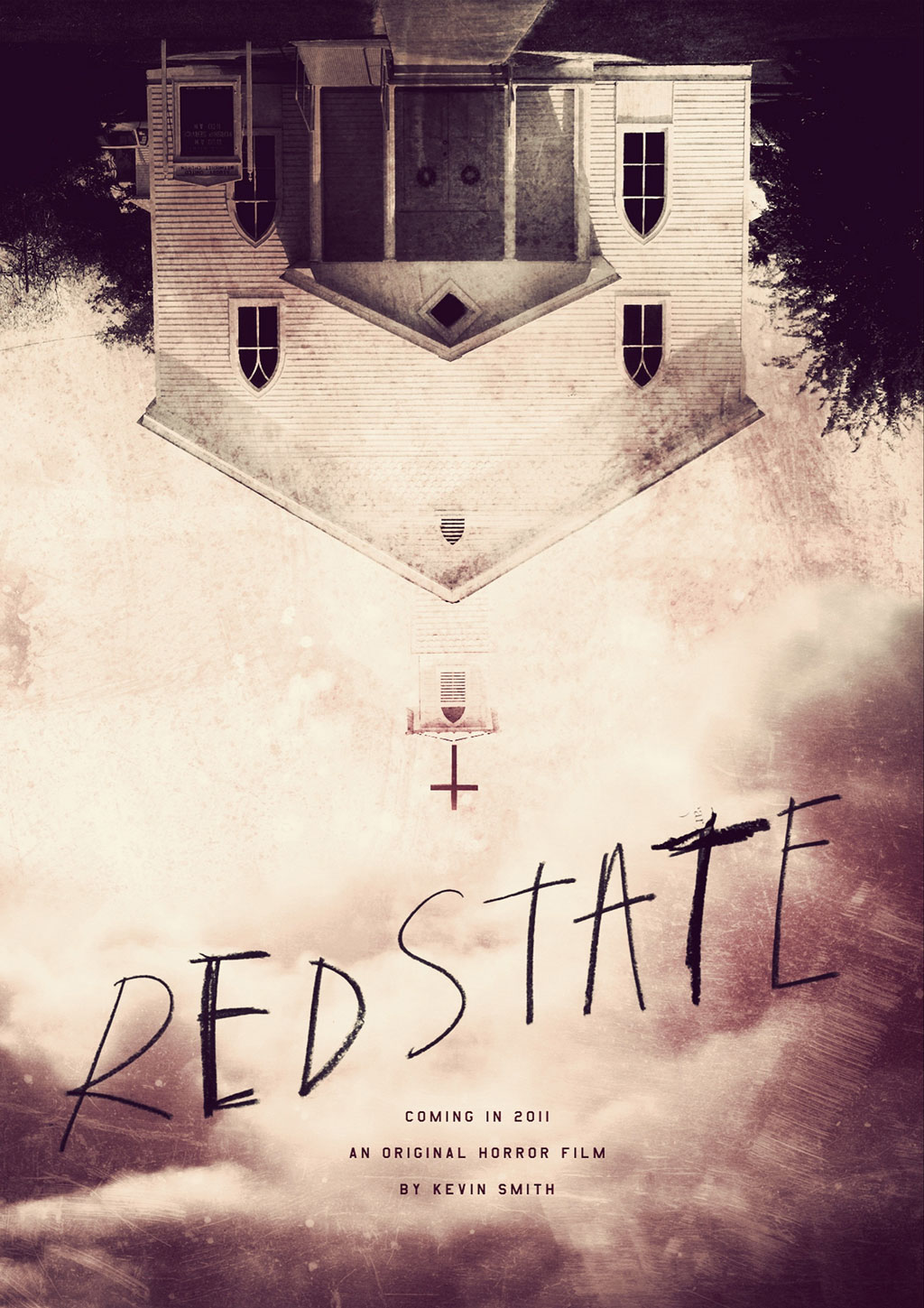
Red State


I have always made no lie of my irrevocable repellence towards fatty fanboy filmmaker Kevin Smith and his fecal-fuming films. I don’t know about most people but I find Smith’s adolescent cinematic contemplations on romance-gone-wrong and prepubescent sex jokes to be nothing more than symbiotic of the white-man-child epidemic that has plagued America for the past two decades or so. After all, if any film director (and I use this word loosely for the mere convenience) epitomizes the thoroughly emasculated American white male, it is Kevin Smith; the pudgy comic book super-nerd-nerd-enabler whose generous sized bitch tits would undoubtedly put prematurely deceased Baltimoron Divine's man-mammary-glands to shame. When I found out that Smith directed a horror movie, I couldn’t think of a more appalling prospect for a film. After all, it is no secret that most horror films suffer from poorly written dialogue but a horror flick with dialogue dreamed up by Kevin Smith could only bring further shame to the seemingly shameless genre. Smith’s horror film is entitled Red State and as one would expect from the title, it is also of a blatantly political nature. Indeed, just by knowing the synopsis of the film and the mental-eunuch man behind it, one can assume that Red State is arguably one of the worst ideas for a film ever. After his recent fallout with brothers Weinstein and a number of cinematic abortions over the past decade or so, one can only assume that Red State is a work of desperation created by a one-trick pussy filmmaker whose artistic impotence and lack of passionate vision is only rivaled by his lack of testosterone. Unsurprisingly, I found Red State to be not only the worst film I have seen all year but also Smith’s most lackluster attempt at assembling something resembling a feature-length film.


Despite Kevin Smith’s assurance that Red State would feature nil of the preschool-potty-mouth humor that permeates throughout his work; the plot of the film is essentially a propaganda piece for such repugnant and sexually immature themes and unsurprisingly features them as well. In the film, a trio of toddler-like teenage turdlings travel to a stereotypically bigoted rural county so they can gang-bang a milf that one of the boys met on a sex website. Of course, the three friends travel under a false pretense and fall prey to a militant Judeo-Christian family church modeled after real-life pastor Fred “I hate fags” Phelps’s infamous church. Todd McCarthy of the Hollywood Reporter described Red States as, "A potent cinematic hand grenade tossed to bigots everywhere” yet the film itself is a flaccid work of atheistic intolerance with anti-Southern and anti-Christian stereotypes that are so predictable that it is essentially an unintentional parody of typical liberal Hollywood parodies. I don’t know whether or not God hates fags but he most certainly hates bovine fanboy filmmakers as the mediocrity of Red State attests to. Ironically and hypocritically, Kevin Smith modeled his self-distribution of Red State after Mel Gibson’s The Passion of the Christ (2004). Unlike Gibson’s film, Red State lacks brutal carnality and an apt atmosphere; two imperative ingredients one expects from quality horror films. Instead, Red State seems to be merely an outlet for Kevin Smith’s seething hatred and fear of rural America, the Second Amendment, masculinity, tradition, Christianity, and any other individual or institution that upholds conservative values. Of course, if Smith had substituted the white Christian fundamentalists with Jewish or Islamic fundamentalists of a similar nature; he would have been branded a bigoted spreader of hate and thrown his career into an abyss much deeper than where it has already fallen.


Indeed, not even the wonderfully obnoxious charisma of celebrated character actor John Goodman could save the genre-confused and half-inseminated cinematic conception that is Red State. Various supporting cast members of the surprisingly entertaining TV series Breaking Bad are also completely wasted in the film. Michael Angarano (Lords of Dogtown, Black Irish), who played the lead protagonist in Red State, was also unable to give anything resembling a memorable acting performance; no doubt due to Kevin Smith’s incompetence as a writer and director who has yet to graduate onto the maturity of a young adult. Of course, childish fantasies can make for brilliant films (e.g. the early works of Terry Gilliam and Tim Burton) yet Smith’s fantasies, at best, seem to be wholly and soullessly contrived and merely an outlet for his stereotypically Hollywood liberal political agenda. If it weren’t for the popular political views preached by schoolyard antichrist Kevin Smith, it would be hard for anyone to be able to revere Red State as anything more than an uninspired work of postmodern trash that falls miles below the films of Tarantino, Rob Zombie, and every other obscenely overrated fanboy would-be-auteur filmmaker. Red State is so thematically and aesthetically redundant and clinically cliché in its political agenda that it is the kind of work that will most likely make even the most faithful of libertine atheists and agnostics question the self-righteous dehumanization of the Christian "other."  Suffice to say, Red State has more liberal dogma than Smith’s earlier effort Dogma (1999) and less genuine horror than Chasing Amy (1997). If one can learn anything by watching Red State, it is that the mainstream left is more intellectually bankrupt than the most inbred of Southern Baptist preachers. Maybe if Kevin Smith were to have studied the work of Luis Buñuel instead of jerking off to overpriced comic books, he would have learned a couple tricks in regard to nuance and subtlety in his execution of Red State. As a film, Red State has nothing to offer to even the least demanding of horror fans. I hate to say it but maybe Kevin Smith might want to consider giving his tiresome soul back to the Weinstein bros. because at least then he would be able to make the sort of whiny beta-male garbage that made him the holy patron saint of feeble and rotund white male virgins. 


-Ty E

Sunday, September 4, 2011

Apocalypse According to Cioran


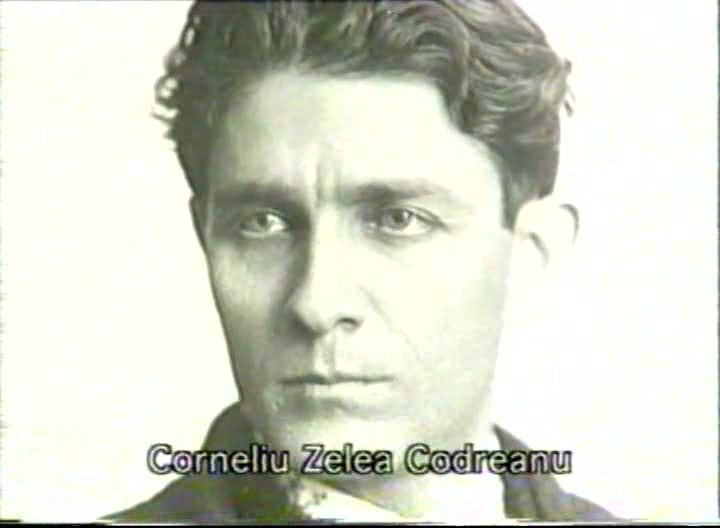
During the beginning of the ethereal yet gritty documentary Apocalypse According to Cioran aka Apocalipsa dupa Cioran (1995), the exceedingly morose quote “World history is nothing else than a repetition of catastrophes waiting for a final catastrophe” appears on the screen among real war scenes of death and destruction. Those familiar with Romanian philosopher Emil Cioran’s work will be anything but surprised by the quote, but for the initiated, such a quote might seem a tad bit misanthropic. Also during the introduction, Cioran makes an appearance with his headed tilted down and with his hands covering his head. Such a dramatic pose would lead many to suspect that the elderly man had just lost his wife to cancer or any other of a number of tragedies that usually affect those people in their barely shimmering golden years, but, alas, Cioran is in his typical and virtually lifelong state of despair; a cursed gift that enabled the Romanian-turned-unenthusiastic-Frenchman philosopher to write a number of books that are often considered the last great philosophical works of the Occident. Cioran has been described as the “King of pessimists”; no doubt a title that he deserves as he both wrote and practiced his disdain for living for most of his adult life like no man before nor after him. In the film Apocalypse According to Cioran, fellow Romanian philosopher (of a later generation) Gabriel Liiceanu (who also wrote a book on his elder) visited Cioran during his last year on earth at his humble apartment in Paris, France; a city the Romanian philosopher had been living in since a self-imposed exile 53 years earlier and described as an "Apocalyptic Garage." Despite living in France for the far greater portion of his life, Cioran refused to allow a French film crew to interview him, so one might wonder why he left his homeland in the first place if he only seems trusting towards those that share the same ancient Slavo-Latin peasant blood. During his twenties, Cioran supported the Iron Guard; a mystical Romanian fascist movement led by the undeniably charismatic and equally handsome Corneliu Zelea Codreanu. As expressed in Apocalypse According to Cioran, Cioran’s emigration to France was largely the result of his disillusionment with the Iron Guard and its notorious acts of bloody murder and selfless martyrdom. While living in Berlin, Germany in 1933, Cioran approved of Adolf Hitler’s execution of the Night of the Long Knives; a cannibalistic purge resulting in the murder of most of the Nazi SA brownshirts leadership but mass murder in his homeland caused great regret and shame in the Romanian philosopher; the sort of discomposure that causes a man to leave his homeland for good.


Like his imperative influence Friedrich Nietzsche, Cioran was the son of a religious man who made no qualms about disavowing his father’s faith. Also like Nietzsche, Cioran’s words are those of a nihilist prophet. Like many great ancient religious texts, Cioran’s works are packed with infinite wisdom and are worthy of much consideration and constant critical contemplation. During his fascist years, Cioran wrote the book The Transfiguration of Romania (1936); a Spenglerian (and, indeed, the works of fellow pessimist Oswald Spengler were a huge influence on the young Cioran) text that calls for the cultural rejuvenation of Romania in the hope of assembling a rich destiny like France and a large population rivaling that of China. As explained in Apocalypse According to Cioran, the Romanian philosopher’s fascist activism was largely the result of his belief in the inferiority of Romania and its relatively uneventful history. Cioran felt that Romania acquired most of its culture from alien peoples and nations and had nothing of its own, thus, he saw the Iron Guard as an active road towards revamping his homeland and putting it on a path to the sort of greatness associated with Germany and France. Of course, one cannot blame Cioran for his sentiments as Dracula is probably what Romania is best known for on an international level nowadays. Like Dracula, Cioran would also spend his nights wide awake. In fact, in Apocalypse According to Cioran, Cioran cites insomnia as the unwanted inspiration that sparked his despair and irregularity; the two uncomfortable states that would help develop and fine tune the prowess of his poetic pessimistic philosophy. As Cioran explains in the documentary, insomnia stirs lucidness and conflict in the sufferer, henceforth creating a wholly atypical and conflicting perspective in the individual. Like many (if not all) great artists, Cioran created works of philosophy mainly for therapeutic reasons, thus, it should be no surprise that his works became all the more dark after his brief and regretful flirtation with fascism. Cioran also cites megalomania as one of the inspirations behind his works and his inevitable break with fascism. In the documentary, Cioran explains that for most of his life he believed that everyone except himself lived under illusion. Naturally, an extremely pessimistic hyper-individualist is going to eventually realize that their philosophy is incompatible with a dangerously altruistic collectivist movement.


During his youth, Cioran made a morbid hobby of collecting human skulls and using them as soccer balls, which is indubitably a purely coincidental metaphor for his pessimistic yet often humorous and strangely joyful writings. Naturally, prophets of doom tend to have a distinct and refined sense of humor for such individuals would find life totally unbearable if they were unable to find amusement in things that also happen to be stabbing at their lost souls on a 24 hour basis. As he makes bluntly clear in Apocalypse According to Cioran, futility and death are the two themes that can be found in all of Cioran’s works and have haunted the unromantic Romanian for most of his life. Apocalypse According to Cioran features a soundtrack reminiscent of the score featured in Herk Harvey’s surrealist horror masterpiece Carnival of Souls (1962) which might sound strange to those reading this review but it is undoubtedly nothing short of complimentary when considering the real-life horrors and despair Cioran lived and wrote about on a day-to-day basis. Whereas one could consider Mircea Eliade the Martin Heidegger of Romania (both philosophers never apologized for their political activism yet both thinkers have retained most of their prestige as distinguished thinkers); Emil Cioran is surely the Oswald Spengler of his homeland as both apocalyptic philosophers originally desired a nationalist revolution in their nation but eventually lost total faith in the cause and died in a state of loneliness and hopeless impotence. Of course, Cioran, unlike Spengler, is still considered a highly revered thinker today as even the wretched Jewess Susan Sontag, who once proclaimed “the white race is the cancer of human history,”stated of the Romanian ex-fascist that he is “one of the most delicate minds of real power writing today. Nuance, iron, and refinement are the essence of (Cioran’s) thinking.” As one would expect from a documentary about Cioran, Apocalypse According to Cioran is not an embarrassingly emotional sentimentalist look at the nihilist priest but a complimentary celebration of his relatively uneventful life and irreplaceable work.


-Ty E

Monday, August 22, 2011

Eyes of Fire


While still in my preteen years, I experienced a life-changing experience when I received a fairly large cardboard box full of horror VHS tapes. Including in the box were such films as Tobe Hooper's The Texas Chainsaw Massacre (1974), Chopper Chicks in Zombietown (1989), From a Whisper to a Scream aka The Offspring (1987), Burial Ground: The Nights of Terror (1981), The Evil Dead Series, and various other films that I have long forgotten. Naturally, many of these films left a deep impression on my relatively pure soul at the time; the forgotten mystical American pioneer horror flick Eyes of Fire (1983) – directed by unknown auteur Avery Crounse – being one of the most memorable and ultimately rewarding. If you ever wondered what a Gothic horror film would be like had it been set in the woods of 1750s American instead of an abandoned Victorian mansion, Eyes of Fire may very possibly be the only film to offer such a delightful yet equally deranged experience. Although it must have been a horrifying experience for European Christians to blindly immigrate to the untamed Americas and fall prey to mostly hostile and heretical mongoloid savages, few films have dared to dive deep into the metaphysical horror associated with such true-to-life (but never mentioned) experience. Not only does Eyes of Fire feature beastly brown men but it also includes nefarious nude spirits lurking amongst ancient trees and engaged in an unnamed wild hunt. While watching the film as a youngster, I couldn’t figure out whether I loved Eyes of Fire or loathed it, but I certainly found myself magnetized to it as I couldn’t help but insert my Vestron VHS copy of the flick into my VCR in a somewhat religious manner. Although I could not articulate it during my middle school days, I now know that I was awed to the state of virtual hypnosis by the genuinely ominous atmosphere and mystical nature of Eyes of Fire. Hell, I found Eyes of Fire to be so creepy that I derived nil sexual interest from the full-frontal nudity quite a rare find for me during those virginal days without cable television) featured in the film. Like the lucid weird horror tales of H.P. Lovecraft, eroticism is totally trampled and nonexistent (despite the rampant nudity and occasional sex scenes featured within) in the wild wooded world contained within Eyes of Fire. Cheap sex is usually a given in the realm of modern horror cinema, so it is no small feat when a film from the genre has the ability to enamor the viewer without relying on the novelty of botched silicone jobs and tortuously dull torture porn.


Until a couple months ago, I hadn’t watched Eyes of Fire for well over a decade and I really had no interest in re-watching the film as many of the works that I enjoyed in my childhood bring little more than nostalgia for me nowadays. Like old girlfriends, I generally find it hopelessly redundant to revisit films that flabbergasted me in the past for such emotions can never be captured once the naive wonder of youth has faded with time. Admittedly, Eyes of Fire proved to be an exception to my mostly full-proof rule. Like Wes Craven’s Buñuel-esque surrealist horror masterpiece A Nightmare on Elm Street (1984), Eyes of Fire still manages to hold most of the same cinematic prowess over me as it did when I was a relatively naïve youngster. In fact, I find Eyes of Fire to be a much grander voyeuristic pleasure nowadays than when I first saw the film as a child as it seems much more coherent. After all, it has been nearly a decade since my pre-Fellini-addict days. Like a Fellini flick, Avery Crounse's supernatural American pioneer flick is full of magic but unlike the eccentric character-driven films of everyone’s favorite 1/2 Roman circus magician auteur, Eyes of Fire is of a quasi-pagan nature where the undeniable majesty of the wilderness has infinite power over the various pseudo-Christs and crosses carved out of timber featured throughout the film. In Eyes of Fire, entire families are lost in the abyss of seemingly shallow streams and children are turned into aesthetically pleasing tree bark. Throughout the film, European Christian settlers also fall prey to the ferocity of bastardized Christian prayers, sober Shawnee Injuns, and the arcane chasm of the wilderness itself. If the film has any message, it is that, depending on the worshiper, any religion has the ability to bring prosperity or pestilence and everything in between. In Eyes of Fire, a charlatan Christian reverend (stereotypically named Will Smythe) thinks that it is a blessing that he randomly finds a demonic Indian child that he can baptize, but, instead, he only sparks hell-on-earth for his followers and the wilderness that surrounds them. Maybe if real-life spiritually-intoxicated Christian missionaries took the time to watch Eyes of Fire, they would think twice about baptizing exceedingly dirty third world savages with their precious holy water. As one soon learns early on in Eyes of Fire, only a somewhat insane feisty fire-crotch named Leah with a knack for white magic has the ability to save these cursed Christians and break the black magic spell, thus, one could argue that the film is of a somewhat pro-Pagan nature.


Eyes of Fire may not be a neglected masterpiece of cinema history but it is surely one of the best kept secrets of the most redundant American horror genre. Like most great horror films, Eyes of Fire is big on atmosphere and features a disparate netherworld worthy of being compared to the most distinctive of real nightmares. Also, unlike most films (and that includes Hollywood) in general, Eyes of Fire is pure Americana, but, thankfully, not in the romantic sense. In fact, Eyes of Fire features the kind of atmosphere you would expect from Mr. David “weird Americana” Lynch, minus absurd humor (although, I do suspect that many viewers will find a scene featuring nude entities taking sips from the mammilla of a cow to be somewhat unintentionally humorous) and peculiar sex fetishes (unless you happen to be an individual who finds the great outdoor to be sexually alluring). Eyes of Fire is one of those rare horror films that will be in most cases enjoyable to even those individuals who tend to find all-things-horror nothing short of repellant. Of course, due to its age and the relatively low-budget that it was shot on, Eyes of Fire sometimes has a certain cheesy charm that will satisfy those many individuals that are addicted 1980s horror films.  If Mother Nature ever contracted a vicious venereal disease it would most likely resemble the ferocious forests featured in Eyes of Fire.  If any film has the ability to tap into spiritual chaos in Christian and Neo-Pagans alike, it is indubitably Eyes of Fire.  As for the title "Eyes of Fire" itself, I sincerely doubt I am diving head-first into the pool of absurdity when I state that the film is a pyromaniac's wet dream.  Indeed, the films features literal eyes of fire but it also features a fireworks show of some of the most aesthetically delectable pyrotechnics ever committed to the highly flammable medium of celluloid.

-Ty E

Saturday, August 13, 2011

Navel and A-Bomb


As someone who likes to indulge in the literary works of Japanese novelist Yukio Mishima, I was somewhat disappointed by Paul Schrader’s bio-pic Mishima: A Life in Four Chapters (1985). Although the film is a piece of cinematic art in it's own right, I feel that it fails to capture the true essence of Yukio Mishima. When it comes to the authentic Mishima in visual form, I believe that Japanese photographer Eikoh Hosoe did the best job portraying the tragic master of pen and sword with his relatively small set of photographs featured in his book Ba-ra-kei: Ordeal by Roses (1961–1962). Although many people believe that Mishima was a perverted megalomaniac, the candid carnal snapshots featured in the book Ba-ra-kei: Ordeal by Rose reveal that he was quite the multifaceted character who could be humorous and humble while still maintaining his militant and melodramatic persona. Before his legendary photo shoot with Mishima, Eikoh Hosoe directed the atomic 1960 Japanese arthouse short film Navel and A-Bomb (Heso to genbaku); a work that manages to meld eccentric homoeroticism and nuclear doom and gloom in a distinctly exquisite manner. Hosoe was given the first name “Toshihio” at birth but later changed it to “Eikoh” to symbolize the new post-samurai Japan that he was living in. Had I never had the blessed opportunity to devour Hosoe's delightfully deranged and thoroughly decadent artistic works, I would think his name change was purely the act of a pretentious Jap art fag on the rag. At the very least, Navel and A-Bomb is a stark yet erotic expression of an artist whose internal suffering is only matched by the atomic explosion featured in the film. Unlike Yukio Mishima, Hosoe was able to accept that Japan would no longer be the land of Samurais but, instead, an economic and technological powerhouse with a western capitalist taint that can never be undone. That being said, I think it is only fitting that Hosoe captured the most iconic photographs of Yukio Mishima; the last famous Japanese figure to commit Seppuku.


For many viewers, Navel and A-Bomb will be a brief yet undesirable exercise in cinematic torture (a metaphorical "ordeal by roses", if you will), but, for the already initiated, the film acts as a therapeutic mini-vacation through the ashy beaches of the Land of the Rising Sun. Indeed, Navel and A-Bomb features plenty of bare belly buttons of all ages and sizes and an exploding atomic bomb, but they are used in a symbolic nature that reflects the zeitgeist of post-World War II Japan. Upon turning an invisible knob over a dejected younger’s x-marked navel, an atomic bomb explodes in a blazing blind fury that brings near darkness to the relatively tiny island country. While the grown men featured in Navel and A-Bomb move around absurdly with a combination of playful pantomimes and seemingly possessed hysterics, the young boys remain fairly immobile; barely even able to crawl and stand on the beach that their elders seem quite comfortable with. Like European children of the same era, these post-WWII Japanese youths are lost in their homeland and remain detached from their own ancient culture. One only has to watch modern Japanese cinema to realize that there is a serious spiritual and psychological crisis that is weighing down on the westernized citizens of Japan and the country's economical prosperity is merely a poor and wholly materialistic substitute that can never fill the irreparable void of organic kultur.  Navel and A-Bomb also features one of the most excruciating performances from a live (or barely alive) chicken that it makes the furious dancing fowl scene at the conclusion of Werner Herozg's Stroszek (1977) seem like a concert encore from Rock-a-Doodle.  When it comes to Japanese cinema, I wouldn't exactly call myself a diehard fanatic, thus, for me, Navel and A-Bomb is nothing short of a hidden cinematic gem. 


-Ty E

Friday, August 12, 2011

Enchanted Forest


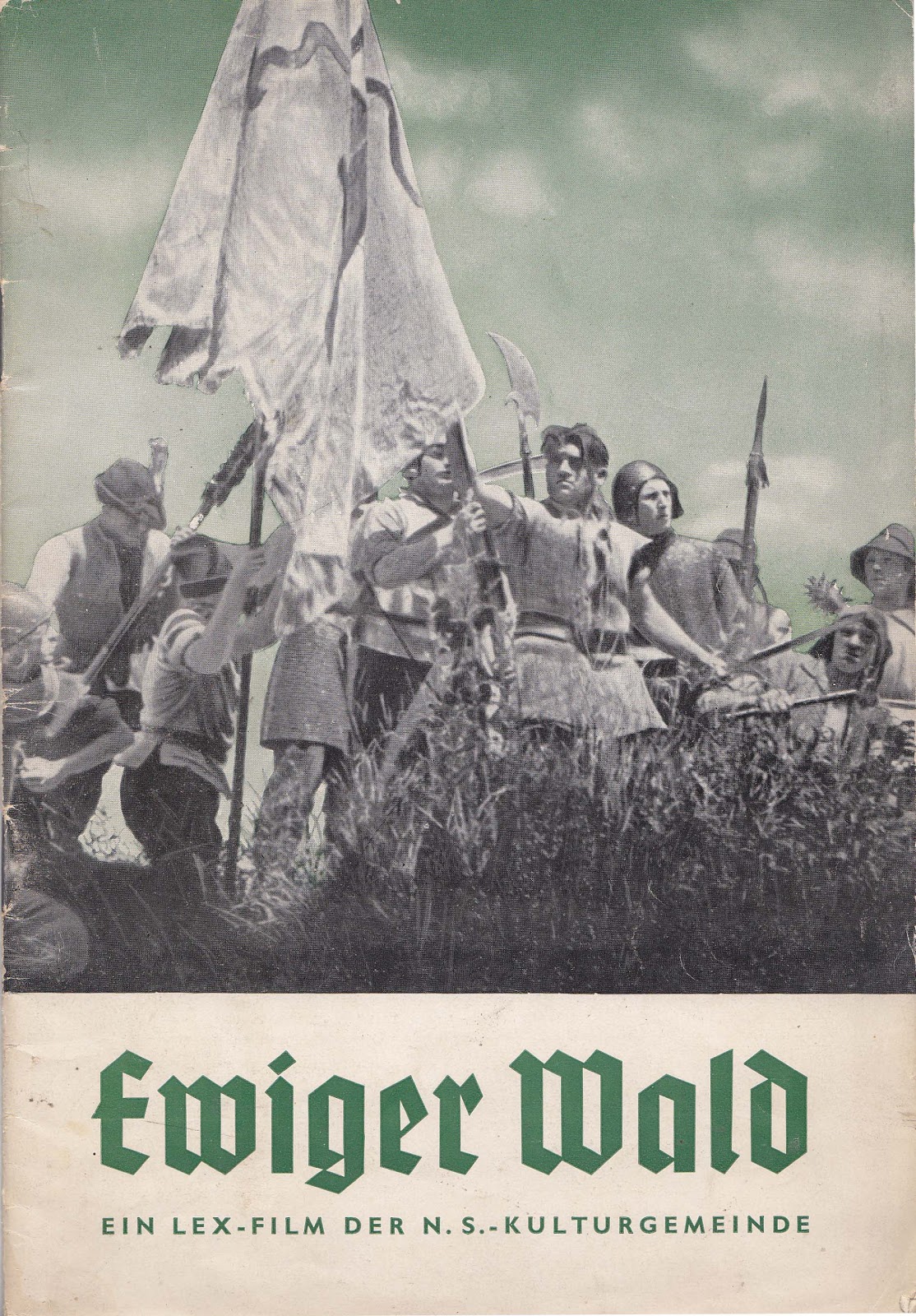
I am not one who enjoys watching poor VHS transfers of films, even if it might satisfy some sort of nostalgic urge. In fact, I purged my fairly large VHS collection a decade or so ago but sometimes I have no choice but to watch a film that has been neglected an appropriate DVD release. I recently viewed a poor (and probably tenth generation) VHS transfer of the Völksch Nationalist Socialist film Enchanted Forest aka Ewiger Wald (1936) directed by Hanns Springer and Rolf von Sonjevski-Jamrowski; a work that churned out an odd mix of mystical awe and a sense of cinematic tragedy upon my fairly cold and mostly impenetrable soul. I have to admit that I was noticeably enthralled by the film due to it's pagan spiritualism but was also discouraged by the realization that the film will most likely never receive anything resembling a proper and respectful release that it undoubtedly deserves. Despite having to endure the poor quality of the copy of the Enchanted Forest I viewed, I can’t think of another film like it that made me romanticize over the lives of my ancient Germanic ancestors. Sure, it must have sucked to live in a time when death was a very probable possibility in everyday life and food was scarce but people during those times were totally at the humbling helm of the organic and they did not have to endure the abstractness of our modern technocratic world. As a child, I had a deep respect for nature, wild animals, the wilderness, and I truly believed that these things were a gift bestowed upon on the world by an all mighty god.  In fact, nothing felt more comforting to me than allowing myself to be swallowed deeply in the pines of local forests that I would frequent in a religious manner. Of course, I still enjoy the outdoors but naturally (or unnaturally), it is virtually impossible for one to live realistically among the leaves and by sleeping under the stars in our deranged day in age. It just so happened that I was reading a book on neo-paganism (Summoning The Gods by Collin Cleary) around the time I first saw Enchanted Forest. One of Cleary’s major points with his book is that, unlike their ancient ancestors, contemporary Westerners have completely lost contact with the very land that they once held sacred. I found it quite interesting that Enchanted Forest, a film and product of somewhat recent technology, was able to duplicate my long dormant love for nature. I certainly did not feel a touch of nature in James Cameron’s epic digital blue turd Avatar (2009); a wholly (but unintentionally) risible pseudo-environmentalist romp into ultra-Hollywood alien-savage-worshiping purgatory. Say what you will about the Third Reich, but at least their state commissioned filmmakers had no difficulty assembling films that depicted absolute beauty in it's most organically magical yet orthodox form. 


The Nazis themselves proclaimed blood and soil as their ideology and quasi-religion but also led the world in technological advancement and I see Enchanted Forest itself as one of truest expressions of their brief anachronistic empire of healthy blood and monolithic industrial progress. If I wanted to illustrate to an illiterate what the spiritual essence of National Socialist Germany was, I would show them Enchanted Forest. Sure, Leni Riefenstahl’s Triumph of the Will (1935) exquisitely documented the aesthetic properties and cheerful folk of Nazi Germany yet the film fails to dream up (not that it really intended to) the true Nazi spirit of ancestor worship. In our modern materialistic world, humans look at all things (both living and not) as objects to be manipulated or utilized to their advantage as opposed to appreciating and humbly respecting the "being" (as German philosopher Martin Heidegger would say) of a particular thing. The Nazis may not have respected certain groups of people but they surely respected their land and their Völk simply for "being." One of the reasons the National Socialists despised the Judaics so much is due to their deracinated anti-nature-nature and their collective cosmopolitan homelessness, thus it should be no surprise that the Nazis originally (early on during World War II) paid for Jews to immigrate to Palestine to establish Israel (their first homeland in thousands of years). Naturally, Hollywood films have always lacked a certain authenticity in regard to portraying different cultures, nations, and peoples as they lack respect in regard to rootedness and anything of an organic nature, and for this reason, their films have always suffered from a sickening artificiality, hence why they tend to produce so many deplorable neo-vaudevillian comedies (a subject they know oh so well) full of infantile sexuality and repellant scat humor. Despite having unlimited funds and state-of-the-art technology, most of the filmmakers working in Hollywood lack the instincts to produce a film so close to nature as Enchanted Forest because the work permeates emotions that are totally alien to the culture-blind boys of Tinseltown.  Believe it or not, money can't buy everything, especially when it comes to something that is passed down through blood.


It would probably baffle a lot of Hollywood green activists actors and Americans in general, to know that National Socialist Germany was arguably the first country to endorse environmentalist policies but this will be no surprise to anyone that has seen Enchanted Forest as the film treats the majestic allure of nature in a most elegant and enriching manner. Of course, the film will be of interest to any serious lover of uncultivated beauty despite whatever political persuasion they may hold. After all, man may have lost faith in god due to technology but few can deny the irreplaceable creations of Mother Nature and her supreme omnipotence and wholly plentiful pulchritude. Enchanted Forest begins in pagan Europe and concludes in Christianized Europe, and as the times change, war only becomes more sophisticated and deadly beneath the alien cross of Christ. The irony of technology is that man has only managed to speed up the death of his fellow man with his“advancement.” For me, the greatest message (whether it was the filmmaker’s intention or not) of Enchanted Forest is that the farther away man falls from nature, the closer he is to his own miserable demise.  Man, most specifically Faustian man, has proven to be the only living organism that has had the gall to wage war against nature, but, of course, he is no match for his all-power enemy and will inevitably fail. As German philosopher Oswald Spengler explained in his 1931 work Man and Technics, technology has only sped up the death of the Occident and given his enemies weapons to use against him, thus, it is only a matter of time before the ultimate showdown begins.  On a lighter note, I would be lying if I did not admit that Enchanted Forest gave me nostalgia for a time that I have never experienced but hopelessly yearn for in a most instinctive manner.  I am sure that there are others that will also feel an atavistic awakening while watching the film.  Enchanted Forest is like a painting by Fidus come to life, only more masculine and domineering and without super-skinny-proto-hippie-nudists.  By the conclusion of Enchanted Forest, you may not be worshiping the black sun but you will have taken a virtual mini-epic journey through the ages of Europe on land, water, and forgotten battlefields where one's ancestors use to earn their livelihood from.  That being said, maybe it is time for me to learn the secrets of the runes. 


-Ty E