Saturday, June 22, 2013
Putney Swope
While I couldn't care less if his much more famous son died the same way as his crack smoking and dick-peddling character in Less Than Zero (1987), absurdist avant-garde auteur Robert John Downey, Sr. (Chafed Elbows, Greaser's Palace) directed a low-budget underground film or two that certainly deserves wider audiences, especially in regard to his breakthrough feature Putney Swope (1969), a film shot on a mere $120,000 poverty budget (although some sources say $200,000) that would arguably be the filmmaker's greatest achievement as a director. Sort of like Blaxploitation meets postmodern Judaic vaudeville meets Dada and Luis Buñuel and the Marx brothers on dope, Putney Swope is a wildly idiosyncratic and incendiary comedy that simultaneously satires the morally retarded and philistinism-promoting advertising world, the dying Anglo-Saxon elite (especially on Madison Avenue), corporate corruption and its ability to corrupt anyone regardless of racial persuasion, revolutionary politics (especially of the far-left and black militant persuasion), and black America and its post-Civil Rights political struggle. Far too politically incorrect, eccentrically esoteric, culturally cynical, and audaciously absurd and oftentimes nonsensical for fans of philistine kosher comedies starring Adam Sandler and directed by Judd Apatow, Putney Swope rather strangely owes a good portion of its success to Jane Fonda recommending the film on Johnny Carson’s The Tonight Show in 1969. Indeed, unlike a lot of so-called Blaxploitation films, which were directed by Hollywood Hebrews to capitalize on the success of Melvin Van Peebles’ Sweet Sweetback's Baadasssss Song (1971), Putney Swope is an experimental arthouse flick that attacks both black and white and, at best, can only be described as proto-Blaxploitation (it predates Van Peebles’ film and Shaft (1971)) of the anti-Amerikkkan sort. The strikingly sardonic low-budget celluloid story of a powerless token Uncle Tom black man on the executive board of an advertising firm who anomalously becomes chairman of the board upon a democratic fluke after the original leader literally drops dead, and that was partly inspired by director Robert John Downey, Sr.'s own experience as a advertising executive (he created a commercial for Preparation H of all things, which was rejected by his bosses but later appeared in his 1968 film No More Excuses), Putney Swope depicts what happens when white America devolves morally and ethnically into black America and the racially-charged, jive-ass absurdity that follows in a film that was probably not shot in mostly black-and-white just for financial reasons.
In a striking opening scene that is indubitably a parody of the beginning of Leni Riefenstahl’s National Socialist masterpiece Triumph of the Will (1935) aka Triumph des Willens of Uncle Adolf flying in a plane and landing on the ground like God coming down from the heavens, a funny and seemingly faggy 60-something-year-old fellow in fetishistic biker apparel with German iron crosses, totenkopfs, a confederate flag, and Nazi eagle patches (sewed to a leather-fag-esque denim vest) named Dr. Alvin Weasly, apparently one of the most respected motivational researchers in the country, arrives via helicopter and is paid $28,000 by a executive board of an advertising firm for merely providing the insight, “Beer is for men who doubt their masculinity. That’s why it’s so popular at sporting events and poker games. On a superficial level, a glass of beer is a cool, soothing beverage. But in reality, a glass of beer is pee-pee-dickie.” Not long after, the chairman of the board croaks at the end of the table and using the democratic process that bureaucratic wasps like so much and has ultimately led to their wane of power in the USA, the other executives vote who will be the next leader and, magically, lone Negro Putney Swope (played by Arnold Johnson of Sanford and Son fame, who had trouble memorizing lines, so director Robert Downey, Sr. later dubbed his parts) takes control of the advertising firm, thereupon turning it into an absurd Afrocentric advertising company that is aptly renamed “Truth and Soul, Inc.” After stealing the advertising idea of a tall and goofy wasp and selling it to a self-described “happy chink” named Wing Soney (Tom Odachi), Swope fires every single white employee (aside from a “token white man,” who is paid the least) and replaces them with all blacks of the brutish black power persuasion, including nefarious Negro militants, black Muslims (a naughty Negro named “The Arab” played by Antonio Fargas makes for one of the most interesting characters), high yellow pricks, and statuesque black divas. Indeed, if you thought Anglo-Saxon America was corrupt, you have yet to see the jaded jigaboo jive realm of Putney Swope.
Ostensibly attempting to rid the black community of its vices, Putney Swope ends doing business with alcohol, war toys, or tobacco companies and soon grabs the attention of the President of the United States, a megalomaniacal German midget named Mimeo (played by Pepi Hermine, who also played “The President” in Werner Herzog’s Even Dwarfs Started Small (1970)) and his pot-smoking and Jew-hating Kissinger-esque kraut associate Mr. Borman Six (a character played by Lawrence Wolf and a name likely inspired by Nazi leader Martin Bormann and the apparent death of six million Jews during WWII), a fiercely funny man who states, “hey, it’s cold in here. Throw another Jew on the fire” as he smokes a joint with the little leader of the free world. Undoubtedly, Putney Swope rules with a brassy black iron fist and he has no problem firing his employees left and right, especially after stealing their ideas from them and claiming them as his own (sort of like how black Afrocentrics claim to have invented imaginary civilizations and pioneered every area of science, technology, art, culture, etc.), but it proves to make for great business, thus making for the perfect cannibalistic capitalist model. Creating commercials featuring the sole Ms. Redneck New Jersey, bodacious black power breakfast cereals, sentimental race-mixing ballads featuring black boys and white girls, psychedelic multicultural chicks with nice tits jumping around topless in an airplane, and a Nazi Borman-mobile with a star of David on the front hood, Swope turns the advertising world into a nihilistic post-Anglo-Saxon Negro nightmare of softcore race-mixing and does so with pointlessly perverse product placement. Naturally, Putney Swope, who constantly changes his dictator look from a militant black panther like Huey P. Newton to a cigar-smoking Fidel Castro to an exceedingly effeminate African tribesmen in a moomoo, eventually runs in to trouble with his homeboys, especially the jihad jigaboo Arab, a “true believer” who considers his boss an unscrupulous and egomaniacal sell-out and sinisterly sleazy traitor to the honkey-hating revolution. A proud brotha’ named Myron X also lets Swope know that he has sold-out and is now “confusing obscenity with originality” in terms of his Russ Meyer-esque advertising campaigns. In the end, everyone one at Truth and Soul, Inc., especially Putney Swope, is more corrupt than the most psychopathic of degenerate wasps, so the Arab decides to take revenge by blowing up all the money at the firm terrorist-style.
If one learns anything from Putney Swope, it is that—regardless of creed, race, and/or ethnicity—capitalism corrupts, especially when the inexperienced slave becomes the master. Interestingly, the original members of the executive board of an advertising firm featured at the beginning of the film are all white (with the exception of a couple Jews thrown in for good measure), with a number of whom being elderly fellows are either asleep, senile, and even dead, thus illustrating the decay of the original Anglo-Saxon elite that originally ruled virtually every crevice of America's power structure, but has given a good portion of their power away due to feebleness and decay. Ironically, it is also the wasp’s love of democracy, freedom, and law that leads to the very overthrow of the Anglo-Saxon elite, thus making Putney Swope a sardonic yet strikingly realistic depiction of post-Civil Rights America through a maniac microcosm as dreamed up in a delightfully deranged manner by director Robert Downey, Sr. Interestingly, Spike Lee later directed a film very similar in theme and sentiment to Putney Swope entitled Bamboozled (2000). Of course, Spike Lee, who has never been a friend of the Jews, portrays the degenerate corporate elite as racist yet paradoxically Negrophiliac Hebrews, thus one could agree that it is also a satire (as well as update) of the ideas expressed in Judaic auteur Robert John Downey, Sr.’s Putney Swope, a film that spreads the very same stereotypes that the black filmmaker’s flick condemns. Even fellow Israelite Amos Vogel had to admit in his groundbreaking work Film as a Subversive Art (1974) regarding Putney Swope, “In this wild satire of Madison Avenue, nobody – not even blacks, arabs, midgets, or Jews – remains exempt from the director’s corrosive, bizarre humor,” hence the film’s genius and ability to stand the test of time after all these years of politically correct brainwashing. While being a brilliant and brazen work that would never be made in our insanely xenophiliac times, where ‘racial sensitivity’ has reached insane neo-bolshevik levels, Putney Swope does show its age in spoofing events and trends of the late-1960s that many modern viewers would probably have a hard time understanding. Still, Putney Swope is a singular work of biting celluloid iconoclasm that takes no prisoners in reminding one of how America and American filmmakers have turned into a bunch of cowardly cultural cuckolds who are hopelessly brainwashed by the sort of mediocre sentimentalism media that the anti-hero Putney Swope sought out to destroy.
-Ty E
By
soil
at
June 22, 2013
0
comments
My Father Is Coming
Ever wondered what would happen if a boorish, beer-bloated Bavarian kraut comes to Jew York City to visit his daughter and discovers that his little girl is a mixed-up, carpet-munching and miscegenating lesbo that no longer has love for the Fatherland?! Well, such is the sexually and culturally confused world of Sapphic German auteur Monika Treut’s cunt-loving Amero-kraut cult comedy My Father is Coming (1991) aka My Father is coming - Ein Bayer in New York, a radically ridiculous and raunchy dyke-fest of the sometimes sentimental but always vulgar sort where a proud German mensch learns to become ‘progressive’ via peversion by having a grotesque Jewish porn star/performance artist by the name of Annie Sprinkle endow him with some much needed kosher carnal knowledge. If Weimar Berlin of the 1920s and early 1930s was the world capital of sexual debauchery and gender derangement before Uncle Adolf kicked all the Jews and their shabbos goy friends out, New York City must have inherited all that degeneracy when all the Hebrews immigrated there, or at least one would assume so after watching My Father is Coming, a film that rightfully associates homosexuality and other sexual aberrations with cosmopolitanism, but also nationalism, especially of the Teutonic persuasion, as outmoded and even socially odious. Clearly influenced by German New Cinema alpha-fag Rosa von Praunheim’s flauntingly decadent documentary Überleben in New York (1989)—a sickening celebration of retarded race-mixing, lurid and loony lesbianism, and cultural deracination that follows three modern German women as their lives change drastically after moving to the big rotten apple—My Father is Coming is a culturally cynical and vaguely campy tale about pussy power and why lesbianism trumps both the father and the Fatherland, at least in sadomasochistic lady-lover Monika Treut's gal-gazing eyes. Like Werner Herzog’s Stroszek (1977) as depicted from the sardonic pseudo-intellectual Sapphic perspective, My Father is Coming is a film that reminds heterosexual men why lesbians—and not the pseudo-lezzy sort featured in silicon-soaked porn flicks—are the greatest enemy of mankind.
Vicky (Shelley Kästner)—a semi-out-of-the-closet lesbian of the German immigrant persuasion, who looks like a cross between Gillian Anderson and anti-feminist feminist Camille Paglia—is quite worried about the fact that her proudly German father Hans (German New Cinema cult actor Alfred Edel, who died two years after the film's release) is coming to visit her in NYC and does not know that she likes licking lilies and lives with a rampantly homosexual homo with an unhealthy fetish for muscular Latinos. A struggling actress who cannot even land a role acting as a German character despite her ostensibly Aryan blood (she looks more Italian/Jewish than anything), Vicky spends most of her time waiting tables and conversing with her Puerto Rican lesbian co-worker Lisa (Mary Lou Grailau) and she has very little time to spend with her father. When boorish Bavarian Hans does arrive to NYC, he comes armed with “real Bavarian sausage” that he smuggled through customs and happens to run into his daughter’s anti-German Hungarian neighbor, who makes some rather snide remarks about how “the fuehrer was a vegetarian” and how she apparently had a German boyfriend once, but dumped him because he brought over potato salad with a swastika drawn with mayo in the middle of dish. After realizing the less than homely Hungarian broad is a lesbo with a jealous estrogen-free lover, Hans leaves and finally runs into his daughter, who pretends her blatantly flamboyantly gay roommate Ben (David Bronstein) is her husband. After being surprised to learn from his daughter that “lots of Russian Jews live here and they hate Germans” when he is denied Jew food at a kosher deli, Hans agrees to go to Vicky’s next acting audition, which happens to be with dildo diva Annie Sprinkle, who is casting for her upcoming erotic film Pornutopia. While Vicky fails to entice and get the part in the porn flick, Hans gets a part in an American TV commercial by happenstance after randomly meeting a casting director, but the burly kraut also starts a relationship with jaded Jewess Annie Sprinkle after she vulgarly urinates in front of him. Feeling a bit of melancholy and jealous that she did not get the role but her non-actor father did, Vicky randomly runs into a James Dean-wannabe female-to-male transvestite named Joe (played by Michael Massee, the man who accidentally killed Brandon Lee during the film of The Crow (1994)), who offers to give her a ride to work, thus beginning an erotically fruitless relationship. While starting a harmless, seemingly one-sided relationship with Joe, Vicky starts an even more steamy affair with her co-worker Lisa. Needless to say, Hans is a little irked when he walks in on his daughter fondling a swarthy Puerto Rican gal, but he eventually comes around after cumming (indeed, the title My Father Is Coming seems to have a dual and quasi-incestuous meaning) and becomes accepting of his little girl’s vice after Annie Sprinkle gives him a rather racy and repugnant rub down, thus committing the unholy sin of racial defilement. In the end, proud kraut Hans is semi-Americanized and leaves NYC wearing looking like lard ass liberal slob Michael Moore in a goofy baseball cap and accepting the fact that his daughter is a deracinated and ethno-masochistic tuna-face dyke.
When discussing why post-WWII Germany is so accepting of gaydom, director Monika Treut theorized, “that after the Third Reich, and with the constitution of the Federal Republic of Germany, people have become very sensitive—have had to be very sensitive—when defining others as outcasts,” thus explaining why queers arguably dominated German New Cinema. Indeed, rather remarkably, in terms of persecution, it is Germans and not gays, transvestites, and lesbos that are the greatest target of scorn, hatred, and ridicule in My Father Is Coming. For example, when protagonist Vicky tries out for an acting role as a German character, the casting director states “think of the Nazis” in terms of the stereotypically robotic Teutonic performance she is looking for, thus illustrating the sort of endless and tedious Teutonophobia that has dominated in Hollywood, mainstream media, and brainwashed American minds ever since the Second World War. Additionally, Hans is taunted by strangers a number of times due to his glaring Germanness, including two dykes insinuating he is a Hitlerite, a German-Jew questioning about what he did “during the war” (He was just a boy and his father was killed), and being denied authentic kosher food. Of course, with My Father Is Coming, auteur Monika Treut symbolically broke with her German identity as virtually all of her subsequent works where shot abroad and she gained her largest audience with American lesbians, thus transcending the blood she herself feels is tainted, so much so that even being a bean-flicking bull-dyke is more socially acceptable. In fact, one could argue that she traded her Aryan identity for an abberosexual one as most of her subsequent works, including Female Misbehavior (1992), Gendernauts: A Journey Through Shifting Identities (1999), and Lesbian Nation (2009), expressed an identity as being one’s (lesbian) sexuality and not the blood and soul of one’s birth. Of course, as exemplified in lezzy Lisa’s remark “no one ever believes me when I tell them I’m Puerto Rican” in My Father Is Coming, Monika Treut seems to think of lesbianism as a multicultural pseudo-race without physical borders and social restraints, while also advocating race-mixing via Hans and Annie Sprinkle as the poisonous antidote to national and racial pride among heterosexuals. That being said, My Father is Coming is essentially a degenerate völkisch propaganda flicks for chicks that do not like dicks, henceforth, it goes without saying that Treut film(s) are the aesthetic/cinematic equivalent of a temporary STD to anyone that is not a clit-hopper. Indeed, Herzog's Stroszek might have ended in terrible tragedy and misery, but I found it far less stomach-churning than the sickeningly sentimental conclusion of My Father Is Coming, a fucked flick where a Fräulein surprises her father with the fact that she fingers other gals and expects him to accept it and he does so only after a Jewess fingers him. It might be a stretch, but I doubt Uncle Adolf would have been impressed with tranny-like Annie Sprinkle's unflatteringly large Jewess jugs but Alfred Edel is a different story, thereupon illustrating the major difference between the Teutons of today and yesteryear.
-Ty E
By
soil
at
June 22, 2013
0
comments
Tuesday, June 18, 2013
Let Me Die a Woman
Admittedly, I have not dug particularly deep into the exceedingly seedy, sleazy, and shitty sexploitation works of jaded Jewess ‘auteur’ Doris Wishman (Gentlemen Prefer Nature Girls, Bad Girls Go to Hell), but Let Me Die a Woman (1977) aka Strange/Her—a quasi/pseudo-documentary about trannies, trannsexuality, and sex-change operations—is the only film she directed that I was actually able to finish without giving up due to sheer and utter boredom. Advertised as “A Hygiene Film” with the less than titillating tagline “It's about real people...,” Let Me Die a Woman is an X-rated exploitation film terribly disguised as a serious medical documentary narrated by a purported real doctor of medicine and featuring interviews with real transvestites, but also featuring sensationally contrived ‘docudrama’ pseudo-porn scenes of so-called chicks with tiny tits and flaccid pricks engaging in amazingly banal ‘erotic’ scenes with ostensibly heterosexual men. Directed by a wanton and artistically whimsical woman who was also responsible for marvelously mediocre hardcore porn flicks like Satan Was a Lady (1975) and Come With Me, My Love (1976) starring the supremely grotesque lesbo Jewess porn star Annie Sprinkle, Let Me Die a Woman goes so far as even featuring a cameo from Hebraic porn star Harry Reems of Deep Throat (1972) and The Devil in Miss Jones (1973) infamy, thus making no bones about discrediting its own moral and scientific integrity as a film that was meant for selling tickets to perverted scopophiles and not as a sincere “how-to” guide on the phenomenon of transexuality and those rather unfortunate and seemingly biologically schizophrenic souls who are so dearly convinced they have the mind and soul of a woman that they become willing eunuchs and guarantee that they will never have a chance to receive a sexual orgasm ever again in their lives. Narrated and guided by a supremely shady Judaic fellow named Dr. Leo Wollman, a man described in the documentary as a “MD, PhD…doctor, surgeon, psychologist, minister, medical writer…A man uniquely qualified to help us understand this phenomenon,” Let Me Die a Woman features not only the unclad bodies of chicks with boobs and balls that are perversely prodded by the heeb Herr Döktor in question, but actual bloody and relatively brutal footage of penises being butchered and inverted during ‘sexual reassignment’ surgery. While describing Let Me Die a Woman as a disturbing piece of lowbrow ‘aesthetic terrorism’ would be too generous of a description for this bottom-of-the-barrel piece of accidentally eccentric exploitation sinema, director Doris Wishman certainly deserves backhanded credit for having the macabre gall to exploit some of the most deleteriously disturbed and self-destructive individuals that make up humanity.
“Imagine if you can what it is like to be a woman imprisoned in the body of a man…or a man trapped in the body of a woman,” or so says the narrator of Let Me Die a Woman regarding the transsexual, a person, to once again quote the film, that must have had something along the lines of a “monstrous, biological joke played on him or her.” Our guide for the documentary is Dr. Leo Wollman (apparently a real doctor whose practice was in an urban ghetto), a supposed Renaissance man in regard to the postmodern tranny condition, and he has a special sensitivity towards speaking in detail about and exaggeratedly prodding his poor patient’s genitals in a most dubious manner. Despite the rather repulsive quack doc being the main narrator of the degenerate doc, a Puerto Rican ‘chick’ named Leslie who had her dick cut off is the true star power of Let Me Die a Woman. Indeed, Leslie is a real male-to-female transvestite who has natural looking breasts and had he/r penis cut off and surgically reconstructed into a vagina of sorts. Undoubtedly, Leslie is an extremely flamboyant individual who looks like she could be an extra from Paul Morrissey’s Mixed Blood (1984) and has an eccentric and intemperate Latina diva tranny essence not unlike John Leguizamo’s character “Ruby” from Danny Leiner’s Time Expired (1992), thus providing a bit of comic relief in an inane piece of pseudo-science. Of course, what is most sensational about Let Me Die a Woman, aside from its real footage of cock-chopping sex-changes being performed, is the various exploitative sex and gore scenes based on ‘true’ stories, including cock-to-cock spooning between man and transwoman and an extremely absurd, Milligan-esque dramatization of a desperate military man turned carpenter stoically dismembering his own dick via chisel in desperation in a scene that looks like an outtake from the classic rape and revenge flick I Spit on Your Grave (1978). In making his argument for the importance of sex reassignment surgery, Wollman matter-of-factly states, “some transsexuals live their entire lives as men. They are ineffective sexually, socially, and are usually failures in all of their undertakings because they are so very insecure.” In terms of ‘hard science,’ one learns while watching Let Me Die a Woman that during a male-to-female sex change, the testicles are thrown away and the penis of the patient is simply inverted/turned inside out, thus acting as a pseudo-vaginal canal. Of course, as degenerate doc Wollman explains in regard to the man-made vagina, “one disappointing feature is the absence of lubricating fluid, because the glands that produce this fluid cannot be transplanted,” so naturally it is quite some time before a man-turned-woman can try their new genitals out after surgery. Wollman explains one rather disgusting story of a desperate dude who got a sex-change in Casablanca and was eager to use 'her' new beaver and did so too soon, thus she needed surgery to fix the damage done. When Leslie had sex for the first time as a new woman with a German fellow, she was lucky that her boy toy assumed he was the lucky one to pop her cherry due to the blood that came out of her designer vagina and never suspected that she was really born a he. In the end, the feisty faux-female Leslie, whose crudely charming character could not have been contrived by a filmmaker as innately talentless as Doris Wishman, seems like the only believable person in Let Me Die a Woman.
In German New Cinema master auteur Rainer Werner Fassbinder’s highly personal (he made it after the suicide of his boyfriend Armin Meier) avant-garde masterpiece In a Year of 13 Moons (1978), one is exposed to a desperately perturbed protagonist named Erwin/Elvira Weishaupt who, although once a married man and father that was never even an active homosexual nor interested in becoming a woman, decided to get his penis cut off in Casablanca after randomly falling in love with a rich yet sadistic Jewish businessman/holocaust survivor. In the end, Elvira’s sex-change does nothing to change her would-be-lover’s mind and s/he ultimately commits suicide as a person who failed to find happiness both as a male and female, thus acting in stark contrast to the false hope that Let Me Die a Woman haphazardly attempts to offer in regard to sex-changes. According to one 2010 study, 41% of American transsexuals have attempted suicide, thus In a Year of 13 Moons does not seem all that extreme in its depiction of a butcher who had their genitals butchered in the hope of changing their lives and inevitably committed self-slaughter as a last resort after realizing what a drastic mistake s/he made regarding the sex-change. The reality is that no person born a man can ever truly be an authentic woman as males and females are innately genetically different in that men have one X and one Y chromosome and females merely have two X chromosomes and no Y chromosomes. While Let Me Die a Woman pretends, quite transparently, to be seemingly sympathetic to its mixed-up subjects, as gay far-leftist film critic Thomas Waugh wrote in a 1978 review of the film with regard the star Leslie, “a young Puerto Rican woman…tells an engaging story of growing up in biological “prison” within a large, poor family and a macho culture. But an offhand remark that if she had any children she wouldn’t want them to be gay suddenly explodes a mass of contradictions that the film is trying to avoid.” Indeed, if anything is learned while watching Let Me Die a Woman, it is that being a transsexual makes for a miserable existence, so much so that it pushes some to destroying their ability to experience sexual pleasure and sexually reproduce. That being said, if Doris Wishman should be remembered for anything, it is for being the sleaziest and most parasitical female filmmaker who has ever lived and with Let Me Die a Woman being her odious magnum opus.
-Ty E
By
soil
at
June 18, 2013
1 comments
Monday, June 17, 2013
World on a Wire
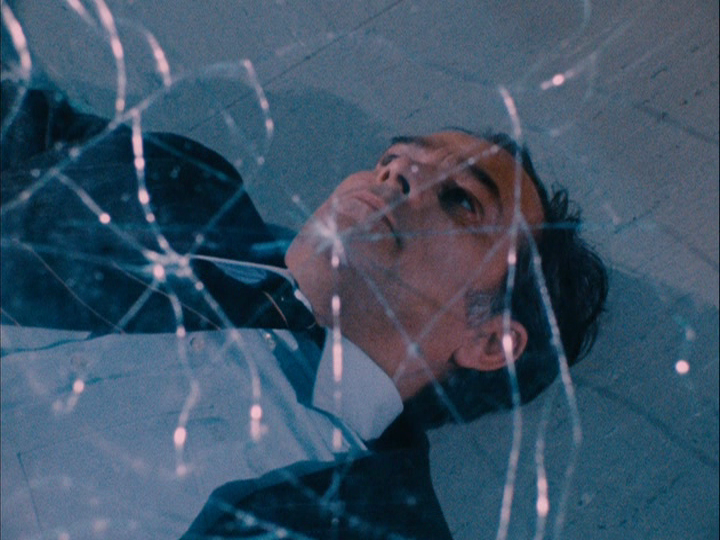
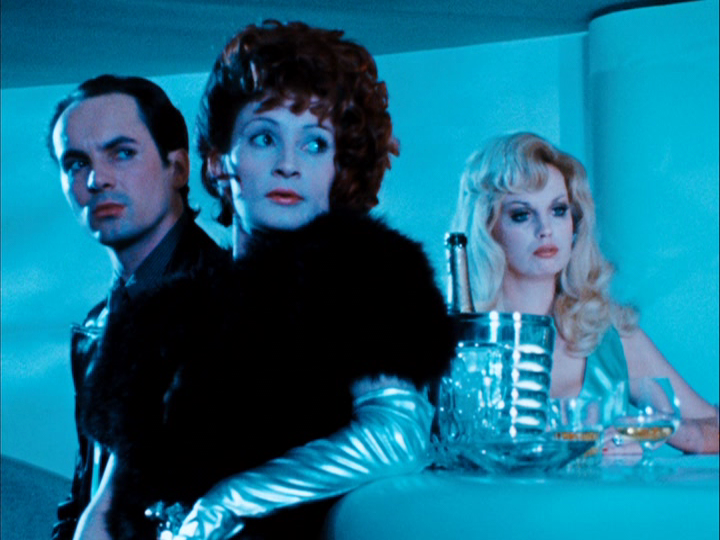
I would not describe myself as anything even remotely along the lines of a science fiction fan or a connoisseur, but I am an unwavering Rainer Werner Fassbinder fiend of sorts, so naturally I am quite keen on his sole yet immense contribution to the sci-fi genre, Welt am Draht (1973) aka World on a Wire, a 212 minute proto-cyberpunk epic shot on 16mm film that was originally released as a two-part miniseries for West German television. Nearly impossible to find until rather recently after a completely restored version appeared at the 60th Berlin International Film Festival in 2010 and was eventually released on DVD/Blu-ray by The Criterion Collection in February 2012, World on a Wire is a Teutonized, semi-futuristic celluloid adaptation of Simulacron-3 (1964) aka Counterfeit World by American science fiction novelist Daniel F. Galouye. Featuring next to nil action nor special effects yet a variety of aesthetically exquisite and quasi-futuristic and sometimes classical sets, World on a Wire is a rare cultivated thinking man’s sci-fi flick for the non-autistic that is certainly a wonderful oddity among Fassbinder’s work in that it is his sole experiment in science fiction, although the director would later play the lead role in his friend Wolf Gremm's darkly comedic and curiously campy science fiction work Kamikaze 1989 (1982) aka Kamikaze 89. Of course, being a fairly early work by Fassbinder, who was especially influenced by American gangster flicks and films of the French New Wave during his formative years as a filmmaker, World on a Wire is more a neo-noir epic set in an aesthetically pleasing technocratic nightmare than an emotionally vacant feeble fantasy-driven escapist piece for virginal fanboys. Featuring what seems to be the majority of Fassbinder’s superstars, including Margit Carstensen, Kurt Raab, Ingrid Caven, and Ulli Lommel, among countless others, as well as a cameo from the filmmaker’s friend/fellow filmmaker Werner Schroeter (Eika Katappa, Der Bomberpilot) and his statuesque muse Magdalena Montezuma, World on a Wire is arguably the German New Cinema alpha-auteur’s first great and epic masterpiece, as a sort of ambitious warm-up for his celluloid magnum opus and Gesamtkunstwerk, Berlin Alexanderplatz (1980). A culturally pessimistic work about a charming kraut Humphrey Bogart/James Bond-like character who finds himself a rather lonely yet marked man and who begins to believe the world he lives in may be virtual reality as opposed to actual reality, World on a Wire—a work predating Blade Runner (1982) by nearly a decade and The Matrix (1999) by over a quarter of a century—brings up moral questions about artificial intelligence and what happens when man’s creations have more so-called ‘humanity’ than man himself, but also the age old questions regarding persona versus individual and how people perceive others, especially in a world that is increasingly technology-driven. Additionally, World on a Wire also happens to be Fassbinder's least 'queer' and most innately masculine cinematic work, thus making it the perfect introduction to the enfant terrible auteur filmmaker's outstanding and highly idiosyncratic oeuvre.
Things are getting rather morally dubious and just plain bizarre at the institute for cybernetics and future science (Institut für Kybernetik und Zukunftsforschung aka “IKZ"), where a new supercomputer holds a simulation program called “Simulacron one” featuring a “virtual reality” of the real world, including 9,000 “identity units” (or electronic man-made individuals with the ability to think, feel, and have memories), some of which have made the mistake of wanting to become real living and breathing human beings. Professor Henry Vollmer (Adrian Hoven), who is apparently on the brink of a major world-changing discovery that “would mean the end of the world,” is the seemingly half-mad head of the Simulacron one program and after stating a number of degrading and quasi-insane things to the Secretary of State Von Weinlaub, including “you are nothing more than the image others have made of you,” dies under extremely questionable circumstances that appear to be totally nonsensical after randomly collapsing. With Vollmer dead, man’s man and lone-wolf Dr. Fred Stiller (Klaus Löwitsch) becomes his successor, but he seems reluctant to take the job, especially after Günther Lause (Ivan Desny), the security adviser of IKZ, mysteriously disappears without a trace after passing on a secret regarding Vollmer’s apparent breakthrough. Even stranger, no one at IKZ seems to remember Mr. Lause, thus leading to the beginning of Stiller’s cognitive dissonance and war against virtual reality as the “man who knew too much.” In control of IKZ is a Svengali fellow named Herbert Siskins (Karl Heinz Vosgerau), who is secretly working with in a partnership with the industrial conglomerate “United Steel.” When one of the contact units, a fellow named Einstein (played by Gottfried John), who happens to be the only one that knows about the simulation, manages to enter the body of IKZ scientist Fritz Walfang (Günter Lamprecht) and enters ‘reality,’ Stiller discovers that his world is nothing more than a simulation as well, thus ultimately leading to the good doctor’s figurative and literal break with reality, but his ‘delusions’ and fears are not unwarranted. In between banging a number of babes, including Vollmer’s daughter Eva (kraut diva Mascha Rabben) and Siskins’ blonde secretary Gloria Fromm (Barbara Valentin), Stiller runs away from the threat of being involuntarily institutionalized in a nut house, packs of police, assassination attempts, and phantom German Shepherds, among other things, after he is framed in a conspiracy created by Siskins and his corporate goons for the death of professor Vollmer and the IKZ’s psychiatrist Franz Hahn (Wolfgang Schenck), a man that eventually realized the corruption at the cybernetics institute. Eventually, Stiller realizes he has a true friend and not just a femme fatale in the form of Eva Vollmer, who is a human contact unit to the real world. Stiller also learns that he was modeled after a real-life human named Dr. Fred Stiller who designed an electric model of himself just for kicks. Considering the real Fred Stiller developed a sort of ‘god complex’ and megalomania due to his control of the Simulacron virtual world, Eva’s love waned from him and she began to develop a deeper love for the sensually electronic Stiller, thus she decided to switch the bodies of both men. Despite its patently pessimistic tone, World on a Wire concludes on a rather positive note, especially for a Fassbinder flick, though it might strike fear into the typical Hollywood filmgoer due to its less than flattering depiction of the real world (as opposed to the Simulacron realm).
In 1973, director Rainer Werner Fassbinder wrote regarding World on a Wire, “This, of course, creates doubts about ourselves merely being projections, since, in that world, projections and real persons look alike…what this is about is based on an old, philosophical model which here creates a certain kind of horror.” With internet social network sites like facebook changing the way people communicate and ultimately replacing real-life physical contact, Fassbinder’s sentiments seem all the more pertinent today in an era where a person’s internet persona typically transcends the true character of their true personality, at least in other people’s eyes, or to once again quote mad scientist Henry Vollmer, “you are nothing more than the image others have made of you.” For a master of oftentimes macabre and misanthropic melodrama, Fassbinder certainly made a great contribution to the realm of science fiction with World on a Wire, a cinematically epic work that manages to combine film noir, high-camp, softcore S&M imagery, a phantasmagorical Cocteau-esque use of mirrors, Sirkian set-design and melodrama, a fantastic and seemingly sardonic hodgepodge of old and new European actors (as well as counter-culture types like Rainer Langhans), music ranging from Richard Wagner’s ”Liebestod” to dreary counter-culture krautrock, absurdist imagery and comedy, and a soothing pseudo-futurist aesthetic for a film that is without contemporaries, although it does make for great double viewing with Stanley Kubrick’s equally antagonistically 'futuristic' sci-fi A Clockwork Orange (1971). Unfortunately, world-class cinematographer Michael Ballhaus (The Bitter Tears of Petra von Kant, Fox and His Friends), who filmed World on a Wire, later bought the rights to Galouye’s Simulacron-3 (1964) and planned to film another adaptation of the sci-fi novel, but he ultimately committed cinematic blasphemy by selling them to epic kraut hack Roland Emmerich (Independence Day, Godzilla), who produced the big science fiction turd The Thirteenth Floor (1999). For me, World on a Wire is just one (but a very big one at that!) of the many reasons why Rainer Werner Fassbinder is the filmmaker whose oeuvre I must often come back to. Rather unfortunately, no scientist thought to make an “identity unit” of Fassbinder so as to prevent world cinema from being the technocratic nightmare of CGI swill, robotic emotions, and silicone tits that it is today. A delightful dystopian flick that does not wallow in technology fetishism, globalist propaganda, and senseless and soulless special effects, World on a Wire is undoubtedly one of the most enthralling portrayals of paranoia-based solipsism in cinema history.
-Ty E
By
soil
at
June 17, 2013
0
comments
Sunday, June 16, 2013
The Endless Possibility of Sky
As far as gay American auteur filmmakers are concerned, Todd Verow is undoubtedly the least tamed and infected with the politically correct LGBT mainstream that has homogenized the homos and turned them into an automaton collective that is no less banal and braindead than Evangelical Christians. Leaving his big and infamous impression on the independent/ New Queer Cinema world with his sweetly scandalous sodomite serial killer flick Frisk (1995), a wicked work based on the seemingly unfilmable 1991 novel of the same name by poofer punk author Dennis Cooper, Verow has displayed an almost pathological and superhuman knack for churning out films like Rainer Werner Fassbinder and, naturally, like the German New Cinema alpha-auteur, many of his films are ‘hit or miss.’ While I thought Verow had gone flaccid with queer melodramas like Between Something & Nothing (2008) and The Boy with the Sun in His Eyes (2009), he has created a number of idiosyncratic and sexually iconoclastic works of the delightfully disturbing sort, including the documentary Bottom X (2012) and The Endless Possibility of Sky (2012), in the past year or so that are worthy of serious attention. While Bottom X, a sort of quasi-anthropological study of an AIDS infected “bareback mancunt” who has fifty different strangers sodomize him over the course of a weekend without using rubbers, is a virtual real-life horror show about a muscular maniac of a homo with a serious death wish, The Endless Possibility of Sky is an aberrant arthouse flick full of lunatic libertinage that takes a look at a group of self-destructive fags with self-absorbed swag who consume any and every drug they can find when not (but also oftentimes while) engaging in suicidal sex and addiction-inspired prostitution. A sort of strangely hypnotic piece of arthouse (anti)erotica featuring scenes of kaleidoscopic yet minimalistic anti-hipster animation of the pop degenerate variety, The Endless Possibility of Sky, as expressed in its allegorical yet matter-of-fact tag-line “Once you reach the sky…it’s all downhill from there,” shows what happens when too much sex, drugs, and indie rock consume a small clique of cocksucking compatriots who rely on a demented fag hag for their daily doses of hardcore narcotics. An innately nihilistic piece of anti-Wes Anderson-esque arthouse meets hysterical hagsploitation and Halsted-esque S&M art-erotica, The Endless Possibility of Sky (2012) is the sort of uncompromising ‘no bullshit’ work of queer cinema that, much like an AIDS-infected shot of semen, strikes pulsating, penetrating fear into the quivering, angst-ridden hearts of "we're just like everybody else" gay rights activists and phony pro-egalitarian art fag hipsters alike.
Drew (Brad Hallowell) is a gay man from the middle-of-nowhere Waterville, Maine, so he naturally finds himself addicted to a life of vice after becoming part of little Sodom subculture in New York City. A former Christian churchgoer from an isolated and sheltered background, Drew eventually adopts a simple nihilistic and hedonistic philosophy in NYC that he describes as follows, “Life and all that other bullshit doesn’t matter. Its just the stuff that gets in the way in between parties because there is no afterwards. The party must never stop. I’ll do anything to keep it going…sex with strangers who have more…sex for money to get more. Steal money…steal drugs…sell drugs. Whatever it takes not to have to stop…that feeling is too good to just go away.” Drew, like his sexually fiendish friends, is a patron of a psychotic woman who claims to get her drugs from aliens and is a self-described ‘venture capitalist’ named Mistress Datina (Verow ‘diva’ Philly), a wreck of a woman who invites “clean” (she sprays their penises at the door!) albeit AIDS-infected homos over for sexual and narcotic debauchery as she has never gotten over the death of her son, thus her fag friends, who engage in meaty manwich orgies right in front of her, act as sort of surrogate sons. A fellow with a certified ‘poz-cock,’ Drew valiantly admits “I don’t know when I became positive” as it “doesn’t matter,” after having one too many lewd libidinous encounters with dozens of other lascivious bugchasers; later on, he learns that his first great lover Christian (Michael Vaccarro) is also HIV positive and he has no interest in taking the drugs that will save his life, but he certainly has a perturbing proclivity for popping the pills that will put him in an early grave. Mohawk-sporting Mestizo Rob (Rob Ordonez) is a punk rock poof that gets carnally involved with Christian, even popping his so-called “slam cherry” by shooting him up with his first shot of "Tina" aka crystal meth and then proceeding to assfuck him silly while he's high as a kite. Rob is not a particularly intelligent individual and almost finds himself cut up into tons of tiny pieces after he overdoses at Mistress Datina’s pleasure dome, but he survives the ordeal, only to become the sex slave of a Dionysian ‘Poppa Bear’ fellow who looks like Peter Kern after he is drugged and repeatedly sodomized over a number of days. Indeed, trouble in poofer paradise comes to the gay boi hustlers, porn stars, and badly damaged dick-stabber druggies of The Endless Possibility of Sky, a film that explicitly but not (too) exploitatively demonstrates that with every great high, be it erotic or narcotic, once must come down and very likely fall very hard in the process. In the ridiculous libertine renegade realm of The Endless Possibility of Sky, once someone enters a figurative hell, there is virtually no return, unless you come back as a self-righteous recovering addict who is willing to literally kill to prove a point.
Near the beginning of The Endless Possibility of Sky, protagonist Drew sums up the wanton Weltanschauung of him and his copulating compatriots as follows, “I felt like an outlaw…like before being gay become all mainstream…before gay became so fucking boring…getting married, having kids, being in the military…back when they would have sex in late night parks, in dark restrooms, trucks…there was a danger, there was an excitement. Yeah, I know…full of self-loathing and internalized homophobia. But it's bullshit…trying to fit in, trying to copy straight bourgeoisie culture…that is self-loathing, that is homophobia. We’re animals, we are the new sexual outlaws. The knowing looks…the codes…the secrets…the only difference is that now, it’s all about the drugs…not the sex.” Indeed, like all of Verow’s digital dimestore works, The Endless Possibility of Sky features no phony LGBT sermonizing or far-left diatribes as the characters of the film are neo-leather-fags (minus the leather) of the designer drug age who form an erotically erratic elite, at least in their own drug-addled minds as they engaged in ritualistic bacchanalia of the boy-buggering variety. While I personally find the severely sadomasochistic behavior portrayed in The Endless Possibility of Sky to be rather repulsive and even reprehensible, the film itself is a thematically liberating affair that bows down to no one, especially the mainstreaming cocksucking queens in Hollywood that have created a pre-packaged pansy ‘gay culture’ that seems to be all the more loathsome and hideous than a couple of anti-p.c. poofs who are proud to have diseased poz-cocks like those featured in Verow's film. Unlike sell-out sods like Gus van Sant, Todd Verow rightfully seems to realize that Fred Halsted is infinitely more important and less deleterious to both gay and straight culture than Harvey Milk. Undoubtedly, The Endless Possibility of Sky features vulgar people doing vulgar things, but it has more aesthetic grace than Hebraic homo sitcoms like Will & Grace.
In a manifesto entitled “NO More Mr. Nice Gay” that he wrote for the Berlin Film Festival Teddy Awards, Todd Verow concluded with the following words: “No more Mr. Nice Gay! Aren't you tired by now of these buff, shiny, happy, pretty pretty gay people in (alleged) comedies about hooking up and being shirtless and oh-so-pretty and oh-so-vacant. No more documentaries about gay marriage and about "how just like everyone else" we are. No more conformity, (whatever that is) and whatever happened to "We're here we're queer get used to it!" Stop pretending that AIDS (or at least the devastating effects of AIDS), homophobia (outside and inside the gay culture), violence, rape, oppression, murder, censorship, don't exist. We are outlaws, we are outsiders and we always will be. You don't need a cock just a camera (and it doesn't have to be a big camera but you have to have the balls to face down the status quo.). Pull it out. Stroke it. Dare the audience, the critics, the programmers, etc. to suck it. Create like there is no tomorrow (in this modern world, you never know) and shoot, shoot, shoot!” And, indeed, if we were to judge him by his work The Endless Possibility of Sky, Verow is thankfully a man that practices what he preaches, so much so that it is rather incriminating, but, more importantly, culturally iconoclastic. However, one can only hope that Todd Verow doesn't have quite the same deletorious death wish as most homos but that, if he does, he's not going to quite such extreme lengths as the curiously debauched poz-cock possessing, "bareback mancunt" of Bottom X or the deliriously drug-addled Christian of The Endless Possibility of Sky so that he can continue producing some of the most aberrant and incendiary American-made homo films of our time.
-Ty E
By
soil
at
June 16, 2013
2
comments
Saturday, June 15, 2013
Joe
Undoubtedly, if the white working-class and white bourgeois united as an anti-leftist, anti-globalist collective, they would take America back virtually instantaneously and start reversing its decided degeneration via multicultural third worldization and Hebraic Hollywoodization and such a sweet scenario seemed to be deranged Jewish screenwriter Henry Wexler’s worst nightmare, at least if one were to judge by his screenplay for Joe (1970) directed by Hollywood ‘for hire’ hack John G. Avildsen (Rocky, The Karate Kid). Joe is the ultra cynical celluloid tale of a corporate executive Wasp type who accidentally kills his daughter’s drug dealer boyfriend and subsequently joins up with a blue collar bro named Joe of the seemingly Irish-American sort who respects the banal bourgeois boob for wasting a piece of hippie shit. Penned by a man whose own daughter described him as “a brilliant man with an IQ of 180 and a Russian-Jewish immigrant drive” and that was "capable of emptying a 13th-floor hotel room on to the street and announcing on a plane his intention to kill President Nixon, inciting the FBI to arrest him. Horrified by her son’s mental illness and consumed with guilt and shame, my grandmother committed suicide,” Joe is certainly a work scripted by a man who simultaneously hates the Anglo-Saxon bourgeois in a Trotskyite fashion, but also the white working-class in a rich kosher capitalist manner, which he portrays as being nothing short of barbaric and vulgar, especially in regard to the film’s 'white and proud' title character. Quite similar to Paul Schrader’s Hardcore (1979) in its depiction of members of an older and more self-restrained generation entering the decidedly debauched counter-culture realm of the boobtube-brainwashed baby boomers—the first generation brought up on and brainwashed by TV and arguably the most spoiled generation in all of human history, hence their self-righteous need to turn America, as well as the Occident, into the corrupt cosmopolitan cesspool it is today—Joe shows the needlessly nasty results of what happens when a concerned and respectable father attempts to save his daughter from a life of drug addiction, loveless sex, and borderline poverty. Of course, before he knows it, at least according to Wexler’s Hebraic logic, the traditional western man's hippie hating also leads to nigger and faggot hatred, as well as coldblooded murder of the totally nonsensical sort. Luckily, Joe backfired on its crazy kosher creators because instead of working to vilify the anti-liberal anti-heroes as intended by Wexler, many viewers saw the flower child killers of the film as all-American heroes , so much so that star Peter Boyle was rather perturbed to witness audience members cheering on his character's homicidal liquidation of an entire house of hedonistic hippies. Starring Susan Sarandon in her debut role as a naïve hippie poser who takes too much speed and has a ‘bad trip’ at a grocery store, Joe, despite the political campaign of its director and screenwriter, is indubitably a therapeutic piece of accidentally politically incorrect carnage that delivers shotgun bullets to the degeneration generation of peace and love and other phony self-absorbed pseudo-cultural swill.
Despite growing up comfortably in a rather wealthy family from New York's Upper East Side, brainwashed would-be-beatnik broad Melissa (Susan Sarandon) has decided of her own free will to live in near destitution with her heroin addicted, drug dealer boyfriend, who is such a good boyfriend that he virtually enslaves his girlfriend with a candy bowl full of drugs. After taking a little too much speed, Melissa has an unbecoming public freak out at a mom-and-pop grocery store and is hospitalized, which infuriates her father, stoic Bill Compton (Dennis Patrick), who goes to his daughter’s ghetto apartment to collect her stuff and ultimately runs into the jaded junky boyfriend, thus resulting in a confrontation that thankfully leaves one dirty hippie dead. Bill gathers up the drugs he finds laying around the apartment and goes to a blue collar bar where he runs into American ‘everyman’ Joe Curran (Peter Boyle), a crudely charismatic working-class mick fellow who loves to rant about his sheer and utter hatred for fags, queers, nigs, social workers, and the young in general. As far as gentleman Joe is concerned, “The niggers, the niggers are gettin’ all da money. Why work, tell me, why the fuck work, when you can screw, have babies, an’ get paid for it?” and “And the kids, the white kids. They’re worse than the niggers. Money don’t mean nothin’ to them. Motocycles, Marijuana. Five dollar records.” Undoubtedly in a state of shock after wasting a “skinny fucker” of a deadbeat junky, Bill mentions to random stranger Joe that he killed one of these very same worthless hippies that he was ranting about (Joe even goes as far as saying “I'd love to kill one” in regard to beatnik bastards), which rather impresses the brazen blue collar worker, thus striking a 'stranger than fiction' bond between the two born class enemies. Sticking it to bourgeois failure Marx (a man who never worked a day in his life and lived off the generosity of others) and his bogus materialistic theories for introducing class war to the Occident, Bill and Joe ultimately become friends united in their hatred for hippies and disgust from aberrant America’s cultural decline. While Bill likes the working-class man’s ‘no bullshit’ attitude due to his own bourgeois friend’s impenetrable phoniness, Joe respects the somewhat uptight advertising executive for doing what he always wanted to do: trampling on a flower child without mercy. After overhearing her mother and father talking, Melissa learns that Bill killed her bum boy toy and naturally she runs away and goes missing. Using the drugs he stole from his daughter’s apartment, Bill meets up with Joe and they start searching for Melissa, eventually partying with a group of hippies that they hope will lead them to the runaway drama queen. Both Bill and Joe smoke some weed out of a hookah and even have sex with some hot hippie hoes, but things take a turn for the worse when two of the male hippies of the group steal the older men’s wallets and drugs. Joe smacks the shit out of a loose hippie chick he just screwed and learns the beatnik crooks are probably staying at a commune in upstate New York. Arriving with shotguns blazing, Joe wastes some hippie pigs and Bill regrettably joins in, bringing carnage to the commune and the literal and allegorical death of a nuclear family.
Undoubtedly, screenwriter Henry Wexler’s Hebraic hatred for traditional Anglo-America and everything it represents reaches its peak at the conclusion of Joe when a wealthy white father unwittingly puts bullet holes in his own daughter in a scene that is nothing short of a Judeo-bolshevik wet dream. In the end, one cannot help but think Wexler had a self-satisfied smirk on his semi-Asiatic face while penning Joe knowing, as portrayed in the film, that no matter how much love and good intentions a father may have had for his children, they had already been lost to a lifetimes worth of brainwashing and spiritual degeneration via Talmudic television and addiction to sex, drugs, and rock n roll, hence why daughter Melissa states “What are you gonna do, kill me too?” Indeed, only after her death is Melissa truly ‘saved’ from a life of senseless sacrilege and STD-ridden sensuality, as the girl essentially died in the spiritual sense the day she bought into the unholy gospel of counter-culture garbage. Interestingly, Melissa’s druggy boyfriend, who is a hack degenerate artist who seems to be a pathetic parody of Warhol Superstar Joe Dallesandro characters in the “Paul Morrissey Trilogy,” especially Flesh (1968) and Trash (1970), which are sardonic satires of the toilet culture that is liberalism and the related counter-culture movements. It has been my experience that most viewers of Joe empathize with the anti-hippie plight of Joe and Bill, and it's highly doubtful that a film like this could be made in Hollywood today. After all, nothing strikes fear in the dead souls of the heebs of Hollywood and the mainstream media more than the idea of the white working-class and bourgeois uniting against the metaphysical disease of leftist degeneracy and taking back America by force. Nowadays, with a good portion of young proletarian whites being shameless wiggers who wish they were poor Negroes and the white upper-classes being contaminated with slavish liberalism, philo-semitism, and hyper-hedonism, the unlikely alliance of the Euro-American blue collar and white collar in Joe seems all the more ridiculous, but as a famous assassinated colored man once so eloquently stated, “I have a dream” and some dreams, like Joe's, are greater and more righteous than others.
-Ty E
By
soil
at
June 15, 2013
0
comments
Pink Ulysses
Apparently influenced by the similarly titled and homoerotically themed arthouse work Pink Narcissus (1971) directed by James Bidgood, Pink Ulysses (1990) is a potent yet unwaveringly pretentious piece of esoteric pomo homo celluloid that radically reworks Homer's epic poem the Odyssey in a campy, carnal, and even comical fashion that trades in cinematic action-adventure conventions for a sort of arcane celluloid aphrodisiac. Directed by Belgian auteur Eric De Kuyper (Naughty Boys, A Strange Love Affair) who described his contemporary cross-European heritage as follows on his official website, “I was born in Brussels. So I speak and write English with a French accent; Dutch with a French accent; and German with French and Dutch accents!,” Pink Ulysses, although a Belgian-Dutch co-production, features dialogue in German, French, Italian, and English, yet one does not need a serious understanding of any of these languages to appreciate the work as it is virtually a modern silent film featuring a number of exquisite tableaux in the camp dandy spirit of Werner Schroeter, albeit more butch, with some aesthetic and thematic ingredients from Kenneth Anger, Carmelo Bene, and Luchino Visconti thrown in for good measure. In fact, even if one understands all of the scantly spoken languages in De Kuyper’s postmodern tragicomedy, there is no guarantee that one will be able to follow the film as it is an audacious yet oftentimes cinematically archaic arthouse flick of the sometimes pornographic sort that mixes kaleidoscopic images of Odysseus’ return home after twenty years of exile in Troy with seemingly pointless modern day black-and-white footage of a funny self-fondling fellow who seems to live the life of a lonely male ‘housewife’ doing such daring and heroic things like ironing shirts, masturbating in front of mirrors, treating homely naked women like cheap furniture from IKEA, and other activities that would have probably inspired our hero Odysseus to commit suicide out of sheer boredom. Director De Kuyper, who also wrote the ‘original’ screenplay, described the film as follows: “‘Homer tells us how Ulysses’ wife Penelope used to weave Laertes’ shroud. The work she did by day she unravelled by night. That process was not dissimilar to the creation and production of Pink Ulysses. Gradually images (collected here and there, also from film classics) and well and lesser known music created a texture of sight and sound, resulting in a variation on Ulysses.” Featuring excerpts from classic silent films like Battleship Potemkin (1925), most specifically the most seemingly homoerotic scenes (apparently, Sergei M. Eisenstein was more on the pink team than the red one), Pink Ulysses is essentially an acutely arcane and fiercely fetishized homophile molestation of both Occidental history and cinema history, yet it will mainly appeal to arthouse fans of any stripe, including those with nil interest in terribly tanned 1950s beefcake pinups, hence why De Kuyper’s film was well received at the 1990 Rotterdam Film Festival and virtually everywhere else it was screened and is not known outside the world of European arthouse cinema.
If Jean Cocteau ingeniously used the ruins of post-WWII Paris as the perfect setting for updating the classic Greek myth of Orpheus with his masterpiece Orpheus (1950) aka Orphée, Eric De Kuyper somehow thought it would be wise to turn the Homer's Greek hero Odysseus into a 1950s-style crypto-homo muscle mag hunk that is lacking in both wit and heroism, at least in any realistic and genuinely masculine sort of way, with Pink Ulysses, a suavely stylized epic without much action, but tons of man meat and muscles. Of course, the Odysseus of Pink Ulysses is far more interesting than the flagrant fairy that makes up the contemporary black-and-white portion of the film. Opening the film ironing his shirt in a rather erratic and seemingly nonsensical fashion, the prissy ‘modern man,’ who never puts his shirt on again for the remainder of the film, enjoys masturbating and gazing in the mirror, which is indubitably an expression of his narcissism and loneliness, and when an unclad automaton of a woman shows up at his door, he clearly does not know what to do with her as a less than manly mensch who prefers to spill his seed instead of spreading it in the vaginal realm. If anything is for sure, Odysseus and his journey offer the contemporary character not only an elaborate romantic fantasy of the marvelously masturbatory sort, but also a striking dichotomy for the viewer of a majestic mythic past and the prosaic present, where domestic chores like ironing make for a stupendously banal way for one to spend one’s day. Of course, Odysseus, who need not worry about wearing shirts and electricity, has so much free time that he can spend a scenic and sensual seven years with a beauteous babe named Circe, who looks good enough to be his wife but is all the more spellbindingly seductive. Despite his propensity for attracting striking statuesque women, the orgasmic (indeed, he always has a smile on his face as if someone is continuously smoking his pole) Odysseus of Pink Ulysses has a seemingly endless proclivity towards softcore exhibitionism, especially around other men, who have nothing on his brawn and biceps. If Odysseus of Pink Ulysses is cunning, it is only in the most philistinic hustler-like sort of way, simply using his Breker-esque physique to lure in his pretty prey. Naturally, as everyone knows, many male suitors attempt to claim Odysseus’ wife Penelope by trying their ultimately inferior skill at the great king’s bow, but the great king and his son Telemachos inevitably kill them all in the end, thus immaculately handling family matters with gusto. Like Alberto Cavallone’s Le salamandre (1969) and Federico Fellini’s And the Ship Sails On (1983), the director and his crew are revealed at the conclusion of Pink Ulysses, henceforth demystifying the movie myths and slapping the viewer across the face with the banality of reality.
In regard to his take on Odysseus’ twenty years of epic limbo, director Eric De Kuyper offered the following hint regarding his rather idiosyncratic and inventive celluloid puzzle: “Perhaps Penelope began to love her son more than her distant, absent husband? And possibly Ulysses began to love the ‘ideal Penelope’ he recognized in magical Circe more than his wife, who would be waiting for him in Ithaca? Perhaps… and the imagination lingers on… How this materializes in a film, a fabric, is Pink Ulysses’ secret. An exploration, an adventurous wandering.” Indeed, Odysseus’ odyssey materializes in a rather classically camp, anti-reality sort of manner that, whether the intention of the director or not, demonstrates how really absurd the Greek tragedy truly is. Why Odysseus, who is on what amounts to a permanent vacation full of captivating scenery and otherworldly sensuality, even bothers to go back to his wife and son in Pink Ulysses is anyone’s guess, but it is quite obvious that director Eric De Kuyper was looking to make a piece of aesthetically antagonistic body worship that spends just as much as time fawning over the ultra-masculine male physique as it does obscuring its message. An arthouse anti-epic that, in terms of action, only features vintage silent footage of men wrestling men and other crypto-homo scenes from film history, Pink Ulysses is masculinity painted pink by a man who is obviously not a fan of Spartacus (1960) and David Lean’s Lawrence of Arabia (1962), but has clearly scoured every curious crevice of cinema history to show that homos have always sat in the director’s chair. Featuring excerpts from The Fall of Troy (1911) directed by Giovanni Pastrone, Strike (1925) and Battleship Potemkin (1925) directed by Sergei M. Eisenstein, and the Cocteau penned work Love Eternal (1943) aka L'éternel retour directed by Jean Delannoy, Pink Ulysses is essentially a celluloid love letter to queer film history that goes to great pains to make sure that Steven Spielberg and even Sam Peckinpah fans find the whole experience to be completely and utterly impenetrable. While Pink Ulysses does feature an authentic pulsating cock busting a load, the film does not feature any scenes of real gay romance, thus following in the cinematically orphic footsteps of the homo auteur filmmakers that came before. Of course, like Pink Narcissus, Pink Ulysses is not a ‘fags only’ flick, but an exquisite, if not flawed, cinematic work that reminds all viewers that, in their need to conceal and obscure their sexuality, queer filmmakers found creative and allegorical ways to express themselves, which certainly beats the slavish cult of victimhood and lack of originality that plague most mainstream (and so not so mainstream) gay films today. Indeed, I doubt anyone would care about their films today if master sodomite auteur filmmakers like Pier Paolo Pasolini, Curtis Harrington, Rainer Werner Fassbinder, Jean Cocteau, and Kenneth Anger made propaganda works promoting gay marriage and queers adopting children. Pure, classic, and cultivated camp, Pink Ulysses is evidence that Nordics can still make worthwhile arthouse films if they try.
-Ty E
By
soil
at
June 15, 2013
2
comments
Subscribe to:
Posts (Atom)
Soiled Sinema 2007 - 2013. All rights reserved. Best viewed in Firefox and Chrome.