Thursday, July 25, 2013

Hécate


While my girlfriend and I love the early films of Swiss auteur Daniel Schmid (Schatten der Engel aka Shadow of Angels, Violanta), especially his masterful second feature-length effort La Paloma (1974) starring Fassbinder’s ex-wife Ingrid Caven, we were both absolutely repelled by his brazenly bitter and precariously pessimistic colonial romance Hécate, maîtresse de la nuit (1982) aka Hécate starring American fashion model turned actress Lauren Hutton (The Gambler, Once Bitten) and the always pompous and unpleasant Frenchman Bernard Giraudeau (Passione d'amore, François Ozon’s odious Fassbinder adaption Water Drops on Burning Rocks). In fact, to simply say the word “Hécate” is enough to consume my typically calm and mild-mannered girlfriend with sheer and utter disgust, which is certainly a sentiment I can relate too, even if I found myself more intrigued by Schmid’s Franco-Swiss film on my second viewing of it due to its historical and philosophical themes regarding the capitulation of Europa as a result of the Second World and rise of a new form of barbaric collectivism as inspired by far-left anti-European sentiment. Having the grand distinction of being Schmid’s most ‘explicitly erotic’ work (even if it does not show much in the way of bare flesh) and set in an unmentioned French-British North African colony, Hécate totally lacks the signature high-camp melodrama and decided aesthetic decadence that made the director's first three films, Tonight or Never (1972), La Paloma, and Shadow of Angels, idiosyncratic masterpieces. A sort of exotic European film noir featuring an apathetic femme fatale who wants nothing in return for her succubus ways aside from destroying the soul of any man that has the misfortune of coming under her spell, and set in a pre-apocalyptic Arabian colonial ghetto as opposed to an American urban ghetto, Hécate is ultimately an unpleasantly poetic celluloid allegory for the decline of Occidental power and influence disguised as one of the most disastrous romances ever depicted on the silverscreen. Based on the novel Hécate et ses chiens written by French Nazi collaborator/Vichy government supporter Paul Morand—a novelist inspired by the Faustian philosophies of Friedrich Nietzsche and Oswald Spengler, as well as the racial theories of frog aristocrat Arthur de Gobineau (whose ideas also inspired Richard Wagner and the Bayreuth circle)—Hécate, unlike similarly themed Hollywood works, makes no attempt to glorify the death of the west nor the so-called ‘noble savage,’ but instead portrays it as a sort of softcore doomsday scenario leading up to a sort of neo-barbarism of global proportions. As a man who suavely satired the far-left 1968 student movement in his debut feature Tonight or Never and always displayed a deep admiration for traditional kultur, Schmid certainly expressed a sense of quasi-Spenglerian cultural pessimism with Hécate that is no less emotionally grating than his discernible disdain for heterosexual relationships. 


 It is the1930s and French diplomat Julien Rochelle (Bernard Giraudeau)—a successful and attractive but otherwise mediocre man—spots a mysterious beautiful blonde woman while lounging at the French embassy in Morocco. After Julien asks a consul at the embassy “what kind of woman is that?,” he learns she is “just a woman looking out into the night.” Of course, little does Julien realize that he will soon be spending a number of sleepless nights in a North African colony searching for the mysterious woman. As Julien narrates at the beginning of Hécate, “The story of Clothilde happened a very long time ago. When I say time…I don’t mean the number of years…I mean that since that time the world has changed. France and England no longer live at the slow pace of horses. France and her Treasury no longer represent the greatest bank in the world. America is arming Russia. Germany will devour everything, even her own downfall. In those days…When was it, already?” Upon arriving at the North African colony, Julien almost immediately starts a steamy love affair with a certain married woman named Clothilde de Watteville (Lauren Hutton), whose husband is a ‘strange French officer’ working as a mercenary in Siberia. Of course, little does gentleman Julien realize that he will be in store for the same sort of internal pain and heartbreak as Clothilde’s husband, a totally broken man who cannot live with or without his wife, but has chosen self-imposed exile and opium to distance himself from his seemingly magical and always wanton witch of a wife. While Julien and Clothilde’s relationship is seemingly immaculate due to its exclusively erotic nature, the French diplomat begins to overstep his bounds when he begins to declare his passionate love for the married femme fatale, which naturally pushes her away. Of course, Julien’s romantic relationship with Clothilde is not the only thing crumbling in the North African colony as the colony itself is falling due to rebel attacks inspired by a hatred for European imperialism. As French consul Vaudable (Jean Bouise), tells Julien regarding the state of the world and the foreboding future of the Occident, “One sees horrors everywhere. Everywhere where order reigns, everywhere where disorder reigns. Occasionally, in the center of Europe, in the center of certain Democracies, it is possible to find a fragrance of tolerance. A conquest against nature. Barbarism is a permanent threat. We can forget the ideas of the French Eighteenth Century. Liberty and individuality are two luxuries that are dying out.” Despite being a French diplomat, Julien cares more about permanently possessing Clothilde than whether or not Europe's empires fall. Every time Clothilde disappears from his presence, Julien wanders on foot both day and night and when he finally catches her during one of these exotic Arabian nights, he forces himself upon her, thus demonstrating the dissolution of his mind as a diplomat-turned-degenerate. When jaded Julien later discovers an androgynous Arab boy hanging outside of Clothilde’s door, he displays his dominance in a rather deranged manner by capturing the brown boy, locking him in his lover’s room, and sadistically sodomizing the uniquely unlucky and unwilling victim. While Julien is not arrested, he is forced to leave his post and his title and pension are revoked as a result of the sodomy scandal. Forced to take the first black boat to France by the French Foreign Office, Julien is forced away from his sweet succubus Clothilde, but he ultimately becomes a successful ambassador anyway despite being a lovelorn lunatic who perniciously pillaged a young untermensch boy. 


 Still consumed with undying love for the ever so cold and callous ice queen Clothilde as a pathetic perennial cuckold of sorts, Julien uses his power as an ambassador to visit his lost lover’s husband in Siberia despite the fact a violent war is waging there. Upon a superficial glance, it is quite apparent Le colonel de Watteville (Gérard Desarthe) is a badly broken man who is addicted to ‘Cocteau’s kick’ and when Julien arrives to speak with him, it comes as somewhat of a shock to the viewer that he is not angered by the fact that the melancholy married man is standing face-to-face with the man fellow that sexually defiled his wife. The Colonel lets Julien know that, “You know…we’re both in the same boat, hoping every day that she’s coming and praying always for her not to come. Here, I’m paying my debt. I am not cured. I’m still waiting.” Not long after his visit with the Colonel, Julien ends up running into Clothilde by happenstance at a party in Switzerland and tells her he went to visit her husband, remarking, “I am like him. I was never cured.” After declaring his love for Clothilde for the last time, he is met with the disappointing response, “Words always come too late…or too soon.” 


 In an interview with Swiss filmmaker Rudolph Jula, director Daniel Schmid provided the following insights regarding Hécate, “A lot of things come together at the end of the world. The novel Hécate was written by Paul Morand, the character was based on his wife Helene, whom I met when she was a very old woman. She was supposed to be eighty-five when she died, and then they found out she was ninety-seven. She’d altered her passport so often that even her husband didn’t know. Hécate is a film about projection, possession, jealousy and logical destruction.” And, indeed, an irrational obsession with projection, possession, and jealously lead Hécate protagonist Julien, an otherwise dull and uninteresting man, to degenerate into a one-man train wreck who will do anything, including raping a teenage Arab boy, to demonstrate his debauched and ultimately demented love for a woman who is only interested in emotionless sex and flaunting her almost witchlike power over and destruction of said men. 


 A patently pessimistic example of ‘love conquers all’ (except for seemingly sociopathtic femme fatales, of course!), Hécate is undoubtedly the closest thing to a French colonialist take on Gone with the Wind (1939), because, like the Hollywood epic, Schmid’s film also depicts not only the failure of a great love affair but also the decline of a civilization, which has ultimately led to the mass-minded and Americanized world we have today where such things as class and culture have been turned into a mockery of the way things once were in the past. The fact that Hécate is based on a novel written by an unrepentant fascist elitist and aristocrat of the soul makes it all the more interesting of a film because, unlike the communist (and Hollywood) writers, who actively sought to destroy traditional Europe and European values via savage class warfare and portray all things classically Occidental as innately evil, most so-called ‘far-rightists’ hope to preserve ancient culture and traditions and rid their nations of vice and decadence, which the protagonist of Schmid’s film ironically ultimately succumbs to. Undoubtedly, to describe Hécate—a film named of the Greek goddess of magic and protection who later came to represent the goddess of darkness, night, and the underworld and a sort of femme fatale—as a great ‘downer’ of a film would be an understatement as few other films have the power to depress, anger, and agitate like Schmid’s dark colonial romance. Of course, with their celebrated cuckold epic The Constant Gardener (2005)—a film about a British cuck of a diplomat in Kenya who makes the major mistake of falling in love with a hysterical ‘humanitarian’ activist, thus leading to both of their demises—Hollywood has popularized what Schmid did long ago with Hécate. The major difference between both films is that while Hécate portrays the dissolution of European power as a bad thing that will inevitably lead to a sort of rise of Bolshevik-esque neo-barbarism on a global level, The Constant Gardener absurdly portrays sacrificing one’s life to disease-ridden ‘noble savages’ as the most morally noble and virtuous thing a person can do, which would have totally repulsed Hécate novelist Paul Morand. Of course, The Constant Gardener is a not only a glaring symptom of Occidental decline and the horrendous and culturally homogenizing Hollywoodization of the world, but also the reign of the untermensch and the total transvaluation of all values, which was not only dreaded by Morand, Nietzsche, and Spengler, but also Hécate director Daniel Schmid, who portrays the darkness and chaos engulfing Europe during the first half of the Twentieth century as a salacious and statuesque mistress of the night. 


-Ty E

Wednesday, July 24, 2013

The Brown Bunny


Maybe it was because he was a staunch and groveling Spielberg apologist or perhaps because he was the man responsible for co-penning Russ Meyer’s pseudo-sexy, scatological satire Beyond the Valley of the Dolls (1970) thus lacking a serious appreciation for cinema as an art form, but the late and less than great film critic Roger Ebert must have been suffering from serious cases of both penis and artistic envy after initially smearing Sicilian-American Renaissance man Vincent Gallo’s second feature-length film The Brown Bunny (2003) by describing it as the worst film in the history of the Cannes Film Festival. Of course, it would take a cancer hex put on Ebert, who inevitably died from the disease after a long and miserable battle that forever silenced his catty voice, for the rather rotund (or as Gallo himself described him, a “fat pig with the physique of a slave trader”) film critic to drastically change his opinion of The Brown Bunny, which had been reedited (cutting 26 minutes of what was originally a 118-minute film), ultimately giving it 3 out of 4 stars and a “thumbs up” rating despite his ongoing war of words with the film's director. While I never had the opportunity to see the infamous Cannes cut (which was apparently an uncompleted workprint that Gallo’s Japanese producers forced him to screen) of The Brown Bunny, I did recently watch the film for a second time (my initial viewing was around the time of the original DVD release) and can safely say it was no less a harrowing yet hypnotic experience than my initial viewing of the film about a decade ago or so and I can see the work being regarded as an unsung masterpiece in decades to come. Although most (in)famous for its doubly climatic conclusion featuring writer/director/editor/producer/star Vincent Gallo—a misunderstood man who, despite his rather unflattering reputation, is undoubtedly one of America's few great artistic polymaths—receiving an unsimulated blowjob from his real-life ex-'lover' Chloë Sevigny (who Gallo claims was never actually his girlfriend, but they did previously date/fornicate), The Brown Bunny is about as far from erotic as films come as a maliciously melancholy ‘fever nightmare’ that slowly but surely gets under one’s skin and eventually tears at one’s psyche via the director’s startlingly naked reflection of his own terribly tormented and undeniably provocative soul. Featuring many cryptic autobiographic nuances from Gallo’s own life, including scenes shot in the small Pennsylvania town where the director’s mother grew up (but which the director never visited previously), authentic footage of the auteur doing his own ‘stunts’ on his motorcycle (Gallo was a professional Gran Prix motorcycle racer in the 1980s), and graphic sexual acts between an ex-partner, The Brown Bunny is nothing less than indisputable proof of the validity of the auteur theory. Indeed, Gallo may be a neurotic 'narcissist' with delusions of grandeur as is oftentimes libeled against him by his mostly jealous detractors, but such seemingly negative qualities make for unwaveringly uncompromising filmmakers who bend the knees for no one, especially in regard to people—namely left-leaning American and British film critics, as well as the majority of the American populous—who have no respect for the medium of film as an art form, but instead see it as the modern equivalent of a peasant circus. The superlatively somber and dispiriting cinematic tale of a motorcycle racer who carries around conspicuously crippling memories of a great love perennially lost due to tragedy, chance, and—most importantly of all—inaction on the protagonist's part during a moment of emotionally-charged self-doubt and disgust, The Brown Bunny is the American heterosexual equivalent of what German auteur Rainer Werner Fassbinder cinematically achieved in regards to sensitively depicting the emotional torment and cognitive dissonance of women, homosexuals, and transsexuals in a manner that mere words cannot express. 


 Bud Clay (Vincent Gallo) has just lost a motorcycle race in New Hampshire and is headed on a one-man road trip to Los Angeles, California to compete in another race, which also happens to be near where he once shared a small home with his lost great love Daisy (Chloë Sevigny). A lost soul grudgingly treading through life, Bud will do anything to relieve his inner torment, which includes approaching three random female strangers on his trip in what will prove to be futile attempts to fill the gaping metaphysical wound that was left by his oh-so dear Daisy. Like Daisy, all three of these women superficially share flowery names, hence Bud's initial yet self-deceiving interest in them. Bud’s first victim/sexless fling is a ‘homely’ (Gallo himself described this girl that way) gal named Violet (non-actor Anna Vareschi), who the melancholy motorcyclist meets at a New Hampshire gas station and convinces to join him on his road trip to California. Upon dropping Violet off at her house so she can collect her belongings for what was suppose to be a romantic road trip between two strangers, Bud coldly drives off and leaves her behind without looking back. Positively possessed by mostly bittersweet memories, Bud makes the mistake of visiting Daisy’s parents’ home, where he grew up in the house next door, but he is in for a rather awkward surprise when he learns that his great love’s mother does not remember him at all, but at least he gets to see her pet brown bunny. After the visit with his could-of-been parents-in-law, Bud goes to a animal shelter and learns from the clerk that bunny rabbits only have a life expectancy of 5-6 years, thus realizing even the cutest of creatures eventually perish and that when Daisy's brown bunny dies the last physical remnant of their relationship will disappear. While making a brief pitstop at a public bathroom, Bud seems magnetized by the glaring misery of a blonde milf named Lilly (played by veteran model-turned-actress Cheryl Tiegs) and proceeds to comfort and kiss the crying stranger, which causes him to cry and leave abruptly, never looking back again. After racing at Bonneville Speedway in a scene that looks like a man fading into a beauteous abyss of nothingness that recalls the hopeless yet breathtaking atmosphere of Philippe Garrel's The Inner Scar (1972) aka La cicatrice intérieure, Bud drives through a seedy Las Vegas ghetto and picks up a seemingly untainted streetwalker named Rose (played by real-life working girl Elizabeth Blake) due to his fondness for her flowery name (which she wears proudly on a necklace), but the miserable motorcyclist wastes no time in kicking her out of his van a couple seconds later.  Undoubtedly, Daisy's ghostly presence has damned the sad speed-racer to a lonely life of romantic disconnections and miscommunications as she has become the irreplaceable model for which Bud will judge all future prospective lovers.


 After dropping his motorcycle off at a LA garage, Bud heads to Daisy’s small suburban home, which is clearly abandoned, and hangs a letter on the front door. Bud spends some time in her driveway reminiscing about kissing Daisy and subsequently checks into a hotel in a hapless manner as if he has finally accepted defeat. While lying around depressed all by his lonesome, Bud is magically visited by the seemingly elusive Daisy and the source of the melodramatic motorcyclist's paralyzing misery finally begins to unravel in a dreadful fashion akin to a mortician's scalpel cutting through a rotting corpse during an autopsy. After nervously running into the bathroom and taking a couple hits from a crack pipe, Daisy asks Bud if he wants to get some beer, which he flatly turns down because he does not drink anymore due to ‘what happened’ the last time they were together. Daisy professes her undying love to Bud, but he starts an argument with her for supposedly “kissing other boys” in the past. Bud proceeds to undress Daisy and she passionately fellates him, even sensually swallowing he seed, but he flips out upon climax and verbally assaults her by stating, “You’re a fucking whore. You’re a whore…You fucked them. You fucking asshole. I hate you so much. I hate you so much.” Bud then starts an argument with Daisy accusing her of having sex with other men at a druggy hipster party the last night they saw one another. Daisy tells Bud that the men seemed friendly and they offered her some bud to smoke, but that she had no intention of sharing carnal knowledge with them. Bud accuses Daisy of killing their unborn child due to her drug use and drinking at the party, but things are much more complicated than he wants to remember. Apparently, what really happened, which is revealed in a series of stomach-churning flashback sequences, was that Daisy passed out at the party and the men took her into a bedroom against her own will, stripped off her clothes, and took turns raping her while she was unconscious. Although Bud walked in on the rape, he figured the worse and did not intervene, but instead left the party, only to discover Daisy's dead corpse being hauled into an ambulance when he returned. It is revealed that Daisy was DOA before she was ever raped after she choked on her own vomit (thus making her rapists unconscious necrophiliacs) and that she never really appeared in Bud’s hotel room and his nasty night with her was merely a figment of his imagination as a man who carries a crippling burden of guilt for not only failing to save the love of his life, but also that of his unborn child and sole progeny. 


 Describing the film as being ‘in the tradition’ of classic ‘adult cinema’ like Last Tango in Paris (1972) and Midnight Cowboy (1969), Vincent Gallo certainly achieved something much more honest, visceral, and stripped down with The Brown Bunny than Bertolucci and Schlesinger did with their respective Hollywood-star-driven films. Not only does The Brown Bunny display deep aesthetic influences from European arthouse films of the 1970s, but it also shares similar aesthetic/thematic similarities with obscure Italian art-sploitation films, especially the lurid libertine tragedies of Alberto Cavallone (Quickly, spari e baci a colazione, Blue Movie), whose wickedly wanton and patently forlorn work Zelda (1974) centers around a suicidal motorcycle racer whose weakness for women ultimately leads to his downfall. The Brown Bunny, which features blatant aesthetic influence from the films of Paul Morrissey/Andy Warhol (the trailer for The Brown Bunny featured a split-screen technique like Warhol's Chelsea Girls (1966)), also seems innately influenced by the European period films of Italian-American actor/Warhol superstar Joe Dallesandro, especially Walerian Borowczyk’s titillating yet terribly tragic erotic arthouse flick The Streetwalker (1976) aka La marge and Aldo Lado’s homoerotic motorcycled-themed crime flick Born Winner (1976) aka L'ultima volta. Indeed, as an auteur piece with the artistic integrity of the great works of old school European arthouse cinema, The Brown Bunny was bound to repel not only a good percentage of the American film-going audience, but also pathetic perverts looking to see a cheap smut flick featuring a famous diva devouring a dick. By combining an unsimulated sex scene with merciless melodrama between two ill-starred and irrevocably severed lovers, The Brown Bunny, not unlike the films of Paul Morrissey, is more anti-pornographic than pornographic, because the last thing a porn addict wants to see during a strikingly sordid and steamy sex scene is a wounded man moan in lovelorn agony like a dying animal while having his manhood mouthed. As Gallo stated himself regarding the scene in an old interview with Rebecca Murray at About.com, “Matthew McConaughey does 600 pushups before he does his shirtless scene. I haven’t even worked with a fucking make-up person in films. You think I made myself look great? Do you think it’s fun to show your cock in a film for ten billion to scrutinize for eternity? Do you think I get off on that? I was interested in the film for the purpose of the film, and I moved past my insecurities, my self-doubt, my self-hate, my incredible privacy that I value. I pushed that aside to achieve the goals that I had in the movie. And I think they’re very clear in the film. I think if you see that film, it’s clear that my intentions were to create disturbing effects around intimacies – both metaphysical and personal intimacies with this character’s life.” An amazing mirthless metaphysical melodrama and allegorical 'ghost story' that is like a healthy medium between Monte Hellman’s Two-Lane Blacktop (1971), Philippe Garrel's The Inner Scar (1972) aka La cicatrice intérieure, Wim Wenders’ Paris, Texas (1984), and Serge Gainsbourg’s Je t'aime moi non plus (1976) aka I Love You, I Don't, and Cavallone’s Zelda, yet totally idiosyncratic and tragically transcendental in its own right, The Brown Bunny is a positively pinning yet crippling celluloid road trip to purgatory directed by one of America’s few true auteur filmmakers. As Gallo stated in an audio commentary track for the Japanese DVD release of The Brown Bunny, he “didn’t spend 3 ½ years making a movie to get a blowjob from Chloë,” despite what beta-male and fecund-free feminist film critics want to believe.  Unlike most films, The Brown Bunny has a heart and soul, but also a famous chick choking on a self-described right-winger's cock, which makes for an irreconcilable combo when it comes to Hollywood liberal types, sexually repressed feminists, Wes Anderson and Sofia Coppola fans, and other culture-distorting rabble.


-Ty E

Tuesday, July 23, 2013

The Merchant of Four Seasons


German New Cinema wunderkind Rainer Werner Fassbinder’s first big domestic commercial and critical success, and a work almost unanimously praised by everyone who saw it—be they uncultivated members of the proletariat or pompous bourgeois snobs—The Merchant of Four Seasons (1971) aka Händler der vier Jahreszeiten was also an extremely personal film for the director who based the soul-stinging work on his own cold family and what he witnessed personally as a mere kindergartener. Centering around a likeable yet superlatively slob-like “born loser” based on the director’s own favorite uncle, The Merchant of Four Seasons was described by Fassbinder himself as “a story familiar to almost everyone I know. A man wishes that he had made something other of his life than he did. His education, his surroundings, and circumstances frustrate the fulfillment of his dream.” In fact, Fassbinder’s uncle was such an important influence on the director at an early age that he was a father figure (his own father, an abortion doctor, had little interest in him) of sorts or as the director’s mother Lilo Pempeit described after bringing her troubled grade school son to a child psychologist, “Rainer was supposed to draw a picture of his family. Where the father belonged, he drew his uncle, my brother. This uncle become the model for the protagonist of The Merchant of Four Seasons.” The first film Fassbinder made after being melodramatically moved and totally transformed by the kaleidoscopic Hollywood melodramas of Danish-German auteur Douglas Sirk (All That Heaven Allows, Written on the Wind), The Merchant of Four Seasons confirmed that the filmmaker was not merely a pretentious dilettante who had watched one too many American film noir movies and Marxist Godard flicks, but an audacious auteur who had a downright nasty knack for cinematic emotional range and expressing the darker aspects of the (in)human condition, especially in regard to those things that cannot merely be expressed with words, mundane existentialist meanderings, and pretentious psychobabble. A positively perturbing yet ingeniously simplistic post-WWII kraut tragedy about a seeming ‘everyman’ who discovers he no longer has the will to live due to his unbearable longing for love and warmth that neither his friends nor family seem decent enough to provide him with, The Merchant of Four Seasons is like a virtual celluloid suicide letter/epitaph written posthumously by Fassbinder, who inevitably suffered a similar cataclysmic fate himself, in tribute to an uncle only he seemed to understand, but being a wee and ultimately impotent lad, was totally incapable of helping. A brutally beauteous film about emotionally ugly members of the Bavarian bourgeois, The Merchant of Four Seasons is an absolutely engulfing warning to family members everywhere why love (or more like lack thereof) is colder than death. Made on an absurdly meager budget of 178,000 marks (less than $120,000) over an eleven day period, The Merchant of Four Seasons is just another reason why Rainer Werner Fassbinder was one of the most prolific filmmakers who ever lived of not just German cinema history, but cinema history in general. 


 In the opening of The Merchant of Four Seasons, one is introduced to unpleasantly plump philistine protagonist Hans Epp (Hans Hirschmüller) and the root of his internal sickness and perennial longing for love, warmth, and acceptance. Returning from his stint in the French Foreign Legion, Hans hopes that his mother (Gusti Kreissl), an apparently devout Catholic who has not seen her son in a year, will embrace him with warm and tender arms, but instead she callously complains “It’s just like you to arrive in the middle of the night” and “The good die young and people like you come back.” Of course, Hans will also inevitably die young and ultimately have the 'last laugh' in a warped sort of way, but it will not be from being penetrated by untermensch bullets nor an Arab sword, but due to his decidedly deleterious weakness for alcohol, which will eventually culminate in his prolonged suicide via intentional alcohol overdose while drinking with his friends and family, who watch on passively, at a local bar. In love with a woman who rejected him due to his undignified profession as a fruit-peddler and married to a patronizing and philandering woman named Irmgard (Irm Hermann) who he does not love but made the mistake of having a young daughter with, Hans—a rather tiny yet unflatteringly pudgy individual with a discernibly swarthy appearance—is stuck in a less than ideal domestic situation that makes him all the more bitter and depressed with each passing day. After an alcohol binge one night where he tells his friends at the bar how he was fired from his previous job as a police officer after a co-employee walked on him receiving a blowjob from a hooker looking to get out of a bad situation, Hans comes home to his angry wife Irmgard, who calls him a “rat,” which enrages the boorish born loser to the point where he irrationally physically assaults her in front of the couple’s young daughter Renate (Andrea Schober). Rather absurdly, Irmgard seeks shelter with Hans’ family, who all take turns trashing their blood relative in a remarkably vile manner in support of a genetic outsider. Only Hans’ sister Anna Epp (Hanna Schygulla) shows her brother support and points out the innate hypocrisy and seething hatred of the Epp family, especially in regard to the protagonist’s journalist brother-in-law Kurt (Kurt Raab), second sister Heide (Heide Simon), and sermonizing mother. When Hans arrives to makeup with his wife and to plead with her to come home, Irmgard calls her lawyer and asks for a divorce, which causes her husband to suffer a major heart attack, while a good portion of his family look on without lifting a finger to help him. Bedridden from the heart attack, Hans stews in melancholy while his wanton and witchlike wife begins an affair with a random stranger named Anzell (Karl Scheydt), which leads to daughter Renate walking in on her mother engaging in carnal knowledge with the mysterious fellow. Despite her extramarital excursions, Irmgard decides to makeup with Hans and comes up with the seemingly bright idea to hire an employee to peddle fruit for them since her hubby can no longer risk overexerting himself as it might result in another, and very possibly fatal, heart attack. By happenstance, Hans ultimately hires Anzell—the man that gave his wife the sexual satisfaction he never could—for the job, which naturally stuns Irmgard, who conspires to get him fired. Luckily, Hans runs into an old friend from the legion named Harry Radeck (Klaus Löwitsch) and hires him for the job, which temporarily makes for a bright light in the failed family man’s life, but all seemingly good things must come to end when you're an eternal failure. 


 Essentially, the final third of The Merchant of Four Seasons depicts Hans as he slowly but surely wastes away via depression and alcohol, while his friend Harry replaces him as a father, husband, and business man. While Hans’ fruit business is now a monetary success and has even inspired his mother to give him the backhanded compliment, “I always felt ashamed when people asked what my son did. I got all hot under the collar. But now I’m really proud of him. You have a proper business now,” he remains apathetic and continues to stew in his miserable and seemingly misanthropic melancholy. In fact, Hans no longer enjoys the all the things that made his life worth living, including his favorite music LP, which he smashes into bits, as well as his “great love” (Ingrid Caven), who he rebuffs after she undresses and approaches him for sex.  Although he cannot articulate why, Hans wants to die and will use the rest of his short life to achieve this task, which ironically makes for his greatest accomplishment during his brief existence. During Hans’ last night alive, he takes a shot of liquor for every single person/institution he loved/hated but was ultimately rejected by, as if accusing them all for contributing to his demise. Hans tells his best friend Harry “you’re the only real human being…but you’re a swine, too.” Apparently, even Harry screwed over Hans during their time fighting for the legion in Morocco in 1947 when his friends voyeuristically watched him be tortured via whip by an Arab soldier (played by Fassbinder’s ‘second great love’ El Hedi ben Salem) in a fetishistic S&M fashion and only helped him when it was apparent that the savage soldier was going to execute him. While Harry ultimately saved Hans from the Islamic savage, the born loser proclaimed to his compatriot that “You should have let me die,” as if accusing him of the misery he would subsequently incur after leaving the legion. At Hans’s funeral, only his “great love” seems to truly mourn him and the always-conspiring Irmgard makes Harry the inevitable offer, “You know the business. I can’t manage on my own. And you get on well with Renate. You like her. I don’t know what you feel for me, whether you like me but I like having you around. If we were to team up it’d be the best for everyone, I think…for you…for me…and especially for Renate.” Of course, Harry, who already became the man of the Epp household by proxy long before Hans committed suicide, receives an offer from Irmgard that he cannot refuse and he assumedly lives happily ever after with his chubby chums' unhappy family. Everything seems to work out in the end for the better, as if Hans knew all along that he was preordained to be sacrificed.


 Undoubtedly, the production of The Merchant of Four Seasons was almost just as much a family feud as the film itself. Ingrid Caven (as ‘Ingrid Fassbinder’)—Fassbinder’s then-wife and rival of virtually every other Fass-bande Superstar, be they male or female—not only played the role of ‘the Merchant’s Great Love,’ but also acted as the production manager for The Merchant of Four Seasons. Apparently, Caven infuriated Fassbinder’s perennial ‘artistic consultant/assistant director’ Harry Baer so much that he decided to throw her out of a ground-floor window, but Mrs. Fassbinder was not the only one that inflamed the hotheaded homo because he also apparently chased around Irm Hermann, who played Hans’ bitchy and unfaithful wife, with a knife. Apparently reduced to tears a number of times by Fassbinder during The Merchant of Four Seasons in what was probably the greatest performance of her acting career, Hermann—who despite the filmmaker's homosexuality, deeply loved and financially supported him during his early poverty years—later stated of the production that she “was treated like filth.” Of course, all of this makes for the greatest irony as Fassbinder once told an interviewer regarding his films, “When I show people, on the screen, the ways that things can go wrong…my aim is to warn them that that’s the way things will go if they don’t change their lives,” yet he inevitably managed to push everyone out of his life, including The Merchant of Four Seasons stars Irm Hermann and Kurt Raab before his premature death in 1982. 


 An emotionally crippling tale of a chubby and somewhat cherubic cuckold who deracinates himself from his unloving family in spirit and emotion before his seemingly preordained death by drink, The Merchant of Four Seasons singlehandedly confirmed that Rainer Werner Fassbinder was a rare filmmaker of German New Cinema who could not only appeal to the stunted feelings of the bloated Bavarian bourgeois, but also poor ‘plebeians’ and philistines who had nil interest in the counterfeit intellectualism of directors like Alexander Kluge, Jean-Marie Straub and Wim Wenders, whose films only tended to interest those lounging in the far-left Ivory Tower. Incidentally, Wenders, who was also born in 1945 and had a doctor for a father like Fassbinder, would describe The Merchant of Four Seasons as his favorite film directed by his deceased cinematic compatriot in an audio commentary he did for a somewhat recent DVD release of the film. Fassbinder himself regarded the film highly among his oeuvre as well, citing The Merchant of Four Seasons as among “The Best” among German New Cinema, as well his tenth favorite film among his own “Top Ten of My Own Films” in a “Hitlist of German Films” he wrote in 1981.  A Teutonic masterpiece of the melodramatically macabre, it is no surprise that The Merchant of Four Seasons was described by more than one film critic as the greatest and most important films of German New Cinema, even if Fassbinder would go on to direct a number of superior works.  Ultimately, The Merchant of Four Seasons is an emotionally trying yet sensitively assembled tribute to everyone who has ever had a loser uncle (mine had the (mis)fortune of dying before I was born) or a familial black sheep who was never given their due.


-Ty E

Monday, July 22, 2013

White Star


According to mainstream cultural critic/film historian Peter Biskind in his classic Hollywood Babylon-esque book Easy Riders, Raging Bulls: How the Sex-Drugs-and Rock 'N Roll Generation Saved Hollywood (1998), cinematic counter-culture auteur/actor Dennis Hopper (Easy Rider, The Last Movie) was snorting about three grams of cocaine, chugging around 30 cans of beer, as well as mixing it with marijuana and Cuba libres, at the height of his deranging drug addiction, which certainly had a somewhat artistically fruitful (he starred in a number of great foreign/cult flicks) yet mentally and economically draining effect on his career. During around the time of his most excessive drug debauchery, Hopper starred in two Germans films, The American Friend (1977) aka Der amerikanische Freund directed by Wim(p) Wenders and the relatively forgotten kraut cult flick White Star (1983) directed by Roland Klick, which has the dubious distinction of being the last film the coke and alcohol-addled actor starred in before he disappeared into the Mexican desert in a high post-hippie haze, was arrested, and finally entered rehab, where he would arguably emerge stronger than ever, subsequently delivering masterful performances in Tim Hunter's River's Edge (1986) and David Lynch's Blue Velvet (1986). Partially artistically sabotaged by Hopper’s coke-inspired incessant tardiness, decidedly debilitating drug withdraw, consistent forgetting/botching of dialogue, and all-around belligerent behavior as a real-life “tortured maniac” playing a cinematic “tortured maniac,” White Star as an unfinished, finished product was ultimately summed up by director/producer Roland Klick as follows, “The film has many great scenes, but its compactness creates too much pressure because we only shot all the big scenes. But other scenes belong in there as well.” Unfortunately, Hopper’s highs and lows were not the only thing that corrupted Klick’s artistic vision as B-movie carny huckster producer Roger Corman—a man know for butchering films, including nonsensically adding scenes from one unrelated and adding them to another and committing a sort of shameless cinematic plagiarism—unfortunately bought the U.S. distributions rights for White Star, cut over twenty minutes of footage, inexplicably added concert scenes of the punk band TSOL from Penelope Spheeris’ Suburbia (1984), dubbed some of Hopper’s dialogue, and re-titled the film Let It Rock. Aside from turning White Star into an aesthetic and thematic hatchet job that is barely recognizable from what Klick originally released with his German cut, Corman somehow managed to change Hopper’s character from being a sleazy music manager into a reporter investigating the punk rock scene. Luckily the original cut of White Star, which was shot in English and features a virtually all-American cast despite being set in Berlin, was released in Germany on DVD by filmgalerie 451, but, rather unfortunately, those few Americans who have seen Klick’s flick have only seen it as the careless celluloid abortion know as Let It Rock. Originally intended to be a relatively decent sized budget production starring a number of big stars, including Jane Birkin, White Star would ultimately only feature Hopper, as well as horror/cult veteran David Hess (The Last House on the Left, Hitch-Hike), and a supporting cast of literal GIs from the U.S Army theater from Berlin, thus making for a culturally mongrelized celluloid work that, although undeniably entertaining, lacks the power of kraut lone-wolf auteur Roland Klick’s previous feature-length efforts Bübchen (1968), Deadlock (1970), and Supermarkt (1974) and would ultimately mark the unofficial end of the filmmaker's career as one of Germany's rare 'masculine' and arthouse-antagonistic filmmakers. 


 A synth-pop musician named Moody Mudinsky (Terrance Robay in his first and sole film role)—a mild mannered and unpretentious young man who has yet to be corrupted by the sex, drugs, and money typical of the music world—has just quit his band The Purple Rats and has gone solo, but he makes the mistake of teaming up with a has-been music producer named Kenneth Barlow (Dennis Hopper), an American, and the purported son of a WWII era American spy who acted as the touring manager of the Rolling Stones in the 1960s, but who has fallen to the dubious and groveling level of becoming an “ordained minister” in the so-called Sun City Unification Church and wants to make a comeback in the modern-day Tangerine Dream-flavored music world, despite his pathological propensity for living in the past. Moody is now Barlow’s ‘White Star,’ so it is only natural that the two will collaborate on a debut solo album entitled ‘White Star.’ Barlow is willing to use every and any dirty and degenerate trick to make his musician client a star and himself rich, and begins by paying his fucked and fiendish swarthy friend Frank (David Hess) to smash up a couple shop windows thereby creating a contrived punk riot at Moody’s debut solo show that ultimately wipes out four city blocks, but proves to also make for good publicity. Sticking to the age old truism “There is no such thing as bad publicity,” Barlow (who gets his own ass kicked in the process) has his faithful friend Frank stir another punk riot in a recording studio, hang up countless flyers around Berlin for an imaginary “White Star” concert tour and then destroys said flyers with red paint (with the painted threat "Kill Moody"), and stage an assassination against his star which ultimately gets an adoring fan killed. Moody’s negro friend George, who runs a fittingly titled recording studio called ‘Uncle Tom’s Cabin,’ confides to his honky pal that “Barlow sold you down the river...Your his White Star.” And indeed, as a squeaky clean ‘All-American’-like kraut with blond hair, blue eyes, and not a single dirty thought in his mind nor any sort of moral taint, Moody makes for the perfect prey for perennial bad boy Barlow, who himself admits, “I haven’t changed man…The times have changed…The fucking times have changed.” When he and Moody are late for a press announcement due to bad traffic, Barlow states the eloquent humanistic words, “God damn, what we need is a god damn good depression so these fuckers couldn’t afford fucking cars.” In no time, Barlow has defiled Moody’s mind and body with his superlatively shady business and publicity tactics to the point where the aspiring synth-pop star/musician finds himself pissing on a hospital floor during a press opportunity where he is really supposed to be cheering up the young girl who was accidentally shot as a result of his manager’s beauteously botched assassination attempt. Of course, the female fan with a bullet in her brain dies and so does Moody’s newly acquired popularity, thus he decides to finally tell bastard Barlow, “We gotta split up, you are killing me man,” which is certainly no exaggeration. In the end, Moody fails to “show them” he “can do it again” as a sleaze-bag who have may fit in the late-1960s drug dealer-like manager, but is certainly not the sort of man that should be managing rock-antagonistic synth-pop groups who play a more traditionally 'European' and non-Blues/American negro inspired style of music. 


 Much like Bloodbath (1979) aka The Sky Is Falling directed by Silvio Narizzano and Out of the Blue (1980), White Star is a sort of unromantic antidote to the druggy counter-culture swill Dennis Hopper played a major part in glorifying with his absurdly overrated directorial debut Easy Rider (1969). Unfortunately, unlike Bloodbath and Out of the Blue, the latter of which the actor also acted as the director of, White Star suffered severely from Hopper’s life-consuming cocaine addiction, or as director Roland Klick stated himself regarding the actor, “As we began, cocaine started to become an issue. He started to really flip out if he didn’t have any or couldn’t get any. He’d turn into this animal. And occasionally he’d turn up absent…We would wait all day for Hopper to show up for two hours in a state where we could shoot something…This time pressure led us to cut more quiet scenes of the film.” Of course, when it comes to the actual scenes where Hopper, hopped on coke, actually showed up to shoot and that are actually featured in White Star, no one would doubt for a second that the character he is 'playing' is a cracked conman who is long past his glory days and is now nothing more than an absurd walking-and-talking anachronism who would have probably been better off dying from an overdose during the late-1960s-early-1970s like many of his cocaine cowboy compatriots. If nothing else, White Star manages to demystify the supposed magic of rock n roll, as well as the entertainment industry in general, by portraying it as a conspicuously corrupt and monetary-motivated degenerate pseudo-dream-factory that has just as much a corrosive and debauching effect on its clients as it does to adoring music fans. While Hopper’s character Barlow incessantly describes his rather naïve client Moody as the “damn future,” his belligerent bullshit is routinely exposed by nauseatingly nostalgic statements he makes, like how his clients from the 1960s “were real stars. There were real stars.” Apparently describing White Star as, “The emotionally most demanding film I’ve ever made, and therefore the most dangerous one – for me,” Hopper was arrested in Mexico shortly after the film's production and finally went to rehab, where he would thankfully, unlike his character in Klick’s film, emerge victoriously from his debauched drug psychosis and ultimately give some of the greatest and most iconic performances of career in films like River’s Edge (1986), Blue Velvet (1986), and Paris Trout (1991), among various others. Unfortunately, director Roland Klick, who White Star star David Hess, himself an American Jew, once somewhat backhandedly described as being, “a dreamer inside a German – not an easy thing to be!,” never recovered from his experience with the Hopper vehicle and he would go on to become a for-hire American TV hack who, probably ashamed of how desperate his career had become, directed a number of TV movies for US network stations under a pseudonym that has yet to be revealed.  Still, for those that enjoy the Americanized punk and Kraftwerk-inspired films of German auteur Eckhart Schmidt like cinematic kraut cult classics like Der Fan (1982) aka Trance, Loft - Die neue Saat der Gewalt (1985), and Alpha City (1985) that portray a Berlin and a music scene that no longer exist, White Star makes for worthy enough way to waste 90 minutes or so because, after all, how could a very high Dennis Hopper, as well as a Svengali-like Hebrew like David Hess, in an American-fried Teutonic flick not be anything less than recklessly entertaining?!  In short, White Star is a decent enough celluloid high for Hopperheads, if not a slightly impure one.


-Ty E

Sunday, July 21, 2013

Bübchen


The subject of deranged children and childkillers oftentimes makes for radically ridiculous and absurdly nonsensical films, especially when treated in a straight and serious fashion with a cheap, contrived, and oftentimes sentimental pseudo-moralistic message tacked on at the end, but at least one cinematic work that I know of, the Western German flick Bübchen (1968) aka Little Boy aka Der kleine Vampir aka The Little Vampire directed by lone-wolf auteur Roland Klick (Deadlock, Supermarkt), manages to handle this uniquely unsettling subject in a fashion that neither preaches a superficial social message, nor treats it in a less than serious and stoic manner yet still manages to be unwaveringly enthralling in its depiction of the seemingly everyday human child as a coldblooded killer. Rather unpopular with film critics in West Germany upon its release due to its uncompromising lack of a then-vogue far-left social critique and Trotskyite finger-pointing, Bübchen is a sort of neo-realist ‘horror’ flick minus genre conventions that gives the audience a cinéma vérité-like view of the seemingly chaotic post-WWII German lower-middleclass and how such a seemingly typical yet innately dysfunctional community deals with the tragic mysterious disappearance of a cute little 2-year-old blonde girl. Apparently inspired by a true story Roland Klick read about in the newspaper, the filmmaker managed to pen the script for Bübchen in a mere 16 hours and planned to shoot in black-and-white. Luckily, the film was shot in color as it manages to capture the grim and colorless, foreboding Teutonic post-industrial wasteland it portrays, where all the adults spend all their time getting drunk and the children are always involved in some barbaric feral-like activity that often results in the senseless destruction of something or other. Like Ulli Lommel’s serial killer masterpiece Tenderness of the Wolves (1973) aka Die Zärtlichkeit der Wölfe and many films of German New Cinema—a nationalist film movement Roland Klick was typically an aesthetic and sociopolitical opponent of— Bübchen is essentially a ‘horror-of-personality’ work mostly shot from the perspective of the prepubescent perpetrator, thereupon making it all the more disconcerting. Sort of like Baby's Day Out (1994) as directed by TCM-era Tobe Hooper meets Michael Haneke’s Benny’s Video (1992), although never plodding and infinitely more cinematically entertaining, Bübchen portrays a drastically degenerating Deutschland where parents are more occupied with beer cans in their hand than their children, thus they can only panic and create cockeyed theories about 'sexual predators' when a wee baby disappears. 


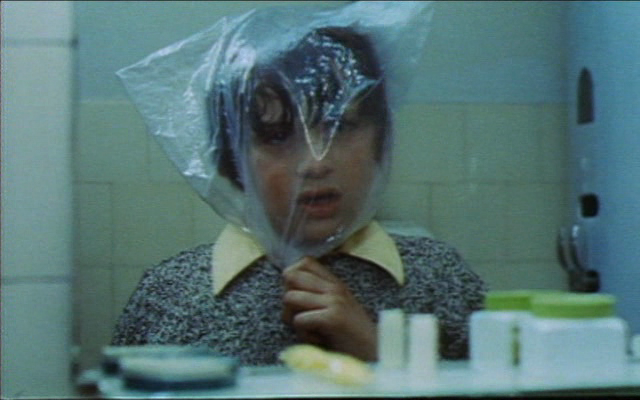
9-year-old Teutonic preteen Achim (Sascha Urchs) is not like other children, especially boys, to the point where he lies to his friends so as to avoid actually hanging out with them. Seeming to suffer from Asperger syndrome with schizoid tendencies and consistently maintaining a fiercely flat affect, Achim pathologically plays with a toy monkey on a rope and seems to prefer the indoors to the outdoors and personal privacy to playing with others kids his age. When his parents make the mistake of allowing a ditzy pixie bitch of a teenager girl named Monika Behm (Renate Roland)—a girl that looks a cross between title character of Valerie and Her Week of Wonders (1970) and Bjork with an androgynous boyish fashion sense borrowed from Twiggy—to watch Achim , as well as his baby sister, it ultimately results in what will be the most terrible day of their lives. Unbeknownst to Achim’s parents, Monika is a slutty and superlatively self-centered girl who has no qualms about ditching the kids she is supposed to be babysitting to be sexually manhandled by a young man much older than herself. Like the pathetic segment of Mondo cane (1962) featuring a bunch of decidedly drunk krauts drowning in their sorrow in the Reeperbahn Strasse of Hamburg, Achim’s parents, especially his father (Sieghardt Rupp), are loser boozers who manage to keep a semblance of lower-middleclass normality, but it all comes crashing down via the painful death of their child that no amount of alcohol will numb. After the parents leave the house and babysitter Monika follows not long after to fornicate in a car with her mechanic boyfriend Otto Borowski (Jürgen Jung), Achim decides to take a couple seemingly innocent photographs of his baby sister, but not longer after the boy has the bright idea to place a plastic bag over the helpless girl’s head, thus leading to her premature death via rather sickening sororicide. Wasting no time to take full advantage of his lack of adult supervision, Achim also plays ‘peeping Tom’ and watches his babysitter Monika and her much older boy toy Otto screwing in a purple car, which the boy subsequently enters and steals the babysitter’s bra as a souvenir. When Achim’s parents come home, they soon notice that their baby daughter is missing and the calculating child killer offers to help support the ultimately futile cause to find his sister. Meanwhile, Monika, who does not want anyone to know she is a teenage tramp who only cares about herself, denies she ever left the home, but soon police get involved and the holes in her personal testimony are exposed. The cold and calculating Achim strategically makes up a lie that he saw a shady young man with a purple car on the day of his sister’s appearance, which ultimately makes Monika’s boyfriend Otto, who owns a similarly colored car, a suspect. Of course, this leads the police to realizing that Monika was screwing Otto in his automobile when she was supposed to be watching Achim’s sister. Monika’s father Erich Behm (Hubert Suschka), who accepts and oftentimes even seems to relish the fact his daughter is a little floozy, comes to the natural conclusion that Achim was probably involved with his sister’s disappearance and tell the children’s parents such. Not wanting to accept the fact their child is probably a deranged little dude, which is quite obvious to anyone looking at the seemingly soulless and monotone fellow, Achim’s parents kick out the Behm family, who happened to be their best friends. Of course, Achim’s father, who probably knows his son better than anyone else, investigates the local junkyard where the boy plays and where Monika got laid, where he discovers the blanket-draped corpse of his only daughter. Instead of going to police and accepting responsibility for what happened, the man gets rid of his baby girl's body, but his son finally gives into pressure and admits the crime to police detectives. Of course, when Achim is taken to where he dumped his sister's corpse, the body is nowhere to be found due to his father's dubious disposing of it in a coal mine shaft. In the end, the illusion of middleclass normality is restored to the German town and a less than proud father must forever live with the fact that his son is the cold-blooded murderer of his very own sister. After everything is said and done, Achim, who has a similarly emotionless stare to matricidal mass murder/child killer Adam Lanza, seems not even the least bit affected by what he has done, but seems all the more dangerous due to successfully getting away with the most sickening sort of crime. 


 Like Clu Gulager’s kaleidoscopic arthouse horror short A Day with the Boys (1969) and both cinematic adaptations of William Golding’s Lord of the Flies (1954), Bübchen went where few films have gone before nor after by portraying the seemingly innocent child as a killer, but unlike the other three cinematic works, Klick’s realistically creepy kraut ‘coming-of-age’ flick never attempts to blame anyone for the prepubescent perpetrator’s dubious mental state, which is thankfully never explained nor intellectually dwelt upon, but simply portrayed in as objective a manner as possible. Still, in its sort of then-contemporary anti-Heimatfilm depiction of blue collar Germans as boorish beer-binging bastards who avoid uncomfortable realities at any cost, Bübchen is certainly a quasi-crypto condemnation of a nation that, not unlike a number of Fassbinder’s flicks, especially The Merchant of Four Seasons (1972) and Jail Bait (1973) aka Wildwechsel, portrays a working-class people that are both unable to handle their emotions and especially the truth, so they simply act out in rather irrational and ultimately deleterious fashions, albeit in Klick’s flick, things go back to ‘normal again,’ thus making it all the more unnerving. An unflinchingly fucked celluloid family affair for the tradition-less and unguided post-Nazi generation, Bübchen is a look at the Teutonic collective conscious through the maniacal microcosm of a deranged demon seed whose act of killing his own baby sister was no more significant to him than pulling a weed. 


 Hoping to direct his acid western Deadlock first, Roland Klick described in the documentary Das Kino des Roland Klick (1997) aka The Cinema of Roland Klick how he got around to directing Bübchen as follows, “For a while I was Fellini’s gopher, I was desperate, and drove to Rome. I tried to get a hold of myself there, and got to work with Fellini on “Satyricon.” And it was there that I imagined the “Bübchen” story. Which is a small story, really. And the small scope of the story reflects my own modest means, in a way.” Indeed, with its gritty lower-middleclass ‘Germanic’ realism and rather documentarian-like perspective, Bübchen is not only about as far away as one could get from Fellini’s big budget’s myth-driven surrealist works, but also director Roland Klick’s own much more popular counter-culture cinematic works like Deadlock, Supermarkt, and White Star. Indeed, Bübchen is like a work of German New Cinema, except with a much bigger soul, if not a decidedly despairing one, which is rather ironic since the work was apparently not given its proper due and actually never received the popularity it deserved until it was re-released under the misleading title Der kleine Vampir aka The Little Vampire. As Klick stated regarding critics' initial panning of Bübchen yet its subsequent popularity as a work that, unlike many left-leaning works of German New Cinema, has stood the test of time, “That’s the way it was…Purely for the reason that the film had classical aesthetics, told a simple story…It is told psychologically, too. The character’s actions are very palpable. But it didn’t interpret it in a socially critical way. It didn’t point an accusing finger. And all of that was out of fashion, so to say, back then. But that’s why my films are still popular today.” A film by Dutch-German cinematographer-turned-filmmaker Robert van Ackeren (Blondie’s Number One, A Woman in Flames), who also shot important and artistically groundbreaking films directed by Werner Schroeter (Eika Katappa, Salome) and Rosa von Praunheim (It Is Not the Homosexual Who Is Perverse, But the Society in Which He Lives), Bübchen is a nearly immaculate anomaly among German cinema by a kraut cult filmmaker who managed to make a sort of accidental hybrid between the (anti)Heimatfilm and German New Cinema, except making it highly palatable for both proletarian and pretentious art fags alike, something that Austian auteur Michael Haneke has yet to accomplish in all of his career of trying.  If you ever wanted to watch the sort of celluloid work that realistically portrays the sort of kid that kills, there is probably no better example than Bübchen, arguably 'un-German' German auteur Roland Klick's most distinctly 'German' film.


-Ty E

Saturday, July 20, 2013

The American Soldier


Originally planned as featuring the director’s then (and thoroughly heterosexual) lover Günther Kaufmann (Rio das Mortes, Whity) and to be shot on CinemaScope in Berlin, The American Soldier (1970) aka Der amerikanische Soldat was ultimately postponed due to auteur Rainer Werner Fassbinder’s bitter and failed love affair with the film’s heterosexual black Bavarian star and would inevitably deevolve. Instead, Fassbinder decided to fly to Paris to enjoy the city of love’s sodomite saunas. When The American Soldier went into production, it did not feature Herr Kaufmann and was shot with a low-budget using black-and-white film stock, thus making the film have similar aesthetic qualities to the director’s two previous kraut gangster flicks, Love is Colder than Death (1969) aka Liebe ist kälter als der Tod and Gods of the Plague (1970) aka Götter der Pest. All three films would make up a kraut-fried yet Hollywood inspired gangster film trilogy, with the final chapter, The American Soldier, being arguably the most cinematically reflexive and purposely postmodern yet ultimately incoherent and avant-garde-addled. With a misleading title that is more representative of Fassbinder’s Americanized love for Hollywood cinema than a true description of the film’s hero, The American Soldier follows a German-born man who “flew over the great pond” to America and fought as an honorary Yank in the Vietnam war to battle the same Bolshevik plague his Teutonic brothers fought in the Second World War, only to come back to his hometown of Munich to work as a cold-blooded contract killer for a trio of corrupt gangster-movie-worshiping cops who have a naughty knack for gambling with pornographic playing cards and petty criminals' lives. Referencing to grand queen auteur filmmakers of German cinema history, F.W. Murnau and Rosa von Praunheim, the latter of which who would incidentally become an arch nemesis of Fassbinder (von Praunheim even once admitted he was relieved when he died), The American Soldier is less an homage to American gangster flicks than a film that deconstructs such works, while also criticizing the corrosive cultural hegemony of America/Hollywood on not just Germany, but also the entire world, hence why the film’s protagonist, a Vietnam vet, ultimately did dirty work for the USA and has now come back to his homeland to wreak havoc and kill a couple fellow krauts along the way. By no means a a cinematically immaculate masterpiece, The American Soldier is essentially a curious piece of experimental kraut crime cinema directed by a man that was destined for greater and less masturbatory things who was practically raised on Hollywood films, but would become what was indisputably post-WWII Germany’s most important and prolific filmmaker and who ultimately made his celluloid works palatable to both the proletariat and the bourgeoisie, something his quasi-commie compatriots like Alexander Kluge and Jean-Marie Straub could never do as pedantic guards of the German of the far-left Ivory Tower. Of course, The American Soldier seems like it was specially tailored for left-leaning film critics and those that would love nothing more than to see the gangster flick aesthetically and thematically defiled, but it is still pure Fassbinder, even not as cultivated and more audience antagonistic. 


 Ricky (Karl Scheydt) alias Richard Murphy alias Richard Von Rezzori, who describes his lifetime story to a whore as follows, “It all began in Germany...Once upon a time, there was a little boy...He flew over the great pond...Damn it,” is the man with the plan, otherwise known as contract killing, but the problem is that a single snitch can get him killed and killing fellow criminals for cops comes with its own number of liabilities. A seemingly stoic veteran of the Vietnam War, which he simply describes as being “loud,” Ricky is more than ready to show off his imported skills as an American-manufactured killing machine. A fellow with a sadistic streak, Ricky almost scares to death a slutty chick (Irm Hermann who is credited as “hure” aka “whore”) by kicking her out of his car and shooting her full of blanks. Not someone to forget an old friend, Ricky hooks up with his old comrade Franz Walsch (Fassbinder reprised his role from Lover is Colder than Death) or as he states while trying to get a hold of him over the phone, “W for “war,” A for “Alamo,” L for “Lenin,” S for “science fiction,” C for “crime,” H for “hell.” Ricky and Franz go for a scenic and soothing ride and the reluctant American sentimentally states to his comrade, “Nothing ever happens in Germany…I’m rather fond of old Germany, all the same.” Indeed, the two boorish Bavarian buds seem to have more than enough fun drinking cheap beer and littering with the empty cans. After going to his mother (Eva Ingeborg Scholz) and Clark Gable-loving gay brother (Kurt Raab) in what turns out to be a rather uneventful family get together involving pinball and foreboding emotional coldness, Franz gets what he came back to Munich for, killing people that apparently need to be killed. The first person that is gunned down is a gay palm-reading gypsy named Tony (played by Ulli Lommel in what is very possibly his most unflattering role ever), which proves to be a rather lackluster, if not lethal, task for Ricky. Seemingly nonsensical things happen around Ricky, including the strange behavior of a maid (Margarethe von Trotta), who after describing supposed German racism against Turks that are called “Ali” (this discussion would inevitably evolve into Fassbinder’s Sirkian masterpiece Ali: Fear Eats the Soul (1974)) and crying about her lover Pierre, stabs herself in the stomach with a butcher knife samurai-style while hanging over a stairwell railing. Of course, Ricky has bigger things to worry about than paying mind to a seeming horribly hysterical and melancholy maniac of a maid because he has fallen in love with one of his contract killing targets, Rosa von Praunheim (Elga Sorbas), the girlfriend of one of the pernicious police who hired him to do their dirty work. Of course, since they hired him to commit highly illegal and innately incriminating acts, the police also decide to dispose of Ricky, but unfortunately Franz gets in the middle of it, thus resulting in the deaths of two best friend who would have been better off dead during the Second World War, at least if one were to judge by their romantic longings for a nation that, at least in spirit, no longer exists. 


 Trading in the pioneering celluloid poems of Teutonic master auteur F.W. Murnau (Nosferatu: A Symphony of Horror, The Last Laugh aka Der letzte Mann) for a uniquely unhealthy and culturally vapid diet of cheap carboncopy cinematic products otherwise known as Hollywood gangster films, Germany lost more than just a good percentage of its population, as well as its international reputation as a result of the Second World War and The American Soldier, like much of Fassbinder’s oeuvre, is certainly a scathing symptom of that. Featuring cops who think they are gangsters after watching one too many American film noir flicks and a culturally confused protagonist who clearly loves his birth nation more than his adopted one yet seems tragically deracinated from it for whatever reason, The American Soldier is the sad, if not oftentimes sardonic, tale of a nation with a decidedly dead soul, where everyone can be bought, sold, and/or killed for the right price, which is undoubtedly an American tradition. The fact that the protagonist of the film, Ricky, who is admittedly “rather fond of old Germany,” is an ostensible aristocrat who consciously made the decision to degrade himself by becoming a peasant soldier in a nation populated by Europe’s rejects in a war battling communism—the very thing the German National Socialists sought to destroy on the Eastern Front—only goes to show how far Germany had fallen. 


 Tastelessly enough, director Rainer Werner Fassbinder would marry star Ingrid Caven during a lunch break in between shooting for The American Soldier and the director can even be seen wearing the same white suit he wore during the wedding in the film. Incidentally, Günther Kaufmann, who Fassbinder fired from starring in The American Soldier for not reciprocating his love to the director, would act as the filmmaker’s best man at the wedding. While not starring in The American Soldier, Kaufmann would provide his Jim Morrison-like vocals to the film’s theme song “So Much Tenderness,” with the lyrics being written by Fassbinder himself and the music by Peer Raben. Fassbinder’s wife Ingrid Caven, who would divorce the filmmaker in two years and inevitably become the cinematic diva of Daniel Schmid (Tonight or Never, La Paloma) sings and performs a song she wrote entitled, “With My Tears,” towards the beginning of The American Soldier. The ultimately bastardized and partially aborted yet still spawned product of a project initially intended to be realized as a romantic present for a black buck Bavarian, The American Soldier practically stews in a certain pessimistic melancholy that is surely colder than death, but also relies on the pseudo-masculine Hollywood cinematic conventions promoted to profit off of the poor proletarian looking to learn how to posture themselves as imaginary American bad asses. As American as imported sauerkraut, The American Soldier is the aesthetically wacky result of what happens when a cultureless consumer consumes a real culture and is vomited out by said real culture. 


-Ty E