Saturday, December 27, 2014

Black Christmas (1974)


Aside from cinephiles and horror fans, it seems that few people seem to realize that belated mainstream American auteur Bob Clark (Porky’s, My Summer Story aka It Runs in the Family), the director of the beloved Xmas time classic A Christmas Story (1983)—a work that managed to do the seemingly impossible by making a Fellini-esque style movie palatable to the American masses, as a film that might be described as an American Amarcord (1973), albeit minus the gigantic talking Mussolini heads and teenage circle jerks—was also responsible for directing one of the most ugly, brutal, and dejecting Christmastide celluloid affairs ever made. Indeed, Clark’s underrated proto-slasher flick Black Christmas (1974) aka Silent Night, Evil Night aka Stranger in the House aka Stop Me was probably the first Xmas themed film that one would probably be better off watching at any other time of the year aside from the holiday season, as a work featuring crypto-alcoholic sorority house mothers who sneak wigs of Whiskey that they have hidden in toilets during Xmas parties, frigid and calculatingly cold girlfriends who surprise the boyfriend’s with the nasty news that they’re unhappily pregnant and plan to get an abortion, assholes with Jew-fros who dress as Santa Clause and call their girlfriend a “bitch” in front of underprivileged children, college girls receiving phone calls from pathetic perverts that say vulgar things in distinctly vulgar ways like, “Let me lick your pretty piggy cunt,” and last but certainly not least, a decidedly deranged psychosexual serial killer who casually kills unwitting college chicks while lurking around the attic and upstairs of their sorority house. Made during the post-counterculture era, Clark’s work is set in a remote college town populated by vulgar and vice-ridden college kids and ignorant townies where the Christmas spirit had already been long shattered before a sexually sadistic killer ever began making his rounds and dispatching sullen sorority sisters. Released well before John Carpenter’s Halloween (1978) and Sean S. Cunningham’s Friday the 13th (1980), thus not only making it one of the first Christmas slasher flicks, but also slasher flicks in general (though, Silent Night, Bloody Night was made in 1972, it was not released until the same years as Clark’s film in 1974), Black Christmas is one of the oh-so rare horror classics that can actually been described as underrated as opposed to obscenely overrated. More importantly, Clark's casually creepy piece of Xmas time celluloid cruelty is a genuinely decent and well constructed work featuring a foreboding sense of suspense and nicely nuanced pacing of the playfully pernicious sort, reasonably memorable acting performances and characters (including that of a faceless killer), and highly imaginative murder scenes with intricate and even sometimes poetic tableaux that range from the strangely surreal to the borderline avant-garde. Of course, as a work directed by the man that previously directed the low-camp tranny exploitation flick She-Man: A Story of Fixation (1967), the classic canuxploitation horror-drama-war hybrid Deathdream (1972) aka Dead of Night, and the cult zombie-comedy Children Shouldn't Play with Dead Things (1973), as well as produced (and some believe also co-directed) the classic Ed Gein flick Deranged: Confessions of a Necrophile (1974), Clark was bound to eventually assemble a masterful horror work and he did not need to use gratuitous sex and violence to do it, yet the innately inferior Halloween—the film credited as jumpstarting the mostly wretched slasher craze of the late-1970s and 1980s—was the work that ultimately received all the glory. Admittedly, I was somewhat disappointed by Black Christmas when I first saw it well over a decade ago, but after learning to appreciate cinema as an art form, I cannot deny that it absolutely murders the competition, as a slasher equivalent to Carl Th. Dreyer’s Vampyr (1932) in terms of its uniquely underrated status in the context of its (sub)genre, as well as a work that makes Silent Night, Deadly Night (1984) seem like a retarded romp, Silent Night, Bloody Night feel like an arthouse abortion, and Christmas Evil (1980) aka You Better Watch Out seem like a spastic yuletide autism fit. 


 Opening with a rather conventional yet nonetheless beautiful nighttime outdoor shot of an old house covered in typical Christmas lights and decorations, Black Christmas initially has the essence of a classic Christmas drama from the 1950s, but things take a dramatic change when the viewer enters the house and is bombarded with the mostly bitchy and/or snarky sorority sisters whose repellant personalities act in stark contrast to the merry holiday they are ostensibly celebrating, as well as the classic building they call home. Unbeknownst to the girls, a nameless/faceless man that the viewer will later know as ‘Billy’ has snuck into the attic of the sorority house while the girls were busy getting good and drunk at their annual Christmas party. The girls soon get an obscene harassing phone call from the killer, who has called before and who the college chicks have aptly nicknamed the ‘moaner’ since he sounds like he is masturbating on the other line. While protagonist Jess Bradford (Olivia Hussey of gay Guido auteur Franco Zeffirelli's Academy Award-winning 1968 Romeo and Juliet adaptation) picks up the phone after it rings, it is her cunty wisecracking comrade Barb Coard (Margot Kidder of Brian De Palma's Hitchcock homage Sisters (1973) and Richard Donner's Superman (1978)) that says to the curious creep caller, “why don’t you go find a wall socket and stick your tongue in it, that will give you a charge” after he says such savagely salacious things as, “Let me lick your pretty piggy cunt” and “suck my juicy big cock. I’ll come over and you can suck it.” Needless to say, the caller is pissed by the college gal's gall and makes Barb a promise that he will ultimately fulfill when he hatefully remarks, “I’m going to kill you.” Indeed, not long after the particularly perverted ‘prank’ call, Claire Harrison (Lynne Griffin), who is not really a big fan of Barb due to her vulgar personality, is asphyxiated by the caller/killer with a plastic bag after he surprises the young lady by jumping out of her closest and manhandling her in a most malevolent manner. Possibly feeling in the Xmas spirit, the killer carries Claire’s body to the attic of the house and poses it in a rocking chair with a vintage baby doll in its arms with the bag that her suffocated her with still over her head, thereupon making the corpse look like a sort of warped Mrs. Claus decoration. 


 Luckily for the sassy sorority sisters, they have an ex-cabaret dancer/crypto-dipsomaniac named Mrs. Mac (Marian Waldman) as a ‘House Mother,’ as she is too busy sneaking swigs of Whiskey that she has hidden inside books and toilets to give a shit about what sort of degeneracy the girls are involved with. Unfortunately for Mrs. Mac, when dead dame Claire fails to meet with her obnoxiously uptight conservative daddy Mr. Harrison (James Edmond), she has to deal with the worried father's super snide scorn. Indeed, on top of being annoyed by the fact that his baby girl is missing, Mr. Harrison seems particularly offended by posters of nude hippie chicks hanging on the walls of the sorority house and complains like the anally retentive bitch that he is, “I’m very disappointed with this atmosphere and I intend to do something about it” to the less than amused house mother.  Mr. Harrison’s attitude annoys Mrs. Mac so much that she rightfully complains to herself, “These broads would hump the Leaning Tower of Pisa if they could get up there,” in regard to her well warranted belief that the sorority girls are intemperate lady libertines who could not be controlled no matter what sort of rules she tried to enforce onto them. When Mrs. Mac goes looking for her kitty cat Claude in the attic of the sorority house after noticing that the attic door is open, she gets a fatal blow to the head via a crane hook, which she is subsequently hung from like a cow carcass, thus reflecting the fact that the crazed killer is not an ‘agist’ when it comes to hunting hoes. 


 Meanwhile, mostly unlikeable protagonist Jess—a girl that seems to have been indoctrinated by a lot of second wave feminist twaddle and has adopted an exceedingly gynocentric worldview—informs her melancholy musician boy toy Peter Smythe (Keir Dullea of Otto Preminger’s Bunny Lake is Missing (1965) and Stanley Kubrick’s 1968 sci-fi masterpiece 2001: A Space Odyssey in a role that was originally offered to fellow Kubrick graduate Malcolm McDowell) that she is pregnant and when he excitedly responds “that’s fantastic,” she coldly replies that she does not want the child and plans to abort it. Needless to say, Peter botches a piano exam he has later that day and subsequently decides to take his anger out on the piano by smashing it to bits.  Seeing as Jess was well aware of the fact that Peter had the piano exam yet she decided to tell him about the abortion right before it just goes to show that she is a self-centered bitch, if not a scheming sadist, who clearly harbors resentment towards men, not least of all her boyfriend (notably, earlier in the film, Peter tells Jess on the phone that he loves her and she coldly responds by merely stating, “I know,” as if disgusted by the thought that the man she regularly bangs has deep emotional feelings for her).  Meanwhile, sorority sisters Barb and Phyllis “Phyl” Carlson (Andrea Martin) accompany Mr. Harrison to the local police station to report Claire’s strange disappearance and the dopey cop working there, Sergeant Nash (Doug McGrath), blows them off and insinuates that their missing friend is probably off blowing her boyfriend in a cabin somewhere. To play a prank on the socially retarded cop, Barb tells Nash that the sorority phone number is ‘fellatio’ and since he has no clue that she is screwing with him, the moronic cop actually writes it down.  While hanging around the police station, the girls also learn that a high school girl named Janice has recently disappeared and it does not take long for her corpse to show up in a local park, so a police officer with some actual sense, Lieutenant Fuller (John Saxon of Enter the Dragon (1973) starring Bruce Lee and Wes Craven's A Nightmare on Elm Street (1984)), begins taking the sorority girls seriously and has their phones tapped so that if the killer calls again, they can figure out his exact location.  Unfortunately for Lt. Fuller, the crazed killer seems to have a lot more sense than the group of college girls whose lives he hopes to protect.
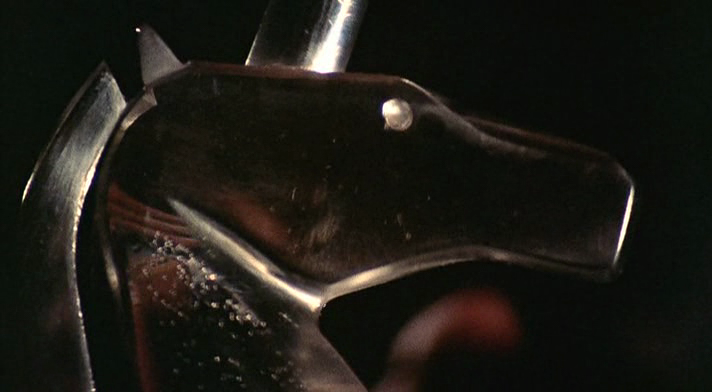


 When Peter tells Jess that he wants to drop out of school and give up his dream of becoming a concert pianist so that he can marry her and so that they can start a family together, she turns him down cold and also reveals that she is going to abort their baby asap, so he breaks a Christmas ornament and states, “you selfish bitch, you’re talking about killing our baby as though you’re having a wart removed” and storms out of the sorority house.  Naturally, due to his melodramatic drama queen behavior, Lt. Fuller suspects that Peter might be the killer. When the ‘moaner’ aka ‘Billy’ later calls Jess and repeats exactly what Peter said earlier in regard to her treating an abortion like it is “having a wart removed,” she becomes convinced that her pissed off beau is the killer. Meanwhile, it is discovered via the phone tap that the killer is actually in the house and using Mrs. Mac’s second line, so Sergeant Nash calls Jess and tells her to get out of the house immediately, but since two of her friends, Barb and Phyl, who she does not realize have already been killed (notably, Barb is stabbed to death with a crystal unicorn statue in a rather aesthetically pleasing scene of almost transcendental slasher savagery), are still upstairs, she moronically goes against the cop’s order and goes to the second floor to look for her friends, who she ultimately finds dead lying together in a bed in rather strange poses. After that, Jess spots the killer looking at her via a crack in the door, so she kicks said door, thus injuring the creep and runs down to the basement of the house and hides. When Peter breaks a basement window so he can get inside the house since no one will answer the phone or door, Jess, who is petrified out of her mind and believes her boyfriend is the killer, decides to beat him to death with a crowbar. When Lt. Fuller and his men later arrive on the scene, they discover a fellow officer dead with his throat slit inside a patrol car outside the sorority house and assume the worst when they eventually find Jess lying on the ground with Peter’s corpse in her lap. As demonstrated by Jess’ killing of Peter and her all-around cognitive dissonance, the killer/Billy almost seems like her Jungian ‘animus’ (the unconscious of a female as expressed in a male inner personality), especially when one considers the rather brutal and visceral nature in which she murdered her boyfriend. Convinced that Peter was the killer, Lt. Fuller and the rest of the police leave the house while Jess, who has been given sleeping pills so that she can get some rest, sleeps like a baby. Not long after the cops leave, it is revealed that the killer is still in the attic with the perversely posed corpses of Claire and Mrs. Mac. The film ultimately ends ambiguously with the killer once again calling the house, thereupon hinting that Jess probably won’t survive the night. 


 Maybe it is my impenetrable sense of nihilism or perennially multiplying cynicism, especially during the holiday season, but I think Black Christmas has certainly replaced Clark’s later work A Christmas Story in terms of personal Xmas favorites. I also must admit that I felt like a little bit of a schadenfreude seeing a crazed killer that is assumedly screwed up as a result of a childhood sexual encounter with his sister (he makes constant references to a girl named Agnes, especially while in the company of his victims) going around and killing a bunch of feminist brainwashed college chicks who only think about screwing losers and who do not have to think twice about an abortion when pregnancy strikes. Indeed, Black Christmas makes for an interesting double feature and comparison piece to Clark’s later classic Christmas flick, as it depicts the post-counterculture/post-sexual-liberation generation and their seeming dissatisfaction with Xmas and life in general in comparison to the characters of A Christmas Story, who find fun, happiness, and fond memories in the most simple and everyday of activities. One of the things that makes Clark’s holiday season horror-slasher so positively potent, especially as a Christmas time chiller, is that, although it features a couple scenes of relatively effective comical relief of the somewhat crude sort, it does not wallow in the sort of moronic irony and compulsive self-consciousness typical of similar films and instead features simultaneously brutal yet beauteous murder scenes with an almost ‘erotic’ thrust and aesthetic sensitivity that few, if any, other slasher films can boast aside from giallos like Mario Bava's equally influential works Blood and Black Lace (1964) aka Sei donne per l'assassino and A Bay of Blood (1971) aka Reazione a catena aka Twitch of the Death Nerve. Of course, the most obvious reason Clark’s film stands out amongst most insipid slasher swill is that it concludes in ambiguity and never reveals the identity of the killer, which is certainly something that would induce cognitive dissonance in contemporary viewers, who need their slasher shit spoon fed to them lest they feel that their rather vulnerable intellect has been challenged. Indeed, it almost seems like Black Christmas is not as popular in comparison to the competition because fanboys don’t have a Michael Myers, Jason Voorhees, or some other sort of masked retard to swoon over and jerk-off to. Also, one could argue that the film is one of the few, if not sole, subtextual slasher flicks due to its arguable depiction of the nameless/faceless killer as protagonist Jess’ animus. Indeed, Black Christmas is the ultimate yuletide slaughter show, as a celluloid gift that keeps on giving as a work that, relatively speaking, leaves the viewer thinking every single time.  Rather unfortunately, Clark later decided to put coal in the figurative stockings of the fans of his film by acting as an executive producer on the wholly and shockingly retarded loose-as-a-NYC-crackhead-hooker Canadian-American remake Black X-Mas (2006) aka Black Christmas directed by Glen Morgan (who somewhat surprisingly directed the halfway decent 2003 Willard remake starring Crispin Glover) and starring exceedingly annoying spoiled Jewess Michelle Trachtenberg. Of course, Clark was also responsible for directing Baby Geniuses (1999) and its sequel Superbabies: Baby Geniuses 2 (2004) before a drunken illegal alien from Mexico tragically killed him and his son in a car accident in 2007, but as the man responsible for not only Black Christmas, but also Children Shouldn't Play with Dead Things (1973), Deathdream (1974), and Murder by Decree (1979), he had more than earned his fair share of respect from genre fans.  I certainly cannot think of another filmmaker whose films have more invaded the hearts and minds of Americans during the Christmas season in such an eclectic fashion than those of Bob Clark, whose masterpieces Black Christmas and A Christmas Story offer the ultimate morbid yet merry schizophrenic celluloid double feature.


-Ty E

Thursday, December 25, 2014

Black XXX-Mas


Feeling more like a cynical Scrooge this year than ever before, I decided to forgo my annual viewing of A Christmas Story (1983) and instead hunted for the most callously cynical and just plain fucked up Christmas film that I could find sans Santa slasher flicks, which ultimately led me to a Belgian short of all things with the blatantly intentionally trashy title Black XXX-Mas (1999) directed by Flemish auteur Pieter Van Hees (Dirty Mind, Waste Land). Judging by the title, one might assume Van Hees’ film is an interracial porn parody of Bob Clark’s classic Canadian proto-slasher flick Black Christmas (1974) and even though it does feature some revolting jungle fever scenarios, it is actually an absurdly grotesque and sadistically sardonic anti-avant-garde molestation of the classic European fairy tale Little Red Riding Hood featuring a nasty and rather nihilistic Nordic take on blaxploitation cinema and set in a decidedly dystopian Belgium of the near future where whites have become a sheltered and soulless minority and Santa Claus is a drunken negro robber who, instead of leaving presents, takes more than just milk and cookies on Xmas eve, especially while lurking around the nice and cozy homes of rich crackers with fireplaces. A film that was made as part of the relatively unknown Belgian film movement ‘Trauma 99’ that was started as a reaction against the patently pretentious Danish ‘meta-realist’ film movement Dogme 95 started by Lars von Trier and Thomas Vinterberg that went completely against the grain of the European arthouse world by advocating the use of gratuitous special effects whenever possible, Black XXX-Mas is pure and unadulterated celluloid trash with an aesthetically and thematically iconoclastic punch that features an intentionally artificial and plastically flashy aesthetic that makes the $100 million explosions of Michael Bay seem quite ‘avant-garde.’ Although I did not realize it until after watching it, I was shocked to learn that the short was directed by the same Flemish filmmaker who directed the arthouse ‘folk horror’ flick Linkeroever (2008) aka Left Bank, which is a fairly serious and elegantly paced work with ancient European pagan themes that hardly seems like it was assembled by the same kind of guy that would make culturally pessimistic Xmas-themed black comedies featuring kraut cannibal cops, teenage mulatto cokeheads, and a colored crook Kris Kringles. Opening with the words “Warning: An Exploitation Tale,” Black XXX-Mas is the way exploitation films should be as a short and sweet assault of audacious aesthetic aberrance, unwavering moral bankruptcy, and keenly kitschy carnage in a work that exploits every unsettling social plague and rubs it in the viewer’s face with the utmost malevolence, thus forcing the viewer to confront an unfortunate reality that they would never be exposed to in any Hollywood hack piece. 


 Opening with the Dogme-95-mocking inter-title, “This certificate proves that BLACK XXX-MAS was made according to the rules of TRAUMA 99,” Black XXX-Mas then introduces ‘God’ (Manou Kersting)—an obscenely goofy-looking dude with a white leather-fag mustache that almost resembles a negro sporting ‘whiteface’ due to his somewhat primitive facial features—sitting on a fancy souped-up hammock in an all-white ethereal pleasure-dome playing a fairly cheap looking portable video game system (aka ‘God’s Gameboy’), which contains planet earth and ultimately reveals the setting of the film on its screen, the ‘Urban Jungle,’ where the discernibly sadistic master of the universe manipulates humans into doing mostly bad and degenerate things.  From there, the viewer is introduced to ‘Little Red’ (Rochelle Gadd)—the mulatto progeny of a beer-chugging black career criminal and a haggard-looking old white slut that seems to suffer from estrogen deprivation—and as she narrates to the viewer with a trashy lower-class British accent in a fairy tale sort of way, “Once upon a time, there was a thing called reality. Now, in reality, there are no good guys or bad guys; there are just bad guys and guys that are worse. Well…that’s what my dad says.” Little Red’s daddy is ‘Black Santa’ (Trinidadian actor Don Warrington, who appeared in Kenneth Branagh’s Hamlet (1996)) and he might be a ruthless robber, but he knows that the multicultural ghetto is no place for anyone, least of all little girls, and as he tells his daughter after seeing her reflection in his beer can as she attempts to sneak out at night in a red mini-skirt, “IT’S A FUCKING JUNGLE OUT THERE!!!!” After watching some trashy TV and drinking some cheap canned beer, Black Santa heads out to rob some rich white folks on Christmas eve, which gives Little Red the opportunity to escape out of her apartment window and enter ‘The Forest’ (as advertised on a beat-up car) where she is sexually harassed by seriously scuzzy black and Arab gangsters while going to buy some cocaine from a slimy Chinaman. When Little Red gives the oriental dope dealer the cash, he picks it up with his teeth and then proceeds to grab the miscegenated teen’s derriere as she goes to grab her bag of coke from a clothesline (!), so she gives the sneaky slant-eyed chink a nice big karate kick to the gut, aggressively declares to the yellow man, “don’t fuck with me” and “the customer is always right,” and goes on her merry way. 


 Everything seems great after Little Red gets her dope and she celebrates by lighting a big fat joint, but the one-lady party soon ends when a fascistic cop with a phony German accent named Wolfgang Schutzwald (also played by Manou Kersting)—a fiendish fellow whose surname ironically translates as ‘protector of the woods’—pulls up in a typically ridiculous-looking smart car and begins feeling up the poor little half-black girl after she fails to show ID. When someone takes photos of Wolfgang (or as he tells Little Red, ‘Wolfy’ for short) while he is grabbing Little Red’s milk chocolate ass and tits, he decides to unload his service gun on them and soon discovers he killed about half a dozen female teenage tourists. After destroying the film in the dead tourists’ cameras, Wolfy states to Little Red, “If you haven’t seen anything tonight, I promise to stop bonking you in the ass,” but she reacts rather melodramatically like blacks tend to do in such precarious situations by threatening to send him to jail and hitting him, so he rationally responds by knocking her out and eating her, stating as he begins gorging on her fingers, “Well, I’m afraid I have to remove the last body of evidence.” Indeed, Wolfy is a sort of postmodern lycanthrope and he seems to have a special taste for dark meat, but unbeknownst to him, so does his wifey. Indeed, while Wolfy was eating Little Red Riding Hood in the hood, Black Santa was robbing his apartment in the white bourgeois side of town and in the middle of gathering up expensive stuff to steal, Mrs. Wolfy came out, saw the giant negro in the red suit, and got so hopelessly aroused that she decided to take off her robe and let the spade stranger do whatever he wanted to with her.  Naturally, as a proud black man, Black Santa isn't about to turn down a fully willing white woman, especially when she makes it so easy for him.  Unbeknownst to Mrs. Wolfy, Black Santa knocked out here prepubescent son when he had the gall to come out and ask Choco-Claus if he was Santa while the thieving soul brother was just getting started loading his sack with stolen merchandise.


 When Wolfy gets home, he happily shouts “honey, I’m home,” but when he notices his wife giving the big black buck in a Santa outfit a blowjob, he yells “oh my gut,” pulls out his service pistol, and begins unloading bullets everywhere, symbolically shooting his wedding portrait in the process. While attempting to run away from the flying bullets, unclad Mrs. Wolfy turns around and reveals ‘she’ is actually a he, a s/he curiously has a cock between her legs, though Wolfgang and Black Santa don't seem to mind. In an attempt to stop her homicidal hubby from killing her new black beau, Mrs. Wolfy jumps in front of Black Santa and is ultimately sprayed with a fatal storm of bullets. While Wolfy stares with a shocked look on his face at his beloved's bloody bare-skinned corpse, Black Santa decides to take decisive action, grabs an assault rifle that is conveniently hanging over the fireplace, and literally blows the cannibalistic cop’s head off after firing a single shot. Meanwhile, Black Santa’s wanton old wench wife calls a male whore service and ‘orders’ a swarthy fellow named ‘The Italian Stallion’, who soon rolls to her door on roller-skates sporting assless leather-chaps and proceeds to show her some Mediterranean carnal magic. After killing Wolfy, Black Santa hears the voice of his daughter coming from inside the corpse of the dead cop, so he rips open the fallen policeman’s mangled corpse and discovers his little girl Little Red inside. After telling Little Red, “I love you, darling” and groping her bloody breasts, the two head home and sing Christmas songs with Mrs. Black Santa under their Christmas tree where they have placed Wolfy’s star-shaped police badge at the top in a pseudo-sentimental scene mocking the idea of a traditional ‘white’ Christmas. In the end, God, who has two bitches by his side, gets tired of playing his Gameboy and declares, “you know there are still people that say I don’t do shit for poor people. Life is a bitch.” 


Personally, I have more sympathy for cannibalistic kraut cops than naughty negro robbers in ghettoized Santa Claus outfits, but I enjoyed Black XXX-Mas all the same, as it dares to depict the truly dystopian Europe of the near future and laugh about it in an ultra-cynical and culturally pessimistic fashion that lets the viewer know that auteur Pieter Van Hees has no doubt in his mind that technocracy, miscegenation, multiculturalism, and black ‘culture’ will not only lead to the death of the timeless European holiday of Christmas and fairy tales like Little Red Riding Hood, but his nation in general. Of course, ‘death’ might be too extreme a word, as it seems more like a defilement and bastardization of Xmas and European culture, just as Black Santa’s daughter Little Red is the product of a mongrelization of Europid genetics and just as Black XXX-Mas is an ugly celluloid bastard that borrows cinematic ingredients from everything from old school blaxploitation flicks to the most superlatively soulless and artificial-looking action-packed CGI-ridden Hollywood blockbusters. Naturally, the difference between Van Hees’ film and the mostly worthless works that it pays (anti)homage to is that the auteur intentionally utilized (or ‘exploited,’ hence why it is truly “an exploitation tale” as advertised at the beginning) these conspicuously crappy conventions and clichés to such an excessive and exaggerated degree that there is no doubt that the director created the film as a sort of radical and even nihilistic reaction to what he sees as the degradation of the art of cinema and culture in general as a result of a largely American/globalist influence. Indeed, with his later feature film Left Bank, Van Hees proved that he not only had the capacity to create something serious and even beautiful, but that he has a true deep sense of Flemish identity as reflected in the film’s traditional European pagan themes that ultimately establish a link between the ancient past and the present in its depiction of rebirth and reincarnation, among other things. Of course, in its devilishly humorous depiction of a ruthless god who literally plays with human lives for entertainment and who less than sentimentally declares “life is a bitch,” Black XXX-Mas could also be described as a piece of atheistic pomo paganism of the post-Odinist sort that reminds the viewer that traditional Christian beliefs and merry Christmases have become obsolete in an increasingly globalized multicultural world.  Of course, whatever way you look at it, Van Hees' short is a fiercely funny antidote to that soulless consumerist joke that Christmas and the so-called ‘holiday season’ has become.


-Ty E

Wednesday, December 24, 2014

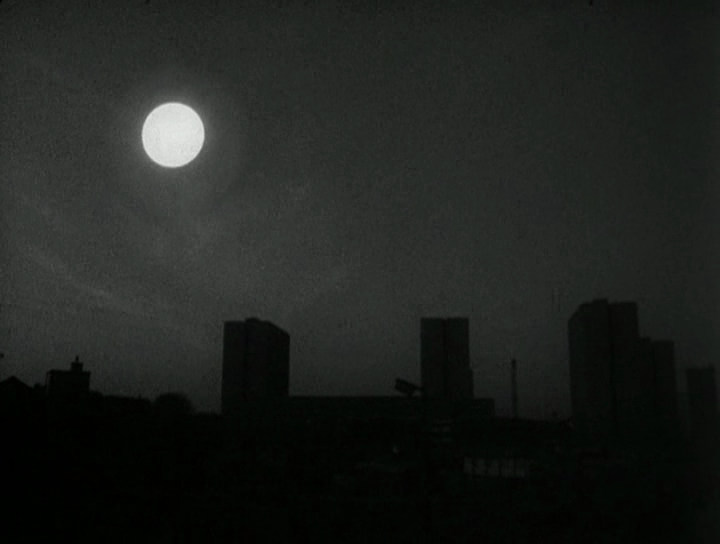
The Moon Over the Alley


Nearly three years ago, I saw a little known British cult masterpiece called Duffer (1971) about a rather naïve and seemingly half-autistic young bisexual twink who allows himself to be the personal sexual plaything of both a sadistic middle-aged sodomite with a rather repugnant worm fetish and a kind yet chubby over-the-hill prostitute in what one might describe as the truest of bizarre love triangles. Needless to say, when I discovered that one of the film’s two Canadian expatriate co-directors, Joseph Despins, was also responsible for directing a gritty black-and-white lumpenprole musical, The Moon Over the Alley (1976), I had to hunt it down, which was not exactly that hard considering it was included with the BFI Flipside DVD/Blu-ray release of Duffer. Notably, the musical was penned by Duffer co-director and star William Dumaresq, who demonstrated a natural knack for sexually torturing a young man onscreen despite the fact that it was the first (and ultimately the last) acting role he ever had. I probably cannot think of a cinematic persuasion that I would be less interested in enduring than that of a British multicultural musical set in a London ghetto full of beatniks, bums, blacks, and bastard kids haunting the streets like lost souls, but of course, Despins’ film is no phony Hebraic Hollywood movie and takes a more honest and, in turn, politically incorrect approach to shitty city living where the only harmony present is in the form of crude folk and soul songs sung in sleazy strip clubs, in front of butcher houses, and on dilapidated park benches. Set in a world where, to quote the eponymous song sung by Joanne Brown, “the moon over the alley makes the world seem sad,” the film might be described as a work of ‘proletariansploitation’ were it not for auteur Despins’ quite discernible empathy for his hopelessly disenfranchised and forlorn characters who have been foredoomed by their own birthright as perennially struggling members of the so-called ‘lumpenproletariat.’ Featuring a musically eclectic score by screenwriter Dumaresq's lifelong collaborator, Grammy Award winning Canadian composer Galt MacDermot of Hair fame, The Moon Over the Alley is a left-leaning work for sure, but not in the college lobotomized ‘social justice warrior’ or Frankfurt School fanboy sort of way, as a work that depicts the rarely good, the oftentimes bad, and the uniquely ugly in regard to London’s most desperate social bottomfeeders. More oriented towards magic realism than kitchen sink realism that was popular among British filmmakers of that time, The Moon Over the Alley manages to be both gritty yet stylish and even somewhat expressionistic as a work that owes more credit to Fritz Lang and G.W. Pabst than Ken Loach and Tony Richardson. Somewhat like a 1970s British take on Fritz Lang’s M (1931) minus the serial killer (although it does have a pedo and a gang of killers!) as penned by a less annoying Brit Bertolt Brecht and directed by a less cynical and more sentimental Robert Altman, Despins' second feature is set in a sort of neo-Dickensian dystopia inhabited by an eclectic collection of poor working-class characters, including a tough and equally tyrannical Teutonic landlady who looks like she was spawned from an American trailer park, a homesick Indian who can only dream of Calcutta and is thoroughly convinced the world is about to end as a result of the moon supposedly being covered in blood, a drunken Irish bartender who stereotypically beats his fiancée and hates England, and a motley crew of droog-like juvenile delinquents that have a propensity for pernicious things like gang-rape and murder. Sentimental without being sappy or phony, The Moon Over the Alley is surely the rare kind of arthouse film about the working-class that could actually be enjoyed by the working-class, thus making for a work that would probably leave a bitter taste in the mouth of pathologically pedantic New York City liberal types who look at people, especially poor people, as statistics and who refuse to believe that there are whites struggling in ghettos. 


 The Moon Over the Alley opens with a truly odd couple—a large and in charge 50-something-year old hobo lady named Sybil (Doris Fishwick) and her much younger and shorter intellectually-challenged beau Akki (Peter Farrell)—walking down a dark London alleyway under the moonlight. As Sybil tells her beloved dullard boy, “…in a little while, you will see that the moon won’t be so bright as it is now. Clouds will cover it…clouds will cover it and spirits will cover it. It will love that, but it will lose in days to come […] it will lose more and more of itself, it will get broke up there. I hope it won’t break us.” As Sybil adds in her particular brand of peasant poetry, “the moon makes you play…the moon makes me sing…the moon means everything to what we do…or don’t do,” and indeed, the fuller the moon gets, the crazier the dirt poor people in the Notting Hill section of London seem to get. The film mainly focuses on the borderline destitute inhabitants of a dilapidated boardinghouse owned by a rough acting and looking German woman named Bertha Gusset (Erna May, who played the sweetheart prostitute ‘Your Gracie’ in Duffer) and her kind but somewhat cuckolded and feeble-minded husband Bert (John Gay), who have a young and considerably gawky teenage son named Ronnie (Patrick Murray, who went on to play small roles in Brit cult flicks like Alan Clarke’s Scum (1979) and Brian Gibson’s Breaking Glass (1980)). Bertha acts rude and aggressive to everyone, including her son, at whom she screams, “wake up, you good for nothing!” right in front of his face to wake him up, though she does tend to get in a happy mood anytime one of her favorite songs comes on the radio to the extent where she starts singing, dancing, and even kissing her loved ones. Despite having an obscenely bitchy mother, Ronnie is a fairly nice fellow who has a little girlfriend named Nellie Tudge (Lesley Roach of the BBC children’s fantasy show Jackanory (1965–1996)) in what is a sort of Romeo and Juliet-esque relationship, as the two teenage lovebird’s mothers hate each other. 


 If Bertha is a rude kraut cunt, Nellie’s mother Ethel (Joan Geary of Fräulein Doktor (1969)) is a two-faced busybody bitch who talks trash in secret to her emasculated tobacco shop owner hubby Joe (Norman Mitchell of the Hammer horror flick Frankenstein and the Monster from Hell (1974)), who seems rather turned-off by his wife's pathological negativity but does not have the testicular fortitude to stand up to her. Ethel is irked that her daughter is dating Ronnie, who in her mind is “the son of his mother” and a half-kraut. Indeed, Ethel hates krauts and thinks that all Germans are Nazis, stating in regard to Bertha, “Don’t tell me Hitler’s dead. If he is dead, he won’t lie down. Don’t tell me Hitler’s lying down because I know different…Fascists just a stones throw away from here.” Although she still speaks broken English, Bertha has been living in England for over three decades and hates foreigners more than the average Brit. When a seemingly deranged middle-aged Hindu fellow comes up to her while she is washing off the front porch of her house, asks her for a room for “just one night,” and eccentrically states, “These stairs are wet! What is happening to the earth? Do you not glimpse in the cracks of the pavement? The hidden worth…the values hidden here. We shall all be dead tomorrow. I’m faraway from home…,” Bertha becomes quite agitated and tells him that she has no problem with colored folks but that she refuses to rent out a room to him. After declaring, “In Calcutta where I was born and educated, life is worse than this…but it is still better in Calcutta” and describing how there will be a “drop of blood on the moon tonight,” the Indian eccentric goes on his merry way while continuing to mumble bizarre gibberish.  To her minor credit, Bertha has good reason to be a bitch because a government bureaucrat came by her house and told her that her house has been scheduled to be demolished in one year’s time, which is a complete and utter outrage since she and her hubby rightfully own the building and should not have their increasingly socialistic government dictate to them what they can and cannot do with their own property. 


 Probably the only thing that all the inhabitants of the boardinghouse have in common is that they are all poor and, at least to some extent, miserable to the point where they seem used to feeling like shit all the time. Jack MacMahon (Sean Caffrey of Val Guest’s Hammer dinosaur flick When Dinosaurs Ruled the Earth (1970)) is a stereotypical Irish drunkard with a shitty attitude in his mid-30s who works as a bartender and has no problem beating up his longtime fiancée Belinda (Sharon Forester) if she gets out of line. When Belinda shows up outside of her fiancé’s boardinghouse sporting a tacky bleach blonde wig and dressed like a cheap hooker, Jack complains “you seem like a changed person” and looks at her if shes an alien. Despite turning 30 soon, Belinda got engaged to Jack when she was 12 and he was 15, but her boy toy will only agree to marry her when she gets enough money to afford a proper apartment for both of them, so she has taken it upon herself to save up enough money to buy a suitable flat by stripping in the red light district. When Jack calls Belinda a “fucking little whore” and smacks the shit out of her because of her new choice of employment, Bertha runs in and smacks the shit out of him, even knocking him out with a single blow, thus demonstrating that an Irish man is no match for a German woman. The newest tenants of the boardinghouse are a Jamaican negro couple, which include the young patriarch ‘Washington,’ his wife, and their baby son ‘Little Washington.’ They live in the upstairs apartment of the boardinghouse with two other black families and Washington has just started working at the same bar as Jack, though they don’t realize that they are neighbors until they begin shooting the shit together. Unquestionably, the creepiest, most introverted, and lonely person living in the boardinghouse is a grotesquely elderly cadaver-like fellow named Mr. Deray (Basil Clarke, who appeared in P.J. Hogan’s Muriel's Wedding (1994)) who lives with rats in squalor and who is an assumed pedophile who spends most of his time stalking and crudely staring at prepubescent little girls, especially when no other adults are around. 


 When Mr. Deray spots a lonely little girl named Katie (played by stunt motorcyclist and top Hollywood stuntwoman Debbie Evans of Terminator 2: Judgement Day (1991) and countless other Hollywood blockbusters when she was a fairly chubby little girl), he goes up to her in a supremely creepy fashion and tries to ply her with candy by sinisterly asking her if she “wants sweets,” but luckily the little lass has enough intuition to sense that he is a sexual predator with unsavory intentions. Katie is outside on the street by herself in a less than safe area because her mother is a floozy and alcoholic who is such a heartless woman that she remarks regarding her progeny while she is standing right there to some guy she has just picked up at a bar, “you wouldn’t think she was mine, would you? That’s the trouble with having a kid like that…I mean she’s got no spirit…that’s what’s wrong with her.”  Of course, Katie's lack of spirit is probably the result of the fact that she has no father and her mother is a self-centered slut who cares more about getting banged by random bros that she meets at the bar than properly taking care of her daughter and watching out for her safety.  Luckily, some dirty hippies cheer up Katie and give her “spirit” by teaching her to sing a folk song. When a gang of violent boys spot Mr. Deray gawking at little Katie in a less than savory fashion while she sings, they decide to hunt him down and beat him to a bloody pulp with the utmost malice.  On the other side of town, McDrunk Jack goes searching for his fiancee in various seedy bars and strip clubs and when he eventually spots her singing and dancing on stage as part of a girlish schoolgirl-like quartet, she becomes so embarrassed that she stops singing and dancing mid-performance and even forgets to show off her derriere at the end of the song like the rest of her co-dancers.  After the bawdy burlesque routine, Jack, who is now angrier than a latent lesbian nun in a porno theater, charges the stage and nonsensically attacks the girls, thus resulting in him being subsequently severely beaten by the bouncer of the club.  Luckily for Jack, his faithful fiancee comes out and comforts him while he is lying in the middle of the street after being beaten to a bloody pulp.  Indeed, in the proletarian world, it seems like people are more liable to stay with you no matter how big of a dick you act like, as people have nothing but each other and thus have a much greater asshole tolerance.


 Meanwhile, Ronnie takes his quasi-girlfriend Nellie for a romantic stroll and pathetically tries to talk her into having sex, but she is too afraid, though she does end up losing her virginity that night, albeit in a heinous fashion that she and her boy toy probably never thought imaginable. Indeed, the same gang of violent hoodlums that brutally assaulted Mr. Deray attack Ronnie and ultimately beat him good and bloody while forcing him to watch his beloved girlfriend Nellie being brutally raped while a dirty adult hippie secretly watches on via a crack in his door and does nothing to help the couple, thus signifying the general apathy of people in Notting Hill when it comes to violent crimes. Meanwhile back at the boardinghouse, an aspiring American singer named Jim (Leroy Hyde)—a fellow that is symbolic of the delusional view that yanks have of England as a dimwitted yet well-meaning dude with a lot of excess cash who decided to move to the UK because he thought it would be easier for him to become a famous folk singer since, after all, the Beatles are from there, and who has willingly paid an inflated rate to live underneath the stairs of the building—spots brutalized and bloody Mr. Deray stumble into the building and immediately informs slumlord Bertha when the old fart refuses help and locks himself inside his apartment. Ultimately, Bertha and Jim find Mr. Deray’s corpse in his apartment and are shocked to see that the old dead pedo has a horrified expression on his lifeless face, as if he saw the Grim Reaper before being sent straight to hell. Meanwhile, since their daughter is late coming home, Nellie’s parents go looking for her and Ronnie, who are ultimately found with the help of hobo couple Sybil and Akki, who were also once victims of the youth gang's savagery.  As it turns out, Ronnie was so brutally beaten by the boy gang that he suffered a small skull fracture and has totally lost vision in one of his eyes. In the end, the government forces the tenants to move out of the boardinghouse and the building his destroyed to make way for Soviet style public housing. 


 Notably, near the beginning of The Moon Over the Alley, teenage lovers Ronnie and Nellie go on a date at a movie theater where they see the once-controversial British cult flick It Happened Here: The Story of Hitler's England (1964) co-directed by film historian/documentarian Kevin Brownlow and military uniform expert Andrew Mollo, which depicts an alternate historical scenario where Britain has been occupied by Nazi Germany. Unquestionably, after watching Joseph Despins’ film, I cannot help but think that England would have been better off if the Third Reich had taken over the country and won the war, as that would have certainly beat the multicultural nightmare depicted in The Moon Over the Alley where educated Indians are thrown into near insanity due to homesickness and where poor sub-literate negroes and perennially pissed off mick drunkards are forced to fight over lousy jobs and stale bread crumbs. Of course, if the film was remade today in an authentic way (which would never happen in a million years considering the sort of authoritarian political correctness that prevails today in less than jolly old England), the central ghetto setting would be a no-go-zone for whites and even police that is inhabited by hostile Islamic Arabs and Pakis who are not beneath raping preteen white girls and forcing them into sex slavery. In The Moon Over the Alley, the only racial tension is caused by whites and white cops, but overall the ghetto is depicted as a largely culturally pluralistic place where everyone is equally poor and similarly struggling, thus making it seem like some sort of multicultural utopia could somehow spring up under the right circumstances, which is pure wishful thinking of the deluded far-leftist idealist sort. Although I absolutely loathe musicals and found most of the songs in the flick to be nothing short of auditory torture, the musical numbers in The Moon Over the Alley are seamlessly interwoven into the film’s narrative to the point where I never really became conscious of the fact that I was watching a quasi-musical, as the work is more of a postcolonial Dickensian parable depicting the excess rabble of a once great but now pre-apocalyptic empire than some sort of pornographically structured celluloid sing-and-dance-a-thon like Guys and Dolls (1955) or West Side Story (1961). Unquestionably, for better or worse, there is no other film quite like Despins’ work, which even features a sort of proto-Goth scene featuring a holocaust survivor-esque tranny doing a spooky drag show in pancake makeup at a bar fittingly called ‘Danse Macabre.’  Of course, one can only wonder if certain members of British Goth/deathrock bands like Bauhaus, Sex Gang Children, and the Virgin Prunes saw the film, though I certainly would not be surprised if they did (notably, Despins and Dumaresq two films were released on DVD/Blu-ray by the BFI largely as a result of industrial musician Peter ‘Sleazy’ Christopherson of Throbbing Gristle/Coil championing Duffer).  Indeed, in a strange sort of inexplicable fashion, The Moon Over the Alley feels like a work of proletarian Gothic horror, albeit with a crummy old boardinghouse instead of a haunted castle and realistic human ‘monsters’ instead of archetypical supernatural beings.  After all, the characters in the film do not need to watch horror films, as they live in a virtual living hell where their neighbors are much more scarier than Christopher Lee or Boris Karloff.  I noticed that a lot of reviewers have written that Duffer and The Moon Over the Alley could not be more different types of films, yet to me, they both captured the same sort of dispiriting spirit of impending doom and abject misery that plagued white London ghettos during the 1970s, although I guess one could argue the latter work is more ‘lighthearted,’ if only because it features catchy songs and does not feature man-on-boy sexual sadism and baby corpses being disposed of in dumpsters, among other things. Not surprisingly considering the marginality of their work together, Despins and Dumaresq would never collaborate on another film after The Moon Over the Alley, which is a shame considering they could have certainly become a sort of Michael Powell and Emeric Pressburger of the underground cult/arthouse world.


-Ty E